

Your-first-job-hunt-can-feel-endless-College-career-coaches.jpeg

Your first job hunt can feel endless. College career coaches recommend trying these 5 things.

For many college seniors, the toughest assignment this spring might be their job hunt.

Grads are still finding roles, though it often takes more time and hustle, several campus career advisors told Business Insider.

“Soon-to-be graduates are getting jobs, but job searches are long, and hiring is slow,” said Jennifer Neef, executive director of the career center at the University of Illinois.

The challenge is showing up in the data. The unemployment rate for recent college graduates rose to about 5.7% at the end of 2025, up from about 5.3% in the third quarter, according to the New York Federal Reserve.

Underemployment is also up, with 42.5% of graduates working in jobs that generally don’t require a degree — the highest level since 2020.

At the same time, the types of open roles are shifting.

In the job listings at the career office at Wake Forest University, overall openings are up from a year ago, though there are fewer entry-level postings in areas like marketing, finance, and HR — especially for jobs built around routine analysis or administrative work, said Andy Chan, who runs the school’s Office of Personal and Career Development.

“These roles still exist, but the companies don’t need as many people to do them,” he said.

Business Insider asked several university career center leaders what grads should consider. Here’s what they recommend:

Be open to a ‘stepping-stone role’

Grads need to identify their priorities and stay flexible, said Matt Augeri, director of operations and strategic initiatives at the University of Iowa’s career center.

Job seekers who want to be in a certain location might have to take a position that’s not a perfect fit, he said. Another way to be adaptable, Augeri said, is to consider “stepping-stone roles” that build skills toward a longer-term career goal.

“Hiring is essentially flat, so students are going to need to be thinking about option A, B, and C,” he said.

Don’t forget about the ‘hidden job market’

One way to carve out an advantage in a lackluster market is to build connections — both to find opportunities and to stay motivated during what can be an extended search.

Networking is more important now in part because the hiring process has become “even more opaque,” Chan said. One reason is that employers are generally offering fewer formal training programs, he said.

At the same time, Chan said, there are more “hidden job market opportunities,” where grads land roles through networking rather than by solely applying through job boards.

Making connections also matters because it can be harder to stand out. Students can use AI to create tailored résumés, though companies can also scan them using AI, he said.

At the same time, it’s become so easy to apply for jobs with a few clicks — or to have AI do it on behalf of job seekers — that many recruiters and employers report being inundated with applications.

Show your work

Chan said entry-level jobs aren’t going away, though the baseline has shifted. Employers now want hires who can do more than the administrative, data, and research work that once defined many first jobs.

As AI becomes more capable, Chan said, employers are looking for candidates to do the same.

“They want people who are able to be effective in these roles at a higher level,” he said.

To show they’ve got what it takes, Chan said, grads should be able to point to some kind of work-related experience — whether that’s from a job, a project, a student club, or a hobby.

Internships are also key, said Augeri, adding that many employers are scanning résumés for this kind of experience.

“They want to hear about it in interviews,” he said.

Demonstrate your AI chops

Most seniors would have started college not long before ChatGPT’s arrival, in late 2022. Now that they’ve been exposed to it for years, it’s important for grads to show they know how to use AI, Chan said.

Doing so demonstrates a willingness to learn something new — a theme that’s likely shaped much of their college experience. Grads also need to show they could use AI in entry-level work “so that they can actually add value more quickly,” he said.

“If you want to win the job, you want to actually have these experiences, know how to talk about them, and why they’re relevant to this employer,” Chan said.

Augeri said that employers’ thirst for AI know-how is showing up in job descriptions across industries, including for roles that aren’t technical.

Many entry-level roles, rather than going away, are instead “infused with this need for AI and discussion of AI,” he said.

Be patient

When employers do make offers, some of them are extending their timelines, said Kathleen Powell, chief career officer at William & Mary. Rather than hiring someone to start in about a month, she said, it might be in three months.

“They keep moving the end zone,” Powell said.

Overall, graduates — and their parents — should be prepared for a process that could stretch on for months and might involve multiple rounds of interviews, said Augeri.

“Start early and be patient,” he said.

Do you have a story to share about your job search? Contact this reporter at tparadis@businessinsider.com.



Source link

NATO-allies-are-linking-their-defenses-together-to-better-hunt.jpeg

NATO allies are linking their defenses together to better hunt and kill drones on its eastern edge

The US and its NATO allies are boosting their ability to detect, track, and target drone threats along the alliance’s eastern edge, its border with Russia.

Through rapid 90-day testing cycles designed to replicate real situations, US forces, Baltic allies, and defense companies are building a shared data network for faster decision-making. The effort links sensors that detect aerial threats with counter-drone systems that can destroy them, aiming to improve defenses against Russian-style drone attacks, including Shahed-type systems.

US and Estonian forces executed exercise Digital Shield 2.0 earlier this month, the second stage in an ongoing testing series.

The exercise “was really born from an initiative to integrate different sensor types into an easily accessible and shareable integrated sensor architecture, or an air picture,” US Army Capt. Micah Maule, plans officer for the 10th Army Air and Missile Defense Command, told Business Insider.

While the first Digital Shield proved the concept, the second expanded the scale, adding more sensors to detect larger uncrewed aerial systems such as Shahed-type drones and additional air-defense and counter-UAS radars to sharpen the picture of incoming threats.

Those systems feed into a common command-and-control network using commercially developed software, creating a streamlined flow of surveillance data that operators can view in a single air picture before deciding how to respond.

“So you could actually task effectors to go out and destroy drones from the same common operational picture,” Maule said.

Digital Shield 2.0 included several simulated scenarios that could become real-world threats, including cyberattacks disrupting operations, high-stress conditions with lots of drone targets, and a live-fire situation running the entire process against Shahed replicators.


A man wearing camouflage stands next to a tall radar. A small white drone stands sits on the beach.

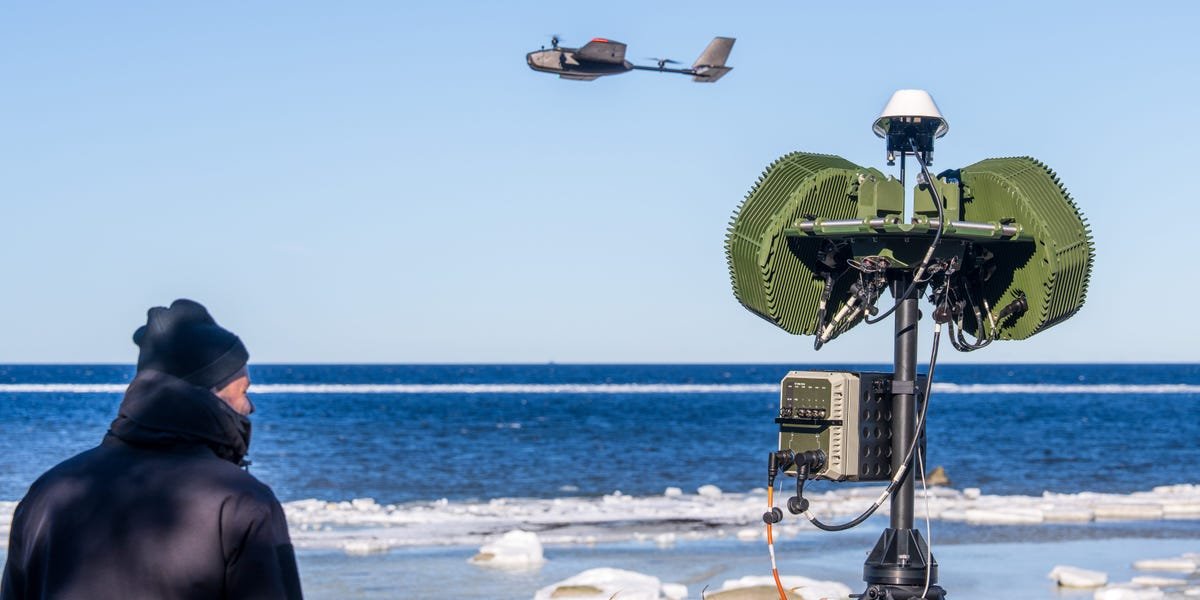
The second testing involved various sensors, counter-drone interceptors, and Shahed replicators.

US Army photo by Maj. Alexander Watkins


Adding more sensors layers the defenses, but it also increases the volume of incoming data. Maule said the goal of the shared command-and-control system is to merge those inputs into one clear picture, reducing the cognitive burden on operators.

An advantage of the design is that the system can be operated farther from the front, out of range of many types of drones, and that it feeds data to multiple partners for heightened awareness.

The rapid pace of the Digital Shield testing reflects the Pentagon’s Silicon Valley-style “move fast, fail fast, fix fast” approach for developing new technology. It also pressures industry partners to keep up. Vendors must meet strict integration requirements, and the swift development cycle forces faster fixes and upgrades based on field feedback.

Digital Shield is an example of the work being done as part of the new Eastern Flank Deterrence Line initiative, which is led by the US and NATO. The effort is intended to build a robust defense against Russia that can detect drones across wide areas and counter them with lower-cost solutions.

Artificial intelligence is also being integrated into the initiative to analyze sensor data faster and speed up decisions on how to respond.

One persistent problem remains the cost of stopping cheap drones.

“We have to beat the cost curve,” Maule said. “If the UAS is a couple or tens of thousands of dollars, you can’t be using extremely expensive interceptors.” The US and its allies have learned that lesson from Ukraine and in the Middle East.


Source link

Videos-show-how-Ukrainian-helicopter-crews-use-machine-guns-to.jpeg

Videos show how Ukrainian helicopter crews use machine guns to hunt Russia’s exploding Shahed drones

Ukraine just gave us an extended look at one of its emerging tactics against Russia’s Shaheds: using helicopters to shoot the drones from above.

The Ukrainian navy published a two-minute montage of such operations on Thursday, saying that a helicopter crew had destroyed eight Shahed exploding drones and Gerbera decoy drones in a single day.

Cockpit and gun camera footage showed the Ukrainians engaging at least five delta-wing drones in flight, with another clip showing unidentified wreckage smoking on the ground.

Some clips indicate that at least one aerial engagement happened in the early morning or at night. Thermal footage from a gun camera showed the operator firing at a delta-wing drone, tracking its flight above open terrain before a screen flash indicates the drone was destroyed.

Other standard optical footage, filmed from a gun camera or the cockpit, appears to show several drones being destroyed high above the clouds or over water near a coastal settlement.

Additionally, an M134 minigun can be seen mounted from a helicopter’s side door, though the videos didn’t show the weapon itself in action.

The clips indicate some of the ideal conditions for downing a Shahed.

For one, the helicopter has to match the drone’s speed and trajectory and gain enough altitude to allow the minigun to fire downward at the Shahed. The chopper crew also needs to come within visual range of the drone to engage.

The footage comes several months after Ukraine said it would officially begin incorporating helicopter crews into its air defense network against Russia’s one-way attack drones, which Moscow uses in mass waves to pressure Ukrainian cities.

Because Russia mass-produces the Shahed and Gerbera, Kyiv has sought more inexpensive means, such as machine guns, instead of traditional antiaircraft missiles to counter them.

Ukraine’s commander in chief, Gen. Oleksandr Syrskyi, said in October that helicopters could sometimes destroy up to 40% of Russian Shaheds and Gerberas in one area.

Thermal and infrared cameras, such as the one seen in the latest footage, were among the systems that Syrskyi said would be equipped on such helicopters to improve their effectiveness.

Ukraine also uses ground crews with interceptor drones or truck-mounted machine guns to destroy Shaheds, but a helicopter crew can reposition much faster to engage multiple threats or hunt down a Russian drone that changes its flight trajectory.

The latter scenario became increasingly common as Russia was found to be outfitting Shaheds with more advanced communications and guidance systems, and, in rare cases, artificial intelligence.

Helicopters also allow for engagements at higher altitudes. Russia often directs its Shaheds to approach their targets at above 6,500 feet before swooping down to attack, making it more difficult for ground-based crews to hit the drones.

Aside from helicopters, Ukrainian troops have also been seen using M134 miniguns on turboprop planes to shoot down Shaheds.

Meanwhile, Russia has since been reported to be attempting to counter the Ukrainian helicopters by equipping its Shaheds with R-60 air-to-air missiles.

In November, Ukraine’s deputy minister of defense for innovation told Business Insider’s Jake Epstein that Moscow was also directly targeting patrolling helicopters and aircraft with Shaheds.


Source link

Headshot of Chris Panella.

The Army’s new drone competition is really a talent hunt. It’s scouting out what makes a top drone pilot.

The US Army used its first Best Drone Warfighter competition not just to test skills, officials say, but to identify what makes a top drone operator — and who in the force is best suited for the job.

Rather than training every soldier to fly drones, the Army is using competition to identify the skill sets of top drone operators and whether there are specific roles within units that would make the most sense for working with uncrewed aerial systems.

The effort reflects a broader shift from treating drone flying as something for all soldiers to approaching it as a specialized skill set that requires the right aptitude, training, and sustained practice.

The inaugural drone competition took place this week at the University of Alabama in Huntsville, gathering teams from across active, Reserve, and National Guard units. There were no requirements on what types of soldiers could participate or where they came from.

Rather, “it was just send your best UAS operators,” Col. Nicholas Ryan, director of Army UAS Transformation at the Aviation Center of Excellence, told reporters, prompting a mix of operators with different backgrounds and expertise.

Over three days, soldiers competed in multiple events, testing their piloting skills. The first was an obstacle course that operators navigated using first-person-view drones.


A soldier holds a drone controller.

Recent US Department of Defense directives have prioritized the development and integration of drones across the Army.

US Army photo by Spc. Michelle Lessard-Terry


The second was a hunter-killer scenario in which teams used a reconnaissance drone to survey an array of targets and decide which were highest priority for simulated strikes with one-way attack drones. The competition didn’t involve any kinetic strikes; instead, soldiers flew the drones into nets on the targets.

The third event was focused on innovation. Soldiers could build, modify, and test their own drones.

Ryan said that the Army was taking notes throughout the competition on who the top operators were, calling it talent management.

“At the end of the day,” he said, “it’s not about receiving trophies or awards,” it is about identifying what sets the top drone operators apart and figuring out how they developed those skills. The goal, he said, is to understand “what lessons can we take from this to find out who the best operator is and how they became the best operator. What skills and resources and training allowed them to become the best operator?”

Soldiers in the US and Ukraine have noticed that gamers make excellent drone pilots, as do soldiers who have experience piloting hobby drones.

“That’s something we’re absolutely looking at right now,” Ryan said.

Army leaders have previously noted a correlation between soldiers who grew up playing video games — or who are active gamers — and drone proficiency.

Troops who game have shown quick reflexes, precise hand-eye coordination, and strong spatial awareness that make them competent with drones.

At an exercise in Germany last fall, a US Army captain told Business Insider that the top pilots were soldiers who “when they got off on Fridays, then go and play video games.”

The Army has been restructuring its approach to drone warfare, rewriting its training and focusing on integrating soldiers with small drone training into front-line units. Lessons and approaches are being shared across the service, building a broader doctrine on how the Army is adopting drones.


A quadcopter drone flies on a field with trees in the background.

The competition allowed Army leadership to learn more about the skillsets and backgrounds that make drone operators successful.

US Army photo by Sgt. Aaron Troutman


Ryan said that the service is realizing that flying drones needs to be a dedicated assignment. “You can’t be a squad rifleman and a drone operator,” he said, explaining that “it’s one or the other because you have to have the level of skill and expertise in operating and employing the drones. That’s what you have to be good at and train at and focus on for most of your time.”

Other Army officials said efforts like the competition were demonstrating where drones best fit in a formation and what aspects of training are most important to maintain these highly perishable skills.

For the most part, soldiers flew their drones successfully, but the Army did take note of communication breakdowns as soldiers went through the hunter-killer lane, specifically getting drones into position and identifying and simulating strikes on targets.

“That’s an example of something we didn’t anticipate, but it’s absolutely standing out as that is something we as an Army need to do better on,” Ryan said. “If we’re going to proliferate these drones and want them to be more effective and lethal, we just need to improve on how our soldiers talk to each other to communicate when they’re using them.”

In future iterations of the Best Drone Warfighter competition, the Army hopes to include kinetic elements as well as electronic warfare and jamming to better replicate real-world scenarios.


Source link