I-tested-3-popular-ways-to-batch-cook-eggs-—.jpeg

I tested 3 popular ways to batch cook eggs — there’s just one method I’ll use for all of my future meal prepping

  • I used the same few ingredients to batch prepare eggs three ways, testing each method’s results.
  • During the experiment, I baked egg muffins, cooked a large omelette, and made a sheet pan of eggs.
  • I’d skip the egg muffins and omelette next time but gladly repeat the sheet-pan method.

Every morning, at least one person in my family cooks eggs.

Whether they make them scrambled or sunny-side-up, the results tend to be inconsistent. One day, the eggs are runny; the next, they’re sticky. It’s a complete gamble.

In search of a fail-proof method for making eggs that allows me to avoid chaotic, messy morning breakfasts, I attempted to meal-prep them three different ways: baking them as muffins, frying them into an omelette, and cooking them in the oven on a sheet pan.

For each method, I used the same ingredients — six eggs, ¾ cup egg whites, 1 cup of chopped red bell peppers, a small onion, and 2 ounces of crumbled feta cheese. Each batch yielded between eight and 12 servings.

Here’s how the eggs stacked up in terms of flavor, texture, and cook time.

Oven-baked egg muffins seemed like an easy-to-prep meal.

I divided the ingredients into 12 sections using the muffin pan.

Jennifer Messineo

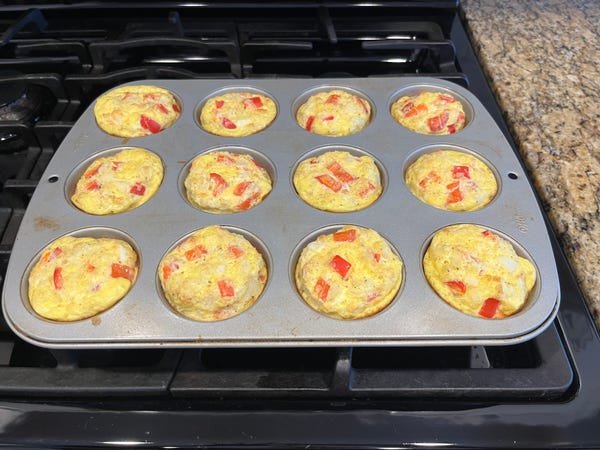
I combined all the ingredients in a bowl, then used a ladle to distribute them evenly into a 12-cup muffin pan.

It proved difficult to distribute the ingredients evenly between the cups without making a mess. Some ended up with extra feta, and others got more peppers.

I planned to cook the muffins for 20 minutes at 350 degrees Fahrenheit, but they were done after 15.

After this test, I’ll never make these egg muffins again.


egg muffin plated

My muffins were too puffy and had too many air pockets.

Jennifer Messineo

I used to make eggs in a muffin tin sometimes, and the results from this test reminded me why I stopped.

Although I liked that they cooked quickly and were easy to portion, the muffins puffed up more than I expected, creating a fluffy egg with a few too many air pockets.

Also, the ingredients didn’t distribute evenly (disappointingly, I had a bite with no cheese!).

The cleanup wasn’t ideal either, as most of the egg stuck to the pan. After soaking it for days, I considered throwing it out.

By the time I finally got it clean, I’d lost the time I saved cooking eggs to scrubbing the muffin pan.

Cooking the eggs into one big omelette should’ve been straightforward.


eggs from meal prep raw but cooking in pan

I kept the eggs cooking over very low heat.

Jennifer Messineo

When it came time to use the stovetop, I decided to make a large omelette in a 12-inch pan using the same five ingredients.

I poured the mixture into the hot, buttered pan and realized how tricky it would be to manage. To accelerate the cooking process and create a fluffy, layered dish, I tilted the pan to lift the edge of the omelette, letting the uncooked egg flow underneath.

I kept the heat low so the bottom wouldn’t overcook. After 10 to 15 minutes, I covered the pan so the center would cook through. Then, I cooked it for about 10 more minutes until the center looked firm.

I ended up having a hard time handling so many eggs in one pan.


eggs from meal prep test in pan

The omelette’s consistency and flavor left much to be desired.

Jennifer Messineo

Lesson learned: Omelettes aren’t meant to be batch-cooked.

I knew cooking a large volume of eggs might be an issue on the stovetop, but I was still surprised that this method took the longest, clocking in at almost 25 minutes from start to finish.

It had an overcooked, eggy smell and taste, and the texture was inconsistent, with a crispy bottom layer and soft center.

Even though I usually fry my eggs on the stovetop, this test made me reevaluate my ways. I also found it difficult to portion the omelette into equal pieces for storage.

I didn’t know what to expect when I pulled out the sheet pan.


sheetpan eggs  in oven

The ingredients spread out evenly in the pan.

Jennifer Messineo

Before this test, I’d never made eggs in a sheet pan. I poured the combined ingredients into the greased, stainless-steel pan and was pleased to see the vegetables and cheese spread evenly.

After baking it for 18 minutes at 350 degrees Fahrenheit, the mixture was cooked through.

It was by far my favorite way to meal-prep eggs.


sheetpan eggs cut into squares

I found it easy to portion and store the sheet-pan eggs.

Jennifer Messineo

The eggs cooked evenly in the sheet pan, and the results had a perfect consistency.

I liked their texture, as they were fluffy but still denser than the airy muffins and omelette. The vegetables weren’t quite as soft as they were in the other methods, but they tasted fine.

I also found it so easy to remove the egg from the pan. The stainless-steel sheet’s surface distributed heat evenly and prevented any crusty edges from sticking to the pan, so cleanup was very easy.

Moving forward, I’ll skip the muffins and omelette and stick with the sheet-pan eggs.


comparison of meal-prepped eggs

I didn’t have to clean very much after making sheet-pan eggs, which I consider a huge bonus.

Jennifer Messineo

As I expected, this test reinforced my belief that eggs are tricky to prepare.

The large omelette I made on the stovetop tasted overcooked and lacked the height I got from the oven. All factors considered, it was my least favorite (although I was nearly as disappointed by the airy, messy egg muffins).

After extensive testing, I can confidently say the sheet-pan eggs were the meal-prep winner. They stayed firm, were easy to divide into 12 even squares, and stayed in one piece when I transferred them to the freezer.


Source link

I-bunked-with-3-strangers-in-a-shared-cabin-on.jpeg

I bunked with 3 strangers in a shared cabin on an overnight train in Europe. I’ll never do it again.

  • I spent 11 hours in a shared cabin on an overnight train from Vienna to Venice, Italy.
  • For less than $100, I got a bunk in a room of six beds with three other people.
  • I’ve traveled overnight on Amtrak, but in private rooms. I didn’t adjust well to the shared space.

My ride from Vienna to Venice, Italy, in October 2022 was bumpy, cramped, and awkward.

During a two-week trip through four European countries, I spent 11 hours bunking with three strangers in an overnight sleeper train.

While it was my first time traveling in a sleeper car in Europe, I’d spent 60 hours on overnight Amtrak trains in the 20-square-foot roomette and 45-square-foot bedroom accommodations, where I had private rooms.

I thought an overnight train would be the best way to travel through Europe so that I could explore more during the day. But the rough ride made sleeping hard, and I didn’t feel rested when I got to Venice.

I booked my ride with the Austrian Federal Railway’s OBB Nightjet.

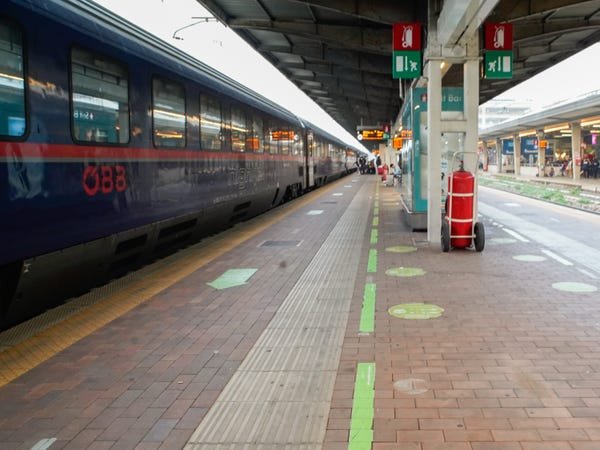
The OBB Nightjet train as it arrives in Venice in 2022.

Joey Hadden/Business Insider

OBB Nightjet — a rail line that operates overnight routes between Austria, Italy, France, and the Netherlands — can go as fast as 143 miles per hour.

Nightjet trains have regular assigned seats, couchette cars (seats that fold out into couches in shared cabins), and sleeper cars with bunks of four or six, which is what I booked. Some routes have private cabins, but mine didn’t.

This overnight leg of my European train trip, which came with breakfast, cost $44 with a Eurail pass. Without the pass, the ticket would have been about $84.


The author's Eurail pass on a European train.

The reporter’s Eurail pass on a European train.

Joey Hadden/Business Insider

To travel by train, I bought a Eurail pass for $477, which gives access to most European trains for a set number of days. Some trains require only a Eurail pass, while others, including overnight trains, incur an additional discounted fare.

My journey began in Austria’s Wien Meidling train station.


The station where the Nightjet took off from

Inside the Wien Meidling train station in Austria.

Joey Hadden/Business Insider

I arrived about an hour and a half before my 9:35 p.m. train so I’d have plenty of time to find the platform.

The departure screens said my train was going to Zurich. At the information desk, I learned that, unlike Amtrak, the train’s cars detach at various stations to go to different locations.


A train car on the Nightjet

Train car number two on the Nightjet.

Joey Hadden/Business Insider

I’d need to board my assigned train car; each has a number.

I paid $10 to wait for my train in OBB’s lounge.


Inside the OBB Lounge

Inside the OBB Nightjet lounge at Wien Meidling train station.

Joey Hadden/Business Insider

The lounge is free for OBB first-class passengers traveling during the day and costs about $10 for all other OBB passengers. Since I didn’t see any empty seats in the rest of the station, I paid for it.

I was surprised to find I was the only one inside the lounge since the rest of the station was full of people. There were plenty of tables and chairs available.

The lounge served complimentary refreshments and snacks, from coffee to nuts and seeds.


refreshments in the OBB lounge

Refreshments in the OBB Nightjet lounge at Wien Meidling train station.

Joey Hadden/Business Insider

It was a smaller selection than I’ve seen at Amtrak’s Metropolitan Lounge, which I’ve visited in New York, but I wasn’t hungry, so I just got a water bottle.

I went to the platform about 20 minutes before my train’s 9:35 p.m. departure.


Platform where the train takes off in Austria

The train platform the reporter used at Wien Meidling train station.

Joey Hadden/Business Insider

When the train arrived, I didn’t have time to check the car number before boarding. I just went to the closest car and asked an attendant for help.

Inside the sleeper cars, I saw narrow, dimly lit corridors full of small cabins with bunk beds.


The corridor inside the Nightjet train

A corridor inside an OBB Nightjet sleeper car.

Joey Hadden/Business Insider

An attendant led the way to my shared cabin.

My room had six bunks and a large window with a curtain. During my leg of the journey, one traveler was already there when I boarded, and two others arrived within an hour.


Inside the author's shared Nightjet cabin.

The reporter gets settled inside her shared cabin.

Joey Hadden/Business Insider

Two got off around 5 a.m., and the other stayed past my stop.

At 74 square feet, it felt like a tight space — especially with everyone’s luggage around. There was space for bags above the beds, but not enough for everyone.

I couldn’t imagine six people squeezing in there.

While my cabin was assigned, the beds were first-come, first-served.


A view of the top bunks from the train's bottom bunk

A view of the top bunks from the reporter’s bottom bunk.

Joey Hadden/Business Insider

Since I’ve experienced more bumps on higher bunks on Amtrak trains, I chose a bottom bunk.

The train provided bed sheets and a pillow.


Bunks inside the Nightjet train

Sheets for the beds inside the cabin.

Joey Hadden/Business Insider

Although they weren’t as soft and cozy as the sheets on Amtrak trains, they were better than nothing.

Temperature and shared lighting controls were above the curtained door to enter the room.


The curtains and controls in the Nightjet bunk

The door to the cabin with dials to control temperature and lighting above.

Joey Hadden/Business Insider

My fellow passengers and I agreed to turn off the lights once everyone was settled into bed.

There was an outlet and a tiny nightstand on the side of each bunk, as well as night lights above the bed. Without curtains around each bunk, I thought I had no privacy.


Lights and outlets on the Nightjet

Lights and outlets in the Nightjet cabin.

Joey Hadden/Business Insider

I longed for a way to close off my bunk for more personal space.

Other passengers in the room said hello to one another upon arrival, but otherwise, the room was quiet.


Inside the shared cabin.

Inside the shared cabin.

Joey Hadden/Business Insider

Some of us watched our devices, while others went right to sleep.

Before bed, I used one of the two bathrooms for everyone in my sleeper car. I thought it was a typical train bathroom with a toilet and a sink.


The bathroom inside the Nightjet train

A bathroom inside the sleeper car.

Joey Hadden/Business Insider

According to Nightjet’s website, only private sleeper cabins come with a shower.

When I was ready for bed, I watched TV before going to sleep. The bed was stiff and uncomfortable, in my opinion.


The author watches TV at night from her bunk.

The reporter’s view from her bed in the evening.

Joey Hadden/Business Insider

I woke up several times during the night to other travelers entering and exiting the room, or due to the bumpiness of the train.

An attendant woke me up with breakfast at 8 a.m., about 20 minutes before my stop in Venice. I got two rolls of bread with butter, jam, and coffee to eat in my bunk.


Morning breakfast on the Nightjet train

The reporter’s view with her breakfast in the morning.

Joey Hadden/Business Insider

There was no café car or common area on board for passengers.

When I got off the train in Venice, I was exhausted from the lack of sleep. I thought it made my first day in the city less enjoyable.


Outside of the Nightjet train as it arrives in Venice

The OBB Nightjet arrives in Venice.

Joey Hadden/Business Insider

“Offering our passengers a high level of travel comfort is an important concern for us,” a representative for OBB Nightjet told Business Insider. “We are constantly working on improvements to our product and also take into account the requirements of our customers.”

While sometimes it’s about the journey, not the destination, in this case, I’d rather arrive feeling refreshed so I can enjoy where I’m going. So, a year later, I booked a Nightjet private cabin to get from Venice to Vienna. That ride was far more comfortable, and I slept easily with no strangers in my cabin.


Source link