
We-moved-our-kids-from-a-small-school-of-100.jpeg

We moved our kids from a small school of 100 students to a larger one with over 700. It worked out better than we imagined.

Last year, our family of five moved interstate. We’d been living in Bright in country Victoria, Australia, for four years, and I wanted to move closer to my parents on the Gold Coast in Queensland.

The Gold Coast is Australia’s sixth-largest city, home to more than 680,000 residents. Bright, on the other hand, is a small town of less than 3,000 people, so the move was a massive leap.

As we packed up our lives in Bright, I had a perpetual bubble of anxiety in the pit of my stomach. Although I was excited for the move, I was also extremely nervous about how our three kids would cope.

One of my biggest worries was how my two oldest children would adjust as they transitioned between wildly different school environments.

My oldest kids handled moving to a much bigger school surprisingly well


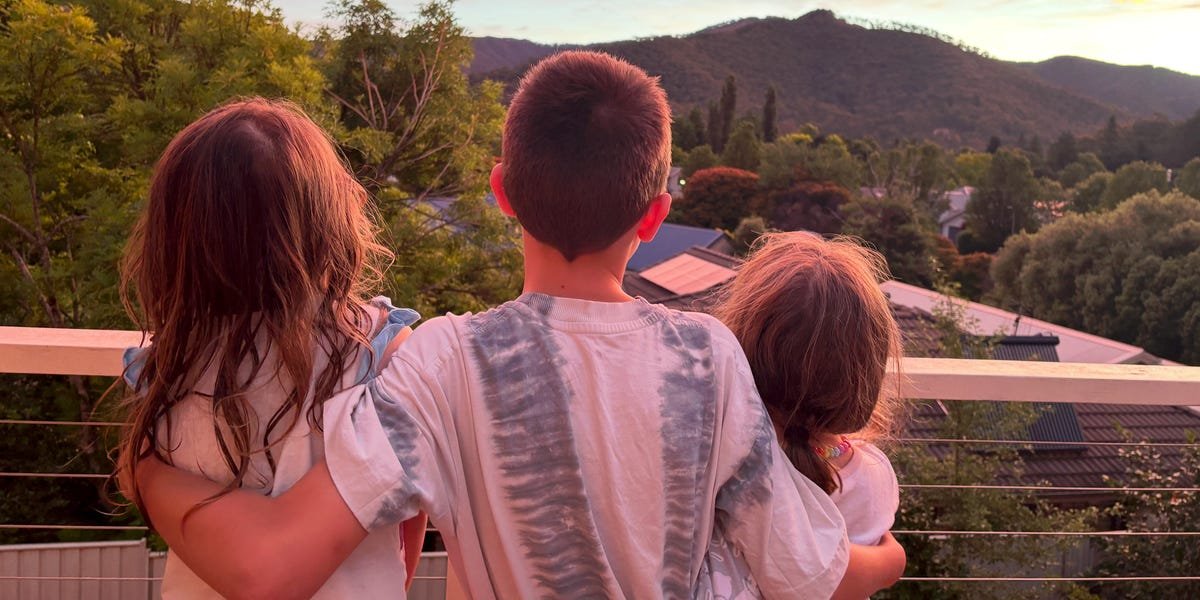
Three kids staring at sunset over mountains/trees

Honestly, I wasn’t sure how my kids would cope with a whole new school. 

Melissa Noble


In regional Victoria, my two oldest attended a country school of roughly 100 kids. It was a wonderful little school with nurturing teachers, strong academics, and friendly families — the kind of place where every teacher knows each child’s name and interests by heart.

Suddenly, though, our very sheltered kids were starting grade five and two in an enormous city school with more than 700 new faces, teachers, routines, and ways of learning.

When the big day finally arrived, I braced myself for tears, phone calls, and a rocky transition.

However, something unexpected happened: There were dry eyes all around. No fuss. No clinging to mummy and daddy or asking to return to their familiar old school. In fact, the kids seemed genuinely excited.

When they came out of school that afternoon, my husband and I tentatively asked how their day had gone.

“It was great — we played footy at lunch, and I really liked my new teacher,” our son said. “A nice girl helped me learn what to do in class,” our daughter added. I felt so relieved, and we all celebrated with ice cream that afternoon.

It’s been a month now, and our kids are killing it. They’ve settled in beautifully and have made some lovely new friends. Our daughter even came home with a principal’s award in her first week.

All of us have learned from this transition

The experience of going from a small country school to a big city school helped us realize a few things along the way.

For one, I hadn’t realized how much we’d missed out on by not being part of a more diverse community.

Living in a more rural part of Victoria, our kids’ school was fairly homogeneous with very little cultural diversity.

Now, in the bigger city, my kids are hanging out with children from a wide range of ethnic backgrounds. They also learn alongside kids who speak several languages, hold different religious beliefs, and come from households with family dynamics dissimilar from ours.

I want our kids to grow up understanding and celebrating differences in race, culture, abilities, and perspectives. Now, they’ll have more opportunities to do so.


Two people in sunglasses smiling

It’s been nice having our kids learn in a more diverse environment — and we’ve connected with some great families. 

Melissa Noble


Fortunately, we’ve also felt warmly embraced by the other parents and our new neighbors.

Living in the country, we met the most beautiful families through the school community. The mums would drop off soup if I was unwell, babysit our kids if we were stuck at work, and look out for them like they were their own.

I thought we’d really struggle to find that same sense of community in a big city. However, I’ve realized that there are good people wherever you go.

In the last few weeks, we’ve had so many kind parents invite us to playdates and parties because we’re new, and I am so grateful for their friendship.

Above all, this transition reminded me that kids are resilient

A friend told me that growth only happens when we step outside our comfort zone, and she was absolutely right. Since we took the plunge and moved, our kids have flourished.

They’ve been forced to make new friends, learn new routines, and try new activities — and they are thriving as a result. Children have a tremendous capacity to adapt and cope under pressure, and I realize now that I should have given our kids more credit.

In the end, the move from a country school to a city one has been better than we could have imagined. My husband and I couldn’t be prouder of the way our children have embraced such a big change, and we’re excited for what the next chapter holds.


Source link

When-my-daughter-was-diagnosed-with-autism-at-age-2.jpeg

When my daughter was diagnosed with autism at age 2, I never imagined she’d own a business and be a reality TV star

This as-told-to essay is based on a conversation with Christine Romeo, mother of “Love on the Spectrum” star Abbey Romeo. It has been edited for length and clarity.

Sometimes I look at pictures of my daughter Abbey when she was 3 or 4. She was just so, so cute. But I think — was I present for that? Did I enjoy that time, or was I too obsessed with therapies and my worries about her future?

It’s normal for anyone, especially parents, to fret about the future, but for parents of kids with disabilities, those worries can be overwhelming.

Abbey is now 27. When she was diagnosed with autism 25 years ago, I couldn’t have imagined that Abbey would be running two small businesses or appearing on reality TV. But along the way, we both learned to think outside the box, and that’s helped Abbey grow so much.

I put Abbey in a vocational program in 8th grade

Abbey went to one of the best schools for autism. She had moderate setbacks, but her curriculum was still focused on academics. She was learning what typical kids were, like tectonic plates and world history, just at a slower pace.


Abbey Romeo

Christine Romeo moved her daughter, Abbey, to a program that would teach her life skills.

Courtesy of Christine Romeo


I could see that wasn’t what she needed. It’s not helpful to learn Western Civilization if you can’t remember what you did yesterday. I would rather Abbey focus on life skills that could help her cope with her autism, like visual clues to help her access her short-term memory.

When Abbey was in eighth grade, I switched her to a vocational program that focused on job and life skills. I had to set my ego aside and do what was right for Abbey. She didn’t need a high school diploma — she needed skills to help her live her life.

I realized as a parent you don’t get to order who your child is

There were moments throughout Abbey’s schooling when I knew I had made the right decision. One time, the teacher sent me a picture of Abbey rewiring a light. I was blown away.

Another was when I came in to see Abbey weaving in the textile program. She was operating this big machine with foot pedals and a large swatch of fabric, and it was regulating her. I had to leave the room, because I was crying.

With Abbey and her brother, who’s a year younger, I realized that as a parent, you don’t always get what you order. I’m determined to help both of them be who they are and be as successful as they’re meant to be.

Entrepreneurs inspired me to not take no for an answer

Abbey excelled at weaving, and I realized selling her creations could be a job. I believe it’s important for everyone to have a sense of purpose, and Abbey had expressed that she wanted a “real job.”

I spoke with her school about creating a program to allow kids to sell their art and crafts. The teacher loved the idea, but the principal didn’t. When he said no, I thought about one of my favorite shows, Shark Tank, and how entrepreneurs don’t take no for an answer. I was determined to find a solution for Abbey, even when the system said there wasn’t one.


Abbey Romeo making a hat

Abbey Romeo runs her own hat-making business.

Courtesy of Christine Romeo


The teacher ended up coming to our home on Saturdays to teach Abbey advanced weaving. Soon, her business, Hats by Abbey, was born. She also has another business shredding people’s paperwork, which they pay for by the bag.

Using cash helped Abbey learn about money

Today, Abbey has control over her days. She often makes hats from 9 to 12, then walks the dog before her voice lesson. She has the sense of purpose that we all need.

For a while, it was difficult for Abbey to connect with the idea of money. I found it helped when she could see cash. I started putting cash in her money box, and if she wanted to order something online, she had to give me the bills.


Abbey Romeo

Charley Gallay/Getty Images for Netflix


The first thing Abbey ordered with her profits was a $160 stuffed lion. It challenged every fiber of my being to let her order that, but she had earned the money, and she got to decide how to spend it. Seeing the glee on her face when she opened the box was worth every obstacle we’ve had to jump over.

Abbey continues to grow so much. I’ve created opportunities, and she’s taken them. It’s been the most beautiful, amazing experience.


Source link