
I-started-letting-my-son-bike-with-his-friends-when.jpeg

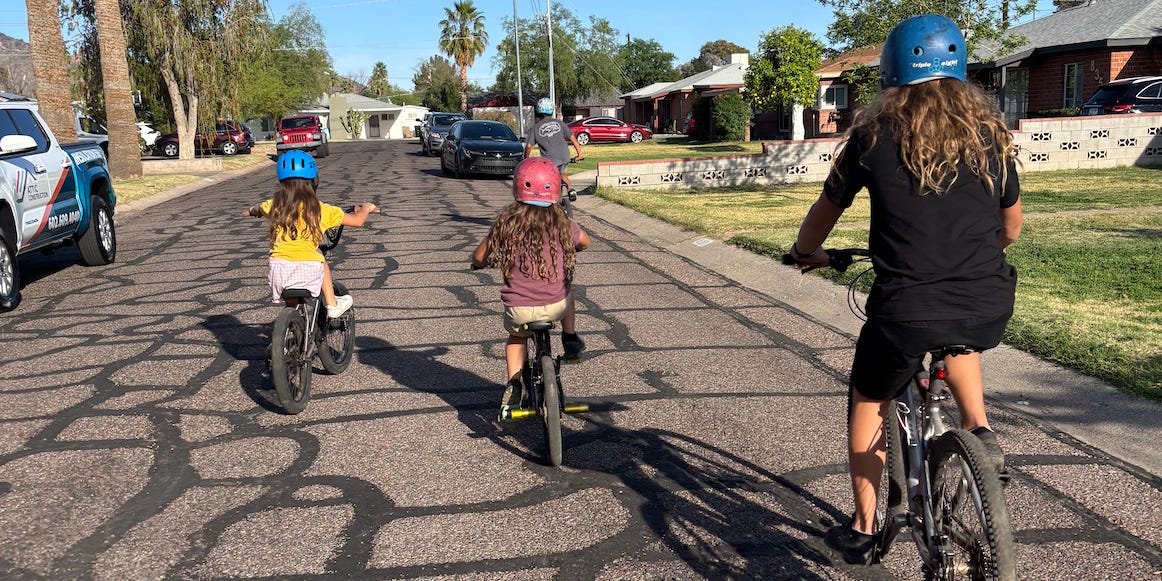
I started letting my son bike with his friends when he was 8. It gives me anxiety, but I see the value in having independence.

The first time my son asked if he could bike in the neighborhood with his friends, I hesitated. His friend balanced on his bike, one foot on the ground, waiting impatiently for an answer. I looked at my eight-year old son, his eyes wide with hope, and every instinct in me wanted to say no.

It was too dangerous. He could get hit by a car. Or kidnapped.

Instead, I took a breath and said, “You can go one block over. And stick together the whole time.”

My son pumped his fist in victory, clipped on his helmet, and hopped on his bike. I didn’t hear from him for half an hour, during which I worried the whole time.

When he returned home, breathless and happy, I knew that I’d made the right choice.

He started asking for more screentime when he wasn’t outside

I bought him an advanced walkie-talkie and GPS tracker so I could check his whereabouts and communicate with him next time he went.

Biking became a regular thing that summer among the four neighborhood boys close in age. Besides biking, they played in our driveway, climbed trees, and made homemade “weapons.”

After about two years, the “bike gang” started to dissolve. One kid moved away. The oldest lost interest. Eventually, my son stopped biking, too. He stayed indoors more often and rarely ventured outside. Instead of pushing his limits in free play, he started begging for more screen time.

I missed the days of the “bike gang,” so when one of the neighbor kids and his younger brother started biking again, I was all too ready to let my son — and now my 8-year-old daughter — join in.

I set boundaries with my kids on how far they can go

I know that biking can be dangerous — my husband was hit on a bike as a kid, so was my little brother, and in my 20’s I was hit while jogging. Cars are not always paying attention, especially now with texting. My kids and I talk about how hyper-aware they need to be at all times. We also discuss stranger danger, and my son now has a GPS tracking watch.

Still, even with these precautions, it’s not easy to send my kids into the world — but the alternative is that they’re cooped up inside or limited to our backyard. Our neighborhood “bike gang” now includes up to seven kids. There’s safety and visibility in numbers, which gives me a small sense of ease.

I now let my kids bike up to a half mile from our house if they’re with the other neighbor kids. When my son is with a fellow 13-year-old in our neighborhood, I let him go even further. They’ve pedaled up to a local church to watch a friend’s theater rehearsal, to my son’s school for band practice, or even to take local taekwondo lessons.

Letting my kids roam the neighborhood is good for their mental health and relationships

As anxiety-inducing as letting my kids bike is for me, I know it’s doing the opposite for them. Research shows that as independent playtime has declined over the past few decades, anxiety and depression have increased among school-aged children.

My oldest child is far less anxious and more confident than he used to be. I believe biking has taught him more responsibility, too, because he has to babysit his sister every time she goes with him. It’s also forced him to learn practical skills, liking fixing a bike tire.

As for my 8-year old, she’s an energetic child who loves to move. Biking with the neighbor kids lets her run off her energy. She also feels older and “cooler” getting to go with the bigger kids.

It’s helped their sibling bond, too, by spending time together doing an activity they both love.

And I’ll be honest that the quiet time in my home, especially when their little brother is napping, is appreciated. I think parenting must’ve been easier before we started keeping kids indoors — and worried about everything.

It’s not easy letting my kids go into the world, but I’m glad they’re getting some semblance of the independence I had as a 90’s kid.



Source link

Amanda Goh

They moved to China for a new adventure. Their 3 kids gained independence — and mom has time for hobbies.

After five years in Qatar, Elisa Orsi and her husband, David Sleight, knew they were ready to leave the desert behind.

They had moved from Australia to the Middle Eastern country in 2019 with their three kids — all under 6 — after Sleight accepted a job there.

Already big travelers before they had kids, the couple used school holidays to see the world after starting a family, before later leveraging Sleight’s teaching career to travel even more.


A family posing with their car in the sand dunes of Qatar.

The family moved to Qatar from Australia because they wanted to experience more of the world.


Provided by Elisa Orsi.


“Usually when people have children, it deters them from travel, but we went completely the other way,” Orsi, 37, a stay-at-home mom, told Business Insider.

Life in Qatar felt safe and comfortable, and it served as a base from which they could explore the region, traveling to places like Jordan, Turkey, and Egypt.

Gradually, the couple found themselves looking for something new.

“By the time we came back from our summer holiday in 2024, we said, ‘OK, we’re done. We need a change,'” Orsi said.

In August 2024, the family packed up their bags and moved to Hangzhou, a bustling city in eastern China.

Moving to China

China had been on their radar for a long time, though neither of them had visited before.

It wasn’t until Sleight came across an online job ad for a teaching role in Hangzhou that they began looking into the city.


A couple in front of a temple in Shanghai.

The family had traveled through other parts of Asia and always wondered what life in China was like.


Provided by Elisa Orsi.


“I was impressed with the natural beauty and how modern the city appeared. I knew China was very well connected by the railway infrastructure, so I wasn’t overly concerned about the location,” Sleight, 45, told Business Insider.

The couple looped their kids, who are now 11, 9, and 7, into the conversation about moving to China early. “We wanted to give them lots of time to process and to get an understanding of what was happening,” she said.

“We have a philosophy that we talk to our children, and we keep them informed about the decisions we make,” Orsi said.


A woman and her three kids in China.

The couple involved their three young children in conversations about the move early on.


Provided by Elisa Orsi.


To ease the transition, they showed their kids YouTube videos about China and the school they would attend.

When they arrived in Hangzhou, Orsi said their first impressions quickly put any lingering nerves at ease.

“We were actually quite shocked to see how clean, how modern, how organized, and how convenient everything is,” Orsi said. “Sometimes you watch videos, but unless you’re actually in it, you can’t really understand it to that degree until it affects your life.”

Their children attend an international school, and Sleight teaches English in the school’s bilingual program.

House-hunting was a breeze because the school put them in contact with a real-estate agent ahead of their move.


The living room.

They live in an apartment about five minutes away from the school.


Provided by Elisa Orsi.


“We wanted to have a bedroom for each of the kids, and we were looking for amenities,” she said. “Most importantly, we wanted to be close to the school.”

Within 10 days of arriving in China, the family moved into a four-bedroom apartment. It’s about a five-minute drive from the school and roughly 50 minutes outside the city center, in a neighborhood dominated by local Chinese families.

Rent is 5,500 Chinese yuan, or about $790 a month, and is covered by the school as part of Sleight’s employment contract.

Life in Hangzhou

Moves like the couple’s have become more common in recent years. China’s latest national census shows that 845,697 foreigners were living in the country in 2020, up from 593,832 a decade earlier.

Even with a growing foreign community, the transition isn’t always easy.

The biggest challenge has been the language barrier, though translation apps have helped. Orsi is learning Mandarin through online apps, while the children learn it at school.

Sleight relies on support from bilingual teachers and staff, and many parents at the school speak English.

“During staff meetings and presentations, I wear an earpiece and listen to a live translation provided by the school’s professional translator,” he said. Sleight added that parents and staff also communicate through a messaging app with built-in translation.

In China, the family also had to get used to a system in which nearly everything, including payments, is done on a smartphone.

Despite those adjustments, Orsi said safety has been one of the most striking aspects of life in China. She said she’s often asked about the presence of surveillance cameras, but sees them as a positive.


A man and his three kids eating their first meal in their new neighborhood in China.

Orsi said the level of safety in China has given her children more freedom to move about on their own.


Provided by Elisa Orsi.


“If anything were to go wrong, the issue would be resolved very, very quickly. So the children, they can be outside on their own,” Orsi said. She added that she probably wouldn’t feel comfortable giving her kids the same level of freedom even in Townsville, a city in North Queensland, where they lived before moving to Qatar.

It’s also common to see children wearing kid-friendly smartwatches, which let them be more independent.

“You can see their location, they can call you, they can pay for things, and so they can go anywhere. They’ll organize their own play dates and go and meet their friends,” she said.

As a woman, Orsi also feels safe walking alone, including from the train station late at night. “I have not thought about it twice. I wouldn’t do it in Australia. And I wouldn’t do it in Argentina, where I’m from,” she said. Orsi moved to Australia in her teens and later met Sleight while working at a telecommunications company.


Two kids along the Great Wall of China.

The family has been using school holidays to travel around China, including to the Great Wall.


Provided by Eliza Orsi.


It took a year, but Orsi says the family finally feels settled in their new home. Most of their social circle has grown out of the school community, including other parents and foreign teachers.

The longer school days have also given Orsi more time for herself. She said she’s picked up new hobbies, including learning to play the piano, going to the gym, and focusing on content creation for their YouTube channel, where she and Sleight document their family life in China.

Sleight is on a three-year contract at the school. As for what comes next, Orsi said the family hasn’t made any firm decisions.

“I think we would probably like to move elsewhere and go to another country when our contract is up, but that could change,” she said. “We may very well decide to stay in China and move to another school or experience a different city.”

Do you have a story to share about relocating to a new city? Contact this reporter at agoh@businessinsider.com.


Source link

We-didnt-need-childcare-but-we-still-paid-7500-to.jpeg

We didn’t need childcare, but we still paid $7,500 to send our toddler to a program for 4 hours a week. It helped her build independence.

When I first found out I was pregnant, I frankly didn’t put much thought into long-term childcare plans. Living in New York City, my husband and I knew we wouldn’t have the traditional village available to us — my parents, while local and thrilled to get a first grandchild, are older and weren’t particularly eager to volunteer for solo babysitting, while his parents live thousands of miles away.

But we were in a uniquely lucky situation: We both happened to have flexible, largely remote jobs.

For the first few months of my surprisingly generous parental leave, my husband and I, cocooned in newborn bliss (and perhaps slightly delirious from sleep deprivation), didn’t stress about what would happen when I went back to work. I figured we could make it work through a combination of creative time management and strategically scheduled naps — at least until our daughter was eligible for 3-K, free schooling available in New York City for kids the year they turn 3.

My husband became the primary parent

Surprisingly, this plan ended up working, for the most part, and for just shy of a year, we managed a fairly even 50-50 split in parenting duties. As time went on and my own work ramped up and the baby potato turned into a sprinting toddler, it became clear that my husband would need to become the primary parent.

It wasn’t something either of us had considered before having a child, but it made the most sense: He found far greater fulfillment in being a father than he’d ever found in his career, whereas I had always defined myself by my work as a writer and editor. He kept his job but scaled back, working largely in the evenings and weekends so he could be free during the day for stay-at-home parenting.

As our daughter became a toddler, she blossomed under my husband’s full-time care, with constant adventuring and frequent playdates keeping her days busy. We didn’t need outside childcare — but as it turned out, she did.

I’d considered traditional childcare, but couldn’t stomach the cost

New York City has notoriously high childcare costs.


Child playing with bubbles

The author says traditional childcare was too expensive in New York City.

Courtesy of Michael Matassa


In the interim between our delicate balancing act and deciding my husband would drastically scale down his work, I considered a number of different options, from traditional daycares (upward of $2,500 a month in my neighborhood for full-time programs) to nanny-share arrangements with other local families (maybe slightly cheaper, but a pain to coordinate).

We were lucky in that we were able to avoid childcare costs, which would have effectively canceled out one of our salaries, though I still toyed with the idea of enrolling her somewhere part time to get her used to the idea in case our situation changed.

Enter Barnard College’s Center for Toddler Development.

I first heard about the program in a local moms’ book club I’d joined. One of our first reads was “How Toddlers Thrive” by Tovah P. Klein, a prominent child psychologist — and incidentally the then-director of the Toddler Center. Another mom in the book club with a daughter two years older than mine mentioned she was now applying.

I was frankly flabbergasted when she explained the details. It’s part research program, where the toddlers are minded by teachers and selected students from the college’s graduate program and observed for published research purposes from behind a one-way mirror, and part “school,” albeit an extremely part-time one, with each “class” of toddlers meeting only twice a week for two hours each day for the duration of the school year.

I was intrigued by the program’s unique “gentle separation period” and its said mission to help toddlers have a positive first school experience while supporting healthy social and emotional development through hands-on, child-guided play.

At that point, my daughter was only 18 months old (the halfway point to our 3-K end goal), but I’d already started to suspect that separation might be an eventual issue. With two working-from-home parents, she was used to having us around constantly — and had never had a babysitter.

The few times we’d tried to step out to grab a coffee and handed her to a grandparent, she would shriek like she was being abandoned. Over the next several months, she also grew more shy, coinciding with her stranger danger peaking.

We paid $7,500 for our 2-year-old

Convinced our future would be filled with school refusals and drop-off meltdowns, I hardcore pitched the Toddler Center to my husband for the coming school year. We didn’t need it for childcare, but I became convinced we did need it to help give our daughter the gentlest, most gradual introduction to being away from us. He was less convinced, sure she would grow out of it and be OK with separating by 3-K, but agreed in the end.

If the program details were mind-boggling, the price point was eye-watering. Though there isn’t a set, publicly announced tuition rate, the Toddler Center offers sliding-scale tuition and payment plans to make the program accessible to a broader range of the population. According to its website, a third of Toddler Center families pay tuition on a sliding scale (I assume the higher-profile alum parents like Amy Schumer, Sarah Jessica Parker, and Robert De Niro paid full sticker price for their kids to attend).

After submitting a sliding-scale tuition application, which required forking over the previous year’s tax returns to prove we were indeed not flush with cash, we landed on $7,500 as the final figure for our almost 2-year-old to take her first baby steps toward school.

At first, it was torturous

It did not go well.


Toddler sitting on bench

The author says at first, her daughter wasn’t comfortable with either of her parents leaving.

Courtesy of Michael Matassa


The first few weeks of the program allowed the parents in the classroom, gradually moving us farther from it (a separate, no-toys-allowed room in the back, meant to be unappealing to the kids) to encourage the toddlers to ignore them and play in the main classroom area. That trick didn’t work on our daughter, who simply sat next to the chair of whichever of us had taken her in that day, chattering happily as we tried to gently encourage her to go away.

As I’d dreaded, the initial actual separation — when parents would bring their kids into the classroom and tell them they were leaving — was horrendous. The Toddler Center mandated that only one parent or caregiver drop off their child each morning.

For the first few weeks after separation, we could both sit in the observation room, where we were treated to a front-row show of our daughter sobbing hysterically and trying to reason with the grad students to open the door she was convinced we were right behind. It was excruciating, and plenty of tears were shed on our end as well.

There was virtually no improvement for months, which was far longer than I expected. And I felt an immense amount of guilt for having come up with this idea in the first place: Were we actually traumatizing her instead of helping her? Had I epically miscalculated this? Did I pay $7,500 to torture my toddler and myself?

I was wracked with doubt, and we debated withdrawing her from the program before the first semester had even finished. It was particularly hard on my husband, who, as the primary parent, was typically the one dropping her off and dealing with the meltdowns — and who also really missed her on school days.

Suddenly, though, and for no particular reason at all, it got better. A lot better.

Instead of sobbing by the door for a full hour and a half, she started interacting with the other kids. She found a favorite grad student she’d attach herself to. She played happily on the classroom slide. And eventually, she comforted the other toddlers during their hard separation days, assuring them their mommies or daddies would be back.

The Toddler Center was expensive, but extremely worth it for us

While it was difficult for my husband to be apart from his little buddy for the few hours a week she was at the program, they turned it into an opportunity for new adventures. In the spring semester, he began biking with her to school, stopping to pick up flowers on the way there and back. Another tradition became that he would bring her a blueberry muffin from a local café every day at pickup. These small rituals helped them bond even more.


Child jumping on sand

The author says the $7,500 she spent was worth it.

Courtesy of Michael Matassa


I don’t pretend to have a handle on the intricacies of toddler psychology, and I can’t tell you what the flipped-switch moment was where it finally clicked for my kid that being left at school with her teachers didn’t mean we were gone forever. And yes, for the record, she still cried during drop-off the first few weeks of 3-K.

But I am convinced that completing the Toddler Center program drastically reduced her adjustment period for “real school.” Tossing her into the deep end for six hours a day, five days a week, was simply not the right option for our family.

In the end, I’m glad I listened to my gut, dug into our pockets, and toughed out the tears — and I’d like to think my daughter, somewhere deep down in her toddler brain, is too.


Source link