

Aditi Bharade

DeepMind’s CEO said there are still 3 areas where AGI systems can’t match real intelligence

True artificial general intelligence is on the way, but it still has some ways to go, said Google DeepMind’s CEO.

Speaking at an AI summit in New Delhi, Demis Hassabis was asked whether current AGI systems can match human intelligence. AGI is a hypothetical form of machine intelligence that can reason like people and solve problems using methods it was not trained in.

Hassabis’ short answer: “I don’t think we are there yet.”

He listed three areas where current AGI systems are falling short. The first was what he called “continual learning,” saying that the systems are frozen based on the training they received before implementation.

“What you’d like is for those systems to continually learn online from experience, to learn from the context they’re in, maybe personalize to the situation and the tasks that you have for them,” he said during the discussion.

Secondly, Hassabis said current systems struggle with long-term thinking.

“They can plan over the short term, but over the longer term, the way that we can plan over years, they don’t really have that capability at the moment,” he said.

And lastly, he said that the systems lack consistency. They’re adept in some areas and unskilled in others.

“So, for example, today’s systems can get gold medals in the international Math Olympiad, really hard problems, but sometimes can still make mistakes on elementary maths if you pose the question in a certain way,” he said. “A true general intelligence system shouldn’t have that kind of jaggedness.”

Humans, in comparison, would not make mistakes on an easy math problem if they were math experts, he added.

Hassabis said in a “60 Minutes” interview last year that true AGI would arrive in five to 10 years.

The executive cofounded DeepMind, an AI research lab, in 2010. The lab was acquired by Google in 2014 and is the brains behind Google’s Gemini. In 2024, Hassabis won a joint Nobel Prize in chemistry for his work on protein structure prediction.

AGI is a disputed topic in Silicon Valley. Databricks CEO Ali Ghodsi said at a September conference that current AI chatbots already meet the definition of AGI, but Silicon Valley leaders keep “moving the goalposts” and pushing toward superintelligence, or AI that can outthink humans.

The AI Summit in India, from Monday to Friday this week, has attracted big names from the tech and AI spheres. Notable speakers on the summit’s agenda include OpenAI CEO Sam Altman, Anthropic CEO Dario Amodei, Google CEO Sundar Pichai, and Meta’s chief AI officer, Alexandr Wang.


Source link

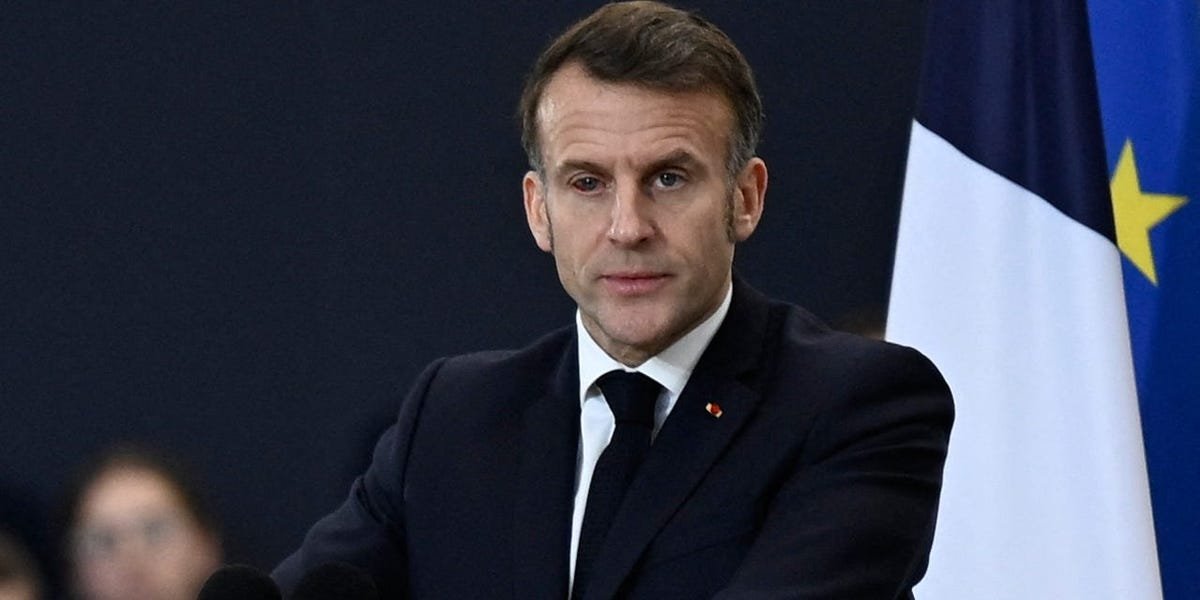
Macron-said-that-Ukraine-now-gets-two-thirds-of-its-intelligence.jpeg

Macron said that Ukraine now gets ‘two-thirds’ of its intelligence from France, not the US

French President Emmanuel Macron said on Thursday that his country has now overtaken the US as the main provider of intelligence to Ukraine.

“Where Ukraine was overwhelmingly dependent on American intelligence capacity, a year ago, two-thirds is today provided by France. Two-thirds,” Macron said in a New Year’s speech to the French military.

The French leader’s comments indicate a shift in the dynamics of Western contributions to the war and suggest that the US may have scaled back its military relationship with Ukraine.

The US briefly suspended intelligence-sharing and aid to Ukraine in March 2025, as the Trump administration was attempting to negotiate a ceasefire between Kyiv and Moscow. After roughly a week, Washington said it was lifting the suspension.

But it’s been unclear so far whether the Pentagon has continued to provide intelligence at the same level as it did during the Biden administration.

The New York Times previously reported that, in those years, US-Ukrainian intelligence-sharing ties had been so close that officials from both countries worked in the same facility to coordinate military strikes.

One of the most vital roles played by US intelligence at the time was providing targeting data and situational awareness for Ukrainian troops, especially when the latter were using American-made systems for the attacks.

Ukraine has since been trying to develop its own strike capabilities, including long-range precision missiles, that might allow it to strike Russia without Western approval.

It’s also unclear exactly how Macron quantified two-thirds of Ukrainian intelligence capabilities. His speech did not say whether he was referring to two-thirds of the intelligence provided by Ukraine’s foreign partners or to two-thirds of all the intelligence used by Ukraine’s forces.

The Élysée Palace and French defense ministry did not respond to requests for comment sent outside regular business hours. Ukraine’s defense ministry and the Pentagon have also not responded to similar requests for comment on Macron’s remarks.

The French president’s point on intelligence-sharing with Ukraine aligns with his larger push to position Paris as a regional military leader, while the Trump administration seeks to curb American involvement in Europe. President Donald Trump has also recently rattled European leaders by alluding that the US could try to take over Greenland, a Danish territory.

Macron said on Thursday that France had helped Ukraine to rebuild its forces and provided Kyiv with security guarantees in the event of a ceasefire.

Last week, European NATO members and the US issued a declaration that said willing countries would form a multinational, “European-led” force to provide “reassurances” to Ukraine and stave off a second Russian invasion or attack.

“The signal sent to our Ukrainian partners, to other Europeans, and to the world is that we are ready,” Macron said. “We are ready to sustain this effort of resistance. We are ready to deter new aggressions or to maintain peace on our soil.”


Source link