Defense startup Anduril is responsible for one of the “principal” systems used against the Iranian Shahed drone during Operation Epic Fury, per the company’s president.
Matthew Steckman, who is also chief business officer for the startup, said in a podcast appearance on Monday that Anduril has been “for the most part, a defensive company in the Middle East” as the war rages into its fourth week.
“We’re heavy participants in the current conflict in the Middle East, mainly on the defensive side,” Steckman said to Harry Stebbings, host of the “20VC” show.
Steckman declined to say which systems are being used in the fight and which specific combat scenarios these weapons are addressing.
He did, however, mention the Shahed long-range loitering munition as a key threat.
Every time Matthew publishes a story, you’ll get an alert straight to your inbox!
Stay connected to Matthew and get more of their work as it publishes.
“So if you’ve read about the Shahed drone, as an example, we’re one of the principal systems to defend against that threat in the Middle East,” Steckman said.
The company’s cofounder, Palmer Luckey, previously confirmed to Axios in the war’s second week that Anduril was involved in the conflict, but declined to name any systems.
Anduril offers a suite of sensors, hard-kill interceptors, and jammers, but only some of them would be typically effective against larger, Group-3 drones such as the Shahed.
For example, the company sells a 360-degree sensor called the Wisp, which uses infrared to detect drones, and a jet-powered drone called the Roadrunner, which is supposed to fly into cruise missiles or larger uncrewed aircraft and destroy them.
It’s unclear if either of these systems was deployed in the Middle East recently. Anduril also provides an AI-powered battle management system, Lattice, that interfaces with all its weapons.
Last week, Lattice was selected by the US Army under a $87 million contract to link its counter-drone systems and enable troops and agents to share data quickly.
Iran has launched thousands of Shahed drones at American forces and their allies in the Middle East after the US and Israel began Operation Epic Fury on February 28.
The sheer number of aerial threats, paired with salvos of Iranian missiles, has raised concerns that the US is depleting its already thin stockpiles of conventional defensive munitions and is not fully prepared to deal with the drone threat.
The Pentagon has since shifted counter-drone assets and teams to defend bases in the Middle East. Ukraine, leveraging years of experience fighting thousands of Russian-made Shaheds, has also sent several hundred experts to the region to assist the Gulf states and the US.
For Brian Auer, the operations manager at Historic Ships in Baltimore, the video of a US Navy submarine sinking an Iranian warship this week looked strikingly familiar.
“I saw the footage of that Iranian frigate getting torpedoed, and it looks like any picture I see from World War II of a similar attack happening,” he told Business Insider of the video released by the Department of Defense on Wednesday.
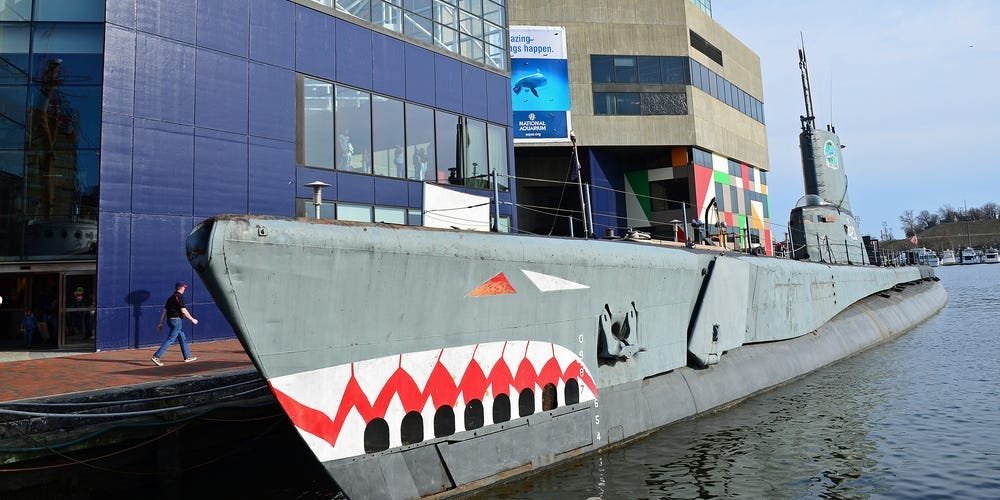
Before this week’s attack in the Indian Ocean, the last confirmed US Navy submarine to sink an enemy ship in combat was the USS Torsk, a World War II submarine that sank two Japanese vessels in 1945 before becoming part of the museum that Auer manages.
Since 1945, large-scale battles between warships have been rare. As naval warfare reemerges as a key strategy in Operation Epic Fury against Iran, museum ships that saw combat in World War II are finding new relevance, showing not just how naval war was fought, but how it might look today. Suddenly, the floating museums feel a lot less like history.
“Those of us who work on museum ships don’t like war,” Ryan Szimanski, the curator at Battleship New Jersey in Camden, New Jersey, told Business Insider. “In many cases, we work here to try and teach people about how awful wars were.
“However, the fact that the United States has fought a naval action — one of the first ones since World War II — is making museum ships like us relevant and part of the public discussion in a way that we haven’t been.”
Museum ships offer immersive experiences
Battleship New Jersey in Camden, New Jersey.
Talia Lakritz/Business Insider
There are around 75 World War II-era museum ships open to the public across the US. These decommissioned battleships, submarines, destroyers, aircraft carriers, and other vessels offer visitors the chance to climb aboard and explore the interiors themselves.
Guided tours, often led by Navy veterans with firsthand experience serving on similar vessels, take visitors through combat areas, such as torpedo rooms, gun turrets, and command centers.
Battleship New Jersey, for example, offers a rare look into Tomahawk cruise missiles as the first surface warship to carry them in 1982. The long-range missiles have also been used to sink Iranian ships during Operation Epic Fury.
The combat engagement center on board the USS New Jersey features a Tomahawk Weapons System.
Talia Lakritz/Business Insider
“Because those are contemporary systems, to be able to see a Tomahawk missile, to be able to see Tomahawk missile launchers in a museum — there’s only a handful of museum ships like us that you could come and see to get that experience,” Szimanski said.
Some ships even offer sleepover experiences where guests can eat meals in the crew’s mess and spend the night in sailors’ bunks.
“It is highly unlikely that the average person will get the chance to visit an active-duty Navy ship,” Szimanski said. “So to experience the conditions, to see what it’s like to serve on a warship, particularly one that has seen combat, visiting a museum ship is your best chance.”
‘Remarkably similar’ to modern Navy ships
The USS Torsk submarine in Baltimore.
Vacclav/Shutterstock
While some technologies and configurations found in World War II submarines may be outdated, many aspects of how they operate remain the same.
“It’s important to remember that the Navy, the military, all of us, operate in a world governed by laws of physics, and so there are some things that are just never going to change in how submarines work,” Auer said. “If you walk through a modern Ohio-class, ballistic missile submarine, you’re going to find things that are exactly the same, or done exactly the same way, on the USS Torsk. And what we can really show is where those things were first done, and why they were done that way, and why they are still done that way.”
Modern submarines still appear “remarkably similar” to their museum counterparts, Szimanski said. The layout of submarines hasn’t changed all that much since World War II. They largely still have the same spaces to eat, sleep, and fire torpedoes.
Auer says that when he leads tours of the USS Torsk for active-duty sailors, he often gets the response, “Huh, we’re still doing it this way.”
The forward torpedo room inside the USS Torsk.
Pixel Doc/Shutterstock
The biggest differences can be found in the ships’ capabilities, Hugh McKeever, the shipboard education manager at the Independence Seaport Museum in Philadelphia, told Business Insider.
Diesel-powered submarines like the USS Becuna, which sank 3,888 tons of shipping in World War II before arriving at the Independence Seaport Museum, had to spend most of their time on the surface with only about 12 hours’ worth of oxygen at a time. Today’s nuclear-powered submarines operate with an unlimited fuel supply and can stay submerged for upward of six months.
“As far as going out to sea, their ability is pretty much limited only by food,” McKeever said.
Overall, World War II-era submarines are less antiquated than one might assume. Some even still work. The USS Torsk’s sister ship, the USS Cutlass, was commissioned in 1945, sold to Taiwan in 1973, and remains operational as part of the Republic of China Navy.
“These boats, to us, are so outdated that they’re museums, but for the rest of the world, they’re relatively advanced,” Auer said. “They’re still very capable of doing the function they were originally designed for. So, were they implemented by some foreign threat, they would be a threat.”
Floating museums find new relevance
The USS Becuna, a World War II submarine, is part of the Independence Seaport Museum in Philadelphia.
Talia Lakritz/Business Insider
For ship museum curators, the resurgence of naval battles in the US war with Iran underscores the contemporary relevance of World War II museum ships and the battle stars they earned. McKeever, for one, anticipates getting more questions about torpedoes as the summer tourist season ramps up.
“For the US as a maritime power, the economic prosperity of the country is tied to the sea and the Navy,” McKeever said. “Our museum vessels represent that constant need for change and growth as a country.”
After all, as Szimanski noted, it was just days ago that no active US Navy ships had ever sunk an enemy warship — the only Navy ships that had fought a naval battle were all museum ships. Despite some rust and peeling paint, it seems they still have a lot to teach us.
The drones Iran is launching at US forces are the same ones Ukraine has fought for years. Ukrainian soldiers say their battlefield experience offers lessons that matter in this fight.
Alex Eine, the commander of a small Ukrainian drone unit, said it was “surprising” to see reports out of the Middle East of multimillion-dollar interceptors being used to combat cheap Iranian one-way attack drones.
“When long-range drones are flying at you, don’t shoot them down with $3 million PAC-3s from Patriots,” he said, referring to a top interceptor for the most advanced US surface-to-air missile system.
Through trial and error, Ukraine developed low-cost defenses to counter Russia’s Geran drones, copies of Iran’s Shahed drones. Ukrainians involved in defending their country and Western analysts say other countries facing these threats need to be doing the same.
A 122nd Brigade sergeant with Ukraine’s Territorial Defense Forces who asked to be identified only by their call sign Fast, said that Ukrainian soldiers “were sure the US had some secret weapon,” some foolproof shield for stopping Shaheds. They were expecting to see it in action when this new war began, he said.
Instead, what they saw were viral video clips of an Iranian delta-wing drone sailing past defenses and slamming into a US Navy base in Bahrain, causing serious damage.
Iran has been firing missiles and drones at US targets and its Middle East allies.
Stringer/Anadolu via Getty Images
“Now we see that it is a hard task, even for the US,” Fast said of defending against Shaheds.
On Wednesday, CNN reported, citing an unnamed source who attended a closed-door briefing, that Defense Secretary Pete Hegseth and the top general, Dan Caine, told congressional leaders that Shaheds pose a greater challenge for the US and allies than initially expected.
The Pentagon did not respond to requests for comment.
Speaking at a press conference on Thursday afternoon, Adm. Brad Cooper, the head of US Central Command, said that the US is “very familiar with the Iranian capabilities” and “planned for it right from the outset.”
He added that while he felt good about what the plan was, the military has been making adjustments.
Dimko Zhluktenko, a Ukrainian drone pilot with Ukraine’s Unmanned Systems Forces, said the US and others should lean more into the kind of low-cost systems that Ukraine has proven work against Shaheds.
Hard-won combat lessons
The reality of any major air defense battle is that some threats are likely to break through.
“I’m not surprised that some Iranian drones penetrated their defenses, as they act like a swarm,” said Ukrainian lawmaker Maryan Zablotskyy, who was an early advocate for interceptor drone air defenses. “It’s very difficult to intercept a whole bunch of them flying at the same time.”
Ukraine has developed mobile fire groups as part of its response to Shahed-style drones.
Andriy Dubchak/Frontliner/Getty Images
Last year, Ukraine saw Russian drones break through and kill over 500 civilians.
“There is no 100% counteraction,” said Oleksandr Skarlat, the director of the Sternenko Foundation, a crowdfunding organization for combat drones. “The question is no longer whether such drones will break through,” he argued, “but what the cost of destroying them will be and how quickly defense systems can adapt.”
Ukraine says it can intercept about 90% of Russia’s Shaheds. That rate isn’t perfect, but Kyiv is able to achieve largely effective coverage and do so with systems that are cheap enough to field at scale, helping it save its missiles like the Patriot and the National Advanced Surface-to-Air Missile Systems, or NASAMS, for Russia’s more dangerous threats.
Ukraine depends on a host of low-cost solutions against Shaheds, including electronic warfare, mobile gun teams, and interceptor drones.
A cofounder of Wild Hornets, the Ukrainian firm behind the popular Sting interceptor drone, said the Shahed threat “forced” their country to develop an entirely new branch of service dedicated to using drones to fight drones.
Ukraine began surging production of cheap interceptor drones, designed to fly at high speeds to intercept Shaheds, in 2025. It says it now produces over 1,000 of them a day.
Ukraine has developed interceptor drones designed to take out Shaheds and other drones.
Alex Nikitenko/Global Images Ukraine via Getty Images
Math problems
Hegseth said on Wednesday that theUS has “the most sophisticated air and missile defense network ever fielded” and that it has vaporized thousands of Iranian threats, both missiles and one-way attack drones.
“We have pushed every counter-UAS system possible forward, sparing no expense or capability,” he said, using an acronym for counter-Unmanned Aerial Systems.
Among the higher-end air defenses on the front lines of this multinational air defense fight are the MIM-104 Patriot and Terminal High Altitude Area Defense (THAAD) systems. Ship-based interceptors, like the SM-series missiles, and planes armed with air-to-air missiles are also in play.
Dara Massicot, a Carnegie Endowment for International Peace defense expert, wrote in an assessment on Monday that drone attacks are being intercepted “at an impressive rate,” but at the cost of “extensive resources of near-constant defensive counter air patrols and the use of ground-based air defense systems that are otherwise needed for intercepting inbound Iranian missiles.”
Zablotskyy,the Ukrainian lawmaker,said that the important thing is to “start thinking low-cost war.” Ukraine’s interceptor drones are priced at around $2,300 to $6,000 each, while Shaheds are generally estimated to cost $20,000 to $50,000 apiece.
Ukraine has more experience operating and stopping drones than any of its allies.
ROMAN PILIPEY/AFP via Getty Images
That cost ratio is much better than expending a multimillion-dollar interceptor missile on a drone costing only thousands. American military leadership says that they are working to address past imbalances.
“Interceptors, in general, we’ve had a number of new capabilities being fielded,” Cooper said on Thursday. “I think you have seen over a period of time us kind of get on the other side of this cost curve on drones.”
“If I just walk back a couple of years, you remember you used to always hear: ‘We’re shooting down a $50,000 drone with a $2 million missile.’ These days, we’re spending a lot of time shooting down $100,000 drones with $10,000 weapons,” he said.
The admiral declined to go into specifics on the new capabilities being fielded.
The US and Israel are flying over Iran and destroying as much as they can of Iran’s missile arsenal to try to limit its offensive attacks — a state-of-the-art air campaign that Ukraine can’t match, and it has cut both missile and drone attacks down tremendously since the war began.
Offers to help
The US military has taken broader drone lessons from Ukraine; however, observers say it has not adopted Kyiv’s low-cost interception architecture at the scale it needs for this and future wars.
The US military’s Patriot air defense system is powerful, but every use is costly.
Thomas Frey/picture alliance via Getty Images
Ukrainians told Business Insider that the US should invest deeply in interceptor drones like the ones they use while also layering in electronic warfare and short-range air defenses.
“The use of interceptor drones might be the key to the Shahed challenge in the Middle East and elsewhere,” said Taras Tymochko, who led the Dronefall project, a program under the charity foundation ComeBackAlive that funded early development of interceptor drones in Ukraine.
“Of course, there is not much time to learn how to use interceptors,” he said. “But it is better to be late than very late.”
On Thursday, Ukrainian President Volodymyr Zelenskyy said that Ukraine “received a request from the United States for specific support in protection against ‘shaheds’ in the Middle East region.” At the same time, reports emerged that the US and other partners were considering purchasing Ukrainian interceptor drones.
In the past, the cost of interception was often vastly more expensive than the target. Cheap interceptor drones are designed to change that.
Jack GUEZ/AFP via Getty Images
Massicot said that while this deeper “learning should have started long ago, now is the time to start — and catch up quickly.”
Several Ukrainians said the urgency for the US to learn from their country extends past the fighting with Iran or the threat from Russia. These countries aren’t its only foes that might rely on Shahed-type drones or swarms.
“Air defense in the Middle East is already unable to withstand the intensity of Shahed attacks,” Skarlat said. “Imagine what will happen if China gets involved” in the drone swarm way of war, he said.
“The world is not ready for massive attacks by Iranian drones,” he said.
The US struck an Iranian drone carrier, and the vessel is currently on fire, the top American admiral in the Middle East said.
Iran’s drone carriers are specialized crewed combat vessels capable of launching a mix of one-way attack drones and uncrewed reconnaissance and strike platforms. Destroying Iran’s naval forces, including warships, has been named a priority by US President Donald Trump and other officials in Operation Epic Fury.
On Thursday afternoon, Adm. Brad Cooper, commander of US Central Command overseeing the Middle East, said, “In just the last few hours, we hit an Iranian drone carrier ship, roughly the size of a World War II aircraft carrier, and as we speak, it’s on fire.”
Cooper didn’t elaborate on where the carrier was located or what it kind of munition hit it. He said that US forces have sunk over 30 Iranian vessels since the start of Operation Epic Fury last weekend.
Tehran has multiple vessels capable of serving as launch platforms for drones, including a former tanker converted into a forward base ship that was seen smoking at its home port in recent satellite images, but Iran’s dedicated, purpose-built drone carrier is the IRIS Shahid Bagheri.
Every time Chris publishes a story, you’ll get an alert straight to your inbox!
Stay connected to Chris and get more of their work as it publishes.
Cooper didn’t identify the targeted Iranian vessel.
The Shahid Bagheri, formerly a container ship before it was reworked and commissioned into the navy last year.
The Iranian vessel features a ski jump-style ramp, one similar in some respects to those on Soviet-built carriers like the Russian Admiral Kuznetsov or Chinese derivatives, that are used to launch aircraft. The vessel can launch a mix of different drones.
During Thursday’s briefing, Cooper also offered several other updates on the US war in Iran. He said that within the last 72 hours, US bombers had struck nearly 200 targets “deep inside of Iran, including around Tehran.” In the last hour, he said at the 5 pm EST event, US Air Force B-2 Spirit bombers dropped “dozens” of 2,000-pound penetrative bombs on buried ballistic missile launchers.
The last day of operations, compared to the start of the conflict, has seen dramatic decreases in Iranian attacks beyond its borders, Cooper said. Ballistic missile attacks are down by 90% and the drone attacks are down by 83%. Reductions in these attacks reduces the strain on air defenders and interceptor stockpiles.
US forces have also targeted Iran’s equivalent of US Space Command, Cooper said, “which degrades their ability to threaten Americans.”
An Israeli F-35 just scored the stealth fighter jet’s first-ever air-to-air combat victory against a crewed aircraft.
An F-35I “Adir” shot down an Iranian Air Force Yak-130 over Tehran, marking its “first shootdown in history of a manned fighter aircraft,” the Israeli military said in a statement on Wednesday.
Lockheed Martin’s F-35 Lightning II entered service in 2015 and is operated by around a dozen countries, including Israel, which fields its own variant of the fighter jet called the “Adir.”
The F-35 has intercepted missiles and drones in combat in the Middle East, but it had never shot down a crewed jet — until now. The incident also marks the first time in more than 40 years that Israeli fighters have downed a crewed enemy aircraft.
The Yakovlev Yak-130, which NATO calls the “Mitten,” is a subsonic twin-seater light combat aircraft that also serves as a training jet. Russia has built hundreds of these planes, which entered service in 2010. Several have been delivered to Iran.
Israel operates its own variant of the F-35 called the “Adir.”
US Air Force photo by William R. Lewis
Since the start of operations on Saturday, Israeli fighter jets have bombed targets across Iran, hitting air defense systems, missile launchers, and military facilities across the country. Hundreds of people have been killed, including dozens of military and government officials, as well as Iranian Supreme Leader Ayatollah Khamenei.
Israeli F-35s are operating in the Middle East alongside US and British F-35s. The UK Ministry of Defense said Monday that Royal Air Force F-35s shot down drones over Jordan, marking the first time one of its stealth fighters has destroyed a hostile target in combat.
American F-35 fighters are one of many US combat aircraft participating in the operations against Iran, including other stealth fighters, electronic attack jets, surveillance planes, airlifters, refueling tankers, and bombers.
US Central Command, which oversees Middle East operations, said on Monday that American forces have bombed more than 1,700 targets in Iran since the strikes began on Saturday.
The US military has targeted Iranian command and control facilities, air defense systems, ballistic missile sites, naval infrastructure, and communications capabilities.
This story is available exclusively to Business Insider
subscribers. Become an Insider
and start reading now. Have an account? .
The US and Israel launched Operation Epic Fury against Iran on Saturday.
Iran’s retaliation involved strikes across six Gulf nations.
Photos taken during and after the strikes showed damage to a luxury hotel in Dubai and other spots.
The attacks launched by the US and Israel on Iran escalated on Saturday, with retaliatory strikes hitting nations across the Gulf.
Hours into what the Trump administration is calling Operation Epic Fury, Iran responded with attacks on more than six countries, from Dubai to Bahrain. Iran said it targeted bases that host US forces in the Middle East.
Satellite pictures also show extensive damage to Iranian Supreme Leader Khamenei’s residence. Khamenei was killed on Saturday, though it is still unclear if he was at the Tehran compound when it was struck.
Intercepted missiles were seen streaking across the sky in Dubai, a tourist hotspot, and their debris appeared to spark fires and other issues. Fairmont’s famous luxury property on the Palm was hit.
Chaos was also abound at airports, amid mass flight cancellations as planes scrambled to clear the airspace over Iran.
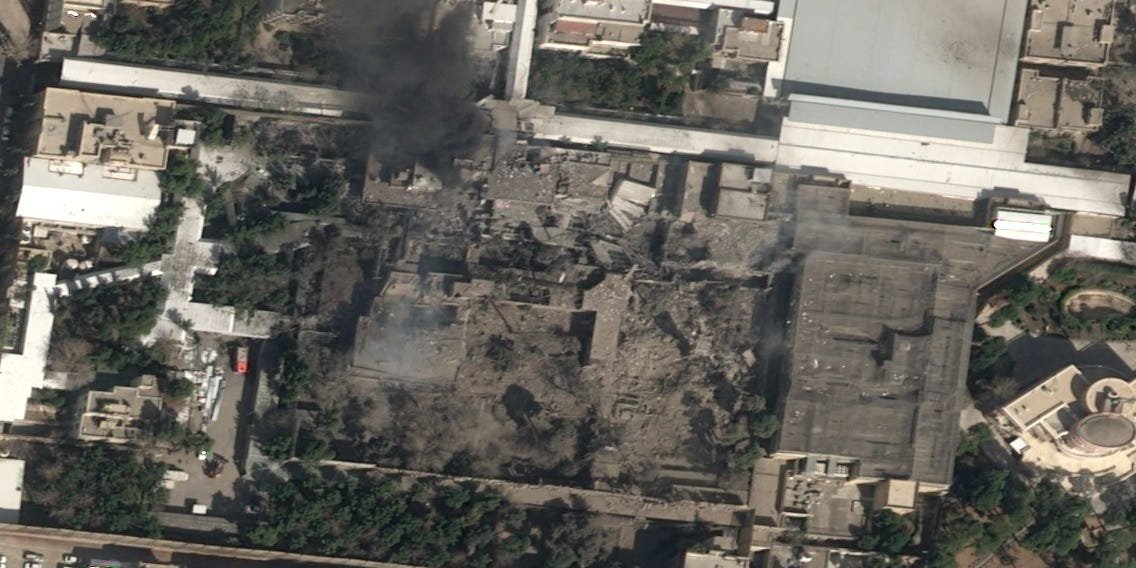
Satellite images captured after Saturday’s US and Israeli strikes on Tehran show that the residence of Iran’s supreme leader, Ayatollah Ali Khamenei, sustained severe damage.
The photos, provided to Business Insider by Airbus, show several collapsed buildings inside a compound in Tehran, which is known to be one of Khamenei’s main residences.
It’s unclear if the Iranian leader was present at the time of the strikes, though the US, Israel, and Iran all said that he was killed on Saturday.
It’s also not yet clear if it was Israel or the US that carried out this particular strike. Representatives for the Pentagon and Israel Defense Forces declined to comment on the hit when asked by Business Insider.
A cropped photo of the Leadership House in Tehran after the Saturday strikes.
Pléiades Neo (c) Airbus DS 2026
One of the heavily damaged buildings in the compound, at the bottom left of the image, is the House of Leadership, which is known as Khamenei’s office and principal place of residence.
In the images, smoke appears to be rising from its roof. Much of the compound has been obliterated, with felled trees and several more smoking buildings.
The large structure to the right of the compound is the Imam Khomeini Hussainia, a place of worship used by Iranian leaders for religious ceremonies and political speeches.
It’s unclear whether this larger building was also attacked, but what looks like debris can be seen on its roof.
A satellite image taken a year earlier shows the complex included at least six buildings, all of which are now damaged by the strikes.
This image from February 28, 2025, shows the complex a year before the strike.
Screenshot/Google Earth
A wider-angle view from another satellite image taken on Saturday appears to show that the strike was largely confined to Khamenei’s compound, which is located in the heart of the Iranian capital.
Smoke rises from Khamenei’s residence in a wider shot of the compound.
Pléiades Neo (c) Airbus DS 2026
The compound’s neighboring buildings appear to be intact.
This Google Earth image was taken on February 28 in 2025.
Screenshot/Google Earth
In a video address after the attacks began, President Donald Trump told Iranians to “take over your government.”
“It will be yours to take. This will be, probably, your only chance for generations,” Trump said.
The US and Israel began their attacks on Saturday morning local time, hitting Tehran and several other Iranian cities in what has been one of the largest strike campaigns in recent years.
The full outcomes of these strikes are still being assessed, and much remains unclear about Tel Aviv and Washington’s exact objectives behind the attacks.
Meanwhile, Iran has responded by firing dozens of ballistic missiles and drones at its neighbors, saying it is targeting US military bases.
Khamenei had been in power in Iran for almost 40 years as a powerful religious leader in Shia Islam, becoming the country’s ultimate authority in government and the military.
It remains to be seen how his death will impact the fate of Iran’s military, society, and government structure.
February 28, 2026: This story was updated to reflect the death of Khamenei, as confirmed by the US, Israel, and Iran.
Iran’s Supreme Leader Ayatollah Ali Khamenei was killed during the massive joint US-Israeli strikes on the country, President Donald Trump said in a Truth Social post on Saturday.
“Khamenei, one of the most evil people in History, is dead,” Trump wrote. “He was unable to avoid our Intelligence and Highly Sophisticated Tracking Systems and, working closely with Israel, there was not a thing he, or the other leaders that have been killed along with him, could do. This is the single greatest chance for the Iranian people to take back their Country.”
Khamenei, 86, was in power for almost 40 years, and his reign was marked by high tensions with the US and the West more broadly, as well as a recent brutal crackdown on Iranians protesting high inflation. Tensions with the US have centered on Iran’s longstanding support for terrorism and its pursuit of nuclear weapons.
In recent weeks, as the US urged Iran to make a new nuclear deal, the American military has been building up its forces in the Middle East. The buildup has been accompanied by heated rhetoric and warnings from both Washington and Tehran.
Missiles struck several high-value targets in and around Tehran, including Khamenei’s compound near Tehran and his offices in the capital. Khamenei’s location during the strikes was previously unknown.
During President Donald Trump’s video statement announcing the start of “major combat operations” against Iran on Saturday morning, the president called for Iranian citizens to “take over your government.” He said, “This will be probably your only chance for generations.” Trump has recently made similar comments in favor of regime change in Iran.
Separately, Israel has repeatedly issued threats against Khamenei. In June 2025, after joint US-Israeli strikes on Iran, Israel’s Defense Minister Israel Katz said Khamenei “cannot continue to exist,” calling him a dictator. Other Israeli officials, like Prime Minister Benjamin Netanyahu, have made similar statements.
Khamenei became Supreme Leader in 1989, acting as the ultimate authority across all branches of the Iranian government and the military. Khamenei was also the country’s religious leader and was granted the title of ayatollah, a title for high-ranking clerics in Shia Islam, Iran’s official state religion.
His death marks a major upheaval amid US combat operations against Iran, which both the US and Israel said was aimed at eliminating imminent threats to Americans and Israelis. The American operation, called “Epic Fury,” has involved a mixture of land, air, and sea assets, including Tomahawk missiles, High Mobility Artillery Rocket Systems, and drones.
It remains to be seen how Khamenei’s death will affect the fate of the Iran’s regime, which is bolstered by the hardline Revolutionary Guard Corps and a vast internal security force.
Iran’s retaliatory strikes targeted US bases across the region, with US assets and partner forces, including Qatar and the United Arab Emirates, involved in air defenses.
New satellite imagery shows an Iranian warship burning pierside following widespread US and Israeli airstrikes.
The imagery, collected Saturday by US spatial intelligence firm Vantor and obtained by Business Insider, shows some of the initial aftermath of the joint US and Israeli attack on Iran, a major combat operation against Tehran after the collapse of talks on nuclear weapons.
The Vantor images show a frigate burning at the Konarak naval base in southern Iran. A large billow of smoke can be seen rising from the wounded vessel.
In a close-up image, two other frigates are seen sitting nearby, appearing unscathed.
Trump said earlier in his video message announcing the US campaign, Operation Epic Fury, that the US military was “going to annihilate” the Iranian navy, as well as the country’s other military capabilities.
Trump said the goal was to ensure that Iran can “never” have a nuclear weapon. The president also urged Iranian citizens to “take control” in the aftermath of US operations.
“This will be, probably, your only chance for generations,” he said.
War analysts at the Institute for the Study of War think tank said on Saturday that there had been unconfirmed reports of strikes on Iranian naval assets.
“An Israeli OSINT [open source intelligence] account reported strikes on the IRGC Navy frigate Jamaran,” ISW said. “There are also unverified reports of strikes on the IRGC Navy Imam Ali Navy Base in Chabahar, Sistan and Balochistan Province.”
Other images collected by Vantor show drone launch activity at two nearby airbases in Konarak. After the initial attacks by the US and Israel, Iran launched retaliatory missile and drone strikes at US military bases around the region in Bahrain, Qatar, the United Arab Emirates, Kuwait, Jordan, and Saudi Arabia.
Iran has also launched multiple barrages at Israel, including missiles and drones, and said it was carrying out an “extensive drone offensive operation” against its longtime foe.
US strikes on Iran included a mix of weapons such as Tomahawk cruise missiles, High Mobility Artillery Rocket Systems, drones, and undisclosed standoff weapons designed for long-range strikes outside the reach of enemy air defenses.
In response to retaliatory attacks from Iran, various air defense weapons have been active, including the MIM-104 Patriot surface-to-air missile and Terminal High Altitude Area Defense, or THAAD, batteries.
Saturday’s strike is the second time in less than a year that the US has launched a strike campaign against Iran. In June 2025, US forces targeted Iranian nuclear facilities. In the weeks prior to the most recent attack, the US built up a massive force presence in and around the Middle East.