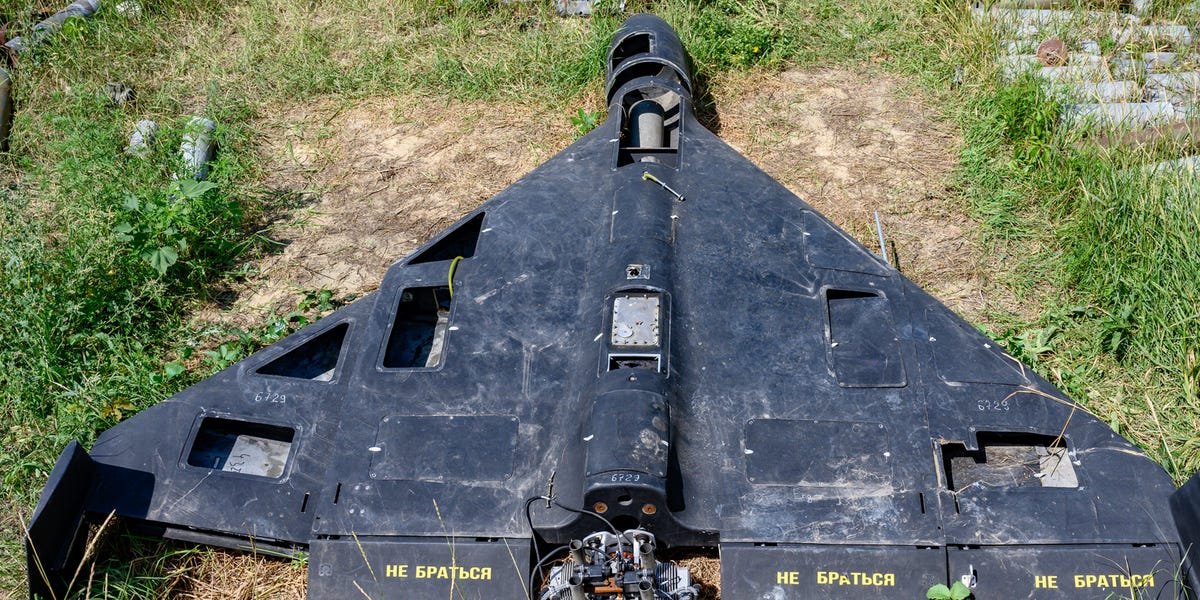
Iran attacked the Erbil region in northern Iraq over 400 times during its war with the US and Israel. WELT’s Chief Correspondent Ibrahim Naber got exclusive access to the wreckage of Iranian weapons used to strike the Kurdistan region.
The cache of damaged weapons includes the Zolfaghar ballistic missile and the Shahed drone, which has become Iran’s mainstay weapon during the war.
Oil prices rose at market open after President Donald Trump leveled a profanity-laden threat against Iran on Sunday.
The president said if Iran didn’t open the Strait of Hormuz by Tuesday, the US would target its power plants and bridges.
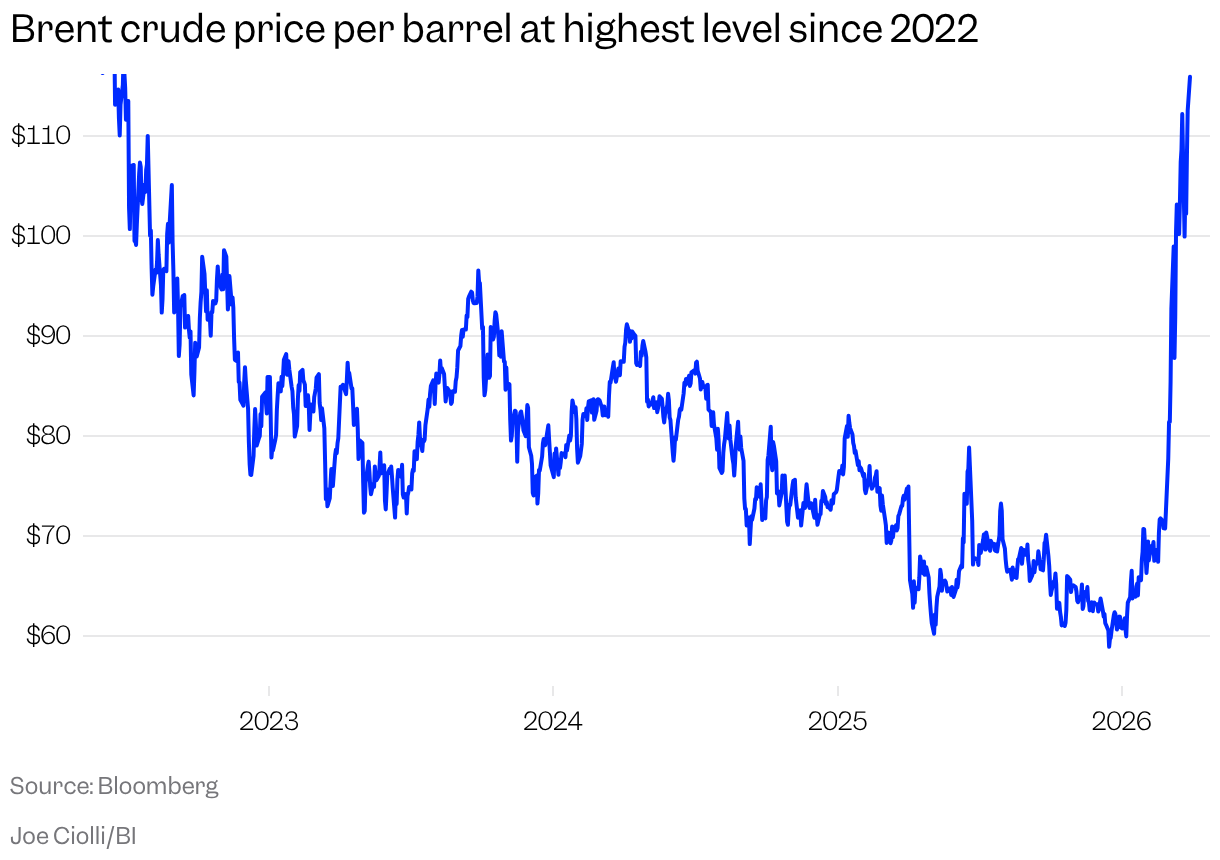
As of 6 p.m. in New York, contracts for Brent crude were trading at $109.57 per barrel, after ending the session Friday at $109.24.
Contracts for West Texas Intermediate (WTI) were up3% at $115 a barrel, after clearing $111.54 at market close on Friday.
“Tuesday will be Power Plant Day, and Bridge Day, all wrapped up in one, in Iran. There will be nothing like it!!! Open the Fuckin’ Strait, you crazy bastards, or you’ll be living in Hell – JUST WATCH! Praise be to Allah,” the president posted to his Truth Social account on Sunday.
After the US and Israel began bombing Iran in late February, Iran retaliated by essentially closing the Strait of Hormuz, through which a fifth of the world’s oil and liquefied natural gas passes.
That closure and other war-related shocks have ripped through the global economy. The average price of gas in the US now exceeds $4 for the first time since 2022, when Russia invaded Ukraine. The cost of groceries in the US is also rising.
Jet fuel prices, too, are on the rise, reaching $195 at the end of March. Those rising costs, coupled with shortages, have pushed some airlines to pass on additional costs to travelers or cancel flights.
As the US-Israeli war with Iran rages across the Middle East and roils global markets, a small subset of drone makers — ones who build drones to destroy other drones — are seeing an upside to the conflict.
Interceptor drone manufacturers outside the region told Business Insider of a surge in requests for demonstrations and inquiries from potential buyers over the past week, as the US and its allies scramble to counter Iran’s loitering munitions.
“Since the beginning of the war, we have been receiving daily requests from the Middle East, whereas previously it might have been once or twice a month,” said Jens Holzapfel, business development director for Nordic Air Defense. The Swedish startup is building a propeller-driven interceptor, the Kreuger-100XR, which is being tested in Ukraine.
New interest has overwhelmingly come from Gulf state governments or entities working with their defense ministries, although European countries have also reached out, the companies said.
Misha Lu, a spokesperson for the Taiwanese firm Tron Future, said international inquiries for its counterdrone products, which include a single-use quadcopter interceptor and net-launcher drone, have “effectively doubled” since the war began.
Almost all prospective clients were asking for ways to protect critical infrastructure, such as airports and power grids, he said.
Lu added that potential buyers are also largely shifting their focus from anti-drone jammers to “hard-kill” solutions, which rely on explosives or physical force to destroy drone threats.
Surging interest in Ukrainian drones
Heightened demand for hard-kill counterdrone tech comes as Iran has launched thousands of one-way attack Shaheds against the US and its allies in the Gulf region. Some of the loitering munitions have successfully gotten through air defenses and struck their targets, including US military facilities.
Key concerns in air defense against Shahed threats have been cost and quantity. Traditional air-to-air or surface-to-air missiles are limited in supply and would be too expensive to engage en masse against Shaheds, which cost $20,000 to $50,000 each.
The Iranian Shahed has been a subject of Western concern for years, as Russia used the drones to bombard Ukraine.
Win McNamee/Getty Images
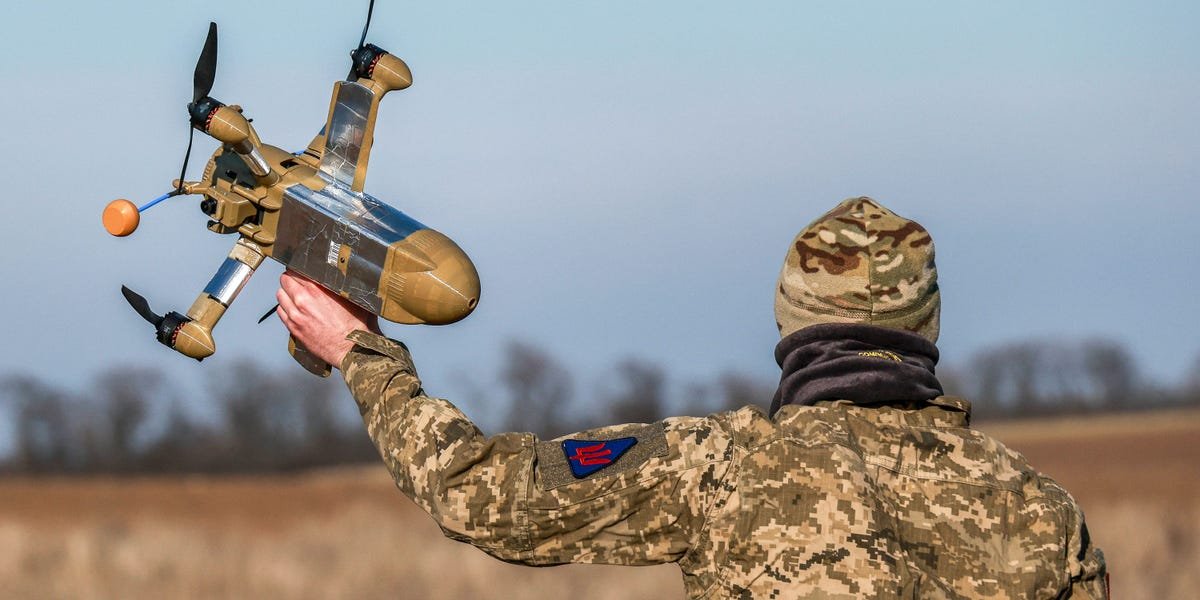
A cheaper solution, pioneered largely by Ukraine, is to use first-person-view or small drones to catch and ram into Shaheds.
The Wild Hornets, the Ukrainian manufacturer of a popular interceptor drone called the Sting, told Business Insider that the company previously fielded one or two business inquiries daily, but since last week has received “several dozen per day.”
Sting production is still heavily dedicated to helping Ukraine fight off Russia’s locally built versions of the Shahed; Kyiv says Moscow has launched over 57,000 of them so far.
“These are requests, not what we’ve agreed to,” a Wild Hornets spokesperson said of the new inquiries. “Our priority is Ukraine’s defense.”
Another major Ukrainian drone maker, Skyfall, told Reuters last week that it was receiving foreign requests for interceptors and could produce up to 10,000 a month without affecting Ukraine’s needs.
Still, Ukrainian firms may have difficulty closing any such deals for now. A wartime law broadly blocks drone exports from the country, as uncrewed aerial systems remain the pillar of its tactical combat operations.
The Wild Hornets manufacture the Sting, a popular interceptor drone now used in Ukraine.
Alex Nikitenko/Global Images Ukraine via Getty Images
Whether the ban will remain, however, is unclear. Kyiv has been exploring the possibility of controlled exports, seeking to promote its fledgling defense tech market and touting its wartime production expertise and ability to test weapons in combat.
Ukrainian President Volodymyr Zelenskyy has also repeatedly signaled openness to assisting allied countries, including Gulf States, that request support and expertise against Shaheds.
So far, though, Zelenskyy has only confirmed that Kyiv is sending experts to the Middle East, without mentioning export sales.
Too much demand to cope with
For interceptor makers in other countries, the sudden demand is so great that most aren’t sure they can keep up with the influx of business. The technology is also fairly young, meaning some firms have yet to build out their production lines fully.
Agirs Kipurs, CEO of the Latvia-based firm Origin Robotics, told Business Insider that his firm is already working to fulfill existing contracts and may thus only meet a “limited part of the demand.”
“Obviously, we will not be able to meet all requests, as we are still scaling up production and building toward full output capacity,” said Kipurs, whose firm builds drones deployed in Ukraine and an autonomous interceptor used by NATO forces.
Jiří Janoušek, a representative for the Czech firm TRL Drones, said his company recently received multiple requests a day for its fixed-wing interceptors — a short-range drone and a larger jet-powered system that are used in Ukraine.
TRL Drones is increasing production capacity to accommodate new requests, Janoušek said, but has had to “carefully prioritize incoming opportunities,” giving preference to customers who already know their operational requirements and are ready to move quickly.
“Supporting Ukraine remains a core priority that continues to utilize a portion of our capacity,” Janoušek added.
Lu, of Tron Future, said that his firm is “fully engaged” with all the inquiries it’s receiving, but is still working on scaling production.
One of Tron Future’s interceptors on display at an aerospace and defense show in Taipei.
Tron Future
Demand from Taiwan and East Asia has recently doubled, too, he added, with inquiries from Taiwanese law enforcement and military agencies reaching double digits.
There is concern about China’s own delta-wing drones, Lu said, such as the Loong M9 and Feilong 300D. Both appear highly similar to the Shahed-136.
Chinese industries have long supplied drone components to both sides of the Ukraine war, and Lu said it’s clear that the People’s Liberation Army is learning from the battlefield there.
“So we know that in a conflict scenario across the Taiwan Strait, we will also see similar saturation attacks where cheap drones of various classes mingle with missiles,” Lu said.
US Central Command released new footage on Wednesday of strikes against some of Iran’s old American-made surveillance and transport military aircraft.
The videos, posted on X, showed a Lockheed C-130 Hercules and a Lockheed P-3F Orion being set ablaze by airstrikes as they were grounded on runways.
It’s unclear when or where the strikes occurred.
The C-130’s frame appears to collapse upon the strike’s impact, with the fuselage separating from its wings in a fireball.
The clips also showed the apparent destruction of an Ilyushin Il-76, a Soviet-designed strategic airlift freighter.
Every time Matthew publishes a story, you’ll get an alert straight to your inbox!
Stay connected to Matthew and get more of their work as it publishes.
“The Iranian regime is losing air capability day by day,” CENTCOM wrote in its post.
The Iranian regime is losing air capability day by day. U.S. forces aren’t just defending against Iranian threats, we are methodically dismantling them. pic.twitter.com/CrJj2nFtHB
Iran has an aging fleet of C-130E and C-130H transport aircraft, which it acquired from the US before the 1979 Islamic Revolution. Tehran was believed to field about 28 of these turboprop planes, but it’s unclear how many remain after recent strikes on its military assets.
Iran also purchased six P-3F Orion maritime surveillance aircraft before the revolution and was, until recently, believed to still operate five of them. Its air force is also reported to have roughly five IL-76s.
Separate satellite images from Monday obtained by Business Insider also show that several of Iran’s American-made F-14 Tomcat fighter jets — made famous by the film “Top Gun” — were destroyed at an airbase in Isfahan.
The US and Israel have continued to launch strikes against Iran, saying they’ve attacked over 5,500 sites and military assets since February 28.
Many of those strikes targeted Iranian naval vessels, which the US is concerned may threaten the Strait of Hormuz, a vital waterway that services about a fifth of the world’s oil supply. Over a dozen reported attacks on the strait have reduced its traffic to a crawl, sending oil prices briefly spiking over $100.
President Donald Trump said on Wednesday that the war with Iran may end soon and there was “practically nothing left to target” in the country.
“Any time I want it to end, it will end,” he told Axios in a phone call.
Newly captured satellite imagery from the ongoing conflict with Iran shows it’s biggest warship — a former oil tanker converted into a floating base — on fire at a military port.
The imagery, captured on Monday by the US commercial imaging firm Planet Labs PBC and obtained by Business Insider, shows a massive plume of smoke rising from what analysts identified as the IRINS Makran in the harbor at Bandar Abbas, an Iranian port city adjacent to the Strait of Hormuz and the Makran’s home port.
President Donald Trump vowed on Saturday to “annihilate” Iran’s navy as he announced the start of “major combat operations” against the country.
A close-up view of the Makran.
Planet Labs PBC’
US Central Command, which oversees Middle East operations, said on Monday that it has destroyed all 11 of Iran’s ships in the Gulf of Oman. It was not immediately clear if that tally includes the Makran.
Commercial satellite imagery captured by US spatial intelligence firm Vantor on Sunday showed destroyed and sinking vessels, as well as damaged buildings at the Iranian naval base in Konarak.
Every time Jake publishes a story, you’ll get an alert straight to your inbox!
Stay connected to Jake and get more of their work as it publishes.
Iran converted the Makran, an oil tanker, into a forward base ship in 2020 and commissioned the vessel into the navy the following year. Technically not a combat ship, it is still Iran’s largest warship and can carry roughly a dozen helicopters.
The deck can accommodate missile and rocket artillery launchers, as well as vertical takeoff and landing drones. The vessel has completed several long-distance voyages, including one that circled the globe.
The Makran is one of several Iranian warships that were once civilian vessels. In recent years, Tehran has converted several container ships into militarized drone carriers.
The Makran is a tanker converted into a forward base ship.
Iranian Army via AP
CENTCOM said it struck one of these vessels, the Shahid Bagheri, in the opening hours of the conflict over the weekend. The carrier’s status is unknown.
The US strikes initially focused on Iran’s naval forces, command and control facilities, intelligence infrastructure, and ballistic missile sites, Gen. Dan Caine, the chairman of the Joint Chiefs of Staff, told reporters on Monday.
US and Israeli aircraft have also targeted Iranian air defenses, paving the way for both militaries to secure air superiority over large parts of the country.
Additional satellite imagery shows widespread damage across Iran, including at drone and air bases, official compounds, and missile bases. Other military infrastructure, such as radar systems, was also struck.
Iran has retaliated by launching waves of missiles and drones at bases hosting US forces across the Middle East, Israel, and most other countries in the region, including the Gulf states.
The US and its allies have said that they have intercepted hundreds of Iranian missiles and drones. Some have slipped past air defenses, though, killing more than a dozen people across the region, including six American service members.
Newly captured satellite imagery shows destruction and damage to infrastructure at military installations across Iran after waves of US and Israeli airstrikes.
The images, collected on Sunday by the US spatial intelligence firm Vantor and obtained by Business Insider, show that a wide range of targets have been struck since Saturday, including a drone base, a naval facility, and a radar system.
The US involvement is more widespread than the brief round of American strikes in June 2025, which primarily targeted Iran’s nuclear sites.
In the southern coastal city of Konarak along the Gulf of Oman, the images reveal destroyed and damaged buildings, storage bunkers, and aircraft shelters at Iranian drone and air bases.
At a nearby naval facility in Konarak, the imagery shows destroyed and sinking vessels and damaged buildings adjacent to the pier. The US military confirmed on Sunday that it had struck a Jamaran-class corvette and said it was “sinking to the bottom of the Gulf of Oman.”
President Donald Trump said on Sunday that the US has “destroyed and sunk” nine Iranian naval vessels and would continue to target the remainder of the fleet.
At the Zahedan airbase in eastern Iran, near the country’s borders with Afghanistan and Pakistan, imagery reveals an obliterated radar system.
Strikes on aircraft shelters at an airbase in Konarak.
The US military said on Saturday that it had targeted Iran’s Islamic Revolutionary Guard Corps (IRGC) command and control facilities, air defenses, missile and drone launch sites, and military airfields. B-2 stealth bombers struck fortified missile sites with 2,000-pound bombs.
In contrast, the US focused its attacks in June 2025 — the first direct American strikes against Iran in decades — on fortified sites associated with Iran’s effort to enrich uranium.
The Israeli military said it has targeted Iranian air defense systems, missile launchers, and fighter jets in strikes that began Saturday and have continued into Sunday. Israel said it has killed 40 senior Iranian commanders, as well as the country’s Supreme Leader Ayatollah Ali Khamenei.
Despite these blows, Iran has managed to launch a steady pace of drones and missiles, damaging buildings and ships across the region.
Israeli fighter jets have dropped thousands of munitions over more than 700 aircraft sorties. More than 200 people have been killed or wounded in the joint strikes, according to local reports.
Iran has retaliated to the strikes by launching hundreds of missiles and drones at Israel and more than half a dozen other countries across the Middle East, including at major US military bases in several Gulf states.
The retaliatory fire has killed and wounded dozens of people in Israel and the United Arab Emirates, officials said, and caused significant damage to civilian infrastructure across the Gulf.
US Central Command, which oversees Middle East operations, said on Sunday that three service members have been killed and five more seriously wounded as part of combat operations against Iran. It said several other American personnel sustained minor injuries.
The announcement marks the first time the US has acknowledged casualties during the operation. Trump warned of potential losses on Saturday when he announced the start of the strike campaign.
“The lives of courageous American heroes may be lost, and we may have casualties. That often happens in war,” Trump said in a video address to the nation. “But we’re doing this — not for now — we’re doing this for the future, and it is a noble mission.”