Sinéad Baker's face on a grey background

The value of cheap weapons in modern war isn’t just the low price

Ukraine’s fight against Russia’s invasion has shown Western militaries the value of cheap weaponry in a large-scale conflict, and the advantages go beyond cost.

Cheap weapons matter because they enable mass. That mass allows militaries to absorb losses, overwhelm defenses, and more.

“We don’t go for mass because it’s cheap,” retired Air Marshal Greg Bagwell, who spent 36 years in the British Royal Air Force and served as its joint warfare director, said. The cheaper it is, the better, he said, but the appeal of massed weaponry “is not just because they’re cheap.” There are operational effects.

Mass allows for failures, losses, and ineffective outcomes. Think cheap quadcopter drones like Ukraine is using to target troops and tanks. Many never reach their target.

Cheap weaponry is often less effective, meaning more is necessary to get the job done, though it is still significantly cheaper than some higher-end capabilities. Thousands of these weapons can be acquired for the cost of only a handful of exquisite systems.

The real value of that mass of low-cost weaponry is that it allows militaries to overwhelm enemy defenses.

“You need to throw enough that you shut down their system and then exploit that gap,” Bagwell said.


A man in green gear holds a large grey drone over his shoulder as he walks through a green field with leaves in the foreground.

Drones are among the cheap weaponry Ukraine is using effectively against Russia. 

GENYA SAVILOV/AFP via Getty Images


Militaries have to balance cost, volume, and effectiveness. “The calculation is one that we’re going to have to continually look at,” he added.

For decades, the West has heavily prioritized smaller quantities of advanced but expensive systems built for precision, not mass.

But Ukraine’s experience against Russia has forced a rethink. In this conflict, both nations are chewing through weapon inventories in a fight that’s defined by extensive use of cheaper weaponry like drones.

Russia’s war against Ukraine has pushed Western militaries to boost their defense spending.

Troels Lund Poulsen, the Danish defense minister, previously told Business Insider that “one of the lessons” from the war in Ukraine was that the West needed far greater quantities of low-cost weaponry to meet the demands of a large-scale, high-intensity war.

Ukraine’s defense industry leaders are making similar observations from their country’s experiences.

Serhiy Goncharov, the CEO of the National Association of Ukrainian Defense Industries — which represents about 100 Ukrainian companies — previously told BI that the West’s longtime focus on a smaller number of exquisite systems would be the wrong approach if it were to find itself in a protracted conflict.

“You don’t need 10 Archers from the Swedish that are probably one of the best artillery systems in the world,” he said, referring to the artillery system made by BAE Systems that Sweden gave to Ukraine. Instead, you need 200 cheap howitzers, such as the Bohdana one that Ukraine makes.




Source link

Line chart

The Middle East crisis isn’t just about tankers — oil output could be forced offline next

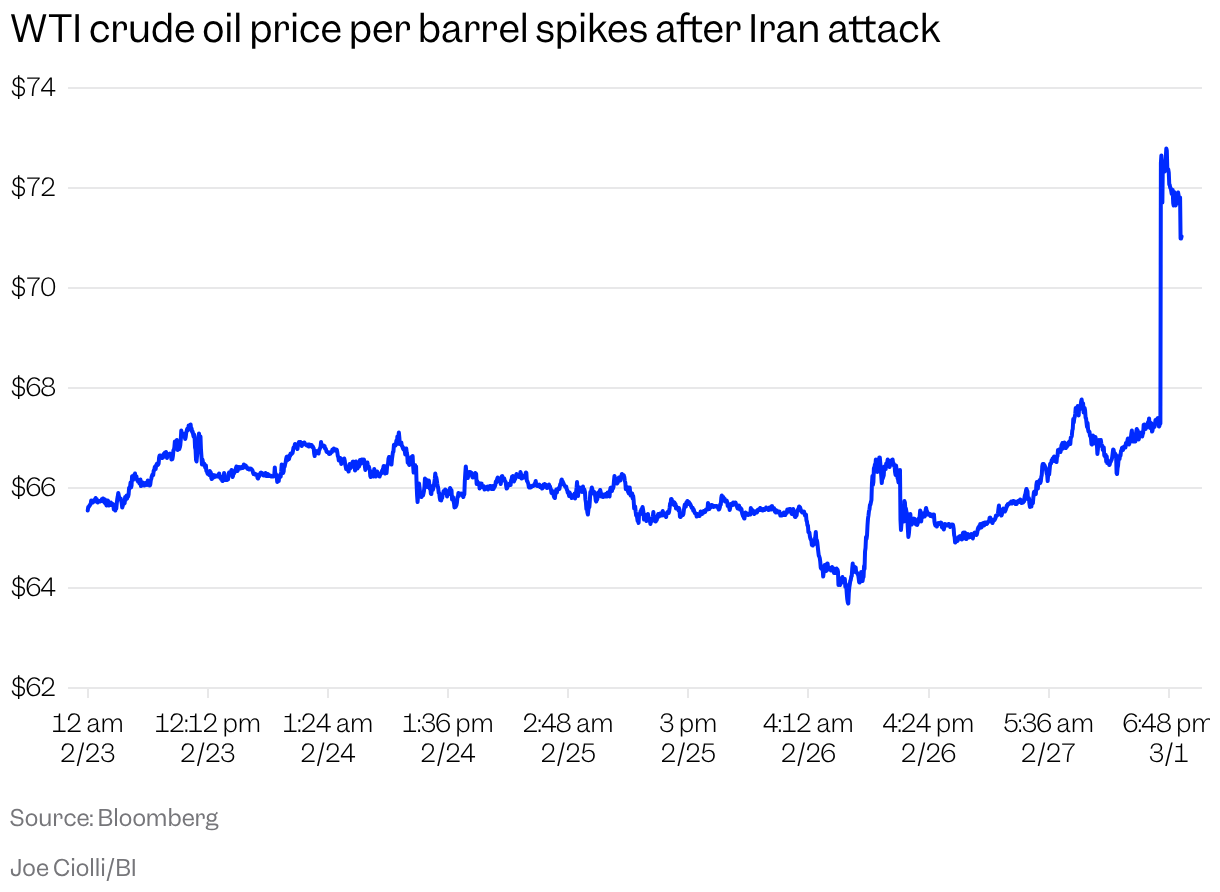
Oil traders are bracing for disruptions to the Strait of Hormuz after the US and Israel struck Iranian targets over the weekend, putting at risk the waterway that carries about one-fifth of the world’s oil.

A longer disruption would shift the risk onshore, because storage tanks across the Gulf can only be filled for only so long.

If the conflict drags on and export routes remain blocked, producers could be forced to halt production as storage fills up, Daan Struyven, the head of oil research at Goldman Sachs, said on Goldman Sachs’ “Exchanges” podcast published Monday. This could send prices sharply higher.

“If the Strait of Hormuz is closed for a very long time, you cannot draw inventories forever, and the market may have to rebalance by incentivizing prices to such high levels that you generate demand destruction,” Struyven added.

Oil prices are already sharply higher this year on the back of heightened geopolitical risks.

International benchmark Brent and US West Texas Intermediate crude oil futures are 3% and 2.4% higher at around $80 and $73 per barrel, respectively, in early trade on Tuesday. Both grades are up about 30% this year.

The Middle East accounts for about one-third of the world’s seaborne crude.

“Gulf producers do have storage capacity, pipelines, and tanker alternatives, but these are not unlimited,” wrote Chris Weston, the head of research at Pepperstone, in a Tuesday note.

“With the Strait of Hormuz temporarily constrained, the longer the disruption persists, the greater the risk that additional facilities and infrastructure across the Gulf region may be forced offline,” Weston added.

JPMorgan analysts have also warned that if the strait is effectively closed for more than 25 days, storage constraints could push major Middle East producers to suspend output altogether.

‘A supply shock of historic proportions.’

Iran’s Revolutionary Guards said on Monday that the Strait of Hormuz is closed and they will attack any ship trying to cross the waterway.

Major lines are rerouting or suspending services and adding war-risk fees, while some marine insurers have canceled war-risk cover for vessels operating in and around Iranian waters.

Apart from oil, Qatar’s state-owned energy company has halted liquefied natural gas production after reported damage to facilities, underscoring how quickly disruptions can spill beyond crude into wider energy markets.

The macro consequences could be severe, wrote analysts at ING on Monday, as even a partial disruption to the Hormuz would produce “a supply shock of historic proportions.”

However, because the US is a major oil producer, higher oil prices benefit shale producers and improve the domestic energy industry.

Still, inflation could tick up for American consumers, so “that balance is politically awkward to explain and economically insufficient to compensate for the broader damage,” wrote ING analysts.


Source link

Dan DeFrancesco

Despite the setback, the president isn’t backing down.

Call it De-Liberation Day.

The Supreme Court blocked a significant chunk of President Donald Trump’s sweeping tariff policy on Friday. But instead of closing the chapter, it’s opened an entirely new book that no one seems to understand.

Let’s break it down:

Return of the tariffs. Despite the setback, the president isn’t backing down. This weekend, he announced plans to impose a 15% “worldwide” tariff. That’s thanks to Section 122, which allows him to briefly implement tariffs broadly. However, they can only remain in place for up to 150 days. Ultimately, he’ll likely need to work with Congress for something more permanent.

The refund issue. One of the biggest questions is what happens to the $133 billion in taxes collected from the struck-down tariffs. More than a thousand companies preemptively filed lawsuits to claw back that money.

The process isn’t as simple as the US government cutting a check. It’s bound to get messy and involve lots of lawyers. Companies will also need to weigh the benefits of fighting for a refund against the risks of angering the current administration.

Some Democrats are calling on the administration to issue $1,700 refunds directly to Americans. Shoppers shouldn’t expect the ruling to mean prices are coming down soon, Goldman Sachs says.

Market reaction. It’s a double-edged sword for investors. The ruling is likely to set a legal precedent that’ll make it harder for the administration to impose larger tariffs than before. That’s good for most businesses. Companies hit with tariffs could also get refunds, which would serve as a nice cash infusion.

On the other hand, lowering tariffs and the revenue they generate puts the spotlight firmly on the federal government’s growing pile of debt. That could push bond yields higher and weigh on stocks.

Jefferies mapped out some consumer stocks that could benefit.

The broader economic impact. Since tariffs will remain in some form, it’s tough to make a definitive statement. However, the most recent data from the past year shows a clear trend: The economy is growing, but not everyone is benefiting.

It’s worth considering that a lot of the dire economic predictions people had about Trump’s policies haven’t materialized. A think tank offered reasons that’s the case.

So who comes out on top? Even with so much still up in the air, we identified some potential winners and losers from the latest shake-up. (Hint: Lawyers are going to be just fine.) Meanwhile, many COOs are likely pulling out their hair from the tariff whiplash affecting their supply chains.

We’ll get more clarity on Tuesday night during Trump’s first State of the Union of his second term. Just don’t expect a warm welcome for some of the Supreme Court justices.


Source link

Amanda Goh

The newest villain in ‘Toy Story’ isn’t a toy — it’s screen time

When “Toy Story” premiered in 1995, the enemy was plastic. In its latest chapter, it’s pixels.

More than 30 years after Woody worried about being replaced by Buzz Lightyear, the franchise is ready to take on a bigger threat: the screen.

The official trailer for “Toy Story 5” was released on Thursday and shows the toys vying for Bonnie’s attention against a frog-themed tablet named Lilypad. Bonnie is the young girl to whom Andy gave his toys when he left for college at the end of “Toy Story 3.”

In the clip, Bonnie receives the device in a package and is almost instantly absorbed, scrolling and tapping with a glazed look as her analog toys watch from the sidelines.

It all builds to a face-off between Jessie the cowgirl doll and Lilypad. Jessie says, “You’re not even listening to me,” only for the tablet to coolly reply, “I’m always listening.”

Jessie, voiced by Joan Cusack, has been in charge since Woody left at the end of “Toy Story 4.” Now, as Bonnie’s attention drifts elsewhere, the gang brings their old — and now balding — leader back.

“I don’t know, Jessie,” Woody says in the trailer. “Toys are for play, but tech is for everything.”

The film is set to be released on June 19, with Tom Hanks and Tim Allen returning to voice Woody and Buzz, respectively.

The storyline taps into a broader debate playing out in real life, as parents and experts wrestle with how screens are reshaping childhood.

Too much screentime has been linked to delays in social skills development, as well as problems with attention and behavior. Those concerns have prompted some governments to move toward banning social media use for children under 16.

The last installment in the Pixar franchise, “Toy Story 4,” was released in 2019. It surpassed $1 billion at the global box office and won an Oscar for best animated feature.


Source link

photo-of-Ana-Altchek

Salesforce exec shares the advice he gives entry-level talent: ‘Hard isn’t necessarily bad.’

As companies rethink how they train early-career workers in a job market shaped by AI, Salesforce executive Andy White said resilience is top of mind for him — both at work and at home.

White oversees Salesforce’s implementation of Slackbot, an AI personal agent that generates responses based on conversations, files, and workflows inside Slack.

As White raises his son and daughter during a period of rapid technological change, he said he preaches to his kids the importance of powering through moments that don’t go as planned. He said resilience is pivotal and that it’s important for people to focus on doing the hard things and being OK when things don’t go as expected.

The senior vice president of business technology said he recently spoke with his daughter about the importance of dealing with situations rather than merely labeling them as “good” or “bad.”

“Hard is hard,” White told Business Insider. “Hard isn’t necessarily bad.”

Expectations, he said, are the “destroyer of hope and joy,” and that when things don’t go as planned, it often turns out to be a good thing down the line, even if it doesn’t seem that way in the moment.

“It’s when we look back, and it’s like, ‘Oh man, I’m glad that didn’t go the way I expected,'” White said. “But when you’re in it, it’s really hard.”

The importance of persistence

The resilience lesson is one White also thinks is relevant for entry-level workers. While junior hires often arrive ready to use new tools and deliver a “pretty high output,” he said, persistence is an area where some still need to grow.

He described today’s entry-level talent pool as “incredibly capable, very bright, and very driven,” with a stronger grasp of how to use AI tools to solve problems.

“They’re much more fluent at being able to leverage AI tooling in the flow of their work,” White said.

However, he said the group sometimes struggles when it comes to working through challenges.

“There’s more willingness to give up sooner,” he said, adding that this trait doesn’t apply across the board.

Finding confidence

White said he’s seen AI tools, such as the company’s recently upgraded Slackbot, help boost entry-level workers’ confidence. He said they could help reduce feelings of imposter syndrome by helping early-career workers navigate challenging situations that arise at work.

With that said, White added that workers need to stay balanced and not let tools make them “overly confident.” He said workers need to bring skepticism to “any kind of information” they get, and be diligent about reviewing sources and citations when using AI.

“If you don’t believe something, read the citation, and if it doesn’t have a citation, you have to assume it’s a hallucination,” White said, adding that he tells his kids the same thing.


Source link

Solopreneurs-explain-what-AI-is-and-isnt-good-for-when.jpeg

Solopreneurs explain what AI is and isn’t good for when you’re running a business

Over eight years of writing for travel publications, Kim Magaraci developed a passion for domestic travel. She learned that travel tips online couldn’t compete with those destinations you could only discover by word-of-mouth.

So, when she founded her travel business, KGM Travel Design, in 2024, she hoped to emphasize personal relationships with vendors and customers and avoid using AI, despite her experience with it.

“I don’t think you can get good advice asking ChatGPT for an itinerary,” she says. “It’s antithetical to everything I stand for.”

And yet, Magaraci realized that using AI for administrative tasks like analytics, compiling reports, and generating condensed client briefs allowed her to spend more time on the personalized relationships that set her business apart.

She’s one of many solopreneurs who told Business Insider that outsourcing administrative tasks to AI platforms such as ChatGPT, Gemini, and Nano Banana — Gemini’s photo-editing AI — has allowed them to scale their business by spending more time on strategic and creative work, including growth decisions and building personal connections with customers.

“It’s getting harder and harder to deny the time-saving aspects,” Magaraci says, adding that she has embraced AI “in order to run a successful business and grow this business into what I want it to be.”

AI supports growth by creating more free time, solopreneurs say

Seneca Connor, founder of The Bag Icon, an accessories brand, uses Nano Bana and other AI products to edit photos and videos. That not only saves her money — up to $2,000 per monthly photo shoot, she says — but also time.


Seneca Connor

Seneca Connor is the founder of The Bag Icon.

Ian Tuttle for BI


With the hours saved, Connor has been able to design more original bags and launch a greater number of bags curated from other designers, all while reducing her marketing costs.

As a result, The Bag Icon saw more than a 20% year-over-year increase in profits last year, despite the impact of tariffs.

Accountant and solopreneur Gloria Hebert uses ChatGPT for her business, Aybear Services, to instantly create educational client worksheets that previously took an hour or two to set up.

This frees up time that she then uses to prioritize analyzing financial data from her bookkeeping clients — data she doesn’t feed into AI because of privacy concerns. Managing finances is the core of her business, so having more time to spend on that has allowed her to streamline her workdays.


Gloria Herbert

Gloria Hebert is an accountant and the founder of Aybear Services.

Stephe Ross Goldstein for BI


The time saved also allows her to organize networking events and community education classes for local business owners, which has led to an uptick in business. “Several of those entrepreneurs hired me to do their books,” Hebert says.

AI allows more time for personalized communications, which build brand following

Lisa York is the owner of Sell More Stuff, an email marketing business. Although she has a small audience, she saw a 33% conversion rate for sales last year, she says. She credits that growth to her personalized, voicey emails, which always open with a personal anecdote and are never written with AI.

“I use a lot of story-led emails,” York says. “People enjoy them, and they open the email because they can see my name.”

That’s something AI just can’t replicate, she says. But York is able to spend time drafting engaging copy because she outsources other tasks — including tech support for her website, research, and brainstorming marketing strategy — to ChatGPT.


Lisa York

Lisa York is the founder of Sell More Stuff.

David Oates for BI


Like York, Connor uses the time that AI saves to build robust communication and rapport with her customers, which she says builds loyalty to her business. Less time spent on photos and video gives her more time to respond to emails and direct messages from clients seeking advice about their purchases.

“It’s building community that’s missing in the big brands,” Connor says.

AI frees up time so solopreneurs can focus on their business’s core

While AI has allowed these solopreneurs to grow their businesses without hiring a team, the technology shouldn’t take over the core aspects of a business, Hebert says. Rather, it can be a tool that allows owners to focus on those critical areas.

“Use it as a resource,” she says.

York — whose target clientele are other solopreneurs — says she’s seeing more people recognize that. “People aren’t scared of it anymore,” she says.


Seneca Connor

Seneca Connor emphasizes that while she uses AI, all thoughts, ideas, and suggestions she shares with her clients are her own.

Ian Tuttle for BI


Connor plans to expand her use of AI this year. She’s experimenting with a digital clone — a video avatar that can deliver a script explaining new products. That approach will save her time on filming videos, but she says she’ll always be the one dishing out the original advice that her clients have come to trust.

Even if a video is created using AI, Connor says, “all thoughts, ideas, and suggestions — those are my own.”


Source link

Chinas-economic-slump-isnt-stopping-a-billionaire-boom-in-AI.jpeg

China’s economic slump isn’t stopping a billionaire boom in AI chips

China’s deepening property crisis has crushed household wealth and dented the fortunes of some of its biggest tycoons — but a new class of AI-era billionaires is rising fast.

This year, the standout winners are coming from China’s red-hot AI chip sector.

On Wednesday, shares of MetaX Integrated Circuits Shanghai — a GPU startup founded by former AMD executives — skyrocketed as much as 755% on their first day of trading on the Shanghai Stock Exchange’s tech-focused STAR Market, before closing up about 700%.

The surge catapulted its chairman and cofounder, Chen Weiliang, into one of China’s fastest-rising tech moguls. Chen’s stake in MetaX is worth about $6.5 billion, according to the Bloomberg Billionaires Index.

Other early insiders also saw eye-popping paper gains.

MetaX’s other two cofounders and co-chief technology officers, Peng Li and Yang Jian, hold stakes worth hundreds of millions of dollars after the blockbuster debut, according to Bloomberg’s calculations.

China’s AI rush

Chen’s rise follows that of another GPU entrepreneur, Zhang Jianzhong, the founder and CEO of Moore Threads Technology.

Earlier this month, Zhang’s net worth jumped to $4.3 billion after his company’s successful IPO, continuing a wave of investor enthusiasm for homegrown semiconductor players.

The richest figure in China’s AI chip scene is Chen Tianshi, a cofounder and CEO of Cambricon Technologies — a company retail traders have dubbed “China’s Nvidia.”

Cambricon’s Chen is now worth $22.5 billion, making him the country’s 16th-richest individual on Bloomberg’s list. He is the 115th richest person in the world.

These new fortunes reflect a sharp shift in investor sentiment.

Chinese AI and semiconductor stocks have been on a tear since the breakout of the China-made DeepSeek-R1 AI model released in January. The model helped spark a rally in local tech names and pushed the Hang Seng Tech Index up more than 20% so far this year.

Washington’s tightening export controls on advanced Nvidia chips also contributed to the boom.

Such restrictions on high-end AI processors have choked China’s access to cutting-edge US hardware and pushed Beijing to lean harder on domestic suppliers.

Still, China’s new AI billionaires remain far from the top of the country’s wealth rankings. The upper tier is still dominated by long-established tycoons.

In the top spot is Zhong Shanshan, the low-key bottled-water magnate behind Nongfu Spring, with a fortune of $68.1 billion, per Bloomberg.

Pony Ma, a cofounder and CEO of Tencent, ranks second with $66.5 billion — a fortune up 38% this year, on the heels of Tencent’s AI-induced rally — while ByteDance cofounder Zhang Yiming comes in third with $65.2 billion.


Source link