

Even-blue-collar-work-isnt-safe-from-AI-a-CEO-who.jpeg

Even blue-collar work isn’t safe from AI, a CEO who makes tech for electricians and plumbers says

Artificial intelligence may be disrupting office jobs first, but blue-collar workers shouldn’t assume they’re immune.

Fred Voccola, CEO of Simpro Group — which builds software for use by tradespeople — said that early AI adoption has largely focused on white-collar roles, but he believes the same forces will increasingly reshape physical work, from electricians to construction crews.

“The hammer will strike first and hardest in the white-collar world,” he said in an interview with Business Insider in London this week. “White collar work is already being disrupted.”

He pointed to one of his own companies, whose content marketing team head count was cut from 17 to 2 people in one year, while still producing more content due to AI.

For now, he said, skilled trades remain relatively insulated because their work is hands-on and harder to automate, but that advantage won’t last.

“I think the trades, if I am an electrician or a plumber or an HVAC person, I’m among the most protected, but that protection lasts only for a limited amount of time,” he said.

“I think that there will be fewer jobs in the blue collar industry as well, every industry in the world, over time, if we’re talking 10 years, 100%, it’s gonna impact everyone,” he added.

‘Quicker, faster, cheaper, and safer’

The next phase of disruption, Voccola said, will come from a mix of AI-powered software and robotics, including tools his own company is developing.

“We have robotic technology,” Voccola said, pointing to use cases such as cabling, inspections, and rescue efforts, where robots could increasingly support human workers.

“This is something that’s coming out of our lab, probably end of this calendar year,” he added.

That shift is already reshaping parts of the labor market, with companies like Instawork using gig workers to generate the real-world data needed to train robots.

Some manufacturers like Aquant and Gecko Robotics are deploying AI-powered robotics and sensors to detect equipment failures before they happen, helping avoid costly breakdowns and improve efficiency.

Voccola pointed to more use cases where he believes machines could outperform humans, including wiring data centers, inspecting infrastructure, and navigating tight or hazardous environments.

“Cabling, going through — instead of digging up all the infrastructure plumbing — sending little nanobots and robotics to see where the problems are, a lot of discovery of things, a lot of electrical testing. These are things that robots can do quicker, faster, cheaper, and safer,” he said.

A Simpro spokesperson told Business Insider the company is “actively working on the technologies discussed,” but declined to share further details.

“This isn’t about replacing experienced technicians, but about helping them get more done, more efficiently,” the spokesperson added.

Still, Voccola said he expects robotics to move into the mainstream within 2 to 3 years and to take over at least 50% of trades tasks within 10 years.

Even so, he acknowledged the uncertainty ahead. The speed and scale of AI-driven change, he said, is unlike anything seen before — and raises difficult questions about the future of work.

“I think it’s scary,” he said.

Blue-collar isn’t immune

Voccola’s outlook contrasts with a growing view among tech leaders and researchers that blue-collar work may be more resilient and more valuable in the age of AI.

A recent Harris Poll released in February found that 76% of Americans believe jobs that rely on hands-on experience are less likely to be replaced by AI.

Some of the most prominent voices in tech have echoed that sentiment.

Elon Musk has said jobs involving physical labor will “exist for a much longer time” than digital roles, while Nvidia CEO Jensen Huang has said that the AI boom could increase demand for skilled tradespeople building the infrastructure behind it.

That demand is already emerging. Meta president Dina Powell McCormick recently said the US will need hundreds of thousands of electricians in the coming years to build out AI infrastructure.

Voccola didn’t dispute that demand may rise in the short term, but he said, over time, the same forces reshaping office work will extend to the physical world — and no job category will be fully insulated.



Source link

Line chart

The Middle East crisis isn’t just about tankers — oil output could be forced offline next

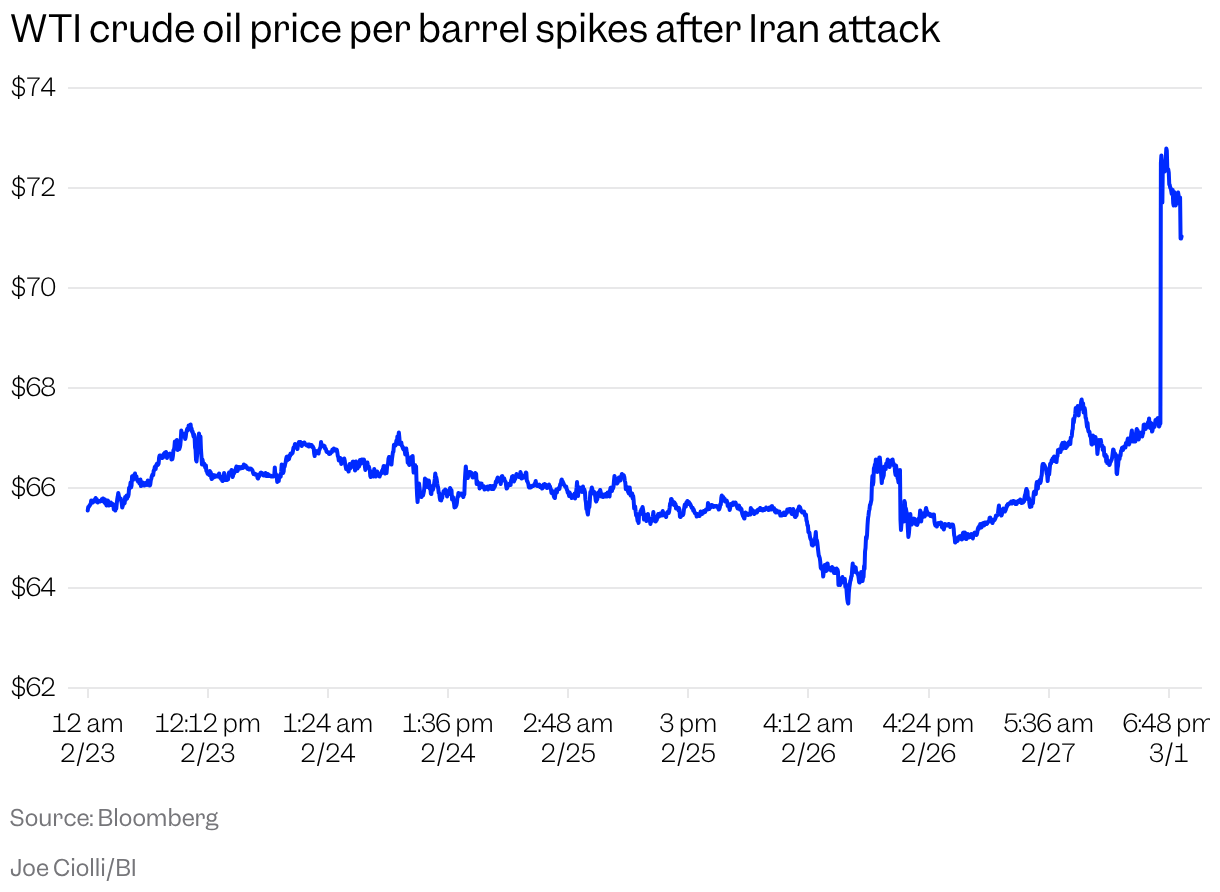
Oil traders are bracing for disruptions to the Strait of Hormuz after the US and Israel struck Iranian targets over the weekend, putting at risk the waterway that carries about one-fifth of the world’s oil.

A longer disruption would shift the risk onshore, because storage tanks across the Gulf can only be filled for only so long.

If the conflict drags on and export routes remain blocked, producers could be forced to halt production as storage fills up, Daan Struyven, the head of oil research at Goldman Sachs, said on Goldman Sachs’ “Exchanges” podcast published Monday. This could send prices sharply higher.

“If the Strait of Hormuz is closed for a very long time, you cannot draw inventories forever, and the market may have to rebalance by incentivizing prices to such high levels that you generate demand destruction,” Struyven added.

Oil prices are already sharply higher this year on the back of heightened geopolitical risks.

International benchmark Brent and US West Texas Intermediate crude oil futures are 3% and 2.4% higher at around $80 and $73 per barrel, respectively, in early trade on Tuesday. Both grades are up about 30% this year.

The Middle East accounts for about one-third of the world’s seaborne crude.

“Gulf producers do have storage capacity, pipelines, and tanker alternatives, but these are not unlimited,” wrote Chris Weston, the head of research at Pepperstone, in a Tuesday note.

“With the Strait of Hormuz temporarily constrained, the longer the disruption persists, the greater the risk that additional facilities and infrastructure across the Gulf region may be forced offline,” Weston added.

JPMorgan analysts have also warned that if the strait is effectively closed for more than 25 days, storage constraints could push major Middle East producers to suspend output altogether.

‘A supply shock of historic proportions.’

Iran’s Revolutionary Guards said on Monday that the Strait of Hormuz is closed and they will attack any ship trying to cross the waterway.

Major lines are rerouting or suspending services and adding war-risk fees, while some marine insurers have canceled war-risk cover for vessels operating in and around Iranian waters.

Apart from oil, Qatar’s state-owned energy company has halted liquefied natural gas production after reported damage to facilities, underscoring how quickly disruptions can spill beyond crude into wider energy markets.

The macro consequences could be severe, wrote analysts at ING on Monday, as even a partial disruption to the Hormuz would produce “a supply shock of historic proportions.”

However, because the US is a major oil producer, higher oil prices benefit shale producers and improve the domestic energy industry.

Still, inflation could tick up for American consumers, so “that balance is politically awkward to explain and economically insufficient to compensate for the broader damage,” wrote ING analysts.


Source link

Dan DeFrancesco

Despite the setback, the president isn’t backing down.

Call it De-Liberation Day.

The Supreme Court blocked a significant chunk of President Donald Trump’s sweeping tariff policy on Friday. But instead of closing the chapter, it’s opened an entirely new book that no one seems to understand.

Let’s break it down:

Return of the tariffs. Despite the setback, the president isn’t backing down. This weekend, he announced plans to impose a 15% “worldwide” tariff. That’s thanks to Section 122, which allows him to briefly implement tariffs broadly. However, they can only remain in place for up to 150 days. Ultimately, he’ll likely need to work with Congress for something more permanent.

The refund issue. One of the biggest questions is what happens to the $133 billion in taxes collected from the struck-down tariffs. More than a thousand companies preemptively filed lawsuits to claw back that money.

The process isn’t as simple as the US government cutting a check. It’s bound to get messy and involve lots of lawyers. Companies will also need to weigh the benefits of fighting for a refund against the risks of angering the current administration.

Some Democrats are calling on the administration to issue $1,700 refunds directly to Americans. Shoppers shouldn’t expect the ruling to mean prices are coming down soon, Goldman Sachs says.

Market reaction. It’s a double-edged sword for investors. The ruling is likely to set a legal precedent that’ll make it harder for the administration to impose larger tariffs than before. That’s good for most businesses. Companies hit with tariffs could also get refunds, which would serve as a nice cash infusion.

On the other hand, lowering tariffs and the revenue they generate puts the spotlight firmly on the federal government’s growing pile of debt. That could push bond yields higher and weigh on stocks.

Jefferies mapped out some consumer stocks that could benefit.

The broader economic impact. Since tariffs will remain in some form, it’s tough to make a definitive statement. However, the most recent data from the past year shows a clear trend: The economy is growing, but not everyone is benefiting.

It’s worth considering that a lot of the dire economic predictions people had about Trump’s policies haven’t materialized. A think tank offered reasons that’s the case.

So who comes out on top? Even with so much still up in the air, we identified some potential winners and losers from the latest shake-up. (Hint: Lawyers are going to be just fine.) Meanwhile, many COOs are likely pulling out their hair from the tariff whiplash affecting their supply chains.

We’ll get more clarity on Tuesday night during Trump’s first State of the Union of his second term. Just don’t expect a warm welcome for some of the Supreme Court justices.


Source link