

Jack Newsham's face on a gray background.

Polymarket let people bet on when Iran would strike Israel. A journalist who covered the war got death threats.

An Israeli journalist said Polymarket users tried to bribe him and threatened to kill him after he reported that an Iranian missile had struck Israel earlier this month.

Polymarket later condemned the harassment and said the conduct violated its rules.

“We’ve banned the accounts for all involved & will pass their info to the relevant authorities,” the company wrote on X.

Emanuel Fabian, a military correspondent for The Times of Israel, wrote this week that the harassment began with emails pressing him to revise a blog post saying a missile hit an area roughly 500 meters from homes in Beit Shemesh, a small city in central Israel.

The initial outreach, written in Hebrew, was polite, Fabian wrote. “Regarding your Times of Israel report that described today’s launch as an ‘impact’ — Beit Shemesh Municipality and MDA (Magen David Adom) later corrected their reports to clarify that what fell was an interceptor fragment, not a full missile,” the first email said, referring to an Israeli emergency-response service.

Follow-up messages from others were more insistent. “I have an urgent request regarding the accuracy of your report on the missile attack on March 10. I would really appreciate a response if possible,” read one.

Fabian wrote that he stood by the reporting, citing Israeli military information and video of a large explosion that, in his view, was inconsistent with interceptor debris.

What followed, he said, was a pressure campaign that spilled across email, X, Discord, WhatsApp, and backchannel outreach through another journalist.

Fabian described repeated requests to change the wording of his report, which he believed was intended to influence the resolution of a Polymarket market tied to whether Iran struck Israel on that date. He said some messages — which didn’t explicitly mention Polymarket, but came from Polymarket users or seemed bizarrely hung up on his blog post — escalated into explicit threats.

“If you do not correct this by 01:00 Israel time today, March 15, you are bringing upon yourself damage you have never imagined you would suffer,” read one.

Fabian wrote that he went to the police and provided evidence.

Polymarklet didn’t answer questions from the Times of Israel about the details of the investigation. Representatives for Polymarket didn’t immediately respond to Business Insider’s request for comment.

Advocates for prediction markets have said they encourage honesty by requiring users to put their money where their mouth is. Shayne Coplan, Polymarket’s founder, has said that people in the Middle East can use military-strike markets to decide whether they want to sleep near a bomb shelter.

The nitty-gritty details of contracts and how they are resolved can lead to contentious arguments. People on Polymarket who wagered on whether Iran would strike Israel by March 10 still haven’t gotten paid, as the contract appears to remain in dispute. Polymarket, which is legally based in Panama, uses a complex, crypto-based process to resolve disagreements.

Fabian isn’t the first person to say they were targeted by prediction market users. The NCAA has cited concerns with prediction markets, reporting that 36% of Division I men’s basketball players said they had been harassed by “someone with a betting interest.”

In January, the organization called for a pause on college sports-related betting prediction market betting until the Commodity Futures Trading Commission, which regulates the platforms, “implements appropriate regulations.”

Polymarket was valued at $9 billion last year and is seeking a $20 billion valuation in talks with investors, The Wall Street Journal reported earlier this month. The company and its competitor, Kalshi, have poured millions of dollars into marketing online, on TV, and in real life, even giving people free groceries in New York City.

The largest chunk of activity on both platforms is betting on sports in a manner that competes with companies like DraftKings, BetMGM, and other traditional sportsbooks. The second-biggest category is speculating on cryptocurrency prices.

Business Insider has previously reported that Polymarket has drawn scrutiny from US lawmakers over concerns about manipulation, insider trading, and the difficulty of investigating crypto-based bets.

Sen. Chris Murphy and Rep. Greg Casar announced Tuesday that they will introduce the “Bets Off Act,” which would ban certain prediction market trades, including terrorism, war, and assassinations.

The attacks on Iran are only one of several geopolitical flashpoints that have been accompanied by concern about the prospect of people with insider information cashing in. One Polymarket user made several hundred thousand dollars correctly betting on the US operation to remove Venezuela’s leader, Nicolas Maduro.



Source link

Israel-says-an-F-35-shot-down-an-Iranian-jet-in.jpeg

Israel says an F-35 shot down an Iranian jet in air-to-air combat, a first for the stealth fighter

An Israeli F-35 just scored the stealth fighter jet’s first-ever air-to-air combat victory against a crewed aircraft.

An F-35I “Adir” shot down an Iranian Air Force Yak-130 over Tehran, marking its “first shootdown in history of a manned fighter aircraft,” the Israeli military said in a statement on Wednesday.

Lockheed Martin’s F-35 Lightning II entered service in 2015 and is operated by around a dozen countries, including Israel, which fields its own variant of the fighter jet called the “Adir.”

The F-35 has intercepted missiles and drones in combat in the Middle East, but it had never shot down a crewed jet — until now. The incident also marks the first time in more than 40 years that Israeli fighters have downed a crewed enemy aircraft.

The Yakovlev Yak-130, which NATO calls the “Mitten,” is a subsonic twin-seater light combat aircraft that also serves as a training jet. Russia has built hundreds of these planes, which entered service in 2010. Several have been delivered to Iran.


An Israeli Air Force F-35I Adir takes off for a mission during Red Flag-Nellis 23-2 at Nellis Air Force Base, Nevada, March 20, 2023.

Israel operates its own variant of the F-35 called the “Adir.”

US Air Force photo by William R. Lewis


Since the start of operations on Saturday, Israeli fighter jets have bombed targets across Iran, hitting air defense systems, missile launchers, and military facilities across the country. Hundreds of people have been killed, including dozens of military and government officials, as well as Iranian Supreme Leader Ayatollah Khamenei.

Israeli F-35s are operating in the Middle East alongside US and British F-35s. The UK Ministry of Defense said Monday that Royal Air Force F-35s shot down drones over Jordan, marking the first time one of its stealth fighters has destroyed a hostile target in combat.

American F-35 fighters are one of many US combat aircraft participating in the operations against Iran, including other stealth fighters, electronic attack jets, surveillance planes, airlifters, refueling tankers, and bombers.

US Central Command, which oversees Middle East operations, said on Monday that American forces have bombed more than 1,700 targets in Iran since the strikes began on Saturday.

The US military has targeted Iranian command and control facilities, air defense systems, ballistic missile sites, naval infrastructure, and communications capabilities.


Source link

Israel-struck-Iran-with-F-35I-Adir-stealth-fighter-jets-that.jpeg

Israel struck Iran with F-35I Adir stealth fighter jets that cost $44,000 per hour to fly

Updated

  • Israeli Air Force F-35I planes struck Iranian missile systems and military leaders on Saturday.
  • The Israeli F-35 variant is known as “Adir,” meaning “Mighty One” in Hebrew.
  • The planes also struck Iran in June and aided defenses against Iranian missiles in 2023 and 2024.

Israel launched what it called “the most extensive aerial operation ever conducted by the Israeli Air Force” on Saturday, targeting Iranian missile systems and military leaders in tandem with US forces. Israel’s F-35I stealth fighter jets were on the front lines.

The Israeli variant of the US-made Lockheed Martin Lightning II Joint Strike Fighter plane is known as “Adir,” meaning “Mighty One” in Hebrew. With advanced stealth capabilities and a customized electronic warfare system, the F-35I is one of the most powerful tools in Israel’s air defense arsenal.

In addition to Israel’s newest assault on Iran, the Israeli planes also conducted preemptive strikes against Iran’s nuclear program in June, intercepted hundreds of drones, missiles, and rockets fired by Iran in a retaliatory attack in 2024, and took down a missile fired by an Iran-backed group in Yemen in 2023, according to the Israel Defense Forces.

Here’s a closer look at the “Mighty One” military aircraft.

F-35 Lightning II stealth fighter jets, produced by Lockheed Martin, are some of the most advanced military aircraft in the world.

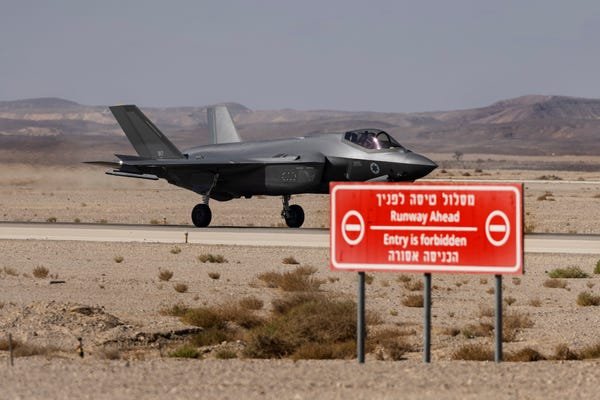
An Israeli F-35I lands at Ovda airbase near Eilat, southern Israel.

Tsafrir Abayov/AP

The F-35 stores its weapons and fuel internally, and its aligned edges and radar-absorbent coating also help the aircraft evade detection. The planes cost $44,000 per hour to fly, The National Interest reported.

They feature advanced stealth and information-processing capabilities and can reach supersonic speeds of Mach 1.6, or 548.8 meters per second.


An Israeli Air Force F-35I Adir multirole fighter aircraft

An Israeli Air Force F-35I Adir fighter aircraft flies over the Negev Desert.

YURI CORTEZ/AFP via Getty Images

Lockheed Martin CEO Marillyn A. Hewson said in 2018 that the planes “can fly in what we call ‘beast mode,‘ carrying up to 18,000 pounds of internal and external ordnance, in a mix that can include 5,000-pound-class weapons.”

In 2016, Israel became the first country other than the US to acquire F-35 fighter jets.


Israeli Prime Minister Benjamin Netanyahu stands next to a F-35 fighter jet just after it landed in Israel at Nevatim air base  in 2016

Israeli Prime Minister Benjamin Netanyahu stands next to an F-35 fighter jet just after it landed in Israel at Nevatim air base.

Amir Cohen/Reuters

Israel was the first country to select the model through the US Foreign Military Sales process and bought 50 planes, according to Lockheed Martin.

Israel has made significant modifications to the jets.


A new production line for F-35 wings is seen in Israel Aerospace Industries' (IAI) campus, near Tel Aviv

A production line for F-35 wings in Israel Aerospace Industries’ (IAI) campus near Tel Aviv.

Amir Cohen/Reuters

Israel manufactures its own wings and electronic warfare system for the F-35I. It also developed its own version of the high-tech helmet that displays the plane’s airspeed, altitude, targeting information, and other crucial stats directly on the pilot’s visor.

The Israeli Air Force named its F-35I variant “Adir,” meaning “Mighty One” in Hebrew.


Israeli Air Force technicians customize an F-35I plane with a Star of David symbol.

Israeli Air Force technicians customize an F-35I plane with a Star of David symbol.

Israeli Air Force

The Israeli Air Force also added a six-pointed Star of David to the design, a Jewish symbol that also appears on the Israeli flag.

In 2018, Israel became the first country to use the F-35I in combat, its air force chief said.


An Israeli Air Force F-35 flies during an aerial demonstration

Israeli Air Force F-35 flies during an aerial demonstration.

Amir Cohen/Reuters

“We are flying the F-35 all over the Middle East and have already attacked twice on two different fronts,” then-Israeli Air Force chief Major-General Amikam Norkin said in a speech at a gathering of foreign air force leaders, Reuters reported.

In July 2023, Israel acquired an additional 25 Adir planes in a $3 billion deal.


Israeli F-35I planes at Nevatim airbase in Israel.

Israeli F-35I planes.

Israeli Air Force

The deal was financed through the military aid Israel receives from the US, Reuters reported.

In November 2023, Israel’s F-35I Adir fighter jets took down a missile fired by an Iran-backed group in Yemen, according to the IDF.


An Israeli F-35 fighter jet

A F-35I fighter jet flies during a graduation ceremony for Israeli Air Force pilots in southern Israel.

Amir Cohen/Reuters

It was the first known intercept of a cruise missile by an F-35 plane.

The Israeli Air Force released footage of the encounter on X, writing in Hebrew that its personnel are “preoccupied at every moment with planning and managing the defense response and are prepared for any threat in any area.”

Iran appeared to target the Nevatim air base, which houses Israel’s fleet of F-35I jets, during an attack in April 2024.


An Israeli F-35 combat aircraft is seen in the skies over Israel's border with Lebanon

An Israeli F-35 combat aircraft in the skies over Israel’s border with Lebanon.

Ammar Awad/Reuters

Out of the over 350 ballistic missiles, cruise missiles, and UAVs, or unmanned aerial vehicles, launched at Israel by Iran and its proxies in Iraq, Yemen, and Lebanon, around 99% were intercepted by Israel and its allies. The IDF released photos showing minor damage near a runway at the Nevatim Airbase and to a road in Hermon caused by the few projectiles that landed.

The missiles appeared to target Israel’s Nevatim Airbase in the Negev desert, which houses its fleet of F-35I stealth fighter jets. The base remained operational throughout the attack, according to the IDF, with the Adir fighter jets aiding the defensive mission.

“Iran thought it would be able to paralyze the base and thus damage our air capabilities, but it failed,” IDF spokesperson Rear Adm. Daniel Hagari said in a statement.

In June 2025, the Israeli Air Force launched around 200 fighter jets, including F-35Is, in a preemptive strike targeting Iran’s nuclear program.


An F-35I Israeli fighter jet used in strikes against Iran.

An F-35I Israeli fighter jet used in strikes against Iran.

Israel Defense Forces

An IDF spokesperson said that Israeli fighter jets struck over 100 sites across Iran to prevent it from developing a nuclear weapon, including military targets and its largest uranium enrichment site in Natanz.

The IDF said that Iran’s nuclear program had “accelerated significantly” in recent months and called it “clear evidence that the Iranian regime is operating to obtain a nuclear weapon.” Iran maintains that its nuclear program is solely for civilian purposes.

“This is a critical operation to prevent an existential threat by an enemy who is intent on destroying us,” Lt. Gen. Eyal Zamir, the IDF’s Chief of the General Staff, said in a statement.

The IDF released photos showing planes used in the large-scale operation, including F-35I jets.

F-35Is struck Iran over the weekend in what the IDF called “the largest military flyover in Israeli Air Force history.”


US and Israeli F-35s flying together during a training exercise.

US and Israeli F-35s flew together during a training exercise. The two countries launched new strikes against Iran using land, air, and sea assets.

U.S. Air Force photo by Senior Airman Duncan C. Bevan

As part of Operation Roaring Lion, Israel’s moniker for Operation Epic Fury, around 200 Israeli fighter jets, including F-35Is, struck 500 Iranian missile launchers and aerial defense systems on Saturday. IDF spokesperson Lt. Col. Nadav Shoshani characterized the operation as “the most extensive aerial operation ever conducted by the Israeli Air Force.”

The strikes “significantly degraded” Iran’s offensive capabilities, the IDF said. The strikes also killed Iranian military leaders, including Iranian Defense Minister Aziz Nasirzadeh and Mohammad Pakpour, commander of the IRGC.

The war in Gaza prompted new scrutiny of US military aid to Israel.


An Israeli soldier sits inside a F-35 fighter jet

An Israeli soldier sits inside an F-35I fighter jet after it landed in Israel at Nevatim Airbase.

Amir Cohen/Reuters

The October 7 terrorist attacks carried out by Hamas killed around 1,200 Israelis and captured over 240.

Israel’s counteroffensive airstrikes and military actions in Gaza resulted in over 72,000 Palestinian fatalities, according to figures provided to the United Nations Office for the Coordination of Humanitarian Affairs by the Hamas-run Ministry of Health in Gaza. The IDF reports that at least 17,000 of these fatalities were Hamas militants. A ceasefire agreement was reached in October.

According to the United Nations Relief and Works Agency, over 1.9 million Gazans, around 90% of the population, have been displaced by the war.

The devastating human toll of the war in Gaza with US-funded planes like the F-35I has prompted new scrutiny of US aid to Israel, with some lawmakers in Congress raising the possibility of conditioning military and economic aid.


Source link

Israel-says-200-fighters-struck-Iran-in-the-largest-air.jpeg

Israel says 200 fighters struck Iran in the largest air operation in its history

Roughly 200 fighter jets participated in Israel’s widespread airstrikes against Iran on Saturday, the Israeli military said, calling the attack the largest air operation in its history.

The Israeli fighter jets dropped hundreds of bombs on 500 targets in western and central Iran, including air defense systems and missile launchers, the military said in a statement. The government earlier announced it had carried out a “preemptive” strike.

Attacks on the defensive systems — a tactic known as suppression of enemy air defenses, or SEAD — allowed Israel to expand its aerial superiority over Iranian territory, the military added.

“This is the largest military flyover in the history of the Israeli Air Force,” it said, adding that the operation was based on extensive planning and “high-quality intelligence.”

The strikes involved Israeli F-35 stealth fighters and F-15 jets. The full extent of the aircraft that participated is unclear.

Israeli warplanes attacked Iran alongside the US military. President Donald Trump described the American involvement as the start of “major combat operations” after nuclear talks between Tehran and Washington broke down.

A US official told Business Insider that American air, land, and naval forces were involved in the strikes against Iran and launched drones, rocket artillery, and cruise missiles, among other weapons.


An Israeli F-15C Buzz launches for a sortie in support of exercise Juniper Falcon, May 7, at Uvda Air Base, Israel.

Israeli F-15 fighter jets were involved in the strikes.

US Air Force photo by Tech. Sgt. Matthew Plew


US fighter aircraft also participated in the attacks, which targeted Iran’s Islamic Revolutionary Guard Corps command and control facilities, air defenses, missile and drone launch sites, and military airfields, the American military said.

Hundreds of Iranians have been killed and wounded in strikes so far, according to multiple reports.

Iran retaliated by launching waves of missiles against Israel and US bases across the Middle East, sending the region into an air defense frenzy.

US Central Command, which oversees Middle East operations, said its forces “successfully defended against hundreds of Iranian missile and drone attacks.”

Several Middle Eastern countries confirmed shooting down Iranian missiles as well, though some projectiles managed to slip past air defenses. CENTCOM said there are no reports of US casualties, nor has there been significant damage to American facilities.

Saturday’s strikes mark the second time in less than a year that the US has attacked Iran. American forces bombed the country’s nuclear facilities in June 2025 as part of Operation Midnight Hammer.

They also follow a steady buildup of US military forces in the Middle East and the Eastern Mediterranean Sea, including more than a dozen warships and hundreds of aircraft.


Source link

Epic-Fury-Video-shows-US-and-Israel-attacks-on-Iran.jpeg

‘Epic Fury’: Video shows US and Israel attacks on Iran as Tehran retaliates

Explosions were heard in Tehran on Saturday, Feb. 28, as the US and Israel launched a joint “preemptive” attack, called “Epic Fury” by the Pentagon

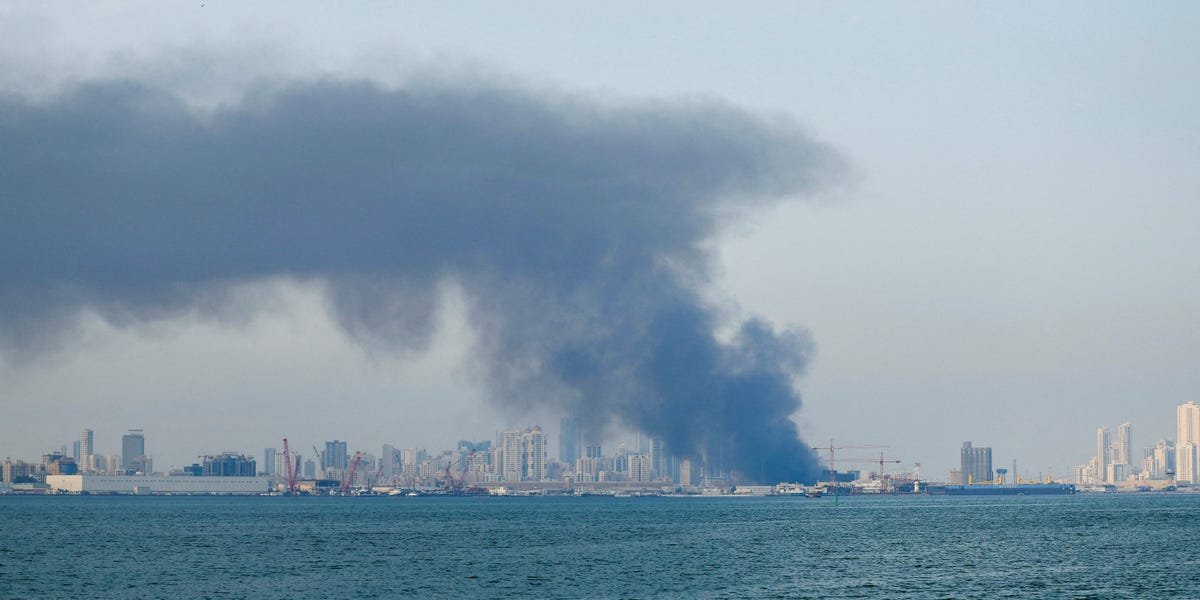
Iranian forces say they struck a US naval base in Bahrain, as the country launched strikes across the region in retaliation.

The attack come amid diplomatic efforts between US and Iranian officials over Iran’s nuclear program.


Source link