

Headshot of Chris Panella.

Israeli combat footage shows it bombing vintage American-made fighter jets in Iran

Israel shared new footage of it bombing two of Iran’s American-made fighter jets preparing to take off as joint US-Israeli combat operations against Iran continue.

Iran’s fleet includes several vintage US aircraft, including the McDonnell Douglas F-4 Phantom II and legacy Northrop Grumman F-5s. Along with Iran’s few US-provided Tomcats, which were iconized in the “Top Gun” movies, these aircraft are part of an aging Iranian Air Force that has limited air combat capabilities against advanced Israeli and US aircraft.

The Israel Defense Forces video captured strikes on the F-5 and F-4 jets at an airport in Tabriz in western Iran on Sunday morning. The IDF said that it hit the aircraft as they were preparing to take off. The footage shows direct hits on each aircraft.

Israel and the US launched massive attacks on Iran on Saturday, dubbed Operation Epic Fury by Washington and Operation Roaring Lion by Israel. The attacks are aimed at eliminating Iranian leadership and ushering in regime change in Tehran. As of Sunday, Israel and the US say they’ve taken out dozens of Iranian officials, including Supreme Leader Ayatollah Ali Khamenei.

Iran has launched several phases of retaliatory missile and drone strikes against Israel and bases hosting US troops in the region, including Qatar and the United Arab Emirates. The US and Israel have said the operations will continue into the coming weeks.

In sharing the video on the F-4 and F-5 strikes, the IDF said the attacks “were conducted to degrade the Iranian Air Force’s activities and to further expand the degradation of their aerial defense.” The US has said operations are aimed at crippling Iran’s military.

Vintage US-made aircraft


An F-4 Phantom II aircraft painted with a camouflage color scheme.

The F-4 Phantom II was a workforce fighter bomber for the Air Force and Navy during the Vietnam War.

Vincent De Groot/185th Air Refueling Wing, Iowa Air National Guard


Iran operates a fleet of aging aircraft, including some that are US-made but have become obsolete over the years due to international sanctions and embargoes that have prevented the country from modernizing its fleet.

The F-4 Phantom II, manufactured by the McDonnell Aircraft Corporation and later McDonnell Douglas, now part of Boeing, entered service in the US in early 1960s and was a workhorse during the Vietnam War and Cold War. The two-seat, twin-engine fighter was flown by the US Air Force, Navy, and Marine Corps for decades as a principal air superiority fighter.

Through the 1970s and the end of the 20th century, the F-4 was gradually replaced by the F-15 Eagle, F-16 Fighting Falcon, and F/A-18 Hornet, as well as the F-14 Tomcat for various US armed forces.


A F-4 Phantom II is seen sitting on tarmac.

The F-4 was retired by the US in 1990s, while other countries gradually stopped flying the aircraft through the 2020s.

AFSC/Defense.gov


Prior to the 1979 Iranian Revolution, which upended ties, the US sold many of these aircraft to Iran.

Iran still fields large numbers of the aging fighters — among the most numerous of these Cold War designs still in service globally — but their operational rates have fallen sharply due to sanctions and the difficulty of sustaining upgrades and spare parts.

Iran has kept some aircraft flying due to reverse-engineering, but it’s been estimated to only have about 60 F-4s, fewer than 50 F-5s, and 20 to 30 F-14s in its inventory. Combat over the past year may have reduced those numbers even further.

Actual airworthy numbers are likely lower than reported, with some jets stripped for parts. Iran’s effective airpower remains contested and constrained by attrition and long-running maintenance hurdles.

In contrast, Israel and the US fly newer, more powerful aircraft, including the fifth-generation F-35 stealth fighter, as well as a mix of highly capable fourth-generation jets like F-16s and F-15s.

In previous conflicts, as well as the current one, Israel has said that it’s achieved air superiority over swaths of Iran with a mix of fourth- and fifth-gen fighters and by degrading Iran’s air defenses.


Source link

Satellite-photos-capture-devastation-at-Iranian-Supreme-Leader-Khameneis-residence.jpeg

Satellite photos capture devastation at Iranian Supreme Leader Khamenei’s residence after US and Israeli strikes

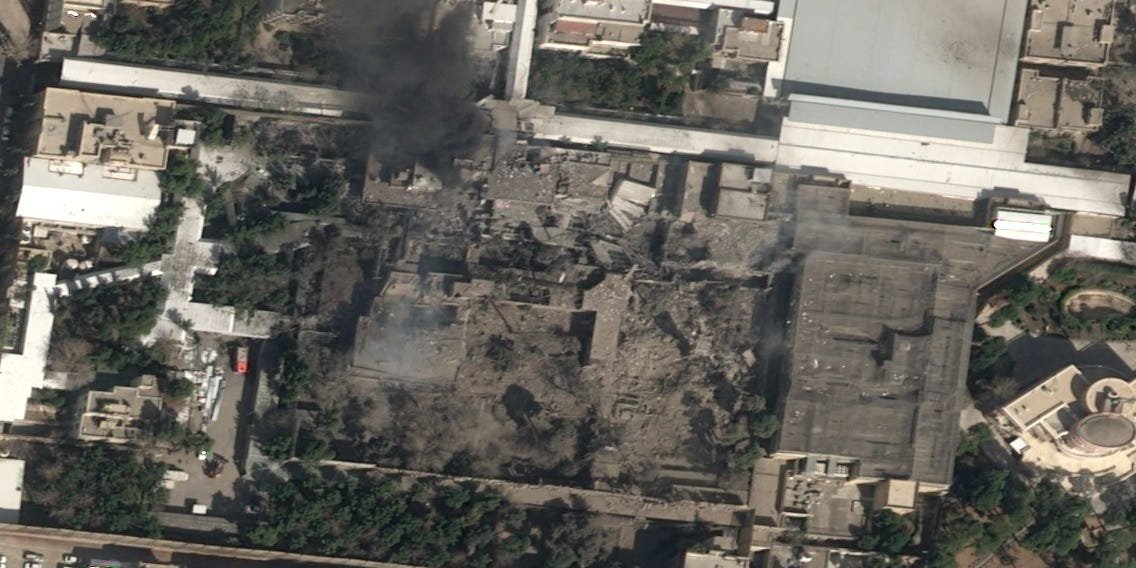
Satellite images captured after Saturday’s US and Israeli strikes on Tehran show that the residence of Iran’s supreme leader, Ayatollah Ali Khamenei, sustained severe damage.

The photos, provided to Business Insider by Airbus, show several collapsed buildings inside a compound in Tehran, which is known to be one of Khamenei’s main residences.

It’s unclear if the Iranian leader was present at the time of the strikes, though the US, Israel, and Iran all said that he was killed on Saturday.

It’s also not yet clear if it was Israel or the US that carried out this particular strike. Representatives for the Pentagon and Israel Defense Forces declined to comment on the hit when asked by Business Insider.


The burning roofs of several buildings can be seen in this satellite image over Tehran.

A cropped photo of the Leadership House in Tehran after the Saturday strikes.

Pléiades Neo (c) Airbus DS 2026


One of the heavily damaged buildings in the compound, at the bottom left of the image, is the House of Leadership, which is known as Khamenei’s office and principal place of residence.

In the images, smoke appears to be rising from its roof. Much of the compound has been obliterated, with felled trees and several more smoking buildings.

The large structure to the right of the compound is the Imam Khomeini Hussainia, a place of worship used by Iranian leaders for religious ceremonies and political speeches.

It’s unclear whether this larger building was also attacked, but what looks like debris can be seen on its roof.

A satellite image taken a year earlier shows the complex included at least six buildings, all of which are now damaged by the strikes.


An image taken in February 2025 shows an overhead view of the Leadership House.

This image from February 28, 2025, shows the complex a year before the strike.

Screenshot/Google Earth


A wider-angle view from another satellite image taken on Saturday appears to show that the strike was largely confined to Khamenei’s compound, which is located in the heart of the Iranian capital.


Ruined buildings can be seen in this wider shot of Khamenei's compound in Tehran.

Smoke rises from Khamenei’s residence in a wider shot of the compound.

Pléiades Neo (c) Airbus DS 2026


The compound’s neighboring buildings appear to be intact.


A wider shot of the Tehran neighborhood shows the Leadership House complex last year.

This Google Earth image was taken on February 28 in 2025.

Screenshot/Google Earth


In a video address after the attacks began, President Donald Trump told Iranians to “take over your government.”

“It will be yours to take. This will be, probably, your only chance for generations,” Trump said.

The US and Israel began their attacks on Saturday morning local time, hitting Tehran and several other Iranian cities in what has been one of the largest strike campaigns in recent years.

The full outcomes of these strikes are still being assessed, and much remains unclear about Tel Aviv and Washington’s exact objectives behind the attacks.

Meanwhile, Iran has responded by firing dozens of ballistic missiles and drones at its neighbors, saying it is targeting US military bases.

Khamenei had been in power in Iran for almost 40 years as a powerful religious leader in Shia Islam, becoming the country’s ultimate authority in government and the military.

It remains to be seen how his death will impact the fate of Iran’s military, society, and government structure.

February 28, 2026: This story was updated to reflect the death of Khamenei, as confirmed by the US, Israel, and Iran.


Source link

Satellite-images-show-an-Iranian-warship-burning-pierside-after-US.jpeg

Satellite images show an Iranian warship burning pierside after US and Israeli strikes

New satellite imagery shows an Iranian warship burning pierside following widespread US and Israeli airstrikes.

The imagery, collected Saturday by US spatial intelligence firm Vantor and obtained by Business Insider, shows some of the initial aftermath of the joint US and Israeli attack on Iran, a major combat operation against Tehran after the collapse of talks on nuclear weapons.

The Vantor images show a frigate burning at the Konarak naval base in southern Iran. A large billow of smoke can be seen rising from the wounded vessel.


Overview of a burning vessel at Iran's Konarak naval base on February 28.

A frigate on fire at Iran’s Konarak naval base.

Satellite image ©2026 Vantor.


In a close-up image, two other frigates are seen sitting nearby, appearing unscathed.

Trump said earlier in his video message announcing the US campaign, Operation Epic Fury, that the US military was “going to annihilate” the Iranian navy, as well as the country’s other military capabilities.

Trump said the goal was to ensure that Iran can “never” have a nuclear weapon. The president also urged Iranian citizens to “take control” in the aftermath of US operations.

“This will be, probably, your only chance for generations,” he said.


A burning frigate at Konarak naval base in Iran.

A close-up of a burning frigate at Konarak.

Satellite image ©2026 Vantor.


War analysts at the Institute for the Study of War think tank said on Saturday that there had been unconfirmed reports of strikes on Iranian naval assets.

“An Israeli OSINT [open source intelligence] account reported strikes on the IRGC Navy frigate Jamaran,” ISW said. “There are also unverified reports of strikes on the IRGC Navy Imam Ali Navy Base in Chabahar, Sistan and Balochistan Province.”

Other images collected by Vantor show drone launch activity at two nearby airbases in Konarak. After the initial attacks by the US and Israel, Iran launched retaliatory missile and drone strikes at US military bases around the region in Bahrain, Qatar, the United Arab Emirates, Kuwait, Jordan, and Saudi Arabia.


Drones dispersed at an airbase in Iran on February 28.

Drones dispersed at an airbase in Konarak.

Satellite image ©2026 Vantor.


Iran has also launched multiple barrages at Israel, including missiles and drones, and said it was carrying out an “extensive drone offensive operation” against its longtime foe.

US strikes on Iran included a mix of weapons such as Tomahawk cruise missiles, High Mobility Artillery Rocket Systems, drones, and undisclosed standoff weapons designed for long-range strikes outside the reach of enemy air defenses.

In response to retaliatory attacks from Iran, various air defense weapons have been active, including the MIM-104 Patriot surface-to-air missile and Terminal High Altitude Area Defense, or THAAD, batteries.


Drones dispersed and a runway blocked at the Konarak drone strip.

Drones dispersed on a blocked runway.

Satellite image ©2026 Vantor.


Saturday’s strike is the second time in less than a year that the US has launched a strike campaign against Iran. In June 2025, US forces targeted Iranian nuclear facilities. In the weeks prior to the most recent attack, the US built up a massive force presence in and around the Middle East.


Source link