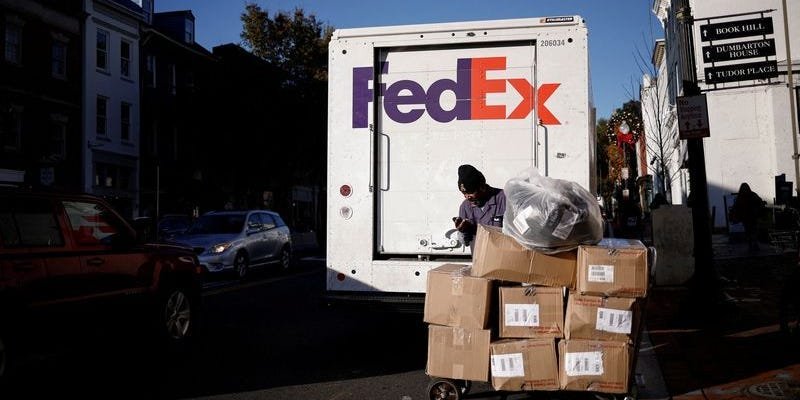
FedEx-says-itll-refund-tariffs-to-customers-if-it-gets.jpeg

FedEx says it’ll refund tariffs to customers if it gets money back from the Trump administration

  • FedEx says it will refund customers for tariff charges if its own efforts to get a refund succeed.
  • On Monday, FedEx sued the Trump administration in trade court seeking a refund.
  • An exact timeline or process for refunds remains unclear after last week’s Supreme Court ruling.

FedEx says it will give you a refund if you used its shipping service and paid President Donald Trump’s unconstitutional tariffs — that is, if the company itself gets a refund from the government.

Days after the US Supreme Court ruled against many of Trump’s tariffs, FedEx filed a lawsuit against the Trump administration seeking a refund of the tariffs it had paid on behalf of customers.

If that effort is successful, the company said, it plans to pass that money on to the businesses and people it charged for those duties.

“Our intent is straightforward: if refunds are issued to FedEx, we will issue refunds to the shippers and consumers who originally bore those charges,” FedEx said in a statement on its website.

Right now, there’s no timeline or process for handling refunds, FedEx said, adding that it’s waiting “on future guidance from the government and the court.”

Rival UPS, which had not revealed plans to seek tariff refunds as of Friday, did not immediately respond to a request for comment from Business Insider.

FedEx is one of many companies suing the Trump administration to recover some or all of the tariffs they paid.

Many US consumers have been hit directly by tariffs through international shipments carried by services like UPS and FedEx, Business Insider previously reported.

Some individual customers and businesses have had packages held up at customs for weeks, or tried to dispute tariff charges they say were incorrectly calculated, including at a 200% rate for Russian aluminum.

Do you have a story to share about tariffs? Contact this reporter at abitter@businessinsider.com or via encrypted messaging app Signal at 808-854-4501. Use a personal email address, a nonwork WiFi network, and a nonwork device; here’s our guide to sharing information securely.



Source link

Polly Thompson

Dell is rolling out a new sales pay structure. Some employees worry it’ll slash their income.

Dell has kicked off its new financial year with a shakeup to how sales staff get paid.

Under the new structure, Dell is increasing rewards for high performers but scaling back earnings for sellers who fall short of their full quota, according to an internal presentation viewed by Business Insider. The tech giant is also tightening the periods over which it measures sales progress to a quarterly basis, rather than twice a year.

The presentation was shared with sales employees in a town hall meeting on February 3, led by Kyle Leciejewski, Dell’s senior vice president of North America sales.

The changes affect sales staff across both of Dell’s key divisions: the Infrastructure Solutions Group (ISG), which sells data center hardware and other AI-related solutions, and the Client Solutions Group (CSG), which sells PC hardware.

The change at Dell mirrors a shift happening across much of Big Tech, where companies have been leaning into a hardcore culture that elevates high performers, penalizes those who miss the mark, and disregards long-held views of workplace loyalty.

The move is “designed to reward you for driving profitable growth, expanding our footprint, and winning market share for Dell,” the company told staff in the presentation.

“We are always assessing our business to remain competitive and ensure we are set up to deliver the best innovation, value, and service to our customers and partners,” Dell told Business Insider.

No commission under 60% of sales targets

Dell sales employees are paid through a mix of guaranteed base salary and a commission-based payment, known as their “target incentive.” The presentation used an example of an employee paid on a 60/40 mix, meaning 60% of their compensation was the salary, and the rest was the target incentive.

Under the previous salary structure, sellers who achieved between 0 and 100% of their sales target received the corresponding portion of their target incentive, according to the presentation. If they hit 80% of their goal, they got 80% of the payout; if they hit 50% of the goal, they got 50% of the payout.

The target incentive doubled for those who hit 100% to 200% of their targets.

Under the new changes, sellers who come in below 60% of their target get no commission.

For those who achieve between 60% and 100% of target, here’s the new pay structure:

  • At 70% of goal, employee gets 25% of target incentive
  • At 80% of goal, employee gets 50% of target incentive
  • At 90% of goal, employee gets 75% of target incentive
  • At 100% of goal, employee gets 100% target incentive

For top performers, the incentives just got better.

Sales workers who hit between 100% and 150% of their targets will now receive commissions worth three times the agreed target incentive portion of their salary, the presentation shows. That marks a 50% increase on what they’d previously received.

Quarterly targets

Dell is also moving sales teams to quarterly targets, according to the presentation.

Small and medium business teams already worked to quarterly targets, but now enterprise, large enterprise, DTS, AI Select, and Dell’s telecom business will move from a twice-yearly compensation plan to quarterly quotas.

According to the presentation, the decision to move to quarterly targets is linked to the company’s upcoming modernization push. As Business Insider first reported, Dell is overhauling its internal systems on May 3 to help streamline internal operations for the AI future — an initiative it is calling One Dell Way.

Dell could adjust the quota cadence in the second half of the financial year, the presentation said: “We will revisit the quota cadence and take the learnings from Q1 and Q2 to inform the decision about 2H.”

Some employees fear pay cuts

Five Dell sales employees who spoke to Business Insider about the pay structure changes said the adjustments were causing frustration and fear among some employees that their take-home pay could drop.

A data center sales rep told Business Insider that for the last three years, they had consistently hit 70% to 80% of their quota, so they were looking at a 20% reduction in their take-home pay unless they could sell more.

All five employees said that hitting 100% of a target would become harder in the new quarterly timeframe. Their reasons included that quotas had risen over the last two years, industry supply chain shortages were slowing sales cycles, and, in certain divisions, such as federal accounts, lead times were long.

Low morale

Employee dissatisfaction at Dell has been growing companywide in recent years amid layoffs and RTO mandates. The company’s employee satisfaction score — known as the employee net promoter score, or eNPS, has declined by almost 50% in two years.

In 2024, Dell’s sales teams received a 5-day RTO mandate months before the rest of the company, and last December, Business Insider reported that leaders were cracking down on attendance.

Sales staff are also dealing with tougher selling conditions amid an industry-wide shortage of memory chips. Along with most competitors, Dell raised prices on many of its products in December.

“Global memory and storage supply are tightening fast,” Dell warned its go-to-market team members in an email viewed by Business Insider. The company told its sellers to “move decisively” ahead of the price increases to “protect value for our customers and for Dell.”

On the back of the AI boom, ISG sales have been strong — revenue was up 29% in Dell’s last full financial year — but annual revenue has fallen for three consecutive years in the CSG division. In July 2025, Dell’s COO and vice chair Jeff Clarke stepped in to handle day-to-day leadership of CSG.

In a memo about One Dell Way last month, Clarke told Dell staffers to get ready for big changes.

“This is the biggest transformation in company history,” Clarke said. “I know there will be challenges, and that’s OK—we’re here to support you and work through this together.”

Have a tip? Contact this reporter via email at pthompson@businessinsider.com or Signal at Polly_Thompson.89. Use a personal email address, a nonwork WiFi network, and a nonwork device; here’s our guide to sharing information securely.


Source link

Taylor-Swifts-latest-business-move-is-another-attempt-to-hack.jpeg

Taylor Swift’s latest business move is another attempt to hack the charts — and it’ll probably work

Taylor Swift is the biggest-selling artist in the world by most reliable measures, so when she makes an unconventional business move — no matter how random or trivial it may appear — it’s worth paying attention.

On Friday, Swift unveiled the self-directed music video for “Opalite,” her latest single from “The Life of a Showgirl.” Upon release, the cameo-laden clip was available exclusively on Spotify and Apple Music, with its YouTube premiere scheduled for a two-day delay.

Streamers like Spotify and Apple Music specialize in hosting songs, albums, podcasts, and playlists — not visual works. Meanwhile, YouTube is famously a destination for music video lovers. So what gives?

As usual, when it comes to Swift, the answer seems to lie with her bottom line. In December, YouTube announced it would withdraw its streaming data from Billboard’s chart formulas because the music company tweaked its methodology so that streams from YouTube subscribers were weighted even more heavily than free streams. YouTube’s stance is that the ratio is unfair to fans.

Swift recently scored her longest reign yet on the Billboard Hot 100 with “The Fate of Ophelia,” the lead single from “Showgirl,” which charted at No. 1 for 10 weeks. With “Opalite” officially serving as its follow-up, Swift appears to be making moves to boost the song’s chart performance.

If fans were flocking to YouTube today to watch her new music video, none of those views would help “Opalite” reach No. 1 — and nobody wants to follow a personal best with a personal flop, least of all an athlete-style competitor like Swift.

Of course, this savvy tweak to the song’s promo schedule was paired with a physical release: a seven-inch vinyl single in “pearlescent blue,” only available in Swift’s online store for 48 hours.

How Taylor Swift moves, other artists tend to follow

Swift’s unyielding commitment to commerce isn’t just something to behold. It’s something to study. Swift’s sales tactics often become instructive for other artists.

Much has been made about Swift’s push to sell physical albums, for example, but many fellow pop stars have followed suit. Charli XCX released about two dozen vinyl variants for her 2024 album “Brat” and its deluxe editions. Sabrina Carpenter, a self-professed disciple of Swift’s work, released 13 vinyl variants last year for “Man’s Best Friend,” in addition to seven-inch singles, cassettes, and CDs. As a result, “Man’s Best Friend” scored the ninth-biggest vinyl sales week of the modern era, according to Billboard. (Seven of the top eight slots on that list belong to albums by Swift.)


Taylor Swift in the music video for

“The Fate of Ophelia” reached No. 1 on the chart dated October 18, 2025.


Taylor Swift/YouTube


So, it could very well mean that Swift’s strategic video rollout will start a trend as well. Although YouTube is the customary platform for music videos, customs can be changed, and she isn’t the only artist who cares about climbing the charts.

It could also be that Swift’s premiere delay will inspire YouTube to rethink its attitude toward Billboard. If one of the most influential celebrities in the world is delaying their content to your product, that could be bad for business — and it wouldn’t be the first time Swift convinced a major company to change its tune. Back in 2015, she criticized Apple Music for refusing to pay artists during a new user’s free trial. Within 24 hours, Apple updated its policy and tagged Swift in the announcement online.

It remains to be seen whether “Opalite” will affect the music industry beyond Swifties, but if the song’s lyrics are any indication, Swift is content to manufacture success on her terms — or, in her words, to make her own sunshine.


Source link

The-Senate-just-voted-to-fund-the-government-—-but.jpeg

The Senate just voted to fund the government — but it’ll still partially shut down for a few days anyway

The US federal government is shutting down again, but it won’t be like last time.

Funding for a slew of federal agencies runs out at midnight late on Friday, and lawmakers on Capitol Hill failed to send a series of bills to fund those agencies to President Donald Trump’s desk in time.

Even though the Senate passed a series of bills to fund the government on Friday, the House is not set to vote on them until late Monday at the earliest, meaning the shutdown will last at least a few days.

Some parts of the federal government have already been funded, meaning that the shutdown, even if it drags out, is only partial.

Additionally, it’s unlikely that this shutdown will last as long as the one that began in October, which stretched for 43 days and became the longest government shutdown in American history.

Here’s what could be affected — and what won’t be

In October, funding for the entire federal government was being held up, and the shutdown was far-reaching. This time, some parts of the federal government would remain operational.

That’s because Congress has already passed a series of spending bills that fund agencies and programs through September 30.

Among those programs are SNAP and WIC, which were notably affected by the previous shutdown. Additionally, national parks would likely remain open, veterans would continue to receive benefits through the Department of Veterans Affairs, and staff on Capitol Hill would continue to be paid.

But plenty of other government agencies and programs would be affected if the shutdown drags out, including the Department of Defense (including troops), the State Department, the Treasury Department, the Transportation Security Administration, and the Federal Emergency Management Agency.

Notably, Immigration and Customs Enforcement (ICE) and Customs and Border Protection would remain operational, even though it’s funded via the Department of Homeland Security.

That’s because DHS received $190 billion in funding via the “One Big Beautiful Bill Act” in July, including $75 billion for ICE and roughly $65 billion for CBP.

It’s unlikely to last as long as before

Unlike in the fall, lawmakers in both parties are working together to try to resolve the situation as quickly as possible.

The odds of a shutdown first rose following the fatal shooting of Alex Pretti by Border Patrol agents in Minneapolis on Saturday.

Democrats vowed to oppose a bill to fund the Department of Homeland Security, which oversees ICE and CBP, until reforms to immigration enforcement are made.

The House had already passed a package of six funding bills, including the DHS bill, and they had been stitched together into one package in the Senate.

The Senate has now passed a reformulated version of that package, with DHS funding continuing for only two weeks to allow for a renegotiation.

It’s unclear as of now whether that package will pass the House when lawmakers return to the lower chamber next week.


Source link