Mark-Zuckerberg-and-Jeff-Bezos-turn-toward-fashion-is-about.jpeg

Mark Zuckerberg and Jeff Bezos’ turn toward fashion is about more than the clothes, expert says

The world of fashion has witnessed a consistent pattern for some time now: Big Tech billionaires gradually entering its orbit from the edges until they’ve found themselves at its center.

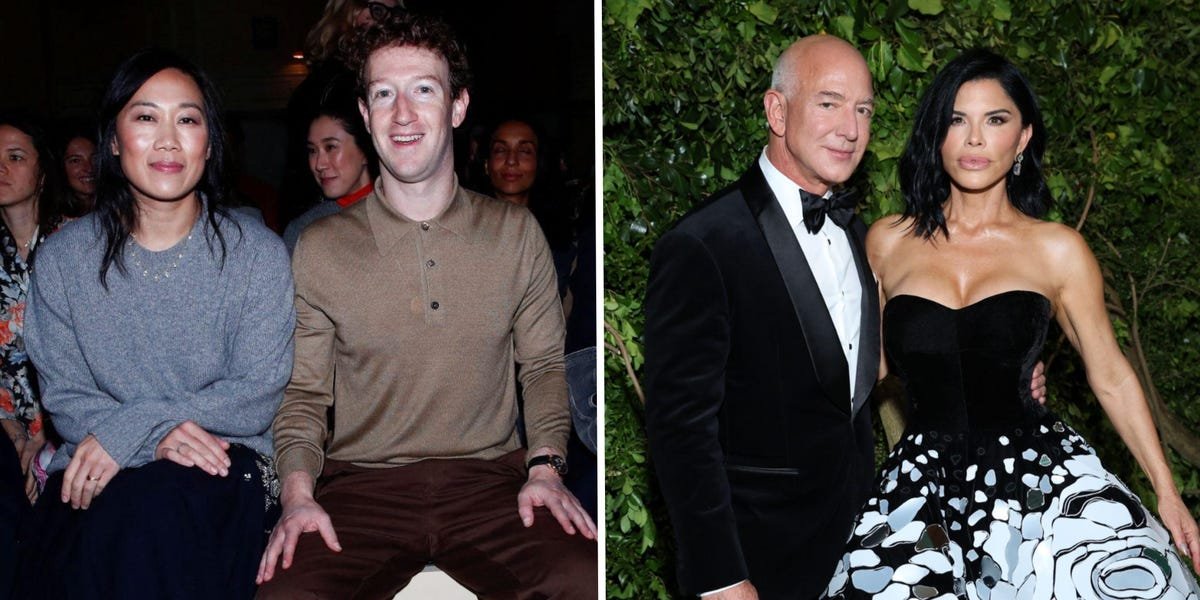
Just last month, Mark Zuckerberg and Priscilla Chan’s presence in the front row at the Prada Fall/Winter 2026 collection stirred the fashion world, amid Meta’s ambition to up the luxury factor in its AI glasses.

A few glances over prove that this was not an isolated case. Amazon magnate Jeff Bezos and Laura Sánchez-Bezos have long been fashion enthusiasts, with the fashion world courting them and vice versa.

There was the Vogue cover. Their roles as lead donors to the 2026 Met Gala — a decision Anna Wintour defended amid backlash. Persistent, if unfounded, rumors that Bezos could acquire Condé Nast. Add strategic appearances with Wintour, front-row seats at Schiaparelli and Dior couture, and Law Roach-styled vintage Versace moments, and the idea becomes clear.

With tech billionaires attending the right places and hanging with the right people, their place in fashion feels less like a cameo and more set in stone. It’s no longer up for debate. What is, though, is why. Why fashion? One expert told Business Insider it’s about power.

From indifference to front row

Since its early days, fashion has gone hand in hand with the elite class. It’s what they consumed, financed, and promoted. The situation hasn’t changed much. Look around, and conglomerates like LVMH and Kering, as well as celebrities, still largely influence the industry.

What has evolved, however, is technology.


Priscilla Chan and Mark Zuckerberg at a 2026 Prada runway show in Milan.

Priscilla Chan and Mark Zuckerberg at a 2026 Prada runway show in Milan.

Alessandro Garofalo/Reuters


“Social media has changed everything,” fashion journalist Louis Pisano told Business Insider. “People have become really image-conscious in a way that we previously only saw in celebrities. Now, everyone needs to brand themselves because everyone knows that every moment is an opportunity to make an impression.”

If before, tech bros were famously indifferent toward fashion — think of Steve Jobs, who proudly wore a black turtleneck and jeans — today, even they seem susceptible to the constant presence of social media.

Pisano points to an Instagram reel posted by Chan that felt distinctly TikToky, as if she and her husband were lifestyle influencers casually strolling through Milan and Prada.

Being mindful about social media is one thing. Venturing into fashion’s gatekept inner circle is another. In an appearance-driven culture, coolness — and the validation that comes with it — still matters above all else.

“You can be a tech bro, and if you’re badly dressed, everybody’s still gonna be like, ‘You look like shit,'” Pisano said. “You have all of this money, so why not look great as well?”

But looking great here isn’t about self-expression. It’s about access — and the kind of cultural legitimacy money alone can’t automatically buy.


Lauren Sánchez and Jeff Bezos

Lauren Sánchez and Jeff Bezos attend the Christian Dior Haute Couture Week Spring/Summer 2026 show as part of Paris Fashion Week on January 26, 2026, in Paris.

Anthony Ghnassia/Getty Images for Christian Dior


Joshua Graham, fashion editor at Rolling Stone UK, compared the entrance of tech bros into the high fashion world with Mark Mylod’s film “The Menu,” in which a group of rich people go to an exclusive restaurant but “don’t really care about the food, just that they’re able to be seen within the context of what the best looks like.”

Pisano voiced a similar point: Over the years, fashion has become one of the easiest pathways to cultural relevance simply because it’s an exclusive framework. You have to be let in.

It is, after all, a business where brands and money tend to speak louder than individual style, and wearing the right label and knowing the right names becomes fashion shorthand, a sort of entry pass to culture’s apex.

Billionaires want staying power

For billionaires used to building platforms, cultural legacy is the next frontier. “Wearing an independent label isn’t going to bring you as much cultural cachet as wearing Prada or a custom Louis Vuitton piece,” Pisano noted. Indeed, symbolic power is still the goal.

”It’ll immortalize them,” Pisano said of tech billionaires’ aligning with luxury houses. Prada has been around since 1913. Schiaparelli since 1927. Dior since 1946. You get the picture. ”They want to attach themselves onto something that they’re betting is going to live forever because social media platforms die out. New ones will come, but you’re always going to need clothes to wear.”

These moguls have already had a hand in shaping society’s tastes and lifestyles thanks to the technology they’ve created. “They control the algorithms and build the infrastructure,” Pisano continued.

Still, he makes the point that it’s not a one-sided relationship. Perhaps, billionaires are already fashion people after all. “Designers need these people in order to push their content out to shopping recommendations,” Pisano noted.

Graham echoes this view, adding that fashion houses need to court relationships with tech titans because, ultimately, labels are always seeking exponential growth. ”I understand why anyone would want to work with Zuckerberg,” the editor said. ”The economy everywhere is in the toilet.”


Priscilla Chan and Mark Zuckerberg

Priscilla Chan and Mark Zuckerberg.

ANGELA WEISS / AFP via Getty Images


So while many were scrunching their faces, wondering why Zuckerberg was pushing himself to the front row at Prada, the reality is that the relationship between tech and fashion is more symbiotic. Brands are increasingly turning to AI instead of creatives, for example.

The danger, Graham warned, is that when billionaires invest in fashion, they should at least pay attention to emerging designers who do it for the love of the art form. He added that so many creatives, such as the late Lee Alexander McQueen, did not enter the fashion world to ”make a quick buck,” but because it was their passion.

”I don’t know if it would be smarter for billionaires to go to a Central Saint Martin show and pick out a few students that they loved,” Graham argued, referencing the graduate show held by the prestigious London art and design school. ”But there needs to be a way for us to find ourselves back in a place where the patronage of fashion isn’t so commercial.”

Graham, like many who questioned why Zuckerberg was sitting front row, said he can understand the critique. “They are very hypercritical of something like this,” but it’s because they care “about what a designer, a garment, a shoe says about you as a person and then says about society as a whole.”

For now, though, the relationship between tech and fashion will continue to evolve. Tech may control the feed, but fashion still controls the culture.


Source link

A headshot.

‘Survivor’ host Jeff Probst spends his downtime watching real-life police interrogation videos

Each Wednesday, millions of people wind down by watching a group of castaways try to outwit, outplay, and outlast each other on CBS’s “Survivor.” But when “Survivor” host Jeff Probst has free time of his own, he’s watching a different kind of unscripted entertainment.

“If I have 15 minutes, my go-to is going to be a police interrogation, almost always,” Probst told me of his daily routine while filming the show’s landmark fiftieth season.

The host said he’ll watch real interrogation videos on YouTube because he loves studying how detectives work.

“You are watching a human walk into a room wondering, how much do these detectives know? What they don’t know is in most cases, the detective knows a lot more than you think, but they want to see what you’re willing to share,” Probst explained.

“Then you watch a great detective or a team of detectives slowly build this box, and the box gets smaller and smaller and the guilty person starts to realize, ‘I’m never going home. They know what I did,'” Probst continued.

“I love those subtle shifts in power dynamics — watching how people respond, what tells they have, and how they give away their truth.”


Survivor 50 castaways sit on a bench in front of lit torches at Tribal Council.

“Survivor 50” castaways at Tribal Council.

Robert Voets/CBS


After spending 26 years and counting holding court at Tribal Council, Probst has plenty of experience being the interrogator.

Probst said his coworkers can tell when he’s getting in “the zone,” preparing to draw conflict and moving anecdotes out of the castaways at Tribal Council.

“All I’m really thinking about is just reminding myself, ‘These 13 people are still in the game. They voted out seven people; they’re tired, they’re hungry,'” he told Business Insider of his mindset.

Being fully present allows Probst to think on his feet while engaging with the castaways.

“I actively choose to be in the moment,” Probst said, launching into an example.

“I see that you’re sad. I could tell when you walked in, your body language, you’re hunched over. The question is, am I going to bring it up? Are you going to bring it up? Is somebody else going to bring it up? Are we going to talk about it or not? I don’t know. Let’s find out!”


Source link

Jeff-Bezos-speaks-out-about-The-Washington-Post-for-the.jpeg

Jeff Bezos speaks out about The Washington Post for the first time since mass layoffs — and focuses on ‘data’

Washington Post owner Jeff Bezos gave his first public statement since the paper enacted massive job cuts this week, and it focused on “data” and understanding reader interests.

The billionaire Amazon founder, who built one of the world’s most valuable companies with a relentless focus on customer satisfaction, indicated he wanted to see that same energy at the Post.

“The Post has an essential journalistic mission and an extraordinary opportunity,” Bezos wrote. “Each and every day our readers give us a roadmap to success. The data tells us what is valuable and where to focus.”

Bezos’ statement came as Post CEO Will Lewis announced he was stepping down, to be replaced in an interim capacity by Post CFO Jeff D’Onofrio.

Bezos’ statement struck a similar tone to comments made by the paper’s top editor, Matt Murray, in addressing staff earlier this week.

“Today is about positioning ourselves to become more essential to people’s lives in what has become a more crowded, competitive, and complicated media landscape,” Murray said during a staff call on Wednesday. “For too long, we’ve operated with a structure that’s too rooted in the days when we were a quasi-monopoly local newspaper.”

Murray sent staffers a detailed memo on Wednesday that outlined focus areas in which he said the Post demonstrates “authority, distinctiveness, and impact.” Those priority areas will include politics, national affairs, national security, and other forces “shaping our future,” like science and business, Murray wrote.

Murray spoke repeatedly about focusing on areas of reader interest and understanding audience data in an appearance following the layoffs on the Puck podcast “The Grill Room.”

The messaging from Bezos and Murray could help appease some critics who have seen moves by the Post in recent years as rooted in political ideology and not data — though it will be difficult to win them over.

The Post faced a revolt both inside the newsroom and among readers when Bezos made a late-hour call in 2024 that the paper wouldn’t endorse a presidential candidate for the first time in 36 years. NPR reported that more than 200,000 subscriptions were canceled in the days following.

The paper faced another round of criticism in February 2025 when Bezos decided to reorient the Post’s opinion section — generally considered the owner’s prerogative — around personal liberties and free markets.

Former Post executive editor Martin Baron, who worked closely with Bezos during his tenure as top editor, wrote in a LinkedIn post after the layoffs that the paper’s challenges had been made “infinitely worse by ill-conceived decisions that came from the very top.”

Critics of Bezos’ moves have said he should consider financially supporting the paper, given its role in society.

“It just seems heartbreaking that he doesn’t feel the paper is important enough to bankroll,” Sally Quinn, the longtime journalist and widow of former Post executive editor, Ben Bradlee, said this week on CNN.

Bezos said in his statement that he felt the Post’s leadership going forward could build an “exciting and thriving next chapter” for the paper.


Source link

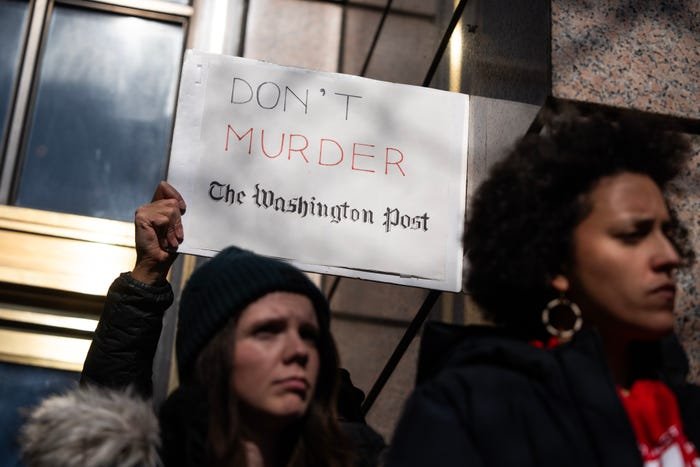
A person holds a protest sign which reads

Washington Post union calls for Jeff Bezos to sell the paper after CEO resigns


Tom Williams/CQ-Roll Call, Inc via Getty Images

  • The Washington Post’s CEO, Will Lewis, departed the paper on Saturday following sweeping layoffs.
  • The Post’s union, in a statement, called Lewis’ exit “overdue.”
  • The union also called for Jeff Bezos, who owns The Post, to sell the publication.

Unionized staffers from The Washington Post issued a statement supporting the abrupt Saturday departure of the publication’s CEO, Will Lewis, and called for Jeff Bezos to sell the paper.

“Will Lewis’s exit is long overdue,” the Washington Post Guild’s statement, which was published on X, read. “His legacy will be the attempted destruction of a great American journalism institution. But it’s not too late to save The Post. Jeff Bezos must immediately rescind these layoffs or sell the paper to someone willing to invest in its future.”

Representatives for the Post union did not immediately respond to a request for comment from Business Insider.

On social media, laid-off reporters celebrated the news of Lewis’ departure. Jada Yuan, a former culture writer at the Post, wrote that she had “never been more thrilled with a news alert.”

“Will Lewis, the absent, ineffective publisher of @washingtonpost has resigned. Or been fired,” she added. “It sucks that it happened after he couldn’t even show up on zoom to lay off 1/3 of the company. But the important thing is he’s gone.”

Lewis’ exit was announced Saturday afternoon, just days after sweeping layoffs hit the legacy publication, leaving hundreds of reporters out of work.

The publication’s unionized employees held a “Save the Post” rally earlier this week, focused on Bezos and Lewis, and said there were risks to press freedom and independent news if legacy publications like the Post are unable to continue operating.


Source link

Will-Lewis-couldnt-fix-the-Washington-Post-Thats-on-Jeff.jpeg

Will Lewis couldn’t fix the Washington Post. That’s on Jeff Bezos.

Will Lewis, the former CEO and publisher of the Washington Post, had a terrible tenure at the paper. The two years he spent there, which ended Saturday with a two-paragraph memo, are chiefly notable for a series of cuts and layoffs, culminating in a 30% bloodletting days ago.

But let’s be clear: This one is on Jeff Bezos.

Most obviously, that’s because Bezos owns the Post, and Bezos was the one who hired Lewis to run the business for him.

Bezos was also the one signing off on Lewis’s actions at the paper, which mostly amounted to making the paper smaller while telling the staff that “people are not reading your stuff.”

And slightly less obviously, it was Bezos who dramatically worsened the Post’s business outlook. He decided not to endorse a presidential candidate in 2024, weeks before the election — a move that outraged many Post readers, who saw the non-endorsement as an attempt to cater to Donald Trump.

That led to more than 250,000 subscriber cancellations, a huge problem for a paper whose circulation peaked at 3 million in 2021.

The best case argument you could make for Lewis era at the Post, if you are inclined, would go something like this: Bezos, who bought the Post in 2013 and then invested heavily in staff, realized a few years ago that he now employed many more people than his business would support. So he brought Lewis in to do the grim work of shrinking the publication. Now that work is done, so Lewis can do something else and Bezos can find someone to help the Post grow again.

But the timing of Lewis’ departure — late afternoon on a Saturday, following days of howling from Post employees and many others about Lewis and Bezos’ stewardship of the paper — suggests this was not a long-in-the-making move.

And again, whether Lewis jumped or was pushed doesn’t matter in the end. The Washington Post is Jeff Bezos. He gets praise if things are going well — which, for several years after his purchase, seemed to be the case — and blame when it doesn’t.

Here I’ll also point out that Bezos, who has no problem being seen jet-setting around the world in a style befitting the world’s fourth-richest man, has been totally MIA during his paper’s recent turmoil.

On Saturday, when the paper announced it had promoted Post CFO Jeff D’Onofrio to acting publisher and CEO, Bezos finally attached his name to a public statement, promising that the new Post would thrive by giving readers things they wanted to read.

“The data tells us what is valuable and where to focus,” he said in a Post press release.

That might qualify for an insight 30 years ago, when newspapers were struggling to respond to the internet. Now that’s table stakes, and you would hope the guy who created Amazon has more up his sleeve.

I have a bunch of ideas,” for the Post, Bezos said in the fall of 2024. “I’m working on that right now.”

We’re still waiting.


Source link

After-Jeff-Bezos-bought-the-Washington-Post-things-went-great.jpeg

After Jeff Bezos bought the Washington Post, things went great — for a while. I asked an insider what happened.

Lots of people are angry at Jeff Bezos because of the massive cuts he’s ordered at his Washington Post. But a decade ago, Bezos was widely celebrated for his ownership of the Post, which he had bought for $250 million in 2013.

Under Bezos’ ownership, the Post made huge investments in tech and staff. And readers loved the results — especially during the first Trump era, when the paper turned profitable.

Now things are very different: The Post says it has been losing gobs of money for the past few years, and Bezos has made a series of moves interpreted as a shift toward Trump — which spurred reader revolts, which made things even worse. And all of that led to this week’s cuts.

I talked to Erik Wemple, a New York Times media reporter who previously worked at the Post for 14 years, to try to reconcile the two eras of Bezos and the Post, and to get a sense of what might happen next. You can hear our entire chat on my Channels podcast; what follows is an edited excerpt from our conversation.

Peter Kafka: What shape was the Post in when Bezos bought it in 2013?

Erik Wemple: The Graham family, which had owned the Post forever, was an amazing steward for the paper. But they had to scale back their newsroom, because the internet had blown holes in classified ads. Classifieds used to be huge at The Washington Post.

At the time Bezos bought it in 2013, it was not dysfunctional. These were really good journalists, but the paper was in a bit of a funk. It wasn’t a reclamation project, but it had seen better days.

It was faded when he bought it.

Correct. And when Bezos came in 2013, he really wowed the staff. We all asked him questions. He answered those questions with tremendous enthusiasm and competence. He seemed really energized by this.

What did he think he was going to do?

When he came in, he was energetic, but deferential on the particulars of running the newspaper. He’s like, “You know what? I’m not in this business, but I do know how to organize discussions about the future of a business.” And that’s what he did. I was in one of them; it was really remarkable.

He had these things that he believed in. He was important in guiding conversations. And it was really remarkable because he backed it up with money. He invested in the newspaper. He invested in political coverage, big time. Investigative went up. International got a huge, huge boost. And the technology did too.

This is exactly what you want from your billionaire tech owner: Give us a bunch of money. Improve our tech. Also, stay away. Don’t tell us what to do.

That was exactly the sentiment. And one of the things you mentioned in there is really worth pausing on for a second, which is the lack of intervention, the lack of meddling. He just sort of looked on. And the newsroom really, really, really roared. Especially in the first Trump period.

So not only does this produce great journalism, it seems like it becomes a business success story — the paper becomes profitable again. Then, after Trump left the White House, there was a lot of hand-wringing about what happens after the Trump bump. People expected audiences to decline across lots of different publications, and that happened, so it makes sense that the Post would struggle a bit. But the numbers you hear about the reported losses — $77 million in 2023, $100 million in 2024 — are staggering. I still don’t understand how you can swing to losses like that just because your traffic goes down. What am I missing?

I share your knowledge gap.

One of the things that has been reported and pretty well substantiated is they may have over-indexed on staff growth. They vaulted up over a thousand in early 2021, up to 1,100. So I think they got ahead of themselves, and they had to pair that back. That’s one of the things.

Another consideration is that the digital advertising market sort of dried up, so that was a big deal.

It’s all somewhat of a mystery, but I don’t doubt that there are meaningful losses.

Can this just be as simple as the Post overhiring? Lots of companies have done that — the tech guys did during the pandemic.

No, I don’t think so. Especially if you look at the more recent past, when they tinkered with the opinion side and shot themselves in the foot.

In October 2024, the Post announced it would not be endorsing a candidate in the presidential election. And that happened after the Washington Post editorial board had drafted an editorial in favor of Kamala Harris. And hell broke loose — a subscription desertion of hundreds of thousands.

That’s an astonishing number. I remember thinking that it couldn’t be real.

The cause and effect could not have been more direct. People said, “No way. I’m not giving my money to this organization.”

The Post has continued to do lots of news reporting that is critical of the Trump administration. Which made me curious about this line in editor Matt Murray’s explanation of the cuts this week. He praises the work the paper has done, and then points out problems, and says “even as we produce much excellent work, we too often write from one perspective, for one slice of the audience.”

It almost sounds like what David Ellison and Bari Weiss say about remaking CBS News. Does that mean we should expect the Post’s news reporting to change in some sort of ideological way?

If Matt Murray or any of his top editors had actually edited that memo, they would’ve asked for specifics. And they would’ve put a big question mark alongside that and ask, “What the hell are you talking about here? Why are you speaking in such elliptical language? Why are you trying to whisper to the newsroom some message that you’re not willing to articulate?”

We need to ask him exactly what he’s saying. I think that that is coded language, and I think that could be political.

It’s a strange thing for the executive editor to be saying. It’s almost as if he’s asking for some force to adjust the newsroom cadence and its sensibility — when he has the power to do that.

(Editor’s note: Business Insider contacted the Post for comment, but didn’t hear back immediately.)

Why does Jeff Bezos own The Washington Post? It seems to be nothing but a headache for him the last few years. It doesn’t seem like it helps him curry favor with Donald Trump. It’s not like he’s using it to buy the “Melania” documentary for $75 million. What is the upside for him, and why does he continue to own it, do you think?

Erik Wemple: I have no idea. That is something all of us in the media trade have been trying to figure out. It is entirely a black box.

Many years ago, he seemed to be deriving a great deal of satisfaction from this. There was a close bond between The Washington Post Establishment and Bezos. I’m pretty sure it isn’t as strong as it once was.

So I think that the enjoyment he got from his association with his institution has probably faded.

But in 2024, he said, “We saved The Washington Post once, and we’re going to save it a second time.” So there’s another challenge, right? I guess that that would be something that he would derive some pleasure from. And I would imagine that if he wanted to get really involved and engaged, the way he was back in 2013-2015, the newsroom would welcome that.

A lot of the success stories we hear about in digital media these days are specifically publications that are focused largely or entirely on Washington, DC: Politico, Axios, Punchbowl, Semafor. Some of them have direct DNA from The Washington Post. Is there any chance of the Post reclaiming any of that, either through an acquisition or just by focusing on Washington and policy?

They have this Washington Post Intelligence thing now, which is sort of akin to that. But I don’t know if there are new streams of revenue opening up at the Post. And I think that that’s one of the reasons that the staff is so disaffected and so disappointed in the current management — they don’t see any sort of progress towards new business.

They’re just seeing cuts.

I think they’re seeing cuts. And also a fair amount of silence. I don’t think that they’re getting the feedback from management that they deserve.


Source link

Peter Kafka

Billionaires like Jeff Bezos can save The Washington Post until they decide they won’t. We need a better model.

The cuts at The Washington Post are brutal.

They are brutal for the paper’s readers, who lose crucial coverage like sports and international reporting. And they are brutal for hundreds of Post employees, including lots of people whose work I pay to read with my Post subscription.

The Post’s cuts have also led lots of people to point out the obvious — that Post owner Jeff Bezos, who is currently the world’s fourth-richest man, worth an estimated $261 billion, could easily fund the paper’s losses … forever, without ever noticing the tab.

For the record: I also wish that Bezos would take his loose change and spend it on journalism.

Note that I didn’t say “journalism instead of” because when you are talking about Bezos-level wealth, you don’t have to choose: You can pay for journalism and rockets and superyachts and Venetian weddings and parties in St. Barts. (And yes, I realize that Bezos’ Amazon expenditures on things like the “Melania” doc are different from Bezos’ personal spending. The point is, he can afford it. In the same way that I can afford to buy a fancy coffee now and then.)

I’m also not weighing in on how much of the Post’s problems are the same problems facing every news organization, versus ones Bezos exacerbated by pivoting toward Trump. Or whether the new Post plan — focus on a handful of topics it thinks will resonate with a national audience, like politics and wellness — makes sense or is simply a too-late move already made by many Post competitors.

But the focus on Bezos underscores the problem the Post has been facing for years: It was a money-losing operation that relied on a billionaire’s goodwill. First, to buy it from its previous owners, who let it go for the price of a Joe Rogan podcast deal, and then to fund its losses for years.

Maybe Bezos really is sick of paying for the Post’s losses. Maybe funding the Post no longer syncs with a turns out, Donald Trump is actually good now, worldview. The point is that the Post has been in the can’t-win position of hoping Jeff Bezos would continue to fund those losses for years. Now he doesn’t want to. (Bezos has yet to comment publicly on the cuts; Matt Murray, the Post’s top editor, told his staff that the cuts are meant to help “reinvent The Washington Post for this new era. This work is difficult, but is essential.”)

Which, again, points out how precarious a position just about every news organization in the US is in right now.

There are a handful of really excellent publications, which are controlled by billionaires or very wealthy families — The New York Times, The Wall Street Journal, and Bloomberg News — that are aimed at an upscale, national audience, and they are doing well. There are some thriving startups and niche publications that tend to focus on topics that rich people — or their employers — will pay to learn more about. (Several of them, it turns out, are focused on power and Washington, DC — a sector the Post should have owned.) And there are various forms of aggregators that make a living by repackaging news other people generate, like newsletter publisher 1440.

And that’s … kind of it. The local news market is so bad we routinely use the word “desert” to describe it. There have been many attempts to solve that, and people keep trying new ways to tackle the problem. I wish all of them well because we really, really need local news. TV news is contracting because TV is contracting. Magazines are now frequently “brands attached to hotels or travel agencies.”

Faced with this grim reality, it’s natural to look at Bezos and think: Just pay for it. And again — I wish he would. But relying on billionaire goodwill is a hope, not a plan.

Journalism — no matter how much we right-size, automate, and innovate — is expensive. And up until the internet, journalism usually existed in the US in spite of those costs because it was bundled with other things people (subscribers, advertisers) were willing to pay for.

Now that bundle has been torn apart, so we need both new models that support what we have today — and ownership structures that will be satisfied with self-sustaining businesses, not ones with huge profit expectations. If I knew how to do that, I’d be doing it. I just know that hoping a billionaire will fix it isn’t the answer.


Source link

Amazon-staff-cope-with-looming-layoffs-by-roasting-Jeff-Bezos.jpeg

Amazon staff cope with looming layoffs by roasting Jeff Bezos’ ‘2-pizza rule’

Amazon employees are doing what Big Tech workers often do when they’re anxious about layoffs: making memes.

The company is expected to cut thousands more corporate roles as soon as next week, Business Insider reported on Thursday, citing people familiar with the matter. This coming round would mark another wave of mass layoffs at Amazon in just a few months, following the roughly 14,000 jobs eliminated in October.

In the absence of official companywide communication, workers have been trying to ease tension in an internal Slack channel with more than 26,000 employees who joined by posting memes and jokes, which Business Insider viewed.

The focus of their snark? Amazon founder and former CEO Jeff Bezos’ famous “two-pizza rule,” originally designed to keep meetings lean and productive. The rule was simple: never have a meeting so large that two pizzas couldn’t feed the entire group.

As the company continues to thin its ranks, employees are using the same logic to point out just how much leaner their teams are about to become.

Amazon did not respond to a request for comment from Business Insider.

One meme showed a single, thin sliver of pizza with the caption “how we feed two pizza teams.”

Another image featured two Amazon Web Services-branded pizza boxes, with the caption “did someone say 2 pizza team?” The meme is a nod to the company’s cloud division, where many of the cuts are expected to land.

“I don’t think I’ve ever been on a team that could be completely fed with just two reasonably sized pizzas until you were still hungry very frugal,” one employee wrote in the Slack channel. “Increasing ‘span-of-control’ for managers seems to be the new rage.”

Others wondered if two Costco pizzas would be considered “reasonably sized.”

“I was thinking more like Domino’s Large pizzas,” another employee wrote.

The pizza jokes weren’t the only coping mechanism. Employees also shared non-pizza memes.

One riffed on the rumored timing, splashing “JANUARY 27TH” over the scene from “The Shining” showing Jack Nicholson’s character smashing through a door with an ax and “AWS” over his face.

Another meme used the “panik/kalm” template to mock corporate buzzwords. It shows an error message about email not working, presumably because the employee was laid off, with the words “Mail not working (have I become Nimble?!)”, referring to CEO Andy Jassy’s 2025 remarks about cutting jobs to stay nimble.

Other posts leaned into the dread of the unknown: one meme laid out a checklist for employees for January 27: “able to login,” “mail and Slack works,” and “no random HR meeting in calendar.”

Another simply captured the vibe in all caps: “I don’t know what will happen on 27 Jan and at this point I’m too afraid to ask.”

Amazon isn’t the first tech giant to see a nervous workforce poke fun at its internal culture. In 2023, Google employees flooded the company’s internal message boards with memes mocking its lavish developer conference, which came months after it laid off 12,000 employees.

Have a tip? Contact Pranav Dixit via email at pranavdixit@protonmail.com or Signal at 1-408-905-9124. Use a personal email address and a nonwork device; here’s our guide to sharing information securely.


Source link