Lauren Edmonds Profile Photo

Airlines are starting to cancel flights as they face jet fuel shortages and rising prices

First, the war made flights more expensive. Now, it’s making them disappear.

The US and Israel’s war on Iran has disrupted supply chains, trapping oil in storage facilities across the Middle East. That has caused the price of oil to rocket past $100 a barrel, and its availability to diminish.

Jet fuel prices, as a result, reached $195 at the end of March, up nearly $100 from the end of February when the war began. And as the war drags on, jet fuel is getting harder to come by for countries that don’t produce their own or have limited supplies.

International Energy Agency Executive Director Fatih Biro said during a podcast interview earlier this week that the loss of oil in April would be twice what was lost in March, resulting in a growing scarcity of jet fuel and diesel.

“We are seeing that in Asia, but soon, I think, in April or May, it would come to Europe,” he said.

June Goh, a senior oil market analyst at Sparta Commodities, said in a post on X that jet fuel requires specialized storage, which means there is less stored than other products, like gasoline.

“Travel has gotten a lot more expensive in Asia, with many airlines adding fuel surcharges or downright canceling flights,” she wrote. “Europe is facing imminent jet fuel supply shortages. Brace yourselves.”

Argus Media, a data analytics company for the energy industry, said in a report this week that “the UK is the most exposed country in Europe to tightening diesel and jet fuel supply.”

Here’s a look at some of the airlines that have already started canceling flights due to rising prices and falling supplies.

European airlines

Ryanair, Europe’s largest airline, said it is considering reducing routes.

CEO Michael O’Leary said its jet fuel supply could be at risk if the war continues during an interview with Sky News this week.

“We don’t expect any disruption until early May, but if the war continues, we do run the risk of supply disruptions in Europe in May and June,” he said.

Lufthansa is also prepping for the worst, a spokesperson told Bloomberg. The company has teams developing crisis response plans, and could ground up to 40 aircraft, the spokesperson said.

A spokesperson for Scandinavian Airlines said it would cut about 1,000 flights due to the surge in jet fuel costs, The Wall Street Journal reported.

“The sharp increase in fuel costs is affecting the entire European aviation system,” a spokesperson told the outlet in March.

The spokesperson said most of the canceled flights were on short-haul routes in the Nordic region, and that they chose airports with multiple flights a day. The airline has also temporarily raised its prices.

United Airlines

United Airlines CEO Scott Kirby said in a recent memo to staff that the company would cut flights over the next two quarters.

“In the short term, that means tactically pruning flying that’s temporarily unprofitable in the face of high oil prices,” Kirby said.

The airline will cancel some off-peak flights and red-eyes.

“If prices stayed at this level, it would mean an extra $11 billion in annual expense just for jet fuel,” Kirby said in a message to employees posted on the company’s website. “For perspective, in United’s best year ever, we made less than $5B.”

Air New Zealand

Air New Zealand said it would cut about 5% its flights, or about 1,100, at the start of May.

“We’re focused on consolidating flights that are off-peak flying hours, for example, or where there is an alternative that we can re-accommodate customers,” CEO Nikhil Ravishankar told 1News, a local outlet, in March.

Vietnam Airlines

Several airlines in Vietnam announced they would cut flights to mitigate fuel shortages and mounting costs.

Vietnam Airlines suspended seven domestic flight routes beginning April 1, a local state-run newspaper reported, according to Reuters. The outlet reported that Vietnam Airlines will slash flight volume by 10% to 20% a month over the next financial quarter if jet fuel prices rise to $160 to $200 per barrel.

Other local airlines, including Vietjet Air and Bamboo Airways, will also cut flights.


Source link

Armed-with-longer-range-missiles-a-top-Russian-fighter-jet-is.jpeg

Armed with longer-range missiles, a top Russian fighter jet is posing a bigger threat, analyst says

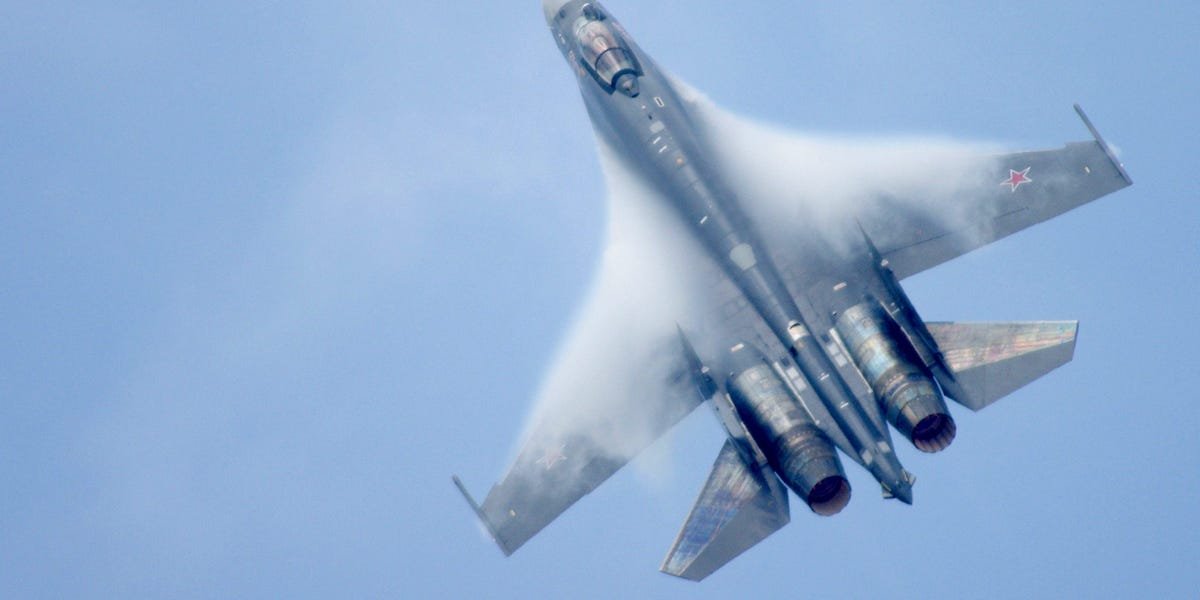
Russia’s Su-35 fighter jets are increasingly flying with longer-range air-to-air missiles that make them a potentially greater threat to NATO air operations, a leading airpower expert assessed in a recent report.

Justin Bronk, a researcher at the UK-based Royal United Services Institute, said in his assessment of Russian air power that regularly arming Su-35 and Su-30SM2 jets with R-37M missiles “has significantly contributed to increasing the threat that they can theoretically pose to NATO air operations.”

The R-37M missile, which NATO calls the RS-AA-13, is “much more capable at long range” than the R-77-1 missiles the Su-35 had previously relied on, Bronk told Business Insider in a discussion of his recent report.

R-77-1 missiles have a range of about 62 miles, while R-37M missiles are understood to have a range of around 200 miles. Real-world kills at range depend on a mix of factors, but reach still matters.

Bronk told Business Insider that the longer-range R-37M missiles had been “very much a specialist weapon” for a limited selection of Russian jets. But “now you see absolutely routine employment” of the weapon on Russia’s Su-35S.

The Su-35 fighter is “the primary air superiority aircraft for the Russians,” he added. The jet is key for Russia’s air force, with the UK Ministry of Defence in 2023 describing it as Russia’s “most advanced combat jet in widespread service.”

Bronk told Business Insider that for the NATO alliance, the regular arming of Su-35s and Su-30SM2s with the R-37M is “a problem” because it puts “more credible long-range air-to-air missiles at play from the Russian side.”

Those missiles used to be contained within a smaller part of the force, mainly Russia’s MiG-31s. Now, Bronk said, having them on more jets “is obviously a significant growth in the potential threat that they can pose to NATO aircraft in a direct conflict.”


A grey fighter jet in a light blue sky with fire visable in its two engines

The R-37M was previously concentrated on Russia’s MiG-31 jets.

Mikhail Svetlov/Getty Images


Additionally, he said, Russia’s Su-35 crews are “generally more highly selected, better trained, more capable than the crews on the MiG-31s.” Russia’s better pilots tend to fly its top jets, and those will be the pilots operating these missiles.

Having them routinely carry long-range air-to-air missiles, rather than the “really pretty limited” R77-1 that they used to carry, Bronk said, “is a significant shift.”

A missile with a longer reach

The R-37M’s combat effectiveness has been spotlighted by Russia’s full-scale invasion of Ukraine, which began in February 2022.

Late that year, a RUSI report said the R-37M, combined with Russia’s MiG-31BM interceptor aircraft, was proving to be “highly effective and difficult for Ukrainian pilots to evade due to its speed, very long range, and specialized seeker for low-altitude targets.”

At that time, it said Russia was just starting to put them on Su-35S jets.

A newer report from RUSI in November highlighted how much more the R-37M missile was being used, saying that this missile “in particular, has been used to destroy several Ukrainian aircraft at long range,” including one kill recorded at more than 109 miles.

“This is significantly beyond the engagement range of most NATO air-to-air munitions,” the report said. But it also said that the missiles’ success was “heavily determined by Ukraine’s lack of effective radar warning receivers,” something NATO has fielded far more robustly across its air forces.

The Su-35 threat

Making the Su-35 more powerful is a big move for Russia. In 2022, analysts at the RAND Corporation described the Su-35 as Russia’s “signature heavy fighter.”

Ukraine has shot down multiple Su-35s in its fight against Russia’s invasion, but Bronk said that despite reported losses, the fleet has “marginally increased since the start of the full-scale war.”

He estimated that in late 2020, Russia had about 90 Su-35s. Between eight and 10 have been lost in combat or accidents, he said, but 55 to 60 new aircraft have since been delivered — leaving Russia with roughly 135 to 140 Su-35s overall, a net increase despite the attrition.

Bronk’s analysis was based on interviews with Western air forces and ministries, data from Ukraine’s armed forces, and open-source information.

He said that the Russian air force has gained so much valuable combat experience against Ukraine that its air force is now “a significantly more capable potential threat for Western air forces than it was in 2022.”

He said that in air-to-air combat, where Russian aircraft take on Western ones, the West still has a strong advantage, but longer-range air-to-air missiles complicate the picture.

And any fight would not only be in the air. The West would face not only Russia’s air force but also its vast ground-based air defense network, which the war has also made more formidable.

Bronk told Business Insider that Su-35 crews are typically “much better at working with the ground-based air defenses,” meaning the jets can operate more effectively under the umbrella of Russian surface-to-air missile systems and are therefore “more credible as an air-to-air threat.”

He said that the improvement of those ground-based defenses throughout the war — combined with the fielding of more powerful missiles on Su-35s that are increasingly integrated with them — is one reason why Russian airpower “represents a greater threat to Western air power capabilities in Europe” than it did before the full-scale invasion.


Source link

A headshot of Insider's Pete Syme

Jet fuel shortage in Cuba forces airlines to cancel flights and send empty planes to pick up passengers

Cuba has warned airlines that it has no jet fuel, forcing some carriers to cancel flights, add refueling stops, or carry extra fuel.

Cuban aviation authorities issued a monthlong advisory on Monday that said jet fuel is unavailable at all of the country’s international airports.

The country relies heavily on Venezuela for much of its jet fuel, but supplies have been hit by US sanctions that have constrained Venezuelan oil exports. President Donald Trump has also threatened tariffs on countries that sell oil or petroleum products to Cuba.

Because of this, the country is running out of jet fuel, and therefore, airlines cannot refuel their planes on the island.

From the US, American Airlines, Delta Air Lines, and Southwest Airlines all operate direct flights to Cuba.

American and Delta said they are operating as usual. In a statement to Business Insider, Southwest said that it was requiring any aircraft flying there to also carry enough fuel to reach its next destination.

Some Canadian airlines are canceling flights entirely.

Air Canada, which had operated 32 flights a week to and from Cuba before, said it would suspend service to the country on Monday.

It will send empty planes to pick up some 3,000 customers who have already traveled to the island. These flights will be loaded with extra fuel, although the airline said refueling stops on the return leg may also be necessary.

Canadian airlines WestJet and Air Transat also said they would operate empty aircraft to help their customers. Air Transat said it would suspend flights to Cuba until at least April 30.

Several international airlines serve Cuba, and many of them are still operating flights. However, some of these will have to stop to refuel elsewhere.

Air Europa, a Spanish airline, said its flights from Havana to Madrid would stop in Santo Domingo, in the Dominican Republic, about two hours away.

“We apologise for any inconvenience this situation, which is beyond Air Europa’s control, may cause you,” it said in a travel alert.

Iberia, the Spanish flag carrier, Air France, and Turkish Airlines also fly to Cuba. They did not immediately respond to requests for comment, although it seems likely the distance would necessitate a refuelling stop.


Source link

Life-as-a-private-jet-flight-attendant-and-earning-over.jpeg

Life as a private jet flight attendant and earning over $100K

By the time 33-year-old private jet flight attendant Kelley Lokensgard greets her VIP passengers on the tarmac, she has been working for hours.

“I grocery shop the night before, then arrive two hours before the flight; I load my flower arrangements, prep my boarding appetizers, and touch up the cabin,” Lokensgard, the chief cabin attendant at Silver Air Private Jets, told Business Insider. “People don’t realize how many fingerprints they leave behind.”

That behind-the-scenes work is part of serving wealthy vacationers, business executives, and celebrities who expect flawless service and discretion.

Lokensgard, what started in 2021, said the job can be nonstop: she’s on duty for up to 21 days a month, sometimes at a moment’s notice, and is responsible for catering meals and tailoring each flight to client preferences.

This is a level of invisible labor that few people outside private aviation ever see; it’s not the glitz and glamour that social media often portrays. But Lokensgard — whose background is in music, youth education, and fine dining — said she loves the grind.


Private flight attendant Kelley Lokensgard at the golden temple in Kyoto.

Lokensgard visited the Golden Temple in Kyoto.

Courtesy of Kelley Lokensgard


“It’s a lot of schlepping and problem-solving and delicate communication with a lot of moving parts and people; you have to be a laborer to want to do this job,” she said. “I can’t imagine something that better suits my random scope of skills.”

Private flight attendants are a small but growing niche within aviation. Jobs, which are largely non-union, span from small and medium-sized private companies like Silver Air to mega operators like NetJets and VistaJet.

While many roles offer full-time benefits, as in Lokensgard’s case, others resemble gig work, which can allow for a flexible lifestyle but often comes with less predictability and fewer labor protections than at most US airlines.

The work often involves long, irregular hours, extended travel, and the demands of high-profile clients. And private flight attendants usually don’t have access to the free standby flights that commercial crew typically enjoy — meaning they only fly if a seat is available.

Still, there’s a significant payoff. Lokensgard gets to see the world through the destinations of her clients — essentially for free — while earning much more than most of her airline counterparts.

Lokensgard, who lives in Los Angeles, earns in the low six figures, though she said some veteran, freelance, and specially skilled VIP cabin attendants can make as much as $350,000 annually. Glassdoor puts the nationwide median annual salary at about $94,000.

By comparison, commercial flight attendants at American, Delta, and United typically earn a base salary between $30,000 and $80,000, depending on seniority, along with a per diem and additional pay opportunities like overtime, holidays, and international flying. Many senior crew members reach six figures after years of service.


Inside one of Silver Air's G550s.

An example of one of Silver Air’s G550s.

Silver Air Private Jets


To prepare for her role, Lokensgard completed five days of training and an online course: “There was so much to learn, it’s professionalism, luxury, service, and safety,” she said. Silver Air also sponsored culinary classes.

Her training is far shorter than the weekslong courses commercial flight attendants must complete, though that’s because the Federal Aviation Administration does not regulate corporate cabin attendant positions — its “flight attendant” rules apply to airlines and public charters, not private jets.

This means cabin training varies widely across private operators, though Lokensgard, as chief attendant, said she is incorporating more shadow flying and collaborative learning at her company.

Private aviation is not your normal 9-to-5

Lokensgard spends most of her days on the Gulfstream G550, a giant multimillion-dollar private jet with a bedroom and enough range to travel across oceans and continents. The plane has an owner but is also managed by Silver Air as a rental; Lokensgard serves whoever is on board.

She said these often long flights mean she is away from home for days at a time and must work early and late hours. A flight from the Los Angeles-area Van Nuys Airport to Tokyo, for example, would take about 11 hours and involve at least two meal services, she said.

Lokensgard must organize catering for the passengers, but is regularly asked to cook. She’ll meal-prep meats and vegetables the night before and has access to an approved skillet, oven, microwave, and chiller to work with on the plane.

“Sometimes our clients don’t want catering, and I will be told, ‘Hey, arrange steak, sushi, chicken tenders, french fries, salads, fruit platter, snacks, and desserts for the flight,'” she said. “I’ll shop at Erewhon, or I’ll ask a local steakhouse to sear a steak that I’ll finish off on the plane. Your head just explodes with ideas.”

Erewhon is the US’ most expensive grocery store and a hotspot for the LA elite.


Examples of meals the flight attendant has made.

Some meal examples include a green goddess salad sourced from an Italian farmers market and a Yucatan-style ceviche.

Courtesy of Kelley Lokensgard


Besides food service, Lokensgard said she must also perform safety checks, prepare meals for the pilots, and make the bed, among other duties. She added that there is surprisingly little time to rest, even on ultra-long-haul flights.

On the ground, Lokensgard is responsible for tasks like dishes, dry cleaning, and arranging catering for the next trip. After international flights, everyone clears customs, and Lokensgard must follow agricultural rules when disposing of food and trash.

Rest policies vary by operator. Lokensgard said her crew gets at least a day of rest after long-haul international flights; previously, Silver Air cabin attendants often finished such trips only to almost immediately hop on a commercial flight home. She receives a minimum of 10 hours of rest after shorter flights.

Lokensgard added that it sometimes makes more logistical sense for the crew to stay with the plane for a few days in its destination, giving her extra time to explore places ranging from major cities like London, New York City, and Nice to quaint ski towns in Austria.

“I make the most of it since we’re sacrificing time away from our families and communities,” she said. “We explore, see museums, and eat amazing food.” She also dedicates time to cultivating relationships with local chefs in the cities she visits for catering needs.


Lokensgard with her husband after being proposed to on the French Riviera.

Lokensgard said her husband flew to the French Riviera to propose to her during one of her layovers. She said he’s supportive of her travel-heavy career.

Courtesy of Kelley Lokensgard


Once home, Lokensgard said the first thing she does is wash her clothes and repack her suitcase, adding that she keeps a spare uniform in her car: “I have my road wardrobe and toiletries and my home ones.”

That constant readiness is essential in private aviation.

For example, on one reserve day — when she’s on standby for last-minute flights — Lokensgard was called at 6 a.m. for a flight that had to take off by 8:30 a.m. But the plane was departing from Teterboro Airport in New Jersey, at least 30 minutes from the crew’s Manhattan hotel.

“We’re ripping back the covers and packing our bags,” she said. “We’re calling to get the fuel trucks ready; I’m DoorDashing food to the airport and studying the client’s eight-page portfolio, but we were in the air by 8:26 a.m. That really built trust with the client.”


Source link

A-US-aircraft-carriers-hard-turn-to-avoid-enemy-fire.jpeg

A US aircraft carrier’s hard turn to avoid enemy fire surprised sailors and sent a jet with bad brakes into the sea

A US Navy aircraft carrier’s hard evasive turn to avoid enemy missile fire caught crewmembers off guard and sent a $60 million F/A-18 Super Hornet rolling off the deck and into the Red Sea, an investigation into the fighter jet loss revealed.

The fighter’s brakes weren’t functioning properly, investigators found, allowing the jet to slide across the deck when the carrier USS Harry S. Truman abruptly changed course during the late April action.

Poor communication, bad brakes, and a slippery surface all contributed to the loss.

A tow tractor also fell into the water alongside the expensive F/A-18 fighter jet, the second of three that the Truman lost during a monthslong Middle East combat deployment. When it went over, it nearly took sailors overboard as well.

Evading enemy fire

During their deployment, the Truman and its strike group led Navy combat operations against the Houthis, the heavily armed Iran-backed rebel group in Yemen that spent more than a year attacking key Middle East shipping lanes.


Three F/A-18 Super Hornets prepare to launch from the flight deck of the Nimitz-class aircraft carrier USS Harry S. Truman, December 21, 2021.

An F/A-18 fell overboard the Truman while the carrier took a hard turn.

US Navy Photo by Mass Communication Specialist 3rd Class Abbigail Beardsley


On April 28, the move crew lost control of an F/A-18 under tow in the Truman’s hangar bay, a maintenance area below the flight deck, the Navy reported at the time, and both the jet and its tow tractor tumbled into the Red Sea.

Right before it fell in, a sailor jumped from the cockpit, suffering minor injuries. The Navy didn’t share information or insight into the warship’s situation at the time of the plane loss.

According to the command investigation, the fighter jet and the tractor fell overboard while the Truman was conducting evasive maneuvers to avoid an incoming medium-range ballistic missile fired by the Houthis, a detail that had been reported but not confirmed at the time.

The move crew, which was preparing the F/A-18 from Strike Fighter Squadron 136 (VFA-136), the “Knighthawks,” for planned flight operations, didn’t hear the announcement that the ship was making a hard turn and was caught unaware when the ship began to tilt.

Sailors had removed the chocks and chains to pull the F/A-18 into the hangar bay. With the brakes engaged but not actually working, there was nothing to hold the aircraft in place when the carrier heeled in an evasive turn.


Two US Navy Aviation Ordnancemen transport ordnance across the hangar bay aboard the Nimitz-class aircraft carrier USS Harry S. Truman in the US Central Command area of responsibility.

The hangar bay is an area underneath the flight deck where aircraft receive maintenance.

US Navy photo


It slid backward toward the deck edge, dragging the tow tractor behind it. The crew moving the Super Hornet abandoned their posts just before the fighter jet fell into the sea.

Bad brakes

The command investigation put the blame for the incident primarily on the fighter jet’s inadequate brake engagement and the lack of communication from the Truman’s bridge to flight deck control and the hangar bay.

Leadership also said that the non-skid, a rough, high-friction coating applied to the decks of Navy ships to keep people, vehicles, and aircraft from slipping on smooth steel surfaces, was ineffective, having not been replaced since 2018.

These problems, the investigation said, cost the Navy an F/A-18, a multirole fighter made by the US aerospace giant Boeing that has been in service with the Navy for decades.

The April incident was one of four major mishaps that the Truman and its strike group suffered during their deployment.

In December, the cruiser USS Gettysburg accidentally shot down one of the Truman’s F/A-18s in what the military described as a friendly fire incident. In February, the carrier collided with a cargo ship. And in May, the ship lost its third fighter jet after a landing failure caused it to slide off the flight deck and plunge into the sea.


Source link