
Spirit-Airlines-plans-to-shrink-its-fleet-to-fewer-than.jpeg

Spirit Airlines plans to shrink its fleet to fewer than 80 jets. It once had over 200.

US budget carrier Spirit Airlines says it is downsizing its fleet by almost two-thirds.

The Florida-headquartered air carrier, known for its no-frills flying and ultra-low-cost fares, filed for Chapter 11 bankruptcy protection in August — the second time in less than a year.

While it once operated more than 200 aircraft, Spirit now intends to run fewer than 80 by the third quarter of 2026. It anticipates adding aircraft between 2027 and 2030.

In a news release, Spirit said it will continue to align its network with consumer demand and focus on its strongest routes and markets, including Fort Lauderdale, Orlando, Detroit, and New York City. It also plans to expand its first class and premium economy options.

The company said it expected its debt and lease obligations to be reduced from $7.4 billion pre-filing to about $2 billion post-emergence.

“While we still have work to do with other important stakeholders, today’s agreements and filings are very material steps forward toward emergence,” Spirit’s president and CEO, Dave Davis, said in a press release. “I also want to thank our team members and guests for their support as we work together to build a stronger Spirit.”

Mounting financial losses

Spirit first sought bankruptcy protection in November 2024, following years of mounting financial losses and the collapse of a proposed $3.8 billion merger deal with JetBlue.

The budget airline, easily recognizable by its bright yellow planes, reported in its initial voluntary bankruptcy petition that as of September that year, it had $9.49 billion in total assets and $8.99 billion in total debts.

Spirit emerged from bankruptcy in March last year after the airline said it slashed $800 million in debt and received a $350 million equity infusion from existing investors “to support Spirit’s future initiatives,” but the rebound was short-lived.

In a Securities and Exchange Commission quarterly report filed last August, the airline’s parent company, Spirit Aviation Holdings, warned it may not be able to stay in business another year. Later that month, the airline filed for bankruptcy protection for a second time and has been cutting costs ever since. At the time of its filing, Spirit listed debt of $8 billion and assets of $8.56 billion.


Source link

Israel-struck-Iran-with-F-35I-Adir-stealth-fighter-jets-that.jpeg

Israel struck Iran with F-35I Adir stealth fighter jets that cost $44,000 per hour to fly

Updated

  • Israeli Air Force F-35I planes struck Iranian missile systems and military leaders on Saturday.
  • The Israeli F-35 variant is known as “Adir,” meaning “Mighty One” in Hebrew.
  • The planes also struck Iran in June and aided defenses against Iranian missiles in 2023 and 2024.

Israel launched what it called “the most extensive aerial operation ever conducted by the Israeli Air Force” on Saturday, targeting Iranian missile systems and military leaders in tandem with US forces. Israel’s F-35I stealth fighter jets were on the front lines.

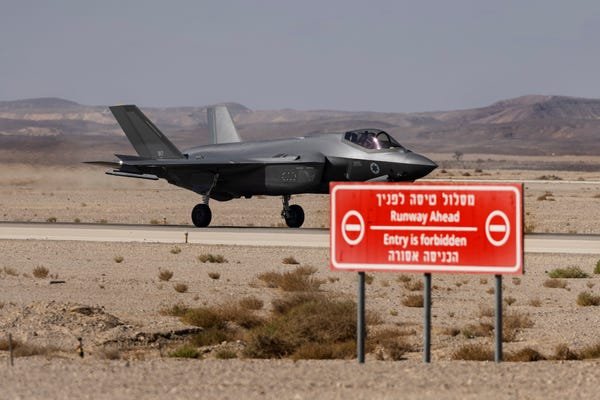
The Israeli variant of the US-made Lockheed Martin Lightning II Joint Strike Fighter plane is known as “Adir,” meaning “Mighty One” in Hebrew. With advanced stealth capabilities and a customized electronic warfare system, the F-35I is one of the most powerful tools in Israel’s air defense arsenal.

In addition to Israel’s newest assault on Iran, the Israeli planes also conducted preemptive strikes against Iran’s nuclear program in June, intercepted hundreds of drones, missiles, and rockets fired by Iran in a retaliatory attack in 2024, and took down a missile fired by an Iran-backed group in Yemen in 2023, according to the Israel Defense Forces.

Here’s a closer look at the “Mighty One” military aircraft.

F-35 Lightning II stealth fighter jets, produced by Lockheed Martin, are some of the most advanced military aircraft in the world.

An Israeli F-35I lands at Ovda airbase near Eilat, southern Israel.

Tsafrir Abayov/AP

The F-35 stores its weapons and fuel internally, and its aligned edges and radar-absorbent coating also help the aircraft evade detection. The planes cost $44,000 per hour to fly, The National Interest reported.

They feature advanced stealth and information-processing capabilities and can reach supersonic speeds of Mach 1.6, or 548.8 meters per second.


An Israeli Air Force F-35I Adir multirole fighter aircraft

An Israeli Air Force F-35I Adir fighter aircraft flies over the Negev Desert.

YURI CORTEZ/AFP via Getty Images

Lockheed Martin CEO Marillyn A. Hewson said in 2018 that the planes “can fly in what we call ‘beast mode,‘ carrying up to 18,000 pounds of internal and external ordnance, in a mix that can include 5,000-pound-class weapons.”

In 2016, Israel became the first country other than the US to acquire F-35 fighter jets.


Israeli Prime Minister Benjamin Netanyahu stands next to a F-35 fighter jet just after it landed in Israel at Nevatim air base  in 2016

Israeli Prime Minister Benjamin Netanyahu stands next to an F-35 fighter jet just after it landed in Israel at Nevatim air base.

Amir Cohen/Reuters

Israel was the first country to select the model through the US Foreign Military Sales process and bought 50 planes, according to Lockheed Martin.

Israel has made significant modifications to the jets.


A new production line for F-35 wings is seen in Israel Aerospace Industries' (IAI) campus, near Tel Aviv

A production line for F-35 wings in Israel Aerospace Industries’ (IAI) campus near Tel Aviv.

Amir Cohen/Reuters

Israel manufactures its own wings and electronic warfare system for the F-35I. It also developed its own version of the high-tech helmet that displays the plane’s airspeed, altitude, targeting information, and other crucial stats directly on the pilot’s visor.

The Israeli Air Force named its F-35I variant “Adir,” meaning “Mighty One” in Hebrew.


Israeli Air Force technicians customize an F-35I plane with a Star of David symbol.

Israeli Air Force technicians customize an F-35I plane with a Star of David symbol.

Israeli Air Force

The Israeli Air Force also added a six-pointed Star of David to the design, a Jewish symbol that also appears on the Israeli flag.

In 2018, Israel became the first country to use the F-35I in combat, its air force chief said.


An Israeli Air Force F-35 flies during an aerial demonstration

Israeli Air Force F-35 flies during an aerial demonstration.

Amir Cohen/Reuters

“We are flying the F-35 all over the Middle East and have already attacked twice on two different fronts,” then-Israeli Air Force chief Major-General Amikam Norkin said in a speech at a gathering of foreign air force leaders, Reuters reported.

In July 2023, Israel acquired an additional 25 Adir planes in a $3 billion deal.


Israeli F-35I planes at Nevatim airbase in Israel.

Israeli F-35I planes.

Israeli Air Force

The deal was financed through the military aid Israel receives from the US, Reuters reported.

In November 2023, Israel’s F-35I Adir fighter jets took down a missile fired by an Iran-backed group in Yemen, according to the IDF.


An Israeli F-35 fighter jet

A F-35I fighter jet flies during a graduation ceremony for Israeli Air Force pilots in southern Israel.

Amir Cohen/Reuters

It was the first known intercept of a cruise missile by an F-35 plane.

The Israeli Air Force released footage of the encounter on X, writing in Hebrew that its personnel are “preoccupied at every moment with planning and managing the defense response and are prepared for any threat in any area.”

Iran appeared to target the Nevatim air base, which houses Israel’s fleet of F-35I jets, during an attack in April 2024.


An Israeli F-35 combat aircraft is seen in the skies over Israel's border with Lebanon

An Israeli F-35 combat aircraft in the skies over Israel’s border with Lebanon.

Ammar Awad/Reuters

Out of the over 350 ballistic missiles, cruise missiles, and UAVs, or unmanned aerial vehicles, launched at Israel by Iran and its proxies in Iraq, Yemen, and Lebanon, around 99% were intercepted by Israel and its allies. The IDF released photos showing minor damage near a runway at the Nevatim Airbase and to a road in Hermon caused by the few projectiles that landed.

The missiles appeared to target Israel’s Nevatim Airbase in the Negev desert, which houses its fleet of F-35I stealth fighter jets. The base remained operational throughout the attack, according to the IDF, with the Adir fighter jets aiding the defensive mission.

“Iran thought it would be able to paralyze the base and thus damage our air capabilities, but it failed,” IDF spokesperson Rear Adm. Daniel Hagari said in a statement.

In June 2025, the Israeli Air Force launched around 200 fighter jets, including F-35Is, in a preemptive strike targeting Iran’s nuclear program.


An F-35I Israeli fighter jet used in strikes against Iran.

An F-35I Israeli fighter jet used in strikes against Iran.

Israel Defense Forces

An IDF spokesperson said that Israeli fighter jets struck over 100 sites across Iran to prevent it from developing a nuclear weapon, including military targets and its largest uranium enrichment site in Natanz.

The IDF said that Iran’s nuclear program had “accelerated significantly” in recent months and called it “clear evidence that the Iranian regime is operating to obtain a nuclear weapon.” Iran maintains that its nuclear program is solely for civilian purposes.

“This is a critical operation to prevent an existential threat by an enemy who is intent on destroying us,” Lt. Gen. Eyal Zamir, the IDF’s Chief of the General Staff, said in a statement.

The IDF released photos showing planes used in the large-scale operation, including F-35I jets.

F-35Is struck Iran over the weekend in what the IDF called “the largest military flyover in Israeli Air Force history.”


US and Israeli F-35s flying together during a training exercise.

US and Israeli F-35s flew together during a training exercise. The two countries launched new strikes against Iran using land, air, and sea assets.

U.S. Air Force photo by Senior Airman Duncan C. Bevan

As part of Operation Roaring Lion, Israel’s moniker for Operation Epic Fury, around 200 Israeli fighter jets, including F-35Is, struck 500 Iranian missile launchers and aerial defense systems on Saturday. IDF spokesperson Lt. Col. Nadav Shoshani characterized the operation as “the most extensive aerial operation ever conducted by the Israeli Air Force.”

The strikes “significantly degraded” Iran’s offensive capabilities, the IDF said. The strikes also killed Iranian military leaders, including Iranian Defense Minister Aziz Nasirzadeh and Mohammad Pakpour, commander of the IRGC.

The war in Gaza prompted new scrutiny of US military aid to Israel.


An Israeli soldier sits inside a F-35 fighter jet

An Israeli soldier sits inside an F-35I fighter jet after it landed in Israel at Nevatim Airbase.

Amir Cohen/Reuters

The October 7 terrorist attacks carried out by Hamas killed around 1,200 Israelis and captured over 240.

Israel’s counteroffensive airstrikes and military actions in Gaza resulted in over 72,000 Palestinian fatalities, according to figures provided to the United Nations Office for the Coordination of Humanitarian Affairs by the Hamas-run Ministry of Health in Gaza. The IDF reports that at least 17,000 of these fatalities were Hamas militants. A ceasefire agreement was reached in October.

According to the United Nations Relief and Works Agency, over 1.9 million Gazans, around 90% of the population, have been displaced by the war.

The devastating human toll of the war in Gaza with US-funded planes like the F-35I has prompted new scrutiny of US aid to Israel, with some lawmakers in Congress raising the possibility of conditioning military and economic aid.


Source link

Headshot of Chris Panella.

Israeli combat footage shows it bombing vintage American-made fighter jets in Iran

Israel shared new footage of it bombing two of Iran’s American-made fighter jets preparing to take off as joint US-Israeli combat operations against Iran continue.

Iran’s fleet includes several vintage US aircraft, including the McDonnell Douglas F-4 Phantom II and legacy Northrop Grumman F-5s. Along with Iran’s few US-provided Tomcats, which were iconized in the “Top Gun” movies, these aircraft are part of an aging Iranian Air Force that has limited air combat capabilities against advanced Israeli and US aircraft.

The Israel Defense Forces video captured strikes on the F-5 and F-4 jets at an airport in Tabriz in western Iran on Sunday morning. The IDF said that it hit the aircraft as they were preparing to take off. The footage shows direct hits on each aircraft.

Israel and the US launched massive attacks on Iran on Saturday, dubbed Operation Epic Fury by Washington and Operation Roaring Lion by Israel. The attacks are aimed at eliminating Iranian leadership and ushering in regime change in Tehran. As of Sunday, Israel and the US say they’ve taken out dozens of Iranian officials, including Supreme Leader Ayatollah Ali Khamenei.

Iran has launched several phases of retaliatory missile and drone strikes against Israel and bases hosting US troops in the region, including Qatar and the United Arab Emirates. The US and Israel have said the operations will continue into the coming weeks.

In sharing the video on the F-4 and F-5 strikes, the IDF said the attacks “were conducted to degrade the Iranian Air Force’s activities and to further expand the degradation of their aerial defense.” The US has said operations are aimed at crippling Iran’s military.

Vintage US-made aircraft


An F-4 Phantom II aircraft painted with a camouflage color scheme.

The F-4 Phantom II was a workforce fighter bomber for the Air Force and Navy during the Vietnam War.

Vincent De Groot/185th Air Refueling Wing, Iowa Air National Guard


Iran operates a fleet of aging aircraft, including some that are US-made but have become obsolete over the years due to international sanctions and embargoes that have prevented the country from modernizing its fleet.

The F-4 Phantom II, manufactured by the McDonnell Aircraft Corporation and later McDonnell Douglas, now part of Boeing, entered service in the US in early 1960s and was a workhorse during the Vietnam War and Cold War. The two-seat, twin-engine fighter was flown by the US Air Force, Navy, and Marine Corps for decades as a principal air superiority fighter.

Through the 1970s and the end of the 20th century, the F-4 was gradually replaced by the F-15 Eagle, F-16 Fighting Falcon, and F/A-18 Hornet, as well as the F-14 Tomcat for various US armed forces.


A F-4 Phantom II is seen sitting on tarmac.

The F-4 was retired by the US in 1990s, while other countries gradually stopped flying the aircraft through the 2020s.

AFSC/Defense.gov


Prior to the 1979 Iranian Revolution, which upended ties, the US sold many of these aircraft to Iran.

Iran still fields large numbers of the aging fighters — among the most numerous of these Cold War designs still in service globally — but their operational rates have fallen sharply due to sanctions and the difficulty of sustaining upgrades and spare parts.

Iran has kept some aircraft flying due to reverse-engineering, but it’s been estimated to only have about 60 F-4s, fewer than 50 F-5s, and 20 to 30 F-14s in its inventory. Combat over the past year may have reduced those numbers even further.

Actual airworthy numbers are likely lower than reported, with some jets stripped for parts. Iran’s effective airpower remains contested and constrained by attrition and long-running maintenance hurdles.

In contrast, Israel and the US fly newer, more powerful aircraft, including the fifth-generation F-35 stealth fighter, as well as a mix of highly capable fourth-generation jets like F-16s and F-15s.

In previous conflicts, as well as the current one, Israel has said that it’s achieved air superiority over swaths of Iran with a mix of fourth- and fifth-gen fighters and by degrading Iran’s air defenses.


Source link

Saab-is-considering-arming-its-Gripen-jets-with-a-proven.jpeg

Saab is considering arming its Gripen jets with a proven drone-killer rocket after watching Ukraine’s war

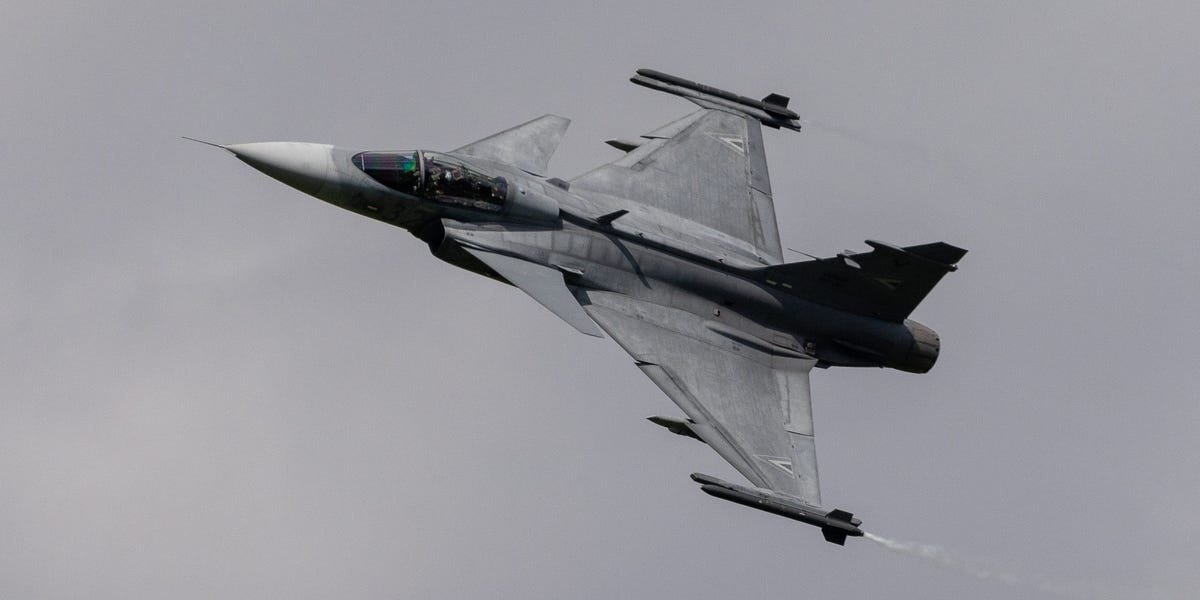
Swedish defense prime Saab is exploring the Advanced Precision Kill Weapon System as a cheaper armament option for its JAS 39 Gripen fighters, firm executives told Business Insider this week.

“The APKWS is in interest because other platforms are now integrating 70mm guided rockets. So we are, of course, eyeing that capability now,” Jussi Halmetoja, operations advisor for Saab’s air domain, said at the Singapore Airshow.

Halmetoja said the company was looking at ways to integrate the weapons system, which uses a guided version of the Hydra 70mm rocket, onto its older Gripen C and latest Gripen E models.

He made the comments as he and Mikael Franzên, chief marketing officer for the Gripen program, discussed the company’s observation from the Ukraine war that it needs more inexpensive weapons to counter uncrewed aerial systems.

“I mean, right now we are using very expensive weapons to kill very cheap drones,” Franzén said of traditional Western air combat.

He added that Saab is hoping to potentially equip the Gripen with systems that can fit multiple munitions onto a single hardpoint.

“If you can have four or 10 on each hardpoint, then you can kill a lot more drones,” Franzên said. The APWKS is typically mounted on aircraft with multilaunch pods.

Kyiv has signed a letter of intent with Sweden to potentially acquire up to 150 Gripen E fighters in the coming years. Ukraine’s air force has yet to fly the jet, which is touted as an ideal fighter for battling Russia because it’s built to operate from dispersed, rugged airfields and in the Arctic domain.

Kyiv is now flying much of its small fleet of F-16 Fighting Falcons from such small airfields, often moving the aircraft to increase their survivability.

But Franzén and Halmetoja said the Gripen can turn around much faster from dispersed airfields and be ready for a new mission within 10 minutes of landing.

Sweden, South Africa, Brazil, Thailand, Czechia, and Hungary are among the countries that fly the Gripen.

The APWKS, meanwhile, is already being deployed across various systems in Ukraine.

For example, the VAMPIRE counter-UAS systems feature a four-barrel launcher for the guided Hydra rockets that can be mounted on a pickup truck.

The cost of using one APKWS round is estimated at $20,000 to $35,000, compared to weapons more typically associated with modern fighters, such as the AIM-9 Sidewinder, which costs roughly $450,000, and the AIM-120 AMRAAM, which costs roughly $1 million.

Concerns about missile costs against cheaper drones have risen steadily since the war began, and as Russia has continuously grown its loitering munitions mass manufacturing.

Outside Ukraine, the US military has also been using the APWKS to recently fight drone attacks in the Middle East. The weapons system, loaded on American F-16s and F-15s, was responsible for roughly 40% of the drone kills scored by US forces against Houthi drones during last year’s Operation Rough Rider.


Source link