
Jury-rules-against-Meta-YouTube-in-bellwether-teen-addiction-case.jpeg

Jury rules against Meta, YouTube in bellwether teen addiction case — the first of many

Meta and Google were found negligent in social media addiction trial in Los Angeles on Wednesday, potentially setting the stage for dozens of similar lawsuits that have been brought against Big Tech companies.

The case centered on a 20-year-old woman, identified as KGM, who said her use of social media from a young age was detrimental to her mental health and accused the companies of knowingly engineering their products to addict kids.

After nine days of deliberation, the jury found Meta, the parent company of Facebook and Instagram, and Google, which owns YouTube, negligent. In a 10-to-2 vote, the jury also ruled that the two companies knew their design was “dangerous” but failed to warn the plaintiffs.

The jury awarded the plaintiff $3 million in compensatory damages and will proceed to punitive damages, which could increase the amount of money owed.

“We respectfully disagree with the verdict and are evaluating our legal options,” a Meta spokesperson said. Representatives for Google didn’t immediately return a request for comment.

The trial in Los Angeles state court has been viewed as a bellwether, offering a key test of how juries may see similar personal injury lawsuits brought by over 2,000 individuals. Meta has said potential damages in certain cases could reach into the “high tens of billions of dollars.”

TikTok and Snapchat were also defendants, but settled the lawsuit before the trial began.

Meta executives testified at the trial last month, including CEO Mark Zuckerberg and Head of Instagram Adam Mosseri, drawing large crowds of media and concerned parents, including some involved in other social media addiction lawsuits.

The companies have argued that plaintiffs’ struggles are due to myriad reasons and can’t necessarily be linked to social media.

During Meta’s closing argument at the Los Angeles trial, Paul Schmidt, one of the company’s attorneys, said the plaintiff needed to prove that if Instagram were taken away from KGM, her “life would be meaningfully different.”

“The evidence has shown just the opposite,” Schmidt said.

In January, Meta warned investors that its mounting legal battles related to youth safety could “significantly impact” its 2026 financial results. Attorneys for more than 100,000 individual arbitration claimants have “sent mass arbitration demands relating to ‘social media addiction'” since late 2024, the company said in a 2026 10-K, specifically noting the case in Los Angeles, as well as a separate case in New Mexico.

The New Mexico case, which occurred at the same time as the Los Angeles trial, addressed different legal and technical issues.

On Tuesday, a jury in New Mexico ordered Meta to pay $375 million after a verdict came down in the state’s lawsuit against the company about sexual exploitation.

Meta said it would appeal the case.


Source link

Guilty-on-all-counts-Jury-convicts-Netflix-director-Carl-Rinsch.jpeg

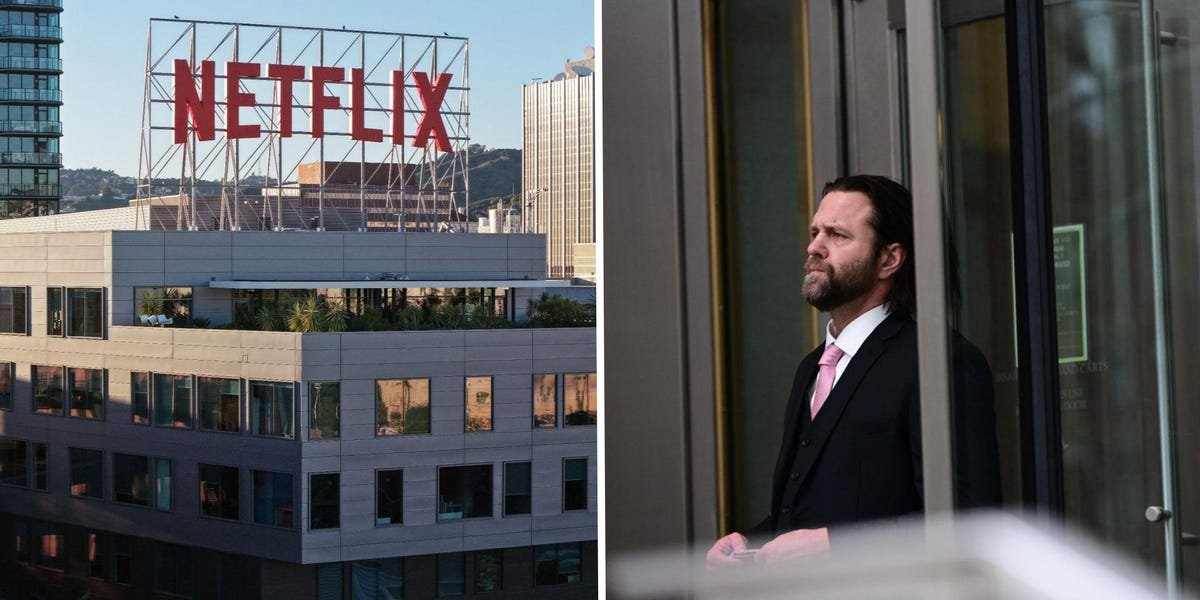
Guilty on all counts: Jury convicts Netflix director Carl Rinsch in $11 million fraud case

A Manhattan federal jury on Thursday found Carl Rinsch guilty on charges that he scammed Netflix out of $11 million in a lavish spending spree.

After less than five hours of deliberation, the jury said it found Rinsh guilty on all seven counts, including fraud, money laundering, and illegal money transmission. He faces up to 90 years in prison, but is expected to be sentenced to far less.

Rinsch, wearing a purple-plaid tie and matching pocket square, looked straight at the judge as the jury foreman read the verdict.

The case centered on the millions of dollars Netflix paid Rinsch to film “White Horse,” a sci-fi epic about a world where clone-like beings, after a schism with humankind, create their own society walled off from the rest of the world. Rinsch testified in his own defense earlier this week.

Rinsch — a Ridley Scott protege who previously directed the Keanu Reeves-starring “47 Ronin” — shot footage for “White Horse” on two continents. But by the fall of 2019, he exceeded the $44 million Netflix budgeted for the project and asked for more money.

Through the end of 2019 and early 2020, Rinsch negotiated with Netflix to figure out how to move “White Horse” forward and realize his ambitions. He envisioned a franchise like “Star Wars” and “Game of Thrones,” complete with an elaborate fantasy world, that could become part of Netflix’s catalogue.

In March of 2020, the streaming service agreed to give Rinsch’s production company another $11 million.

Then, everything went wrong.

On the witness stand in Manhattan federal court, he said he believed the bulk of the $11 million was meant to reimburse him for keeping the production of “White Horse” afloat the previous fall, when it had gone over-budget. According to him, Netflix expected him to conduct only “soft pre-production” on a potential second season.

Netflix balked. Former executives testified in the trial that the $11 million was meant to go toward finishing a first season that Rinsch never delivered. According to prosecutors, the entire negotiation for the $11 million was a sham, and Rinsch meant to defraud the company all along.

At closing arguments on Wednesday, Assistant US Attorney David Markewitz presented the jury with a Buzzfeed-style list of “10 Ways You Know Carl Rinsch is Guilty.” In a slideshow, he walked them through what he said were Rinsch’s contradictory claims — on the witness stand, in emails and text messages, and in prior statements in a civil legal dispute with Netflix — that he said demonstrated Rinsch wasn’t telling the truth.

He argued it was absurd to think Rinsch’s lavish purchases — like a $439,000 handmade Hastens mattress — could not have possibly been meant for the production of “White Horse.” And Rinch’s 2021 purchases of Rolls-Royces were insured in his own name, rather than insured by Netflix.

“In a TV show, a mattress is going to be covered by sheets and a blanket,” Markewitz told the jury. “No one watching ‘White Horse’ from home is going to have any idea what is under those linens.”

Daniel McGuinness, an attorney representing Rinsch, told the jury that Rinsch never had the “intent” required to find him guilty.

He showed them emails and texts leading up to the March 2020 agreement that he said demonstrated Rinsch’s negotiating posture had always been that Netflix owed him about $11 million for reimbursement. Rinsch never said he would spend all the money on additional production for “White Horse,” McGuinness said.

In reality, according to McGuinness, the situation was a “contract dispute” based on misunderstandings between Rinsch and Netflix.

“They were talking past each other, and the government has turned it into a nefarious fraud conspiracy,” McGuinness said.

This is a breaking story. Please check back for updates.


Source link

Jury-hears-how-Netflix-director-lost-a-fortune-on-options.jpeg

Jury hears how Netflix director lost a fortune on options trades — days after streamer sent him $11M for ‘visionary’ show

Director Carl Eric Rinsch made so many failed, seven-figure option bets after Netflix wired him $11 million that his broker at Wells Fargo tried — and failed — to stop him, a New York fraud jury heard on Tuesday.

“I can afford to lose the money,” Rinsch said, according to testimony by his former Wells Fargo advisor, Ronald See.

And when the brokerage hit the brakes — limiting him to $250,000 per transaction — the show developer was undaunted.

On March 30, 2019, just three weeks after receiving the $11 million, Rinsch instructed See, of Wells Fargo Advisors, to wire his remaining $8.5 million to Citibank so he could establish a new brokerage account with Charles Schwab.

“They won’t put restrictions on me there,” Rinsch wrote See in a letter shown to jurors.

Rinsch, 48, is on trial in federal court in Manhattan, fighting charges that he had no right to use the $11 million Netflix sent him on anything other than “White Horse,” the 120-minute TV series he’d already spent $44 million of Netflix’s money on. (Rinsch ultimately never finished a single episode of the clones-versus-humans sci-fi thriller.)

Defense lawyers counter that the $11 million was actually Rinsch’s contractually-promised payment for having completed principal photography, and was his money to spend as he pleased.

Either way, testimony on Tuesday by two of Rinsch’s former financial advisors showed that he was eager to spend the cash prosecutors say the director had quickly moved into his Wells Fargo account.

The streamer wired Rinsch the $11 million on March 6, 2020, as the COVID-19 pandemic halted film production worldwide.

Over the next three weeks, he then lost some $5.8 million, almost all of it on highly risky options trades involving Gilead Sciences, which was developing COVID-19 treatment drugs. (See would earn a $22,000 fee on these losses, the defense pointed out on cross-examination.)

The director was off to the races again as soon as he switched to Charles Schwab, according to testimony.

“I could send $3 mm personal to get started,” he wrote to his new financial advisor, Adam Checchi, who also testified on Tuesday.

“I understood that to mean three million from his personal funds,” Checchi said under questioning by a federal prosecutor.

Checchi told jurors that Rinsch would soon lose almost $6 million more, mostly on failed, highly risky bets that Gilead’s stock would rise and that the S&P 500 would decline.

“I’m not a broad, diversify kind of guy,” Rinsch explained in a late March 2020 email, adding that he pursues “aggressive” option trading “fully expecting to lose it all.”

Earlier in the day, former Netflix executive Peter Friedlander, who on Monday called Rinch’s project “visionary,” completed a second day of testimony.

On overhead screens, defense attorney Benjamin Zeman showed Friedlander — and the jury — emails from August 2019, in which Rinsch begged for “immediate support” with casting in Brazil.

“Show is set to collapse,” Rinsch wrote.

The defense is blaming the implosion of White Horse on Netflix’s decision to pull support for the project in September 2020.

In the email chain projected throughout the courtroom on Tuesday, Zeman attempted to show jurors that a year earlier, Friedlander was already cold toward the show developer’s requests for help.

“His own delays in decisions have caused this,” Friedlander wrote in forwarding Rinsch’s email to Mike Posey, an original series vice president, and others, including production executive Shelley Stevens and Rahul Bansal, an original series director.

Rinsch would continue asking for support — and money — for another six months before Netflix forwarded the $11 million payment at the center of the trial. The project was ultimately written off by Netflix as a tax loss eight months later, in November 2020.

Rinsch’s trial is expected to continue through next week. He faces up to 90 years in prison if convicted of wire fraud, money laundering, and engaging in unlawful monetary transactions.


Source link