
Amanda Goh

For this mom, moving to work in South Korea felt like a ‘full-circle moment’ — even if it came with one sacrifice

When Motolani Adedipe moved from Oklahoma to Seoul, South Korea, in August, she didn’t just pack her suitcase — she brought along her 6-year-old daughter, newborn baby, and mom.

Adedipe, who is from Nigeria and moved to the US to attend grad school in Texas, first grew curious about South Korea while interning at a biotech firm in Boston, where she shared an apartment with a Korean roommate.

“For that summer, I ate a lot of Korean food. She put me on K-dramas,” Adedipe, now 39, told Business Insider. That early curiosity soon grew into an interest in Korea’s history, economy, and language.


A woman posing with calligrpahy.

She became interested in Korean culture after sharing an apartment with a Korean roommate in Boston.

Provided by Motolani Adedipe.


Adedipe began learning Korean nine years ago online and continued after she moved to Oklahoma for work, where she became an associate professor at the University of Oklahoma Health Sciences Center.

In September 2024, Adedipe applied for a Fulbright scholarship to extend her research in prostate cancer survivorship. She already knew she wanted to go to South Korea — even as she prepared to give birth to her second child that November.

She made it through the first review in December, but when months passed with no update, she figured she hadn’t made it. So when the acceptance came through in April, the moment felt surreal.


A woman giving a presentation at a podium on stage.

Winning the Fulbright scholarship gave her a chance to further her research in South Korea.

Provided by Motolani Adedipe.


“It was like the best news and almost the worst news at the same time. Best because finally I get to do this. But of course, the anxiety, how do we start planning now?” Adedipe said.

Thankfully, her family was supportive, especially her husband.

“It required faith, sacrifice, structure, and for both of us to really imagine a life that looked very different from what we had planned,” she said.

Moving to Seoul

Her physician husband couldn’t accompany her to South Korea, but they agreed that she would bring both daughters along.

“How many of her peers would ever say, ‘Oh, I took a gap year in Korea’?” she said, referring to their 6-year-old.

Knowing the scholarship would last just one year made the decision easier. Her husband has visited them in South Korea several times and plans to make more trips over the coming months.

“I saw it as an opportunity for my children to experience another culture, language, and way of life, while still having a clear sense of return,” Adedipe said.

Now, she homeschools her daughter in the morning before sending her to a “hagwon,” a type of private academy that many Korean students attend after school.


A young girl wearing a hanbok, photographed from the back.

She says she sends her daughter to an after-school academy in Seoul.

Provided by Motolani Adedipe.


“Not all of her friends speak English, so they kind of communicate through play,” she said.

Adedipe’s mom, who had traveled to Oklahoma to help out with the kids, joined them in Seoul.

As she searched for housing, Adedipe had a long checklist: enough space for her family, easy access to the subway, flat streets her mother, in her early 60s, could navigate, and a neighborhood that felt safe for kids.

She found a two-bedroom, one-bathroom apartment in Mapo-gu, a district in western Seoul home to several universities.


A woman posing in Bukchon Hanok Village in South Korea.

Her two-bedroom apartment is about a 30-minute commute to her office.

Provided by Motolani Adedipe.


Although the apartment was smaller than she initially hoped for, it turned out to be a great fit: It’s surrounded by greenery and about a 30-minute commute to her workplace.

Her scholarship includes a housing stipend that covers her rent, which she declined to share.

Per the latest December data from the Korea Real Estate Board, the median monthly rent for an apartment in Mapo-gu is 1.39 million Korean won, or about $940.

Adedipe says her schedule varies from week to week, but her work typically starts in the afternoons. She goes into her office at Seoul National University Hospital several times a week, while continuing to supervise her lab in Oklahoma remotely at night.

Forging closer relationships with her loved ones

Data from the Ministry of Justice showed that the number of foreigners living in South Korea at the end of 2024 stood at 2.65 million, a 5.7% increase from the previous year.

A US veteran who had retired in South Korea previously told Business Insider that he appreciated the country’s safety and culture of respect. Meanwhile, a millennial who moved from Switzerland to Seoul said she valued the convenience of city life, including how most stores stay open late.


A woman posing with a famous Little Prince statue in Busan, South Korea.

She says she has been surprised by the kindness of strangers in the city.

Provided by Motolani Adedipe.


One of the biggest adjustments, Adedipe said, has been the extent to which technology is deeply woven into daily life in Seoul. Nearly everything is tied to having a registered phone number.

“Once I got my card and I got a bank account and I got a phone number that was registered, life became easy,” she said.

Even though the city is known for its fast-paced lifestyle, Adedipe says she’s been surprised by its human side.

“I lost my stylus in the bus, and I was able to get it back. It was tagged, and they verified they found it. That could never happen in the US,” she said.

Watching her daughter flourish and adapt to their life in Seoul has been especially meaningful.

“Now that I’m seeing where she’s shining. My goal is to keep encouraging her to find her passion in life and do that,” she said.


A woman wearing a traditional hanbok.

Being able to live and work in South Korea felt like a “full circle moment” for her.

Provided by Motolani Adedipe.


In addition to learning Korean, her daughter takes part in extracurricular activities, such as piano, inline skating, and Taekwondo.

“She’s doing everything that I never could have been able to give her because in Oklahoma, if you’re doing all those classes, you have to drive your kids to all those classes,” she said. “But here in Korea, because of how the education is structured, she does all of that in a school, and she loves it.”

Living abroad with her mother has brought them closer. After leaving Nigeria for the US in her 20s, Adedipe went nearly eight years without seeing her mom because of visa issues.

“And now that I get to live with her again, it’s like a dream come true,” she said.

Looking back on her own experience, Adedipe says living and working in South Korea has felt like a “full circle moment,” after years of interest in the country.

“It felt like all the pieces of my life — research, storytelling, culture, and well-being — were suddenly being invited into the same room,” she said.

Do you have a story to share about relocating to a new city? Contact this reporter at agoh@businessinsider.com.


Source link

Burned-out-in-her-50s-she-left-corporate-life-Starting.jpeg

Burned out in her 50s, she left corporate life. Starting over in Korea helped her heal.

Jane Newman spent her evenings watching K-dramas on her recliner during the pandemic lockdowns. She didn’t expect they’d spark a curiosity about South Korea that would eventually lead her to move there and start over.

In 2023, Newman was working for a consulting firm in Brisbane, Australia. As a manager, her heavy workload didn’t let up even as the world began to return to normal.

After months of long hours spent in front of a screen, she was burned out and beginning to feel the strain.

“I started out with a whole lot of shoulder and back pain, and then it developed into arm pain, and I couldn’t use my mouse,” Newman, now 60, told Business Insider.


A woman posing in a red suit in South Korea,

Jane Newman said she burned out from her corporate job in Australia.


Greg Samborski.


Standing desks and different chairs fixed little, so she took a sabbatical.

Newman had first visited South Korea the previous year, curious about the country she’d only seen on TV. Remembering how much she had enjoyed that trip, she decided to return for a two-month break.

When she went back to work, the symptoms didn’t take long to resurface. This time, Newman found herself struggling mentally and emotionally, too.

“I found it more and more difficult to do my work,” she said. By July 2024, she and her employer agreed it was best for her to step away from the company.

“I knew that South Korea was a place that I loved, and it made me feel good,” Newman said. “So I made the decision to go back and stay for a few months to see how it felt.”

New career, new home

For three months, she lived in an Airbnb in Gwacheon, a city just outside Seoul. Newman lived with her host, a local woman who had invited her to participate in the community events.

There, she joined a group supporting former US military “comfort women,” as well as two English clubs where members met to discuss news, read English fiction together, and give weekly presentations on various topics.

“I met the most wonderful people, and they really invited me into their conversations. And I got to know a lot more about Korea itself, and its history,” she said.


A woman leaning against a tree in South Korea.

Newman says she found healing in a small community outside Seoul, where she learned more about South Korean history and culture.


Greg Samborski.


“All of those things made me feel really welcomed, and at home, and part of a community, which is what I was really lacking back in Australia,” Newman added.

In Brisbane, her social life largely revolved around people she knew at work, or old friends she’d kept in touch with from her years living in the UK when her daughters were young. She was part of a bushwalking community and a social dining community, but most of those groups faded after the pandemic.

As Newman considered her next career steps, she found herself drawn toward public speaking and coaching to help people navigate the pressures of modern society and technology.

That focus also eventually led her to begin developing a tech startup in South Korea aimed at helping young people struggling with social isolation.

By February 2025, Newman moved to Seoul to begin her next phase of life.

She said her Gen Z daughters weren’t surprised by her decision since they already knew how much she loved South Korea. Both had already taken trips to visit her there.

When it was time for Newman to look for an apartment, she wanted a place that was close to public transport, with separate spaces for living and sleeping, and a good view.

It took her about two weeks to find a place. She now lives in Dongdaemun, a popular neighborhood, where her two-bedroom apartment costs 1.43 million Korean won, or about $1,000, a month.


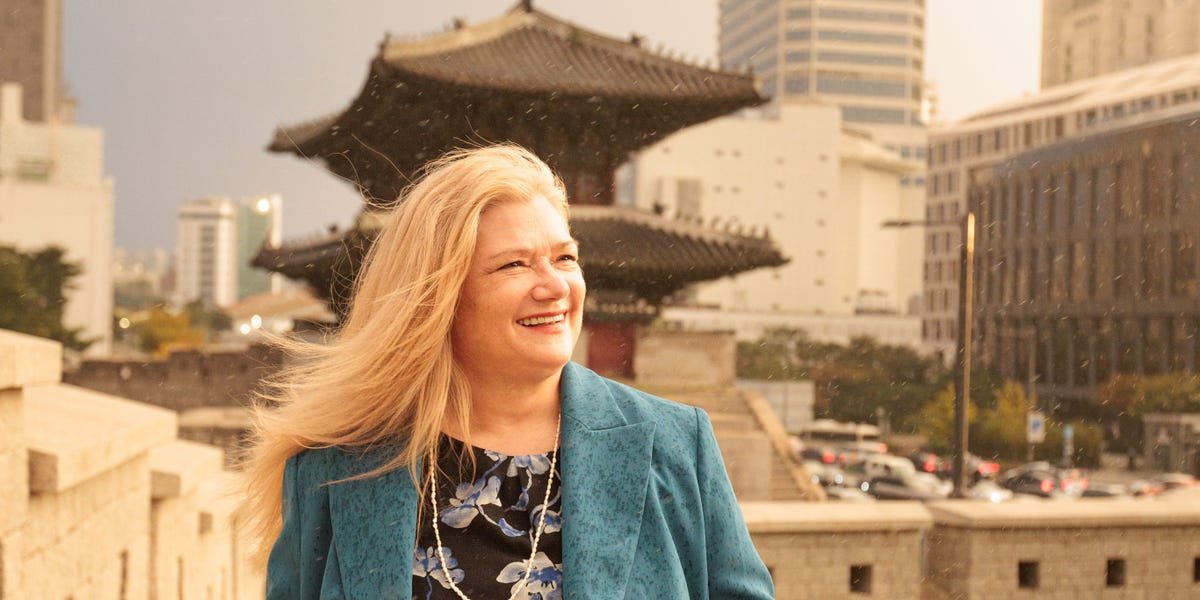
Skyline from Seoul City Wall at Dongdaemun.

Newman lives in Dongdaemun, a popular neighborhood in Seoul.


Jane Newman.


Building a new life from scratch

South Korea has become an increasingly popular choice for foreigners in recent years.

Data from the Ministry of Justice showed that the number of foreigners living in South Korea at the end of 2024 stood at 2.65 million, a 5.7% increase from the year before.

For Newman, building friendships in Seoul came more naturally than she expected.

“I’ve found that every time I’ve come to Korea, I’ve made new friends,” Newman said, adding that this included people she met through a fan group for a Korean actor she admired.


A photo of Cheonggyecheon stream in Seoul.

Newman says she makes it a point to get out of the house once a day to enjoy her surroundings.


Jane Newman.


These days, Newman’s routine is a mix of work and settling into life in Seoul.

She starts her mornings with a coffee from the Starbucks across the street before diving into her coaching sessions and working on getting her startup off the ground.

Compared to her previous job, where working 60 hours a week was common, Newman says she now works around 20 to 30 hours a week.

With the more flexible schedule, she has time to exercise, meet people, and sometimes work from libraries or cafés.

“But I do make sure I get out once a day to go out and enjoy this beautiful place I’m living in,” she said.

Do you have a story to share about relocating to a new city? Contact this reporter at agoh@businessinsider.com.


Source link