
I-moved-my-family-from-Florida-to-Colombia-The-lifestyle.jpeg

I moved my family from Florida to Colombia. The lifestyle is affordable and we love the vibrant culture, but it’s hard to adjust to the lack of urgency.

This as-told-to essay is based on a conversation with Alyssa Bolaños, a 35-year-old creative freelancer living in Medellín, Colombia. It’s been edited for length and clarity.

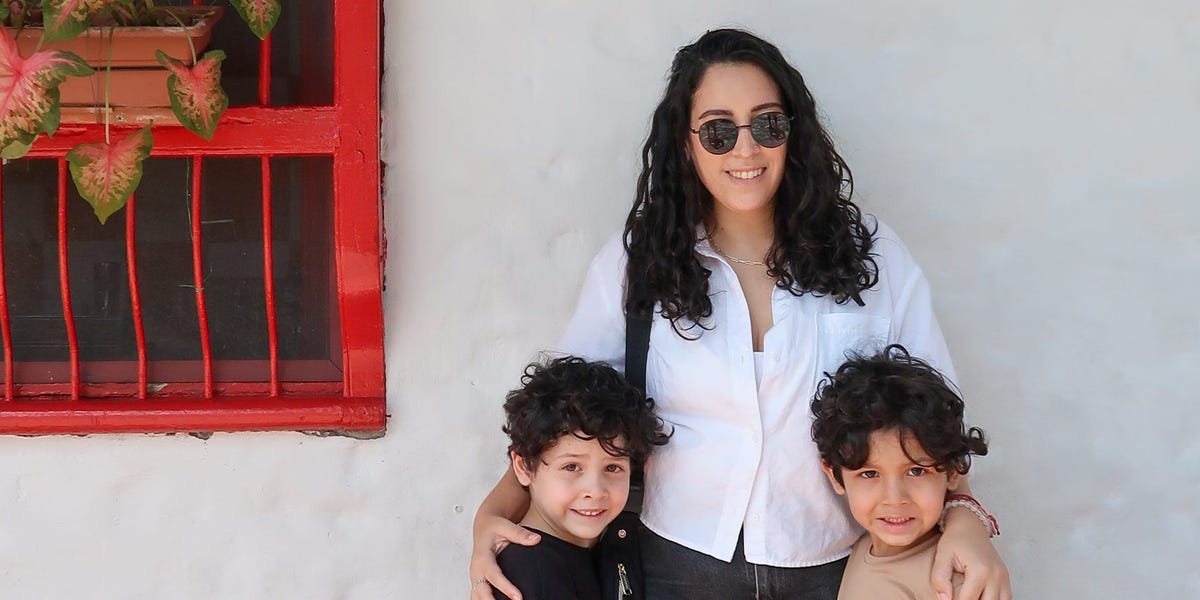
My husband, two sons —who were four and five at the time — and I moved from Orlando to Medellín, Colombia, in August 2025.

My husband is from Colombia, and he always said he never wanted to move back, but when the Trump administration took office a second time, we started having serious conversations about it.

We also had safety concerns about our children’s school and decided we absolutely did not want to raise our kids in a place with a threat of school shootings. That’s what really clicked with my husband and made him think, “We can’t stay here.”

Since moving, we’re spending more time as a family, enjoying the affordable lifestyle, and integrating into Colombia’s vibrant culture. I’m still adjusting to some of the differences in work culture, and I miss my family, but I have no plans of moving back.

Our families were concerned about us leaving

Once we made the decision to move, I really didn’t have any fears. The only problem was that our immigrant families questioned why we would move back after they sacrificed so much to move to the States — my parents are from Cuba.

We weren’t going to let anyone’s perspective hold us back because, at the end of the day, we have to focus on the lives of our children and ourselves. It was really only six months from that point that we actually moved.

The emotional aspect of moving, saying goodbye to friends and family, was the hardest. Family is a big part of Latino culture, so it was hard being the first of our family to leave.

The whole process of selling and donating our belongings was also exhausting. We shipped two big boxes of our belongings, but we had to be really discerning about only taking the most sentimental things with us.

I’m able to be present in my kids’ lives here

Colombian culture is so family-oriented. When people finish work, they spend time with their families and enjoy life. Every day is a reason to celebrate, and I love that about Colombia.

My husband is a stay-at-home dad, and I do a little bit of everything as a freelancer, like social media strategy and marketing for brands and small businesses. We’re currently homeschooling our kids while we wait for them to be accepted into a school in the area.

Actually being present with your kids is a blessing that you don’t always get as a parent in the States. In Colombia, we spend lunchtime from 11 a.m. to 2 p.m. playing with them or exploring. It’s tiring to be with your kids all the time, but it’s a luxury.

The food and the walkability are also amazing. We don’t have a car, so we walk most places or take public transit. Our kids also scooter around. Worst case, we take an Uber.

The lack of urgency here is good and bad

People work to live here, not live to work. It’s an amazing change of pace, but it’s still taking some getting used to. I used to sit at my desk job all day and work the entire time. Here, there are lots of holidays and a strong emphasis on getting outside and spending time with loved ones.

One thing I didn’t expect was the overall lack of urgency. In the States, we’re so used to the “go go go” hustle culture. I got so accustomed to constantly moving and feeling like I was doing something wrong if I wasn’t being productive.

In Colombia, there aren’t as many strict timelines, and people are more focused on enjoying little moments in their day. If I’m being honest, the lack of urgency stresses me out sometimes, but I’m really trying to be chill with it and remember that not everything is an emergency.

This change of pace is good for me, but it’s hard.

I miss my family, but I prefer the Colombian version of things

There’s not much I really miss about the United States other than family and friends. We’re lucky to have some family and friends here who have introduced us to others, and we’ve attended some events for other immigrants, but building new connections is taking time.

Other than that, we have all of the same comforts like public transportation, air conditioning, and stores. People have this misconception that Colombia is a backward place, and it’s absolutely not like that.

Medellín is innovative and full of life, culture, and community. There are even some Colombian versions of things I prefer, like the Colombian Frisby instead of KFC. I miss IHOP a little bit, though.

Our lifestyle is affordable, but there’s a caveat

Our groceries are less than they used to be for our family of four, and my personal cellphone bill is $30 a month. Everything here has been much more affordable and accessible for us.

That being said, I always want to be careful saying that our lifestyle is affordable because Colombia is experiencing a big problem with gentrification. If you move here, my advice is to support local Colombian stores and really integrate with the culture. Colombia is a beautiful place, and we have no plans to leave.

Do you have a story to share about leaving the United States? If so, please reach out to the reporter at tmartinelli@businessinsider.com.


Source link

Read-Bari-Weiss-new-memo-that-defends-pulling-a-60.jpeg

Read Bari Weiss’ new memo that defends pulling a ’60 Minutes’ segment and says Americans lack trust in the press

  • CBS News chief Bari Weiss sent a memo to staff defending her decision to hold a “60 Minutes” piece.
  • Weiss made the decision to pull a segment on the CECOT prison shortly before it was due to air.
  • She said winning back public trust in the news sometimes means holding stories.

CBS News head Bari Weiss sent a Christmas memo to staff on Wednesday defending her decision to pull a “60 Minutes” segment on the Trump administration’s use of El Salvador’s notorious CECOT prison.

In the memo, signed by Weiss and other CBS News leadership, she wrote that the press needed to win back the public’s trust, and that “sometimes it means holding a piece about an important subject to make sure it is comprehensive and fair.”

“Right now, the majority of Americans say they do not trust the press,” she wrote. “It isn’t because they’re crazy.”

Weiss’ decision to hold the “60 Minutes” shortly before it aired led to blowback both inside and outside CBS News, which is owned by Paramount Skydance. Sharyn Alfonsi, who reported the segment, wrote in note to colleagues that the decision was a “political one,” multiple outlets reported.

Weiss said in her memo that she and other CBS News leaders are “not out to score points with one side of the political spectrum or to win followers on social media.”

The media world has heavily scrutinized Weiss’ management since she was installed atop CBS News by Paramount CEO David Ellison in October. Paramount also acquired The Free Press, the conservative-friendly news site Weiss founded after leaving The New York Times’ opinion section, for about $150 million.

Paramount is dueling with Netflix to buy Warner Bros. Discovery. President Donald Trump has said he would be involved in the regulatory review process.

Weiss added in the memo that CBS News would hold itself to a high standard of fairness and be independent.

Here’s the full text of the memo:

Hi all,
Right now, the majority of Americans say they do not trust the press. It isn’t because they’re crazy.
To win back their trust, we have to work hard. Sometimes that means doing more legwork. Sometimes it means telling unexpected stories. Sometimes it means training our attention on topics that have been overlooked or misconstrued. And sometimes it means holding a piece about an important subject to make sure it is comprehensive and fair.
In our upside-down moment, this may seem radical. Such editorial decisions can cause a firestorm, particularly on a slow news week. And the standards for fairness we are holding ourselves to, particularly on contentious subjects, will surely feel controversial to those used to doing things one way. But to fulfill our mission, it’s necessary.
No amount of outrage—whether from activist organizations or the White House—will derail us. We are not out to score points with one side of the political spectrum or to win followers on social media. We are out to inform the American public and to get the story right.
Restoring the integrity of the news is a difficult task. We can’t think of a more important one.
Merry Christmas—and thank you, especially, to everyone who is working over this holiday.
Yours,
Bari
Tom
Charles
Adam


Source link

Rivians-CEO-said-theres-a-shocking-lack-of-choice-for.jpeg

Rivian’s CEO said there’s a ‘shocking lack of choice’ for EVs in the US

Rivian’s CEO and founder, RJ Scaringe, said the US needs a lot more cheap electric vehicles.

Speaking at the Fortune Brainstorm AI conference in San Francisco on Tuesday, Scaringe said a lack of choices was the reason for low EV penetration in the US.

He said that electric vehicle adoption in the US, at 8%, is significantly lower than in the rest of the world.

“I really think the constraint isn’t the demand side, I think it’s the supply side,” Scaringe said. “I think there’s a shocking lack of choice, that there are much better choices in Europe. And by far, there’s the most choice in China.”

He said that for consumers interested in EVs, there were “well under five great choices” at a price point close to the average price of a new car in the US.

He added that, within a price range of $50,000, there was only one compelling choice of EV: a Tesla. In October, Tesla unveiled its most affordable models to date: the $36,990 Model 3 Standard and the $39,990 Model Y Standard.

“And that’s not a reflection of a healthy market with lots of choice,” Scaringe said. “If you think of it as a consumer, you have 300 different internal combustion engine choices at that price or lower, and you have maybe one highly compelling EV choice.”

Rivian is working to provide cheaper EV alternatives. It is gearing up to start production on its cheapest EV to date, the R2 model, a $45,000 SUV.

In the interview, Scaringe also said he agrees with the Trump administration’s push to bring manufacturing back to the US.

“I think the push to industrialize in the United States is appropriate, and it’s something we’re very aligned with the administration on,” he said.

The US EV industry comprises Rivian, Tesla, Ford, General Motors, Hyundai, BMW, and Kia, among others.

Brands like Volkswagen, BMW, Mercedes-Benz, and Tesla dominate the EV market in Europe. Chinese brands like BYD, NIO, and MG also sell on the continent.

Meanwhile, the EV industry in China is seeing fierce competition. BYD, Tesla’s biggest global rival, saw its sales fall 12% in October compared to the same period a year earlier, as it faces a tough fight from local EV startups Xpeng, Nio, and Leapmotor.

Other players, such as smartphone manufacturer-turned EV maker Xiaomi, are also seeing success in the country with strong sales.


Source link