
Oracles-Larry-Ellison-downplays-software-apocalypse-fears-We-think-the.jpeg

Oracle’s Larry Ellison downplays software apocalypse fears: ‘We think the SaaSpocalypse applies to others, but not to us’

Oracle executives downplayed fears that AI will spell the death of software-as-a-service companies.

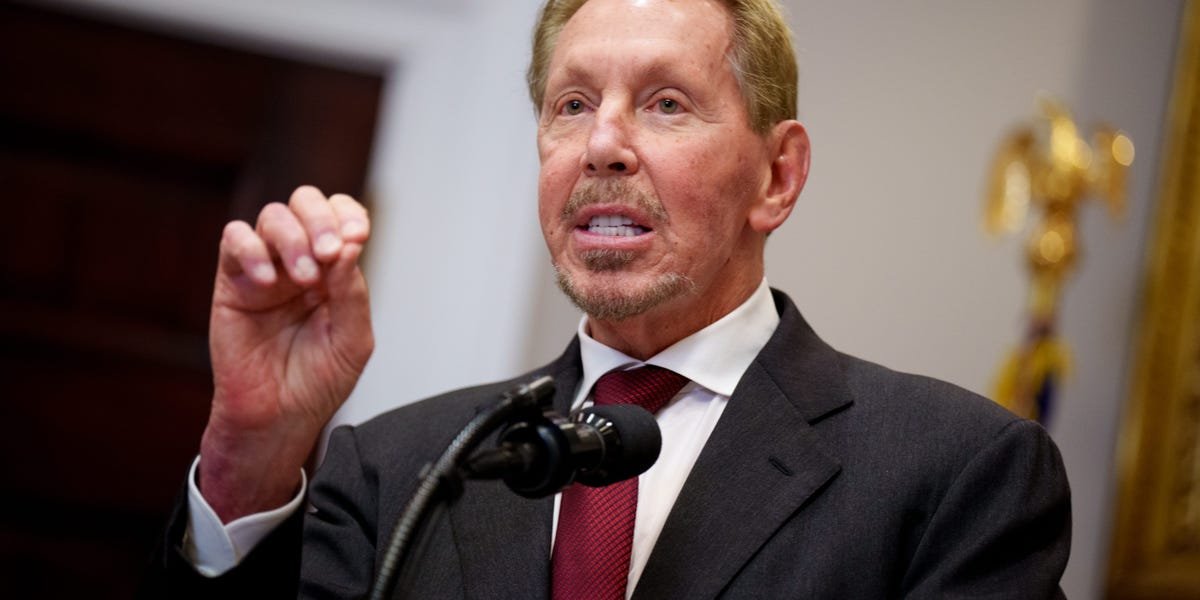
Oracle Chairman Larry Ellison said during the company’s earnings call on Tuesday that he believes the so-called Saaspocalypse will be a problem for other companies, but not his.

“We have these coding tools now that allow us to build a comprehensive set of software, agent-based software, to implement to automate a complete ecosystem like healthcare or financial services,” Ellison said. “That’s what we’re doing at Oracle. That’s why we think we’re a disruptor. That’s why we think the Saaspocalypse applies to others but not to us.”

Fears that AI will replace traditional software tools have been particularly high over the past month, after Anthropic released new agentic AI tools, triggering a sell-off in software stocks, including Salesforce and Asana.

Oracle CEO Mike Sicilia also said on the earnings call that he doesn’t agree with the idea of the Saaspocalypse.

“I do think that AI tools and their coding capabilities would be a threat if we weren’t adopting them, but we are, and very rapidly,” he said. “We are building brand new SaaS products using AI and also embedding AI agents right into our existing applications suites.”

Sicilia added, “I’ve not yet met a customer who tells me they’re ready to give away their retail merchandising system, their core banking system, demand deposit account systems, electronic health record systems, and some cobbling together of niche AI features are going to replace all of that overnight. In fact, we hear quite the
opposite from the customers.”

Oracle isn’t the only company trying to downplay the fears of AI companies like Anthropic and OpenAI becoming a threat to software giants.

Salesforce CEO Marc Benioff recently tried to reassure investors that the company’s focus on AI agents would insulate it from the software apocalypse. “If there is a ‘SaaSpocalypse’, it may be eaten by the ‘SaaS-quatch’ because there are a lot of companies using a lot of SaaS because it just got better with agents,” he said.

Workday CEO Aneel Bhusri also tried to allay fears during the company’s earnings call last week that HR and business software systems require complex security and regulatory needs, and boasted that AI companies such as Anthropic and OpenAI are running its software.

Have a tip? Contact this reporter via email at astewart@businessinsider.com or Signal at +1-425-344-8242. Use a personal email address and a nonwork device; here’s our guide to sharing information securely.


Source link

Ayelet Sheffey

What Jensen Huang, and Larry Page’s reactions to the California wealth tax reveal

It’s a classic fight-or-flight response — with a billionaire’s twist.

A proposed wealth tax in California prompted the state’s resident billionaires to consider whether they wanted to continue their residency if the one-time 5% tax is approved.

Their reactions, said CFP professional Don Hilario, who works with financial planning clients in California, boil down to risk tolerance.

The tax, as proposed, would only apply to assets in the state during the 2026 tax year. Google’s billionaire cofounder, Larry Page, moved some of his assets out of California ahead of the January 1, 2026, deadline to avoid facing the tax, Business Insider first reported. Meanwhile, Nvidia’s billionaire CEO Jensen Huang said he has “not even thought about it once.”

“We chose to live in Silicon Valley, and whatever taxes they would like to apply, so be it,” Huang told Bloomberg TV’s Ed Ludlow. “I’m perfectly fine with it.”

Hilario, whose financial planning clients include individuals in Big Tech, said that the lingering uncertainty of the tax can trigger a need for certainty and autonomy.

“People who want to have a greater sense of control will do the Larry Page route,” he said, “versus people who have the temperament to endure will take Jensen’s route.”

Hilario described a hypothetical scenario in which individuals with high net worths are considering purchasing a home. In a period where the economy and interest rates are uncertain, do you want to put the lion’s share of your expenses toward the home in the event that rates will be higher in the future, or do you hold out and continue accumulating your wealth in the event that economic conditions improve?

“That’s the same type of emotions that exist with this tax bill because the fear of not taking any action is unsettling,” Hilario said.

The proposal, put forth by the union SEIU-United Healthcare Workers West to offset potential budget cuts to healthcare and education, is far from being implemented — it would require 870,000 signatures to make it onto the November 2026 ballot.

The SEIU said in its proposal that the concentration of billionaire wealth in California makes the state “uniquely positioned to address both the well-documented crisis of wealth inequality in the United States and the emerging and interrelated crises the state faces” with the budget cuts.

In addition to Huang and Page, other billionaires are voicing their opinions on the proposed wealth tax. LinkedIn’s cofounder, Reid Hoffman, wrote in a post on X that the proposal has “massive flaws.”

“Poorly designed taxes incentivize avoidance, capital flight, and distortions that ultimately raise less revenue,” he said.

Alex Spiro, an attorney who has previously represented billionaires, wrote in a letter to California Gov. Gavin Newsom that his clients would “permanently relocate” if the tax were to become law. Hilario said that the significant uncertainty surrounding the proposal, including how assets will be valued and whether the tax would change over time, likely forced billionaires to decide how risk-averse they really are.

“I still think ultimately it’s unclear. And I think when it’s unclear, it’ll make people, in this case, investors, be more cautious and defensive,” Hilario said. “And then a big part of it is, how do we respond emotionally? I think whether you’re taking early action or enduring, you do want to gather information and avoid making a decision that would ultimately be irreversible.”


Source link

Larry-Page-is-officially-moving-business-out-of-California-ahead.jpeg

Larry Page is officially moving business out of California ahead of a proposed billionaire’s tax

Billionaire Larry Page is peacing out of California.

The Google cofounder has cut ties between California and many of his assets that risked exposing him to a proposed new wealth tax in the state, meeting an end-of-2025 deadline, according to filings reviewed by Business Insider.

Page’s family office, Koop, was converted out of California in late December and incorporated in Delaware, per filings with both states. Page converted several other entities to Delaware, including Flu Lab LLC — a vehicle he has used to fund research on tackling influenza and lists its principal office address in Nevada — and another entity named One Aero, which has funded his flying car ventures and lists its principal office address in Florida.

A filing was also made to convert Dynatomics, LLC from California to Delaware with a new principal address in Keller, Texas. Page launched Dynatomics, a new startup focused on applying AI to aircraft manufacturing, in 2023, Business Insider previously reported. A source close to Page said that the team, run by Chris Anderson, continues to work out of California.

Anderson and representatives for Page’s family office did not respond to requests for comment.

The New York Times reported in December that Page had told people he was considering moving to Florida because of a proposed ballot measure that would tax the state’s wealthiest residents. The proposal, if passed successfully, would mean that any California resident worth more than $1 billion would be taxed 5% of their assets.

Under California law, residency is determined by the nature of a person’s ties to the state, with factors such as the time spent in the state and the maintenance of substantial business ties taken into account. If the ballot measure is approved in November, it would take effect retroactively for residents living in California as of January 1, 2026.

A source close to Page said the Google cofounder had already left the state. Whether Page’s move is temporary could not be learned.

Page is ranked the second-richest person in the world, according to the Bloomberg Billionaires Index.

Page’s family converts other entities to Delaware

Besides his family office and funding vehicles, Page converted out an LLC that Business Insider previously identified as being used to purchase islands in Puerto Rico and the Virgin Islands, from California to Delaware, with a new address listed in Florida.

A separate LLC Page used to purchase an Island in Fiji was also converted out to Delaware.

Page’s wife, the scientist Lucinda Southworth, founded a marine-conservation charity named Oceankind. Filings show that Oceankind converted out of California to Delaware in December.

Delaware has become a popular state for businesses to incorporate due to its favorable tax structure, privacy, and its home to a court system specifically designed to handle corporate disputes. The state does not require LLCs to disclose the names and addresses of directors when incorporating, providing them with an extra layer of privacy.

Privacy is especially important to Page, whose family office is shrouded in a level of secrecy unparalleled by most and carefully managed by its CEO, Wayne Osborne.

Cristina Rosado, an attorney who handles many of Page and Southworth’s assets, signed several of the California filings.

Page incorporated three entities in Florida last year, as previously reported by The New York Times. A Koop LLC was incorporated in Florida in January 2025, per filings reviewed by Business Insider. It could not be confirmed if it belongs to Page.

California’s billionaire tax proposal

The California billionaire tax proposal faced some opposition from leaders in venture capital and politics. In a post on X in December, venture capitalist Vinod Khosla said the proposed measure would mean California would lose its most important taxpayers and “net off much worse.”

“Long term damage unless legislature bans wealth taxes,” he added. “Easier to equalize taxes on work income and capital gains at the national level.

Matt Mahan, Democratic mayor of San Jose, California, on Monday described the tax as “a political plan that will sink California’s innovation economy.”

White House AI czar David Sacks has criticized the proposal and said it will backfire. He has also said he believes Miami and Austin will overtake New York and San Francisco for finance and tech, respectively. He announced this month that his venture capital firm, Craft Ventures, had opened an office in Austin.

Last month, celebrity lawyer Alex Spiro wrote a letter to California Gov. Gavin Newsom, warning that the proposed billionaire tax would “trigger an exodus of capital and innovation from California,” Business Insider previously reported.

Have something to share? Contact this reporter via email at hlangley@businessinsider.com or Signal at hughlangley.01. Use a personal email address and a non-work device; here’s our guide to sharing information securely.


Source link