Watch-Artemis-II-launch-thats-sending-astronauts-back-to-the.jpeg

Watch Artemis II launch that’s sending astronauts back to the moon for the first time since 1972

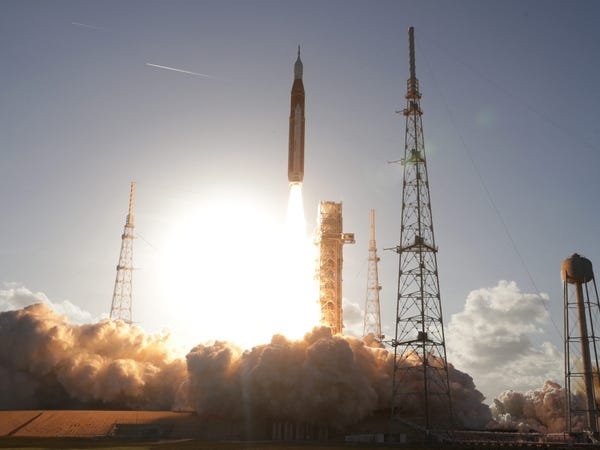
NASA successfully launched Artemis II on Wednesday evening, sending astronauts around the moon for the first time in more than half a century.

The launch from Kennedy Space Center in Florida at 6:35 p.m. local time marked the start of a 10-day lunar mission, during which the Orion spacecraft is expected to come within several thousand miles of the moon’s surface.

Four astronauts — Reid Wiseman, Victor Glover, Christina Koch, and Jeremy Hansen — are aboard the Orion. The crew nicknamed the spacecraft “Integrity.”

The mission is a historical milestone involving international coordination with the Canadian Space Agency and the European Space Agency. The last time humans traveled to the moon was Apollo 17 in 1972, when two astronauts set foot on the lunar surface.

Artemis II does not involve a landing on the moon’s surface, but it is a key step toward NASA’s goal of returning humans to the moon and eventually sending them to Mars.

“You’re doing it for the scientific potential, economic potential, as a technological proving ground to do the things on the moon that you’re going to need on Mars,” Jared Isaacman, NASA administrator, said in an interview with CBS News on Tuesday.

During the mission, the astronauts will test Orion’s living and working conditions in deep space before returning to Earth.

A NASA spokesperson did not immediately respond to a request for comment.

The Artemis II mission will be a 10-day journey around the moon

A plume of smoke rises with the launch of Artemis II. 

Steve Nesius/Reuters

Artemis II will be a critical mission to test the living conditions inside the Orion spacecraft over the next 10 days.

The first 24 hours will include multiple orbits around the Earth.

NASA expects Orion to reach the far side of the moon around flight day 6 before returning to Earth for splashdown around April 10 or 11.

The US space agency previously had to delay the Artemis II launch twice due to technical issues with the Orion spacecraft.

The 4 astronauts include 3 Americans and one Canadian


Four astronauts

Artemis II flight crew includes Reid Wiseman, Victor Glover, Christina Koch, and Jeremy Hansen 

NASA/Aubrey Gemignani/Handout/Anadolu via Getty Images

The Artemis II flight crew includes several firsts: Christina Koch, the mission specialist, is the first woman on a lunar mission; Victor Glover, the pilot, is the first person of color; and Jeremy Hansen, the other mission specialist, is the first Canadian.

Reid Wiseman, the mission commander, was previously a flight engineer aboard the International Space Station for a 165-day mission.

Orion, nicknamed Integrity, is built to withstand a return to Earth


Orion spacecraft

The Orion spacecraft was designed and built by Lockheed Martin. 

Jim Watson/AFP via Getty Images

Orion, the spacecraft built by Lockheed Martin, is designed to withstand a brutal journey from Earth to deep space and back.

On Artemis I, the uncrewed launch in 2022, Orion was sent 1.4 million miles beyond the Moon and back, according to NASA.

The space crew nicknamed the spacecraft Integrity.

NASA previously did an uncrewed test flight in preparation for Artemis II


Orion capsule landing in the Pacific Ocean.

The Orion capsule of the Artemis I launch splashed down in the Pacific Ocean on December 11, 2022. 

Mario Tama/Getty Images

In 2022, NASA flew Artemis I, an uncrewed mission, that tested the agency’s deep-space exploration system inside the Orion spacecraft.

The Artemis I launched on November 16, 2022, and splashed down in the Pacific Ocean on December 11, 2022 — a 25-day mission.

Re-entry speed of the Orion was 24,581 mph, according to NASA.

Artemis II will be a stepping stone for missions beyond the moon


Jared Isaacman

NASA Administrator Jared Isaacman said the Artemis II mission will be a critical step toward future Mars ambitions. 

Brendan Smialowski/AFP via Getty Images

The Artemis II is not just the precursor for plans to land humans back on the moon.

NASA Administrator Jared Isaacman said in a CBS News interview that the mission will be critical for deeper-space missions, namely Mars.

It’s “a stepping stone for all the things that we are going to do farther out into our solar system, like someday American astronauts planting the stars and stripes on Mars,” he said.

The next mission, Artemis III, is expected to test docking with commercial lunar landers that NASA will use to return humans to the moon’s surface. NASA is targeting a 2027 launch date.


Source link

The-history-of-Apple-in-photos-from-the-early-Steve.jpeg

The history of Apple in photos, from the early Steve Jobs era to the iPhone launch to its 50-year mark

Apple marks the 50th anniversary of its founding on April 1.

The tech giant is one of the world’s most valuable companies, known for innovative products like the iMac, iPhone, and iPod. Its storied past is one of incredible highs, including a $4 trillion market cap, and alarming lows, like its series of stumbles in the 1990s.

It’s had many leaders over the years — most notably Steve Jobs, who put the company on the map with his lofty ideas and unique leadership style. After Jobs stepped down from the position to focus on his health, Tim Cook took over as CEO and has guided the company through much success and turbulent times.

During Cook’s tenure, Apple has launched new products like the Apple Watch, Vision Pro, and AirPods. The company has also launched its own artificial intelligence software, Apple Intelligence.

Here’s a look at Apple’s history in photos, from its inception through its hard times to the triumphant return of Jobs and beyond.

Matt Weinberger and Avery Hartmans contributed to earlier versions of this story.

Apple was cofounded on April 1, 1976, by Steve Jobs and Steve Wozniak in Los Altos, California.

Steve Wozniak, left, with Steve Jobs. 

Kimberly White/Reuters

Apple’s first “office” was the garage at Jobs’ parents’ house. There was a third cofounder, too: Ronald Wayne. Jobs brought Wayne on board to provide business guidance for the two young cofounders.

Wayne sketched the first Apple logo by hand.

The cofounder left the company before it was officially incorporated. He took an $800 check for his shares in the company. Apple would officially incorporate in 1977.

The company’s first product was the Apple I.


Apple I computer Apple 1

An Apple-1 computer built in 1976. 

Justin Sullivan/Getty Images

It was just a motherboard with a processor and some memory, intended for hobbyists. Customers had to build their own case and add their own keyboard and monitor, as seen in the picture above.

The Apple I was invented by Wozniak, who also hand-built every kit.

Meanwhile, Jobs handled the business end, mainly trying to convince would-be investors that the personal computer market was primed to explode.

The Apple II was introduced in 1977.


Apple II computer

The Apple II was a one-of-a-kind personal computer that the company released in the late 1970s. 

Eric Risberg/AP

The personal computer was designed by Wozniak, and it would go on to take the world by storm. The Apple II’s killer app was VisiCalc, a groundbreaking spreadsheet software that propelled the computer ahead of market leaders Tandy and Commodore, according to the National Museum of American History.

With VisiCalc, Apple could sell the Apple II to the business customer. By 1978, Apple would actually have a real office, with employees and an Apple II production line.

Xerox PARC convinced Jobs that the future of computing was with a graphical user interface (GUI).


steve jobs young lisa computer 1983

Jobs with the Lisa computer in 1983. 

Ted Thai/The LIFE Picture Collection/Getty Images

In 1979, Apple engineers were allowed to visit the Xerox PARC campus for three days, in exchange for the option to buy 100,000 shares of Apple for $10 a share, according to Newsweek.

A year later, Apple released the Apple III, a business-focused computer intended to counter the growing threat from IBM and Microsoft.

But the Apple III was only a stopgap, and Xerox PARC had led the young Jobs to think in a different direction.

Jobs spearheaded the effort to equip Apple’s next-generation Lisa computer with a GUI, but was bumped from the project thanks to infighting.

Lisa was released in 1983 to much fanfare, but disastrous sales — it was too expensive and didn’t have enough software support, CNBC reported.

Jobs led the next project, the Apple Macintosh.


Steve Jobs

Jobs and the new Macintosh personal computer following a shareholder’s meeting in Cupertino in 1984. 

AP Photo/Paul Sakuma

It was billed as the most user-friendly computer to date. It would go on to become popular with graphic-design professionals, who liked its visual chops (even though it was in black and white).

It was still very expensive, however.

Around the time of the launch of the first Macintosh in 1983, Apple got a new CEO: John Sculley.

Sculley was serving as Pepsi’s youngest-ever CEO, but Jobs, then head of Macintosh development, managed to bring him to Apple with the now-legendary pitch: “Do you want to sell sugared water for the rest of your life? Or do you want to come with me and change the world?” Forbes reported.

In 1984, Apple released the TV commercial that made it a household name.

This ad, appropriately called “1984,” was directed by Ridley Scott and cost the company $1.5 million. It aired during the third quarter of Super Bowl XVIII, and never again.

This was also when tensions between Jobs and Bill Gates started to run high.


Bill Gates Steve Jobs

Jobs (left) had beef with Bill Gates over the creation of competing products. 

Kristy MacDonald/AP; Gary Stewart/AP

Originally, Microsoft was working hard at making software for the Macintosh. But those plans were scuttled in 1983 when Microsoft revealed that it, too, was working on a graphical user interface called Windows.

The Macintosh had strong sales, but not enough to break IBM’s dominance.


steve jobs john sculley steve wozniak

From left to right: Jobs, Sculley, and Wozniak. 

Sal Veder/AP Images

This led to a lot of friction between Jobs — the head of the Macintosh group who liked doing things his own way — and Sculley, who wanted stricter oversight of future products in light of the Lisa disaster and the Macintosh’s disappointment.

Things came to a head in 1985 when Jobs tried to stage a coup and oust Sculley — but Apple’s board of directors took Sculley’s side and removed Jobs from his managerial duties.

A furious Jobs quit and went on to found NeXT, a computer company making advanced workstations where he had total control.

Wozniak later left and sold most of his shares around the same time in 1985, saying the company was going in the wrong direction. With Jobs gone, Sculley had a free hand at Apple.

At first, things seemed great.


John Sculley Apple Computer

Under Sculley’s leadership, Apple introduced color to the Macintosh with the System 7 operating system. 

Associated Press

Apple introduced its PowerBook laptop and System 7 operating system in 1991. System 7 introduced color to the Macintosh operating system, and would stick around (with updates) until OS X was released in 2001, according to Cult of Mac.

The 1990s would see Apple enter many new markets, none of which really worked out.


Apple Newton

Apple’s Newton MessagePad, pictured above, wasn’t a hit with consumers. 

SSPL/Getty Images

Possibly the most famous Apple flop of the ’90s was 1993’s Newton MessagePad, which was Sculley’s brainchild.

It literally created the market for “personal digital assistants,” but it was $700 and did little more than take notes and keep track of your contacts, according to MacWorld.

At the same time, Microsoft’s influence was on the rise.


bill gates windows

Gates holding Microsoft Window’s operating system in 1992. 

AP Photo

Macs offered an excellent, but limited, software library on expensive computers.

Meanwhile, Microsoft was selling Windows 3.0 on cheap, commodity computers.

Sculley was relieved of his duties in 1993.


Michael Spindler Apple

Michael Spindler, pictured above, stepped up as Apple’s CEO in 1993 after Sculley left the role. 

Luc Novovitch/AP

After Apple missed on its first-quarter earnings in 1993, Sculley stepped down and was replaced as CEO by Michael Spindler, a German expatriate who had been with Apple since 1980, the Los Angeles Times reported.

Spindler had the unfortunate job of following through with Sculley’s big PowerPC processor plans, which would prove to be a mistake.

In 1994, the first Macintosh running on a PowerPC was released.


amelio jobs

Gil Amelio, left, and Steve Jobs on a podium during an Apple event. 

AP

Apple’s fortunes continued to sag as Windows took off. After acquisition talks with IBM, Sun Microsystems, and Philips all fell through, Apple’s board replaced Spindler with Gil Amelio in 1996, The New York Times reported.

Amelio’s tenure was equally troubled.


Steve Jobs Next

Amelio brought Jobs (pictured above) back to Apple after a disappointing year for the company under his leadership. 

Dick Drew/AP

Under his reign, Apple stock hit a 12-year low (largely because Jobs himself sold 1.5 million Apple shares in a single transaction), according to CNET.

Amelio decided to purchase Jobs’ NeXT Computer for $429 million in February 1997 to bring him back to Apple.

On the July 4 weekend that same year, Jobs would stage a boardroom coup.


steve jobs

Jobs was later reinstated as Apple’s interim CEO. 


Lou Dematteis/Reuters


Jobs convinced Apple’s board to install him as interim CEO. Amelio resigned a week later.

1997 would also see the introduction of Apple’s famous “Think Different” ad campaign.


Apple think different

A billboard for Apple’s “Think Different” ad campaign featuring Yoko Ono and John Lennon. 

Gilles Mingasson/Liaison/Getty Images

It celebrated famous artists, scientists, and musicians. Jobs opposed parts of the original idea for the commercial, such as his narrating it.

Ultimately, Jobs got his way, and the famous ad was narrated by actor Richard Dreyfuss.

Under Jobs’ leadership, the company would make nice with Microsoft.


steve jobs bill gates microsoft 1997

Jobs (on the podium) and Gates (on the screen) at an Apple event in 1997. 

Jim Bourg/Reuters

In August 1997, Jobs took the stage at Apple’s Macworld Expo to announce that Apple had received a $150 million investment from Microsoft.

“We need all the help we can get,” Jobs said, to boos from the audience, CNBC reported.

The late 90s were a new era for hardware and software, too.


steve jobs imac 1998

Jobs posing with the Apple iMac G3 computer launched amid a hardware boom. 

Mousse Mousse/Reuters

Jobs had Jony Ive spearhead the design of the iMac, an all-in-one computer released in 1998.

In 2000, Jobs introduced Mac OS X, based on the NeXT operating system, finally replacing System 7.

And in 2006, Apple finally moved to an Intel-based system architecture.

Apple had two massively influential product releases in the 2000s, beginning with the iPod in 2001.


ipod steve jobs john mayer 2004

John Mayer (left), Jobs, and the iPod. 

Justin Sullivan/Getty Images

The iPod blew other MP3 players out of the water and radically altered the way we listen to music. It birthed a number of iterations that would span over a decade, including the iPod Nano, iPod Shuffle, and iPod Touch.

The iPod also launched Apple’s white earbuds as a status symbol.

But the single biggest victory for Apple was 2007’s introduction of the iPhone.


Steve Jobs

The launch of the iPhone in 2007, which Jobs is holding in the picture above, was a game-changing product for Apple. 

Alessia Pierdomenico / Reuters

When the iPhone went on sale, customers lined up outside stores in the US to get their hands on one.

The iPad came out in 2010.


Steve Jobs holding an ipad

Steve Jobs announced the iPad onstage. 

Bloomberg/Bloomberg via Getty Images

Apple positioned the new product as a cross between a smartphone and a laptop. It helped define the modern tablet product category.

The company expanded into services, helping fuel Apple’s growth as iPhone sales lagged.


Tim Cook

AppleTV+ has won Academy Awards in major categories. 

Alberto Rodriguez/Variety via Getty Images

Under Cook — who took over after Jobs’ death in 2011 — Apple introduced new hardware product lines, including the Apple Watch and AirPods.

Apple also launched its own music and video streaming services, as well as other subscription offerings, such as news and gaming.

The Apple Watch was announced in 2014.


Apple watch display

Tim Cook announced the Apple Watch in September 2014. 

Stephen Lam/Getty Images

The Apple Watch marked the company’s first venture into wearable technology. It quickly became one of the world’s most popular smartwatches.

Apple’s chief design officer, Jony Ive, left Apple in 2019 and set up his own design shop, LoveFrom.


Jony Ive Met Gala 2016

Jony Ive at the 2016 Met Gala before leaving Apple. 


Dimitrios Kambouris / Getty Images


Apple said at the time that it would become one of LoveFrom’s “primary clients.” The two companies’ relationship wound down in 2022, according to The New York Times, which reported there were frustrations on both sides about the arrangement.

In August 2020, Apple hit a new milestone before other companies.


Tim Cook

Apple hit a $2 trillion market cap in August 2020 under the leadership of CEO Cook. 

AP

It became a $2 trillion company — the first company to do so — just 24 months after reaching the $1 trillion threshold.

Apple became the first public company to close with a market cap above $3 trillion.


People walk near the Nasdaq building in Times Square on January 24, 2023

Hitting the $3 trillion valuation was a milestone for Apple. 

Eduardo Munoz Alvarez/VIEWpress

The stock closed at $193.97 in June 2023. Apple’s ecosystem, led by the iPhone, iPad, and Services, has driven consistent growth through booms, downturns, and even a pandemic. Months later, Apple’s valuation dropped to $2.8 trillion ahead of the iPhone 15 launch in September.

Some Apple fans were disappointed by the new iPhone 15.


Apple iPhone 15 family of devices

A line of iPhone 15 devices displayed at the Apple store. 


Apple


Following the September launch, some Apple fans said the iPhone 15 looked nearly identical to its predecessors. They claimed it’s a design choice that reflected Apple’s lack of innovation on the smartphone front. 

The biggest change was the shift away from the Lightning charging port to USB-C. The launch reflected Apple’s transition into a more incremental phase rather than era-defining moments.

Apple has faced regulatory scrutiny.


European Commission press conference

European Commissioners at a news conference in Brussels. 


Reuters


In January 2024, Apple was forced to crack open its App Store after the European Commission pushed the company to comply with the Digital Markets Act.

Under the DMA, third-party app stores would finally be allowed on Apple’s iOS operating system in the EU. That would allow developers to distribute their apps beyond the App Store, which takes a cut from app sales. 

The law aims to prevent Big Tech, which the EU calls “gatekeepers,” from dominating the digital marketplace. It forced Apple to open up parts of its digital walled garden in Europe.

Apple also saw iPhone sales slump in China, a major market, at the start of 2024, losing its rank as the top smartphone provider in the country.


iPhone Shanghai Apple store

An Apple Store in Shanghai, China in March 2024 amid a dip in iPhone sales. 

CFOTO/Future Publishing/Getty Images

iPhone sales in China dropped by 24% during the first six weeks of 2024, according to Counterpoint Research, as local rivals like Huawei took a larger share of the region’s smartphone market.

In February 2024, Apple launched its nearly $3,500 Vision Pro headset.


Apple's Vision Pro

The Vision Pro lets you see your surroundings with breakthrough ‘EyeSight’ tech. 

Apple

It’s an AI-driven “mixed-reality” headset that allows users to toggle between the digital and real worlds. However, the reception to the Apple Vision Pro was mixed. 

Some initial users expressed awe over the Vision Pro’s spatial computing capabilities. Others, however, said the headset’s design, blurry screen, and lack of use cases don’t justify its high price. These issues may have led some customers to return the product within two weeks of purchase. 

Following the Vision Pro release, Apple killed its electric car weeks later, shifting its focus to generative AI.


A graphic of a fictional Apple Car.

A graphic of a fictional Apple Car, a project the company abandoned earlier this year. 

Grafissimo/Getty, Apple, Tyler Le/BI

Apple worked on its self-driving electric car, a multibillion-dollar effort dubbed “Project Titan,” for nearly a decade before deciding to pull the plug, Bloomberg first reported. 

Execs told nearly 2,000 employees part of the electric-vehicle team that many would be moved to the company’s artificial-intelligence division, per the outlet. 

The US Department of Justice filed a lawsuit against Apple in March 2024.


A flag waves outside the federal Department of Justice building in Washington, DC

The US Department of Justice. 

Samuel Corum/Getty Images

The DOJ accused the iPhone maker of using anti-competitive tactics to dominate the smartphone market. It was a direct challenge to how the iPhone ecosystem works and how Apple makes money from it.

In the suit, the DOJ and 16 attorneys point to everything from the Apple Watch’s incompatibility with non-iPhones to the awkward green-bubble text messages sent through Android phones as evidence that Apple uses unfair practices to beat its competitors. 

Apple denies these accusations. 

The iPhone 17 lineup and iPhone Air came out in 2025.


iPhone 17 Pro Max

Apple said the iPhone 17 Pro is equipped with its most powerful chip yet. 

Nikolas Kokovlis/NurPhoto via Getty Images

The base iPhone 17 features a 6.3-inch display, upgraded Ceramic Shield 2 for added durability, and Apple’s A19 chip designed to power its Apple Intelligence features.

Apple said the iPhone 17 Pro is equipped with its most powerful chip yet, and boasts camera capabilities comparable to having eight professional lenses in a single device.

The model has helped the iPhone regain its footing in China.

Meanwhile, the iPhone Air is the company’s thinnest and most power-efficient model to date at 5.6 millimeters, with Ceramic Shield on both the front and back. It also introduces a new “plateau” design that integrates the front and rear cameras, speaker, and other components.

Apple hit a $4 trillion market cap for the first time in October 2025.


Tim Cook

Tim Cook has seen Apple through major financial milestones. 

Fabrice COFFRINI / AFP via Getty Images

Apple secured a $4 trillion market capitalization for the first time in October 2025, becoming only the third public company ever to be worth that much, after Nvidia and Microsoft.

The company introduced its cheapest laptop yet in the MacBook Neo.


Apple MacBook Neo

The MacBook Neo costs $599. 

Apple

The tech giant unveiled its new MacBook Neo in March 2026 at a special event in New York City.

It sells for $599, making it $500 cheaper than the new M5 MacBook Air, which starts at $1,099.

Tech YouTuber Marques Brownlee described the MacBook Neo as “potentially Apple’s most disruptive product in the last 10-plus years.”

On April 1, 2026, Apple celebrates 50 years in business.


Thinking Different sign

Apple hit 50 years on April 1. 

JUSTIN TALLIS / AFP via Getty Images

Apple has survived a lot of ups and downs to celebrate its 50th anniversary. It’s commemorating the milestone with a series of celebrations attended by public figures, Apple execs, and loyal fans, including a presentation at Shanghai Fashion Week and live music performances.


Source link

10-new-EVs-priced-below-50000-that-launch-this-year.jpeg

10 new EVs priced below $50,000 that launch this year

  • The EV industry has some problems: tax credits were cancelled, US sales dipped, and prices are still too high for many car buyers.
  • Automakers are readying a new slate of new EVs — including 10 with base prices below $50,000.
  • Four out of the 10 upcoming more affordable EVs are a result of a joint venture between two Japanese behemoths.

It’s expected to be a difficult year for electric vehicles.

Federal tax credits ended months ago, US sales have cooled, and automakers are shelving models that lost billions.

But there’s a new guard of EVs priced at less than $50,000 right around the corner that could test that prediction.

Major automakers are launching or re-releasing roughly 30 EVs in the US this year, Business Insider found — and yes, there’s plenty of higher-priced luxury offerings in the lineup, from a high-powered Ferrari to Jaguar’s controversial new coupe.

But 10 of those new or refreshed EVs start below $50,000 — the average price of a new vehicle in the US in December.

“The price for EVs has been too high,” Kevin Roberts, CarGurus’ director of market intelligence, told Business Insider. “As you see more practically-priced EVs, that’s where you’ll see growth in demand.”

These more affordable vehicles will test if lower prices are enough to convince Americans to jump on the EV bandwagon, or whether the market will continue to fizzle.

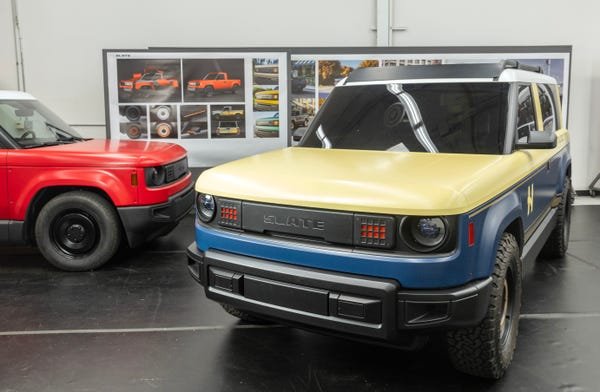
Slate Truck — mid-$20,000s, expected late 2026

Slate’s sales pitch is an ultra-customizable pickup truck with bare-bones features. Pricing is expected to start in the mid-$20,000s.

Myung J. Chun / Los Angeles Times via Getty Images

Slate is selling a stripped-down modular car that owners can design for themselves. It’s like if IKEA got into the car business.

The car company is entering the market with a deliberately bare-bones truck: we’re talking two cloth seats, no infotainment system, no speakers, crank windows, and only enough juice in the battery for 150 miles of range.

From there, buyers can add an extra row of seats, an SUV-style bed cover, or brightly colored exterior decals to cover up the slate gray exterior.

Expected to start in the mid-$20,000s, the Jeff Bezos-backed startup is pitching minimalism as an alternative to the expensive, feature-stuffed EV market.

Kia EV3 — $35,000, expected early 2026


A grey Kia EV3 at the Munich Auto Show.

Kia’s diminutive electric SUV is finally coming stateside. It blends design cues from its older siblings, the mid-sized EV6 and the three-row EV9.

Sjoerd van der Wal/Getty Images

Kia already sells a broad lineup of electric vehicles globally, but only a small handful have reached the US so far. The EV3, expected to arrive in early 2026, has already been on sale in Europe and Asia for nearly two years.

It could be the company’s most important American addition yet.

Roughly the size of a Toyota RAV4, the EV3 blends the sporty proportions of the EV6 with the boxy, upright design language of the three-row EV9.

Pricing will start around $35,000, and the five-seater is expected to cover roughly 300 miles with a full battery.

Rivian R2 — $45,000, expected early 2026


A white Rivian R2 on stage during the car's press launch in March 2024.

Rivian shrunk its popular three-row luxury SUV and slapped on R2 badging. The 5-seater with a $45,000 price is the company’s biggest bet.

PATRICK T. FALLON/AFP via Getty Images

Rivian faces a critical 2026, and the lower-cost R2 is at the center of its bet.

Since 2022, the startup has introduced itself through the high-end R1S — a powerful, three-row SUV with a starting price north of $70,000.

The R2 is meant to pull Rivian into the mass market.

Like Kia’s EV3, R2 promises roughly 300 miles of range and seating for five, putting it squarely in RAV4 territory. But, unlike the Kia, its outdoorsy, gear-forward aesthetic targets a different buyer: more REI than retro-modern.

Whether that identity can drive real sales — despite Rivian’s $10,000 premium compared to other cars on this list — is the question hanging over the R2.

Toyota C-HR — $35,000, expected early 2026


A red 2026 Toyota C-HR driving down a street at dawn.

Toyota is rebooting the C-HR in the US market this year. This time, it’s a $35,000 EV.

Toyota Motor USA

Toyota’s next EV comes with a familiar name.

From 2018 to 2022, the automaker sold the C-HR as a small, angular gas-powered SUV in the US — before pulling it after weak sales.

Now the nameplate is back, reimagined as an electric vehicle.

Arriving in 2026, the electric C-HR is a five-seat SUV expected to deliver about 290 miles of range.

It will become Toyota’s second EV in the US, following the bZ4X — recently renamed the bZ — which has quietly emerged as a surprise hit in the EV market.

But, like the other cars on this list, the lower price could make the C-HR the mass-market play.

Subaru Uncharted — $35,000, expected early 2026


An orange Subaru Uncharted stands on a turntable during the car's US unveil.

The Uncharted is Subaru’s lowest-cost EV. It’s a re-skinned Toyota C-HR.

Josh Lefkowitz/Getty Images

Look familiar?

Since 2019, Toyota and Subaru have been locked in a joint development contract for all EVs. When Toyota’s bZ4X launched in mid-2022, so did the nearly-identical Subaru Solterra.

The EV equivalent of twinning continues with the Uncharted. It’s essentially the same as the Toyota CH-R, but with Subaru badging.

Pricing, range, and seating are all the identical, too: $35,000, 290 miles, room for five butts.

Subaru Trailseeker — $40,000, expected early 2026


A blue Subaru Trailseeker on stage at the LA Auto Show.

Subaru debuted the Trailseeker, a wagon-like EV SUV, during the New York Auto Show in 2025

Josh Lefkowitz/Getty Images

Subaru’s Trailseeker looks like a throwback.

The company has been building all-wheel-drive wagons for the US market since the mid-1970s. That tradition continues with the Trailseeker in 2026: but now, it’s powered by electricity, not gas.

Priced in the low-$40,000s, it’s slotted above the Uncharted, and still has seating for five.

But the athletic numbers show off the Trailseeker’s improvements.

The Trailseeker’s battery makes 375 horsepower, jolting the car from standing to 60 mph in just over four seconds — that’s nearly a second quicker than the lower-priced Subaru.

Toyota bZ Woodland — $40,000, expected early 2026


A gray Toyota bZ Woodland at the LA Auto Show.

Toyota’s bZ Woodland also comes out of the joint venture with Subaru. It’s a re-badged Trailseeker.

Josh Lefkowitz/Getty Images

Does this also look familiar?

Like the Uncharted and the C-HR, Toyota’s bZ Woodland comes out of the company’s joint venture with Subaru.

The new EV is nearly identical in size, price, and capability to Subaru’s wagon-like Trailseeker.

The differences are subtle: a Toyota-specific front design, and a badge that lacks Subaru’s long history selling wagons in the US. Whether that matters to buyers remains the car’s main question.

Nissan Leaf — $30,000, already available


A light blue Nissan Leaf on a carpeted floor at the Silicon Valley Auto Show.

The Nissan Leaf was re-imagined as a crossover SUV with a $30,000 starting price and 300 miles of range.

Tayfun Coskun/Anadolu via Getty Images

When the Nissan Leaf launched in the US in December 2010, it was a breakthrough as the first modern, mass-market electric vehicle sold nationwide.

But the Leaf aged quickly. In 2020, Tesla introduced the Model Y, a similarly priced electric crossover with far more range. Leaf sales collapsed as the EV market moved on.

Now, Nissan is giving the Leaf a long-overdue reset. For around $30,000, the redesigned 2026 Leaf returns as a fast-charging, five-seat electric SUV with an estimated 300 miles of range — finally aligning the once-pioneering nameplate with today’s EV expectations.

Chevy Bolt — $30,000, expected mid-2026


A red orange Chevy Bolt at the LA Auto Show.

The Chevy Bolt is returning with the same silhouette and price — but now it gets more electric range.

Josh Lefkowitz/Getty Images

Like the Leaf, Chevy is also returning the once-iconic Bolt in 2026.

For years, the Bolt was America’s entry-level EV. Drivers were able to nab the five-seater for as little as $30,000. But, it was discontinued in 2023.

Now, the diminutive, low-priced SUV is expected to relaunch in Chevy showrooms this summer. It looks nearly identical to its outgoing version, but comes with an upgraded battery that can propel the car for 260 miles.

Lucid crossover — high-$40,000s, expected late 2026


A darkened image of Lucid's blurred-out mid-size SUV.

Lucid has remained tight-lipped about its lowest-cost SUV. It’s likely hitting US dealerships in the back half of the year.

Lucid Motors

Like Rivian, Lucid has also rushed onto the scene with two luxury-priced cars — the high-end Air sedan and lofty Gravity SUV.

This year, it’s expected to release its first mass-market vehicle: likely a five-seater crossover SUV with a base price in the high $40,000s.

Details remain sparse. But Lucid released the image above with the rumored car’s silhouette darkened out. It’s also trademarked the name “Earth” for a potential upcoming vehicle.


Source link

YouTube-TV-is-planning-to-launch-a-cheaper-skinny-sports.jpeg

YouTube TV is planning to launch a cheaper ‘skinny’ sports bundle following its battle with Disney

YouTube TV will unveil new prices soon. But this time, it will be good news for sports fans.

YouTube is launching a set of cheaper, slimmed-down versions of its popular live TV service in 2026, which it’s calling “YouTube TV Plans,” the video giant announced on Wednesday. One of the new plans will be a sports bundle that provides access to ESPN Unlimited, FS1, and NBC Sports Network.

While YouTube TV isn’t yet revealing pricing for these 10 or so genre-specific packages, they’ll cost less than the Google-owned service’s typical rate, which is $83 a month.

“Our goal is to let you tailor your subscription with more options,” said Christian Oestlien, YouTube’s head of subscriptions, in a statement. “Whether you stick with our main YouTube TV plan with 100+ channels, focus on sports, combine sports and news, or select a plan centered on family or entertainment content, subscribers will be able to easily choose the plan that works best for them.”

YouTube TV secured the rights to form these so-called “skinny bundles” after hard-fought negotiations with Disney, Comcast’s NBC, and Fox. YouTube TV’s battle with Disney was especially intense, as it left subscribers without ESPN and ABC for 15 days.

Justin Connolly, YouTube’s global head of media and sports, said at a media event on Tuesday night that YouTube worked with its partners on “ingesting the entirety of the sports programming” in its service, so that YouTube TV can be a one-stop shop for sports fans. Besides aggregating live games, Connolly said YouTube is being fan-friendly by aiming to “meet the consumer where they are” on price.

YouTube TV’s price has steadily increased since it launched in 2017 at $35, though it’s also added more channels. Last December, YouTube TV’s monthly price rose by $10.

Other TV providers have launched sports-focused skinny bundles, with some tradeoffs.

Fubo’s $55.99 a month Sports + News bundle includes all of ESPN and Fox’s channels, plus CBS and the NFL Network, but it doesn’t have NBC or Warner Bros. Discovery’s networks like TNT or TruTV. It also doesn’t have the news networks CNN and MS Now (formerly MSNBC), though it has Fox News.

Sling TV’s Orange & Blue bundle goes for $60.99 and has ESPN, Fox with cable sidekick FS1, WBD’s channels like TNT and CNN, and the NFL Network. It also carries local channels like NBC and ABC in certain markets. But Sling doesn’t have a deal with CBS, plus its main bundle doesn’t include specialty sports networks like the SEC Network, the Big Ten Network, or NBA TV. Sling offers a Sports Extra add-on for $15 a month on its main plan, bringing the total to $76.

DirecTV’s MySports package costs $69.99 but is more comprehensive, with the full suites of ESPN, Fox, and WBD, plus all four major local broadcast networks: ABC, CBS, NBC, and Fox (with possible exceptions in certain markets). It also carries the flagship networks for four major US sports: the NFL, NBA, MLB, and NHL.

Sports fans could complement those skinny bundles by buying a digital antenna or by using streaming services like Peacock or Paramount+ that give access to NBC and CBS, respectively.

ESPN also offers a subscription to its entire suite for $29.99 a month, or a bundle with competing streamer Fox One for $39.99 a month.

YouTube said its new sports plan will have ESPN’s full suite of programming plus sports channels from Fox and NBC, with the option to add on NFL Sunday Ticket and RedZone for more money. Otherwise, it’s unclear exactly which channels this bundle will have.

As YouTube TV’s sports bundle enters the market, sports fans have more choices than ever. The challenge for them now is finding the right plan.


Source link