I-visited-the-National-Air-and-Space-Museums-lesser-known-second.jpeg

I visited the National Air and Space Museum’s lesser-known second location. One exhibit stopped me in my tracks.

  • I visited the National Air and Space Museum’s second location, the Steven F. Udvar-Hazy Center.
  • The Virginia museum has over 200 aircraft and spacecraft in 340,000 square feet of exhibit space.
  • The space hangar featuring the space shuttle Discovery was a highlight of my visit.

The National Air and Space Museum’s flagship location in Washington, DC, is one of the most-visited museums in the US, but the building isn’t large enough to display all of the aircraft and spacecraft in its collection.

That’s where the Steven F. Udvar-Hazy Center comes in. The National Air and Space Museum’s lesser-known second location, a hangar-like structure in Chantilly, Virginia, offers 340,000 square feet of exhibit space with over 200 aircraft and spacecraft on display.

“What you’re going to see are the first, the last, the only, the last remaining, the most significant. So it’s an A-plus, as far as the collection,” Holly Williamson, the museum’s public affairs specialist, told Business Insider.

Here are the coolest things I saw during my visit.

The Steven F. Udvar-Hazy Center in Chantilly, Virginia, is located on the property of Washington Dulles Airport.

The Steven F. Udvar-Hazy Center in Chantilly, Virginia.

John M. Chase/Getty Images

Unlike at the National Air and Space Museum’s flagship DC location, where timed-entry tickets help manage large crowds in the smaller space, reservations are not required at the Udvar-Hazy Center.

Admission to the museum is free, and parking costs $15.

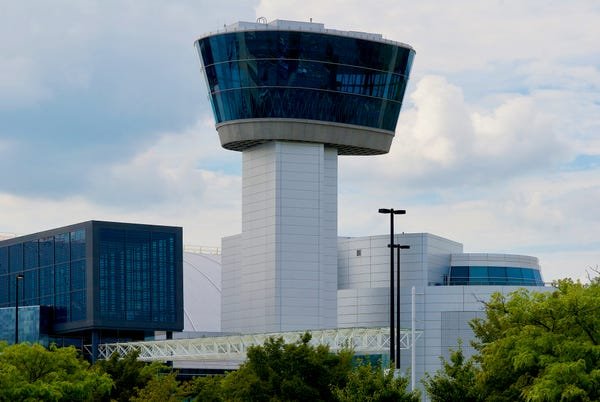
The museum takes advantage of its proximity to the airport with the Donald D. Engen Observation Tower.


Inside the Donald D. Engen Observation Tower.

Inside the Donald D. Engen Observation Tower.

Talia Lakritz/Business Insider

At 164 feet tall, the observation tower educates visitors about the history of Air Traffic Control and provides a 360-degree view of the modern airport in action.

Inside the tower, I watched planes take off and land at Dulles Airport while listening to live Air Traffic Control audio.

The Mary Baker Engen Restoration Hangar gives a behind-the-scenes look at how the museum restores historic aircraft.


The Mary Baker Engen Restoration Hangar at the National Air and Space Museum's Steven F. Udvar-Hazy Center in Chantilly, Virginia.

The Mary Baker Engen Restoration Hangar.

Talia Lakritz/Business Insider

Visitors can watch restoration work happen in real time from a balcony with floor-to-ceiling windows overlooking the hangar.

Among the works-in-progress are “Flak-Bait,” a Martin B-26 Marauder that flew 202 combat missions during World War II and participated in D-Day, and a Sikorsky JRS-1 seaplane that was present at Pearl Harbor when it was attacked on December 7, 1941.

The B-29 bomber Enola Gay, which dropped the atomic bomb on Hiroshima during World War II, is in the museum’s collection.


The Enola Gay viewed from an elevated platform at the National Air and Space Museum's Steven F. Udvar-Hazy Center.

The Enola Gay.

Talia Lakritz/Business Insider

On August 6, 1945, the Boeing B-29 Superfortress bomber Enola Gay dropped the first-ever atomic bomb used in warfare on Hiroshima, killing at least 70,000 people.

The “Little Boy” atomic bomb weighed 9,700 pounds, forcing the aircraft to remove most of its protective and defensive armament in order to carry the enormous weight.

The Enola Gay exhibit sparked controversy when the plane was first displayed in 1995, as veterans’ groups and anti-war activists debated how the historical narrative around the use of the atomic bomb should be presented.

The Boeing 367-80 Jet Transport, the only model of its kind ever built, was the prototype that led to the development of the Boeing 707 jetliner.


The Dash 80.

The Boeing 367-80 Jet Transport.

Heritage Images/Heritage Images via Getty Images

In the 1950s, Boeing set out to build a jet aircraft that could function as a passenger aircraft, a cargo plane, or a tanker used for mid-air refueling.

Boeing began building this prototype jet in 1952, and it flew for the first time two years later. It traveled 100 miles per hour faster than the de Havilland Comet, the world’s first jetliner developed in the UK, and had a range of over 3,500 miles, revolutionizing the air travel industry.

Known as “Dash 80,” the developed version of the aircraft entered service as the first jetliner in the US, the Boeing 707.

The museum also featured a Concorde supersonic commercial jet that was operated by Air France.


An Air France Concorde supersonic passenger jet.

An Air France Concorde supersonic commercial jet.

Talia Lakritz/Business Insider

The governments of Britain and France collaborated to create the first supersonic commercial jets, which operated commercially from 1976 to 2003.

Traveling at twice the speed of sound allowed the planes to cross the ocean in record time. Concorde’s fastest flight from New York City to London lasted just 2 hours, 52 minutes, and 59 seconds.

The museum’s Concorde jet, which flew for Air France, measures 202 feet and 3 inches long with a wingspan of 83 feet and 10 inches.

One of the museum’s centerpieces is a Lockheed SR-71A Blackbird, the world’s fastest aircraft propelled by air-breathing engines.


A Lockheed SR-71A Blackbird.

A Lockheed SR-71A Blackbird.

Talia Lakritz/Business Insider

The Lockheed SR-71A, a supersonic reconnaissance aircraft, was designed to fly high and fast enough to avoid Russian missiles during the Cold War. It was capable of flying at an altitude of over 85,000 feet at speeds of over three times the speed of sound, or approximately 0.7 miles per second.

The aircraft became known as “Blackbird” for its black paint that was capable of absorbing radar signals.

This Blackbird logged 2,801.1 hours of flight time over 24 years of service before retiring in 1990.

The entrance to the James S. McDonnell Space Hangar, with the space shuttle Discovery placed front and center, stopped me in my tracks.


The space shuttle Discovery.

The space shuttle Discovery.

Talia Lakritz/Business Insider

It’s hard to capture the full scale of Discovery in a photo, but I found it awe-inspiring to see such an enormous, historically significant spacecraft in person.

The shuttle measures 122 feet long, 78 feet wide, and 57 feet tall, towering over the other artifacts in the hangar. When fully loaded for missions, the orbiter weighed around 250,000 pounds.

Discovery was NASA’s longest-serving orbiter and flew 39 missions — more than any other space shuttle orbiter.


The space shuttle Discovery at the National Air and Space Museum's Steven F. Udvar-Hazy Center.

The space shuttle Discovery.

Talia Lakritz/Business Insider

Discovery flew its first mission in 1984 and returned from its last in 2012, spending a total of 365 days in space.

Among its many historic accomplishments, Discovery deployed the Hubble Space Telescope in 1990 and became the first space shuttle to dock with the International Space Station in 1999.

Hanging above Discovery was the Manned Maneuvering Unit that astronaut Bruce McCandless used during the first untethered spacewalk in 1984.


The Manned Maneuvering Unit, then and now.

The Manned Maneuvering Unit in action.

Talia Lakritz/Business Insider ; Encyclopaedia Britannica/UIG Via Getty Images

The backpack propulsion device, powered by nitrogen jets, allowed McCandless to fly around 300 feet away from the space shuttle Challenger. His untethered spacewalk was immortalized in an iconic photo of the lone astronaut floating above the Earth.

The Udvar-Hazy Center is worth the detour from the National Mall.


The space shuttle Discovery at the National Air and Space Museum's Steven F. Udvar-Hazy Center.

The space shuttle Discovery at the National Air and Space Museum’s Steven F. Udvar-Hazy Center.

Talia Lakritz/Business Insider

My phone’s step counter recorded nearly 10,000 steps on the day I visited the museum. There’s an incredible amount of ground to cover and objects to see.

I can’t believe I didn’t know that the National Air and Space Museum even had a second location when I started planning my visit to Washington, DC. Now, I’m recommending it to all of the air and space enthusiasts I know.


Source link

How-a-lesser-known-Swedish-private-equity-giant-plans-to-win.jpeg

How a lesser-known Swedish private equity giant plans to win over US retail investors

EQT is one of the largest private equity investors in the world — yet most wealthy Americans have barely heard of it. That’s the uphill battle facing Peter Aliprantis, the Swedish firm’s head of private wealth in the Americas, as EQT tries to pitch in a market dominated by Wall Street brands with plenty of CNBC airtime.

“Most people in the United States are not familiar with us, and the way we say it, we’re the best-kept secret,” Aliprantis told Business Insider.

Private Equity International ranked the firm as the second-largest private equity firm, with $312 billion of assets under management. It raised more than $113 billion in third-party private equity capital from 2020 to the end of 2024, putting it ahead of Blackstone, and just behind KKR so far this decade.

Like many of its competitors, it’s turning to private wealth as the newest source of growth. The industry’s change of fundraising focus comes as private equity firms are slow to return cash to investors, and over-allocation among institutional investors means that institutional funding is slowing.

But the same reasons that the firm isn’t as well-known in America are actually an advantage, Aliprantis said.

In a world where debt-heavy buyouts are proving more difficult and an increasingly concentrated American private market is pushing some to invest internationally, a global industrialist approach can be attractive.

EQT has returned capital at a normal pace, with $23 billion in distributions for the year ending June 2025. The firm has also been building a private wealth business for the past four years, which accounts for 10% of its current assets. The firm has a goal to reach between 15-20% during its current $100 billion fundraising cycle, according to its second-quarter report.

Aliprantis walked Business Insider through the firm’s pitch to financial advisors and private wealth distribution networks, explaining why its global reach is a significant advantage in 2025.

The key for EQT, Aliprantis said, is for the firm to offer individual investors the “exact same deals” it gives institutional investors.

EQT’s industrialist, international advantage

EQT was founded in 1994 as a spin-off from industrial holding company Investor AB, but the firm’s history stretches back to Sweden’s Wallenberg family. The Wallenbergs, called the “Rockefellers of Europe,” have created an empire of business holdings including massive stakes in Sweden’s biggest firms, like ABB, AstraZeneca, or Saab.

“The Wallenberg family has a 160-year heritage of owning and developing companies,” Aliprantis said. “We’re not financial engineers. We don’t add a lot of leverage to what we do, and we’re very, very different from what a lot of our peers on Wall Street are doing.”

Aliprantis’s comments echo a larger change in the industry, which is running out of easy money-making deals and cheap financing and now has to extract returns by actually building stronger companies.

But the firm’s biggest advantage, Aliprantis said, is its global nature.

Only 35% of its assets are based in North America, and the firm has 26 global offices where its deal teams invest in local private equity, infrastructure, and real estate deals.

“A lot of our colleagues based in New York will fly deal team partners over to different places around the world to do the deal and then get on a plan and fly home,” Aliprantis said. “Our deal teams are pretty much based in the locations where they do deals.”

This means the firm “gets the call” when local companies are looking to sell, and keeps them from larger “bake-offs” where the price might be bid-up.

This has also meant the firm can continue to provide distributions to its clients even if the market is slow in one locale.

“If you’re a US-based domicile private markets firm that has 70 to 80% of your assets in the US, guess what? If the US IPO market is slowing, you’re going to have a problem exiting,” Aliprantis said.

“Here in the US, it’s always been too much money chasing too few deals. You know what? That’s a US thing,” Aliprantis said.” If you go to Europe and you go to Asia, it’s the opposite.”

For example, Bain estimates there’s about $480 billion in dry powder for European private funds, including venture capital, compared to Pitchbook’s $914.5 billion for US-focused private equity firms, not including VC. Apollo’s Marc Rowan also recently told the Wall Street Journal that as an industry, they find themselves short ideas rather than capital.

Aliprantis said investors’ biggest reason to diversify away from the US market is its concentrated bet on AI.

“Their concern is that the Mag Seven is roughly 37% of the S&P right now, and valuations are stretched,” Aliprantis said. “Is AI really going to work? Is it not? How additive is it going to be to the bottom line? We don’t know.”

How to keep retail investors happy

Across the spectrum, Aliprantis said, the “biggest concern” is that retail investors are getting a set of less attractive deals, while institutional investors are getting a “separate set of deals.”

Aliprantis said that the firm’s six evergreen vehicles are composed of the “exact same deals” that its institutional clients invest in.

The key to doing that, and to being a responsible investor or retail capital, is “size and scale,” Aliprantis said.

Size also helps with the balance sheet necessary to launch a private wealth business. It can cost millions of dollars to hire the necessary staff to start selling to financial advisors and other wealth management channels before any revenue is returned to investors.

EQT was able to use its balance sheet, as a public company in Sweden, to build its private wealth team and now has 70 private wealth professionals globally, with 20 based in the US.

That’s not to say that smaller funds won’t succeed, but it will be much harder, Aliprantis said. With so many investors competing for retail capital, consolidation is inevitable.

“The race is on in the industry right now,” Aliprantis said.


Source link