
Theron Mohamed — Profile Picture

Greg Abel pays tribute to Warren Buffett in his first letter as Berkshire Hathaway CEO, calling him a ‘very hard act to follow’

Greg Abel paid tribute to Warren Buffett and reassured Berkshire Hathaway shareholders he wouldn’t do anything drastic as their new CEO in his first letter to them on Saturday.

Buffett handed Berkshire’s reins to Abel at the start of this year, ending a six-decade run during which he transformed the failing textile mill into a sprawling conglomerate worth more than $1 trillion.

The legendary investor oversaw a 6,100,000% return for Berkshire shareholders between 1965 and 2025, trouncing the S&P 500’s total return of 46,100% including dividends. His compounded annual gain of 19.7% was nearly double the index’s 10.5% figure over a 60-year timeframe.

“Warren is obviously a very hard act to follow,” Abel wrote, continuing Buffett’s decades-long tradition of penning an annual shareholder letter.

Berkshire’s new boss dedicated the first section of his letter to Buffett, praising everything from his patience and judgment to his investing prowess, legacy as an educator, track record as a CEO, and the unique company he built with the late Charlie Munger.

Abel used the letter to properly introduce himself to shareholders, and even tried to inject some of Buffett’s trademark wit.

“I will not be your CEO for the next 60 years as simple arithmetic makes that — shall we say — an ambitious plan,” he quipped.

More of the same

Abel made it clear to shareholders that he “gets it” — he understands what makes Berkshire special and has no plans to ruin it.

He walked through what he called Berkshire’s “foundational values”: its decentralized model, integrity, financial strength, capital discipline, risk management, and operational excellence.

Abel lingered on the topic of capital discipline, showing he’s aware of how much scrutiny Berkshire has received for hoarding more than $370 billion of liquid assets.

He signaled there won’t be any rushed deals or immediate dividend payouts on his watch. He described Berkshire’s cash pile as both its rainy-day fund and its “dry powder” for stock purchases and acquisitions, but said he’ll remain disciplined in spending it “regardless of the size” of the company’s reserves.

Digging into the details

Abel’s letter contained several key nuggets for close followers of Berkshire.

First, he described its Kraft Heinz investment as “disappointing” with a return “well short of adequate,” echoing Buffett’s uncharacteristic bashing of the food giant.

Second, Abel broke out the five stakes in Japanese companies purchased by Buffett a few years ago. The dedicated table showed Berkshire paid a total of $15.4 billion for positions worth a combined $35.4 billion at December’s close, and collected $862 million in dividends from them last year.

Third, he revealed that Ted Weschler now oversees about 6% of Berkshire’s investments after assuming control of the recently departed Todd Combs’ portion of the company’s portfolio.

Abel also positioned Weschler as one of his key deputies, writing that his “impact extends beyond these investments” to weighing in on big opportunities and Berkshire’s businesses, and providing other support.

Finally, he signaled a shift to a bigger brain trust at Berkshire. Instead of Buffett and Munger holding court for the entire Q&A at Berkshire’s annual meeting, as they did for many years, Abel will field questions with Berkshire’s insurance chief, Ajit Jain, and later with Katie Farmer and Adam Johnson, two of his top deputies.



Source link

Dominick Reuter

Hundreds of Target employees urge the company to keep ICE out of stores. Read the letter to leadership.

Target employees are pushing the company to take a firmer stand against ICE.

In a letter emailed to management on Friday, employees called on Target to “do the right thing” and bar federal immigration authorities from its stores. The letter, viewed by Business Insider, was signed by 284 employees, many of whom said they were residents of Minnesota, where Target is headquartered.

“Target’s continued inaction in the face of the current administration puts all of us at risk of more harm in our workplaces and represents a moral failure to protect those in our community,” said the letter, which included current CEO Brian Cornell and incoming CEO Michael Fiddelke as recipients.

A day after the letter was sent, federal agents shot and killed a second Minneapolis resident, Alex Pretti, further complicating tensions between protesters and the Trump administration.

The letter also highlights the January 7 death of Renee Good after her encounter with immigration authorities in Minneapolis. No charges have been filed in connection with Good’s death, and Deputy Attorney General Todd Blanche has said there is currently no basis for a criminal civil rights investigation. Homeland Security Secretary Kristi Noem said the officer fired in self-defense, while Minnesota Gov. Tim Walz has called for a transparent investigation.

Target has made several public moves since the letter was sent, including joining a statement with more than 60 other Minnesota businesses calling for de-escalation. Cornell also met with local faith leaders on Thursday to discuss the situation.

On Monday, Fiddelke sent a video message to staff that did not mention Trump or ICE by name, but said “the violence and loss of life in our community is incredibly painful.”

The Minneapolis-based retailer employs roughly 7,000 corporate employees at its headquarters offices, among its 440,000 employees across the US and around the world. The company also operates roughly 50 stores in the Twin Cities market.

The letter from employees highlighted Target’s scaled-back LGBTQ+ Pride collection, its wind-down of certain DEI initiatives, and its donation to Donald Trump’s inauguration fund as examples of how the company has “abandoned its community” in recent years.

Some of the demands may be outside Target’s legal ability to fully address, such as the calls on Target to block immigration authorities from its properties.

Corporate immigration attorney John Medeiros told the AP last week that law enforcement officers are typically allowed to operate in publicly accessible areas of retail businesses, like parking lots and sales floors.

Guidance from the Minnesota Attorney General’s office says employees should not interfere with agents’ lawful activities at their places of business, but neither are workers required to answer questions or tell agents whether a certain person is on the premises.

In a memo last week, chief HR officer Melissa Kremer said Target “does not have cooperative agreements with any immigration enforcement agency.”

Read the full letter from employees here:

TO: Target Leaders
FROM: Concerned Team Members
Date: Fri, Jan 23rd, 2026
Subject: Urgent Actions to Protect our Communities from ICE
We, the undersigned, are writing this letter to express solidarity with our neighbors, guests, and team members targeted by the violence perpetrated by agencies like ICE, and demand urgent action from the Target Enterprise and its leadership.
Target’s previous acts have left many rightfully concerned for its integrity. Target abandoned its community with its scale back of its Pride collection, year after year, and its winding down of DEI initiatives across the Enterprise. Then, Target went beyond mere “business decisions” when it directly funded the current administration through its $1 million donation to Donald Trump’s inauguration officially stating “We work with elected officials at all levels of government to provide the best retail experience for the more than 2,000 communities we’re proud to serve”, despite the fact that Target has never previously donated to an inauguration. On the contrary, the current ICE invasion lays bare the contempt the current administration has for the communities Target lives in as starkly shown with the cold blooded murder of our neighbor Renee Good (in which, ICE denied her accessible, lifesaving care after she had been shot by Jonathan Ross) or Trump’s threats to invoke the insurrection act against a population of peaceful protesters.
In the face of this tyranny, continued silence from our leaders will never make us safer, as already evidenced by ICE’s kidnapping and assault of two Target Richfield employees who were both minors and citizens. Target’s continued inaction in the face of the current administration puts all of us at risk of more harm in our workplaces and represents a moral failure to protect those in our community.
Despite its previous failures, Target still has ample opportunity to do the right thing. In line with the demands of community leaders like ICE Out MN and ISAIAH, we, the undersigned, demand the following immediate actions from our leaders:
  1. Issue a public statement from the leadership team and enterprise to call for an immediate end to the ICE “surge” into MN and for ICE to leave the state.
  2. Exercise Target’s Fourth Amendment right to its maximum and keep ICE out of Target stores, properties, and parking lots;
    1. Update training and policy to enable team members such as AP and Corporate Security to trespass, de-escalate, and remove any ICE agents operating illegally without a judicial warrant.
    2. Publicly post signage denying entry into Target properties to immigration authorities.
  3. Cut current and future funding from Target and its affiliates to the current administration and any causes that support ICE and its occupation of the Twin Cities.
  4. Follow the recommendations of local community leaders in what Target can do to help heal the damage our previous inaction has brought, as well as future steps of what Target can do to support our communities going forward.
If Target takes these steps, it will find that it will not be in this fight alone: The city of Minneapolis already has a separation ordinance to keep ICE off of its property and prevent collaboration between MPD and ICE and has opened litigation to challenge the current admistration’s illegal use of force; Costco and other companies have set the example of how for-profit companies can stand their ground in this administration; Over a hundred faith leaders have come together and have arranged to meet with Target leaders to advocate for our neighbors (and they continue to fight, even as Target leaders fail to take their urgent concerns and reschedules their meeting); On Saturday, at least tens of thousands of residents took to the streets at Powderhorn Park and Lake Street to demand ICE out of the Twin Cities; And now, on the date that this letter is sent, residents and workers across the Twin Cities are joining in protest in solidarity with local labor unions that have organized a day of “no work, no school, no shopping” for the 23rd , where the Twin Cities community is showing its collective power to fight back effectively against the rise of authoritarianism.
Strength comes in open solidarity, and the leaders of Target still have the chance to do the right thing. The Twin Cities and Target Team Members already stand together, but leadership must act now.
Signed, 275+ Members of the Target Team

Have a tip? Contact Dominick Reuter via email at dreuter@businessinsider.com or call/text/Signal at 646.768.4750. Use a personal email address, a nonwork WiFi network, and a nonwork device; here’s our guide to sharing information securely.


Source link

xAI

California sends xAI cease-and-desist letter, saying it must stop allowing sexualized deepfake images of minors


Anadolu/Anadolu Agency via Getty Images

  • California sent xAI a cease-and-desist letter, demanding it stop allowing deefake images of minors.
  • Elon Musk’s xAI faces sustained criticism over Grok’s ability to create nonconsensual sexualized images.
  • The letter, sent by AG Rob Bonta, threatens legal action if the deepfakes continue to be permitted.

California Attorney General Rob Bonta has demanded that xAI prevent its chatbot, Grok, from continuing to create sexualized deepfake images of children.

Bonta’s office sent a cease-and-desist letter to Elon Musk’s AI startup on Friday after sustained criticism over the bot’s ability to create nonconsensual sexualized images, including those of minors.

Earlier this week, X said that it implemented restrictions on Grok.

“We have implemented technological measures to prevent the Grok account from allowing the editing of images of real people in revealing clothing such as bikinis,” X’s safety account said in a blog post on the platform on Wednesday. “This restriction applies to all users, including paid subscribers.”

However, that didn’t stop the X or Grok app from creating sexualized images, Business Insider’s Henry Chandonnet found on Thursday.

Representatives for the CA Attorney General’s office did not immediately respond to requests for comment from Business Insider.

In an automated response to Business Insider, xAI said, “Legacy Media Lies.”

This is a developing story. Please check back for updates.


Source link

Read-the-letter-celebrity-lawyer-Alex-Spiro-wrote-to-Gavin.jpeg

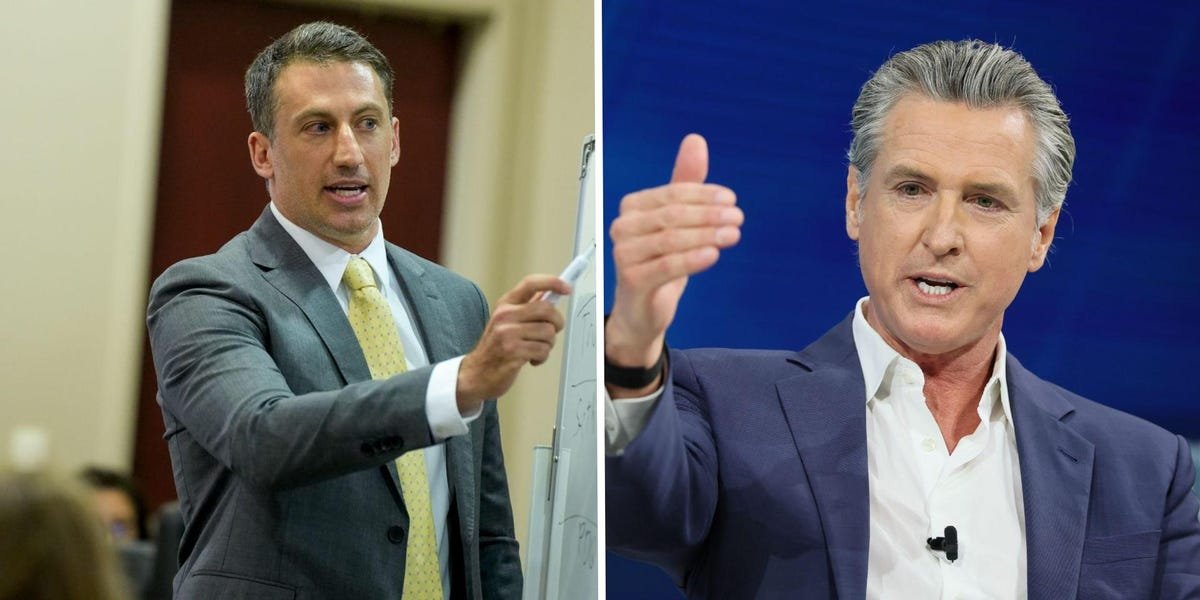
Read the letter celebrity lawyer Alex Spiro wrote to Gavin Newsom, warning that his clients will ‘permanently relocate’ if California wealth tax passes

A proposed billionaire tax in California has the wealthy threatening to flee, according to a letter written by power lawyer Alex Spiro to Gov. Gavin Newsom.

In a December 11 letter that was obtained by Business Insider, Spiro lays out his opposition to the proposed tax on behalf of his clients, whom he calls “California residents who would be subject to the proposed Billionaire Tax Act.”

“It will trigger an exodus of capital and innovation from California,” Spiro wrote. “Our clients have made clear they will permanently relocate if subjected to this tax.”

The measure proposes that California residents with assets exceeding $1 billion be subject to a one-time 5% tax on the value of their assets. If the proposal receives enough signatures, it will appear on the state ballot in November 2026. If passed, it would apply retroactively to all California residents as of January 1, 2026.

While Newsom has said he is against the tax and would “fight” it, he would not have the ability to veto it if it were to pass as a ballot measure.

Several wealthy Californians, including venture capitalist Peter Thiel and Google cofounder Larry Page, have considered shrinking their presence in California, according to a New York Times report. Representatives for Page and Thiel did not respond to Business Insider when asked if they were represented by Spiro.

Over the weekend, billionaire Palmer Luckey took to X to voice his opposition to the measure.

“I made my money from my first company, paid hundreds of millions of dollars in taxes on it,” the Anduril cofounder wrote. “Now me and my cofounders have to somehow come up with billions of dollars in cash.”

While it’s not clear which clients the lawyer was referencing in his letter to Newsom, Spiro’s client roster in the past has included billionaires and A-listers. He has previously represented Kim Kardashian, Jay-Z, and Elon Musk.

Read the full letter below:

Re: Constitutional Concerns Regarding Proposed Billionaire Tax Act
Dear Governor Newsom:
I represent California residents who would be subject to the proposed Billionaire Tax Act if it qualifies for the November 2026 ballot. I write to urge you to work to prevent this initiative from moving forward. The Act has serious legal problems and would cause significant economic damage to California and the broader economy.
First, and most importantly, the Act would be unconstitutional. Although the Act purports to be a tax, it is in reality an uncompensated confiscation of property. The Act imposes a 5% levy on total accumulated wealth, including illiquid assets that generate no income. That is in substance a taking without just compensation. As the Supreme Court explained in Armstrong v. United States, the government cannot force “some people alone to bear public burdens which, in all fairness and justice, should be borne by the public as a whole.” 364 U.S. 40, 49 (1960). The Act concentrates an extraordinary burden on a small group to solve a general revenue problem— exactly what the Constitution prohibits.
Second, for the people who relocate from California in 2026 before the November election, the Act would tax them after they have become citizens of other States and without any ability to vote on the measure. The Supreme Court has held that retroactive taxation cannot be “harsh and oppressive.” United States v. Carlton, 512 U.S. 26, 30 (1994). A 5% levy on total net worth imposed on former residents who departed before the law was even enacted clearly meets that definition.
Third, the Act’s unprecedented novelty makes it especially vulnerable to a legal challenge. California has never imposed a wealth tax, much less one that reaches former residents and that is targeted at a small group of citizens. The Supreme Court closely scrutinizes unprecedented exercises of government power precisely because they lack historical precedent. See Biden v. Nebraska, 600 U.S. 477, 505 (2023). In fact, it has not hesitated to invalidate the retroactive application of new taxes, even for far less extreme measures. See Blodgett v. Holden, 275 U.S. 142 (1927). There can be no doubt that the current Supreme Court would carefully evaluate a law so out of step with the American legal tradition.
From an economic perspective, the Act creates two serious problems. First, it will trigger an exodus of capital and innovation from California. Our clients have made clear they will permanently relocate if subjected to this tax. They are not alone. See California’s wealth-tax test: Have voters finally found a policy that the state’s inherent economic strengths can’t overcome?, Wash. Post (Nov. 17, 2025) (opinion) (describing the tax as “almost tailor-made to drive most Silicon Valley tech companies to Austin, Texas”). In other words, by passing this proposal California would exchange a one-time windfall for the permanent loss of billions in annual income taxes, capital gains taxes, property taxes, and economic activity. The state’s most economically productive residents would take their businesses, jobs, and charitable giving with them. Second, the Act will force destructive asset sales. Our clients hold equity stakes in operating businesses, venture capital funds, and real estate. Paying a 5% wealth tax would require massive forced liquidations, depressing asset values and triggering market instability that would harm ordinary investors whose retirement accounts hold these same investments.
Our clients are prepared to mount a vigorous constitutional challenge if this measure advances. Litigation would be protracted and expensive, and it would generate sustained negative attention to California’s business climate. The prudent course is to prevent this constitutionally defective measure from reaching the ballot. We respectfully ask that you discourage signature gathering, oppose qualification, and if necessary, campaign against passage.
Our clients prefer to remain in California and continue contributing to the state’s economy and civic life. But they will not remain if subjected to an unconstitutional confiscation of their wealth. We hope this can be resolved through political channels rather than through years of contentious litigation.
Respectfully,
Alex Spiro


Source link

My-grandmother-wrote-me-a-letter-before-my-wedding-Her.jpeg

My grandmother wrote me a letter before my wedding. Her marriage advice insulted me at first, but now I get it.

I married my husband, Scott, in April 2025 after four years of dating.

Nobody was more excited for the wedding than our families. They rallied around us, sharing tips and calming me down when the planning became stressful.

My sister made a scrapbook for me to open the night before the nuptials. Inside, there were handwritten letters from my bridesmaids, my mom, and my 79-year-old grandmother.


Wedding photo

The author on her wedding day.

Courtesy of the author


The letters were sweet, romantic, and optimistic — well, almost all of them were. My grandmother’s letter had an ominous tone.

“I wish you and Scott all the happiness in the world in your married life. I am sure you two are just right for each other. That’s not to say it will all be plain sailing,” she wrote.

“There may be bumps along the road,” she added, “but love has a way of forgiving a multitude of sins.”

I was alarmed by my grandmother’s note

It was a huge contrast to the other letters in the scrapbook. While my bridesmaids reminisced about the past and shared excitement for my future, my grandma’s words stopped me in my tracks.

I remember laughing and shaking my head in disbelief. I then handed the letter to my mom, who was equally unimpressed.

It’s not that I didn’t appreciate the advice. But really, who wants to hear the words “love” and “sins” mentioned in the same sentence? Especially when it’s in relation to your own husband.


Couple selfie wedding day

The author was taken aback by her grandmother’s letter at first.

Courtesy of the author


For a brief moment, I contemplated what she meant by the word “sins.” Cheating? Lying? Or something else?

My gran has a fantastic relationship with my husband, so I couldn’t imagine what sparked her cautionary words. Similarly, I had never spoken a bad word about Scott to my grandmother.

Of course, like any couple, we’d had fights, but it was never anything relationship-threatening. And I had never spoken about it with my her.

Ultimately, I disregarded the note, just as you would ignore a speck of dirt on a white wedding dress. Even if nobody else notices it, you know it’s there.

Five months later, I learned a major lesson

The wedding day was picture-perfect.

I felt so fortunate that we got to celebrate with our loved ones, especially our grandmothers. Both Scott and I were the first grandchildren in our families to get married, so it felt extra special.

Five months later, I found my grandma’s letter while looking through the scrapbook. It looked different to me with fresh eyes. Now that some time had passed, I could look at it from a new perspective. I could read without taking it personally.

I thought about my grandmother’s life, and I realized that her words were never about my husband and me.

My gran married my late grandfather when they were just teenagers, and it’s fair to say they had many bumps in their own love story. Let’s just say, their relationship wasn’t like the kind I grew up watching in romantic comedies and Disney films.

However, they loved each other deeply. They were loyal, forgiving, and supported each other throughout their more than 50-year marriage.

Staying in love is a choice

Thinking about their relationship reminded me that falling in love is a feeling, but staying in love is a choice. It’s an action. It’s not something that just happens to a person.

The wedding is the beautiful part, but the marriage? That’s where things have the potential to get messy.


Granddaughter posing for photo with grandma

The author now understands where her grandmother was coming from.

Courtesy of the author


I’ve been married for less than a year, so I’m not pretending to know all the answers. But if I’m honest with myself, I can admit that my grandma’s letter shook me because it didn’t fit the aesthetic Instagram version of what I thought marriage was supposed to be.

I know that my husband and I have a great deal of joy ahead of us. But we’re also going to witness one another’s pain, grief, disappointment, and growth. That’s just a part of sharing your life with someone.

If I ever catch myself feeling unprepared, I know I can revisit my grandma’s letter.


Source link