
I-started-letting-my-son-bike-with-his-friends-when.jpeg

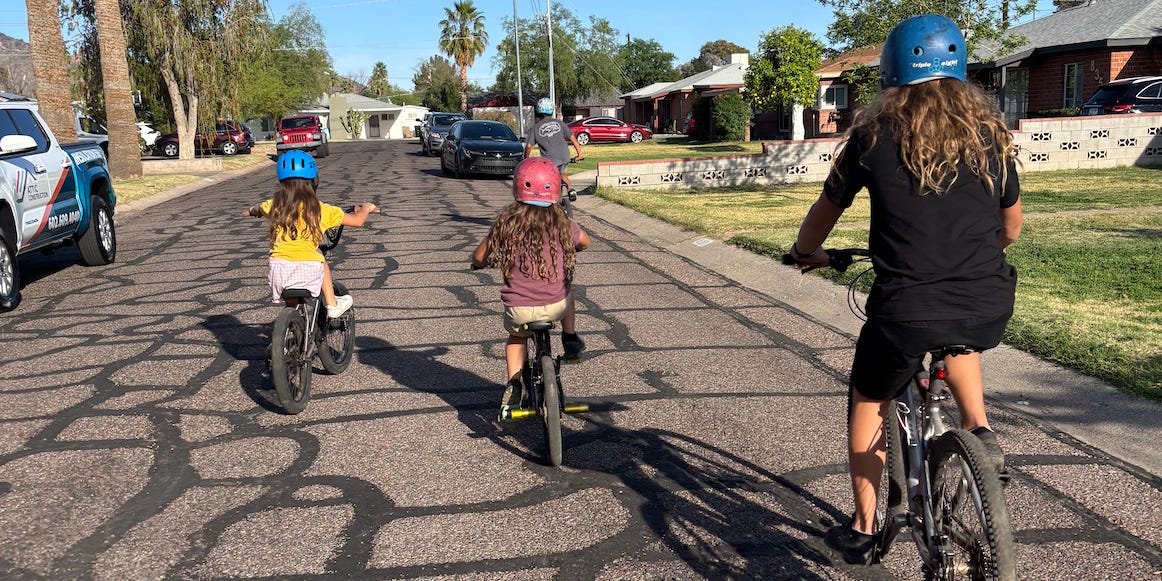
I started letting my son bike with his friends when he was 8. It gives me anxiety, but I see the value in having independence.

The first time my son asked if he could bike in the neighborhood with his friends, I hesitated. His friend balanced on his bike, one foot on the ground, waiting impatiently for an answer. I looked at my eight-year old son, his eyes wide with hope, and every instinct in me wanted to say no.

It was too dangerous. He could get hit by a car. Or kidnapped.

Instead, I took a breath and said, “You can go one block over. And stick together the whole time.”

My son pumped his fist in victory, clipped on his helmet, and hopped on his bike. I didn’t hear from him for half an hour, during which I worried the whole time.

When he returned home, breathless and happy, I knew that I’d made the right choice.

He started asking for more screentime when he wasn’t outside

I bought him an advanced walkie-talkie and GPS tracker so I could check his whereabouts and communicate with him next time he went.

Biking became a regular thing that summer among the four neighborhood boys close in age. Besides biking, they played in our driveway, climbed trees, and made homemade “weapons.”

After about two years, the “bike gang” started to dissolve. One kid moved away. The oldest lost interest. Eventually, my son stopped biking, too. He stayed indoors more often and rarely ventured outside. Instead of pushing his limits in free play, he started begging for more screen time.

I missed the days of the “bike gang,” so when one of the neighbor kids and his younger brother started biking again, I was all too ready to let my son — and now my 8-year-old daughter — join in.

I set boundaries with my kids on how far they can go

I know that biking can be dangerous — my husband was hit on a bike as a kid, so was my little brother, and in my 20’s I was hit while jogging. Cars are not always paying attention, especially now with texting. My kids and I talk about how hyper-aware they need to be at all times. We also discuss stranger danger, and my son now has a GPS tracking watch.

Still, even with these precautions, it’s not easy to send my kids into the world — but the alternative is that they’re cooped up inside or limited to our backyard. Our neighborhood “bike gang” now includes up to seven kids. There’s safety and visibility in numbers, which gives me a small sense of ease.

I now let my kids bike up to a half mile from our house if they’re with the other neighbor kids. When my son is with a fellow 13-year-old in our neighborhood, I let him go even further. They’ve pedaled up to a local church to watch a friend’s theater rehearsal, to my son’s school for band practice, or even to take local taekwondo lessons.

Letting my kids roam the neighborhood is good for their mental health and relationships

As anxiety-inducing as letting my kids bike is for me, I know it’s doing the opposite for them. Research shows that as independent playtime has declined over the past few decades, anxiety and depression have increased among school-aged children.

My oldest child is far less anxious and more confident than he used to be. I believe biking has taught him more responsibility, too, because he has to babysit his sister every time she goes with him. It’s also forced him to learn practical skills, liking fixing a bike tire.

As for my 8-year old, she’s an energetic child who loves to move. Biking with the neighbor kids lets her run off her energy. She also feels older and “cooler” getting to go with the bigger kids.

It’s helped their sibling bond, too, by spending time together doing an activity they both love.

And I’ll be honest that the quiet time in my home, especially when their little brother is napping, is appreciated. I think parenting must’ve been easier before we started keeping kids indoors — and worried about everything.

It’s not easy letting my kids go into the world, but I’m glad they’re getting some semblance of the independence I had as a 90’s kid.


Source link

Aditi Bharade

Why Starbucks is letting Brian Niccol use the company plane for more personal travel

Starbucks is getting CEO Brian Niccol to use the company jet for all his travels — and removing his quarter-million travel budget cap.

In a Monday filing, the Seattle-based coffee chain said that it was changing its agreement on how much Niccol could use the company’s private jet for his personal travel. And the main reason for this change is to ensure Niccol’s safety.

Before September, Niccol’s use of the Starbucks plane for non-work reasons was subject to an annual cap of $250,000, and if he exceeded that amount, he had to reimburse the company, the Monday filing wrote.

But after September, the board removed the $250,000 annual cap and replaced it with a “more frequent quarterly review of Mr. Niccol’s personal flights by the chair of the Compensation Committee,” per the filing. Starbucks has not imposed a new maximum spending limit.

“This change was driven by the security study’s recommendation that Mr. Niccol use Company aircraft for all air travel, including personal travel, and the Company’s ongoing monitoring of Mr. Niccol’s security situation,” the filing wrote.

A Starbucks spokesperson said the company’s board recently decided to enhance security measures for Niccol, following a review of threats and risks to the chief executive.

Following the review, the board has made it a requirement to use private aircraft for all his travels, the spokesperson added.

Last year, Starbucks was hiring for a pilot to fly its private Gulfstream jets. In the job listing, the company said it would pay the pilot a salary between $207,000 and $360,300.

The filing also wrote that Niccol was paid about $31 million in compensation in 2025, a drop from the $95.8 million he was paid in 2024. His 2024 compensation was boosted by $90.2 million in stock awards he received as part of his signing contract.

Niccol started at the company in September 2024, moving over from Chipotle. He has helmed the chain’s “Back to Starbucks” turnaround plan, an effort to turn around several quarters of poor results because of a declining customer experience.

His offer letter in August 2024 showed that Starbucks had permitted him to use the company jet to commute from his home in California to the company’s headquarters in Seattle. In July last year, Business Insider learnt that Starbucks had set up a satellite office close to Niccol’s residence in Newport Beach.


Source link

Hate-your-old-Gmail-address-Google-is-quietly-letting-some.jpeg

Hate your old Gmail address? Google is quietly letting some people change it without losing data

It looks like you may soon be able to change that old email address you made in high school.

Google account users have long been unable to change their email addresses without creating a whole new account, but Google seems to be quietly rolling out an option to update them. That’s according to a support page published by the company, which outlines a new process to change the email or username used to identify your account.

The update on Google’s account help page says certain account holders can now change their @gmail.com address without losing access to their data or services. The feature was first reported in the Google Pixel Hub Telegram group in a message that said the update is being gradually rolled out to users. As of Friday morning, the modified instructions were available on the Hindi version of Google’s support page.

The support page suggests this option is currently only available in some regions, including Hindi-speaking areas.

According to a translated version of the Hindi support page, the new email must end in @gmail.com, and it can only be changed up to three times. Once the address has been changed, it’s irreversible.

To make the change, you would visit your Google Account page, click “Personal Info,” and go to the “Email” section, according to the Telegram message.

It’s unclear when it will roll out more widely, and Google didn’t immediately respond to a request for comment from Business Insider. As of Friday morning, the English support page said usernames ending in @gmail.com usually can’t be changed.

Once the change is made, the Hindi page said, your old Gmail address will be used as an alias to receive emails. You can reuse your old Google account email address at any time, but you can’t create a new Gmail address for the next 12 months.

You can sign in to Google services like Gmail, YouTube, Google Play, or Drive with your old or new email address.


Source link

A-Nobel-Prize-winning-physicist-explains-how-to-use-AI-without.jpeg

A Nobel Prize-winning physicist explains how to use AI without letting it replace your thinking

Think AI makes you smarter?

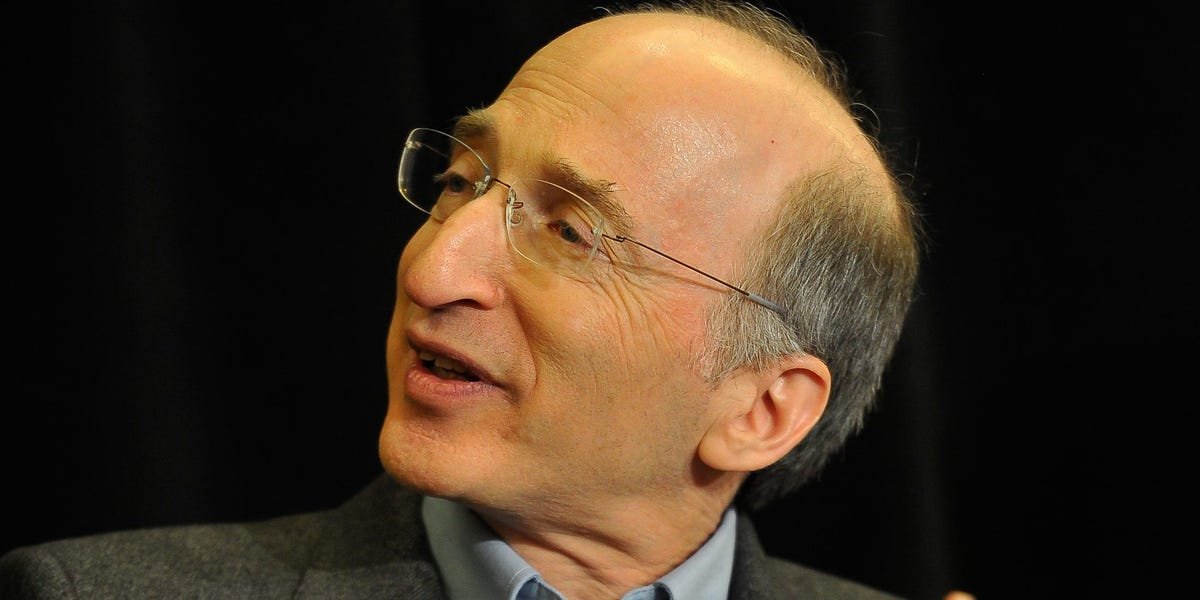
Probably not, according to Saul Perlmutter, a Nobel Prize-winning physicist who was credited for discovering that the universe’s expansion is accelerating.

He said AI’s biggest danger is psychological: it can give people the illusion they understand something when they don’t, weakening judgment just as the technology becomes more embedded in our daily work and learning.

“The tricky thing about AI is that it can give the impression that you’ve actually learned the basics before you really have,” Perlmutter said on a podcast episode with Nicolai Tangen, CEO of Norges Bank Investment Group, on Wednesday.

“There’s a little danger that students may find themselves just relying on it a little bit too soon before they know how to do the intellectual work themselves,” he added.

Rather than rejecting AI outright, Perlmutter said the answer is to treat it as a tool — one that supports thinking instead of doing it for you.

Use AI as a tool — not a substitute

Perlmutter said that AI can be powerful — but only if users already know how to think critically.

“The positive is that when you know all these different tools and approaches to how to think about a problem, AI can often help you find the bit of information that you need,” he said.

At UC Berkeley, where Perlmutter teaches, he and his colleagues developed a critical-thinking course centered on scientific reasoning, including probabilistic thinking, error-checking, skepticism, and structured disagreement, taught through games, exercises, and discussion designed to make those habits automatic in everyday decisions.

“I’m asking the students to think very hard about how would you use AI to make it easier to actually operationalize this concept — to really use it in your day-to-day life,” he said.

The confidence problem

One of Perlmutter’s concerns is that AI often speaks with far more certainty than it deserves and can be “overly confident” in what it says.

The challenge, Perlmutter said, is that AI’s confident tone can short-circuit skepticism, making people more likely to accept its answers at face value rather than question whether they’re correct.

That confidence, he said, mirrors one of the most dangerous human cognitive biases: trusting information that appears authoritative or confirms our existing beliefs.

To counter that instinct, Perlmutter said people should evaluate AI outputs the same way they would any human claim — weighing credibility, uncertainty, and the possibility of error rather than accepting answers at face value.

Learning to catch when you’re being fooled

In science, Perlmutter said, researchers assume they are making mistakes and build systems to catch them. For example, scientists hide their results from themselves, he said, until they’ve exhaustively checked for errors, thereby reducing confirmation bias.

The same mindset applies to AI, he added.

“Many of [these concepts] are just tools for thinking about where are we getting fooled,” he said. “We can be fooling ourselves, the AI could be fooling itself, and then could fool us.”

That’s why AI literacy also involves knowing when not to trust the output, he said — and being comfortable with uncertainty, rather than treating AI outputs as absolute truth.

Still, Perlmutter is clear that this isn’t a problem with a permanent solution.

“AI will be changing,” he said, “and we’ll have to keep asking ourselves: is it helping us, or are we getting fooled more often? Are we letting ourselves get fooled?”


Source link