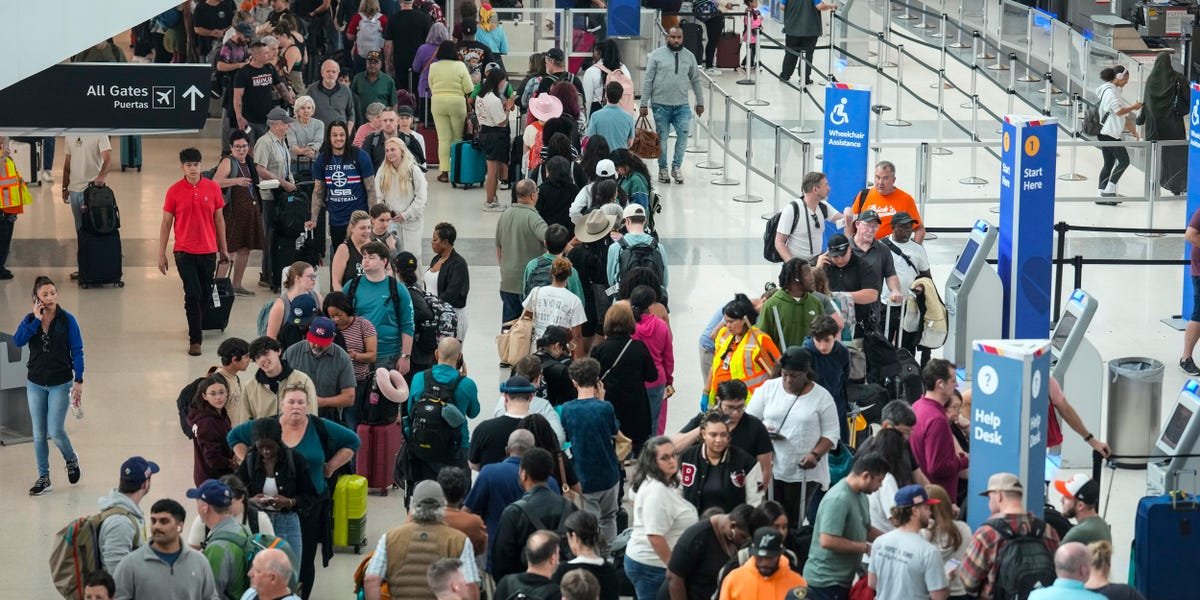
It looks like the worst of the airport chaos is coming to an end.
Wait times at security checkpoints have plummeted at Atlanta’s Hartsfield-Jackson International Airport, which was one of the hardest hit by Transportation Security Administration staffing shortages.
While last week it warned passengers of four-hour lines, its website listed waits of less than five minutes at all checkpoints just after 6:20 a.m. ET.
The airport had previously suspended this feature during the peak of the staffing shortages, instead displaying a message telling people to expect four-hour waits in line.
Delta Air Lines’ main hub, Hartsfield-Jackson, is also the world’s busiest airport by passenger numbers, handling over 100 million last year.
Every time Pete publishes a story, you’ll get an alert straight to your inbox!
Stay connected to Pete and get more of their work as it publishes.
It’s an especially busy time for flying, too, as people travel for Spring Break.
Atlanta is not the only place where TSA wait times have dropped sharply this week. Houston’s George Bush Intercontinental Airport also suffered from four-hour wait times last week. But on Tuesday morning, its website showed lines of a maximum of 30 minutes.
New York’s John F. Kennedy and LaGuardia airports have also restored their websites’ estimated wait-times feature. Lines at JFK were the longest of any airport monitored by Business Insider, with a wait of 43 minutes, while Newark had 20-minute lines.
Baltimore airport, which handles around 13 million passengers annually, said on social media that it had seen a “return to normal” on Monday.
“The normal, quick and efficient checkpoint operations we’re known for have returned today,” the airport said in an X post.
We know the last few days have been difficult.
The normal, quick and efficient checkpoint operations we’re known for have returned today.
Travelers are once again advised to arrive 2 hours ahead of scheduled departure. pic.twitter.com/QQlAwA8Izb
Lines began to improve after President Donald Trump signed an executive order on Friday to pay TSA agents, bringing many back to work.
The workers hadn’t been paid since mid-February, when a partial government shutdown began. Up to 11% of TSA agents called out of work on the worst-affected days.
While the Senate approved a deal early Friday to fund most of the Department of Homeland Security, it was opposed by Republicans in the House of Representatives who want more funding for Immigration and Customs Enforcement. Democrats want ICE to be reformed in the wake of January’s violence in Minnesota.
TSA agents began receiving paychecks on Monday, though the shutdown is still ongoing. Plus, Congress has gone on recess for two weeks, while the two parties remain at loggerheads.
Flying during a partial government shutdown is like playing a game of TSA line roulette.
A shortage of security agents at Houston’s Hobby Airport and New Orleans’ Louis Armstrong International Airport led to extraordinary security queues that stretched up to three hours on Sunday. The general line in Houston snaked into the parking garage.
Airports in San Juan, Atlanta, and Charlotte have similarly told travelers to budget extra time for staffing-related security delays after many TSA agents — deemed “essential” and required to work without pay during the shutdown — didn’t show up. Wait times at these airports were under 30 minutes on Thursday, but that could change with little notice as the busy spring break season goes into full swing.
Agents are expected to receive their first $0 paycheck this weekend, raising the likelihood that more fed-up agents will call in sick.
Henry Harteveldt, a travel analyst and the president of Atmosphere Research Group, told Business Insider that, for now, the TSA chaos appears localized to select airports where mass callouts collided with peak spring break travel. The US Travel Association estimated that a record 171 million people will fly in March and April.
Most other airports across the US are operating normally. Houston’s larger airport, George Bush Intercontinental, reported wait times as short as a few minutes Thursday morning; major hubs like New York, Boston, Los Angeles, Miami, and Dallas-Fort Worth were reporting 20 minutes or less.
Still, this hasn’t made the situation any less confusing.
Harteveldt said it’s likely the chaos will spread to other airports the longer security officers work without pay — with the coming missed paycheck likely motivating even more callouts, as seen during the full government shutdown in October and early November.
“We know from the last government shutdown that it’s difficult for TSA employees to work for a sustained period without any income,” he said. “So these individuals calling out or leaving to work a supplementary job that will provide some type of pay is completely understandable.”
Here are tips if you’re headed to the airport as the shutdown drags on.
Budget extra time
Between the partial shutdown and higher fuel prices due to the war in Iran, Harteveldt advised that travelers who haven’t yet booked should consider postponing until things are “calmer and more predictable.”
Consider taking a train or driving if you must travel. If you must fly, be sure to budget extra time for security, whether the airport is bottlenecked or running normally.
A TSA agent shortage caused by the partial government shutdown led to long lines at airport security.
RONALDO SCHEMIDT / AFP
“Short-staffed airports may be less diligent in updating security wait times, so the 15- or 30-minute waits you see online may not be accurate,” Harteveldt said.
Houston Hobby Airport on Tuesday told passengers to arrive three hours early for domestic flights and four hours early for international flights due to staffing shortages at TSA.
Sally French, a travel analyst at NerdWallet, said she usually recommends travelers use the MyTSA mobile app to check security lines ahead of time, but warned it may not be accurate because it is not being updated during the shutdown.
Get in the fast lane
Travelers should check whether their ticket and the airport allow them to use security lanes that bypass the general line.
“If you can opt into the TSA’s Touchless ID, that may be faster, but it and other expedited lines still may be closed during the shutdown,” Harteveldt said.
Touchless ID still requires an agent present to manage and monitor the station, but the ID process is faster.
Charlotte Douglas International Airport
Touchless ID is a voluntary system that allows enrolled passengers to enter security using facial recognition instead of showing an ID and boarding pass to a TSA agent. Eligible travelers must have a passport, an active airline profile, and be a TSA PreCheck member.
However, the feature is only available to passengers of participating airlines at certain major airports and may be unavailable during the shutdown.
French said people with certain airline status or who bought higher-fare tickets should check if they have access to expedited security lanes.
Some airlines allow people to buy separate access to speedier lines: United’s “Premiere Access,” for example, starts at $24 and includes an exclusive security line, though the perk is subject to availability.
Invest in TSA PreCheck
French said TSA PreCheck is among the most reliable ways to get through security faster: “I always recommend applying for TSA PreCheck; so many credit cards offer it as a benefit in that they cover your application fee.”
TSA PreCheck — which allows passengers to keep their toiletries and laptops in their bags, wear their shoes and jackets, and use a metal detector instead of full-body scanners — costs about $76 for a five-year membership.
Houston Hobby Airport made headlines on Sunday when the general security line reached three hours. PreCheck could be a saving grace.
Brett Coomer/Houston Chronicle via Getty Images
It requires proof of US citizenship or residency, passing a background check, and completing an in-person interview.
Credit cards like the Chase Sapphire Reserve and the Capital One Venture offer PreCheck reimbursement. The quicker line typically requires fewer agents thanks to the less intensive screening — and it’s still open at most airports despite DHS briefly closing it earlier in the shutdown.
CLEAR, a privately owned security program available at most major airports, is another option. Enrolled travelers verify their identity using biometrics and are then escorted to the front of the line — similar to Touchless ID. It’s $209 annually.
Don’t bet on compensation from your airline
If long TSA lines make you miss your flight, airlines will often rebook you on the next available flight.
But that’s largely as much as airlines offer — the shutdown is out of their control, so any hotel or meal vouchers would be a goodwill gesture. Still, it’s good to ask.
Travel insurance and credit-card trip-delay coverage also usually won’t help, since they only cover events like bad weather or mechanical problems. Staffing issues aren’t always a covered reason. Passengers can also ask their airline about standby or refunds, but policies vary.
Bottom line: give yourself extra time and know your airline’s rules before traveling this month.
Morgan Stanley is reducing its global workforce by 3%.
The reductions are expected to impact roughly 2,500 positions out of the about 83,000 the firm reported at the end of 2025, a person familiar with the situation confirmed to Business Insider, adding that they will take place in early March. The Wall Street Journal first reported Morgan Stanley’s cuts on Wednesday afternoon.
The cuts will be global and span the firm’s three primary business units: Institutional Securities, Wealth Management, and Investment Management. The rationale for the reduction is a combination of shifting business priorities, a revised global location strategy, and individual performance reviews, the person added, saying that the action is set to affect both front-office, revenue-generating roles and back-office support positions.
Notably, the person said that, while the firm’s respected wealth management division is affected, the cuts in that business line are focused on corporate “home office” roles. Financial advisors in field offices are not affected by this round of layoffs, the person continued.
The move follows a similar round of cuts last spring, when the bank reportedly trimmed approximately 2,000 roles. However, the current reductions come at a more optimistic moment for the firm’s bottom line. In its most recent earnings report, Morgan Stanley posted record full-year 2025 revenues of $70.6 billion, with investment banking revenues surging 47% in the final quarter of the year.
The layoffs come as the broader financial industry prepares for an anticipated windfall in corporate dealmaking, and some rivals are touting how they’re bulking up — not pulling back — on head count to meet the moment. Still, while Morgan Stanley is reducing head count in specific areas, the person with knowledge of the bank’s thinking said, it’s still planning for long-term growth and intends to add resources in some sectors while trimming in others.
OpenAI says its agreement with the Department of War is “better” and has more safety guardrails than the one Anthropic was blacklisted for refusing to comply with.
In a blog post published Saturday, OpenAI shared some contract language from its agreement with the Department of War, including clauses that indicate its tech cannot be used for mass domestic surveillance or to power autonomous weapons or high-stakes decision systems like “social credit” scores.
“We think our agreement has more guardrails than any previous agreement for classified AI deployments, including Anthropic’s,” OpenAI’s post read. “In our agreement, we protect our red lines through a more expansive, multi-layered approach. We retain full discretion over our safety stack, we deploy via cloud, cleared OpenAI personnel are in the loop, and we have strong contractual protections. This is all in addition to the strong existing protections in U.S. law.”
OpenAI CEO Sam Altman took to social media shortly after the company’s blog post was published, answering questions from users concerned about the nature of OpenAI’s agreement with the government.
In Ask-Me-Anything-style responses, he doubled down on OpenAI’s agreement being better than Anthropic’s, not just for the broader AI landscape but also for the American people.
Every time Katherine publishes a story, you’ll get an alert straight to your inbox!
Stay connected to Katherine and get more of their work as it publishes.
“Anthropic seemed more focused on specific prohibitions in the contract, rather than citing applicable laws, which we felt comfortable with,” Altman wrote in response to a question about why OpenAI agreed to partner with the government when its rival would not. “I think Anthropic may have wanted more operational control than we did.”
OpenAI’s agreement with the federal government comes on the heels of Anthropic being blacklisted and declared a supply chain risk after refusing to comply with the military’s terms of use for the company’s frontier model, Claude.
Anthropic, in a Friday statement, said that “no amount of intimidation or punishment from the Department of War will change our position on mass domestic surveillance or fully autonomous weapons” and vowed to “challenge any supply chain risk designation in court.”
OpenAI, in its Saturday post, argued that Anthropic should not be designated as a supply chain risk and said it had made its position “clear to the government.” Its agreement with the Department of War stemmed, in part, from a desire to “de-escalate things between DoW and the US AI labs.”
“A good future is going to require real and deep collaboration between the government and the AI labs,” OpenAI’s post reads. “As part of our deal here, we asked that the same terms be made available to all AI labs, and specifically that the government would try to resolve things with Anthropic; the current state is a very bad way to kick off this next phase of collaboration between the government and AI labs.”
Representatives for OpenAI and Anthropic did not immediately respond to requests for comment from Business Insider. It was not immediately clear whether Anthropic, or any other leading AI company, had been offered similar contractual terms to those that OpenAI said it had agreed to.
OpenAI said that, as part of its deal with the Department of War, it will maintain “full control” over the safety stack it deploys, and robust “safety guardrails” to prevent misuse. Should the government violate the terms of the agreement, OpenAI said it “could” terminate the contract.
“We don’t expect that to happen,” OpenAI said in its post.
Altman, in his Ask Me Anything posts, wrote that OpenAI would not agree to allow the government to use its technology for mass domestic surveillance “because it violates the constitution.”
He added that he is prepared for a potential dispute over the legality of specific governmental requests in the future, but added that if the Constitution were amended to make such surveillance legal, “Maybe I would quit my job.”
“I very deeply believe in the democratic process, and that our elected leaders have the power, and that we all have to uphold the constitution,” Altman wrote. “I am terrified of a world where AI companies act like they have more power than the government. I would also be terrified of a world where our government decided mass domestic surveillance was ok. I don’t know how I’d come to work every day if that were the state of the country/Constitution.”
The dispute between the government and the AI giants has sparked widespread criticism, with critics concerned about the ethical implications of the Department of War’s use of AI and OpenAI’s agreement to provide the government access to its technology.
OpenAI on Saturday said it believes AI will “introduce new risks in the world” and, by allowing the government use of its models, will give people defending national security “the best tools” to do so.
Business Insider previously reported that Anthropic’s model, Claude, shot to the top of the app store on Saturday, and many people on social media, including celebrities like Katy Perry, have publicly posted about canceling their ChatGPT subscriptions in the wake of OpenAI’s agreement with the government.