
We-moved-our-family-of-4-into-a-one-bedroom-apartment.jpeg

We moved our family of 4 into a one-bedroom apartment — in many ways, it’s made our lives so much better

When I first moved back to the UK in 2020, I bought a traditional Glasgow tenement apartment.

Perfect for one, it’s almost identical in size to my old place on the Upper East Side and sits at the edge of a leafy park in a trendy neighborhood.

However, when my partner and I decided to move in together, it made sense that we’d live in his palatial three-bedroom place on the other side of town. His two children live with us on alternate weeks, and my tiny one-bedroom wasn’t going to cut it.

Or so we thought.

We’d been renting out my pocket-sized pad for several years, but three months ago, we moved into it temporarily so I could be closer to my mom while she recovered from surgery.

Quickly, we realized that we’d all be happier living in this neighborhood closer to the kids’ schools — but buying a bigger place just isn’t a financial option right now.

Could we make it work as a family of four without all the extra square footage?

Only a few weeks later, we transformed my living room/dining room into a second bedroom and started a more compact life.

I thought the move would mean sacrifice for all of us, but in many ways, living in a smaller space has made our lives so much better.

We spend more quality time together now


Family in living room area

When solitude isn’t an option, we connect with each other. 

Julia Clarke


I won’t pretend I didn’t have some concerns about our plan. Our kids grew up being able to disappear into their bedrooms for hours at a time. Now they’re sharing a room where we also need to eat our meals.

As it turns out, the extra space we had in our roomier apartment meant that we spent less quality time together as a family.

As soon as we moved, we saw how much our kids thrive on connection when solitude isn’t an option.

We’ve started playing card games together after dinner and the kids often opt for a game of chess or guitar practice together without us even having to suggest it. They still have friends come over for sleepovers and playdates — we’ve just learned to be a bit more flexible about space and sleeping arrangements.

Individual screens and headphones can be a blessing when we want some quiet time, but more often than not, we find TV shows that we can all cozy up and watch together rather than splitting up.

Most miraculous of all, our teenager has even started opening up to us again.

Life is simpler now — and we’re more organized


Bunk beds in living room near couch

Life is simpler with fewer things. 

Julia Clarke


Kids aren’t known for being the tidiest beings on the planet, and I worried that such a small space would get too cluttered to breathe, but downsizing has made life simpler and mostly easier for all of us.

Living in a huge apartment meant we had more places to hide things we didn’t want to deal with, and more surface areas to cover with toys and laundry.

We could barely open a cupboard door without being buried by an avalanche of skis, camping equipment, and painting supplies. Sundays always meant a battle with the kids over tidying their rooms.

We built shelves and added some storage in my place, but mostly we moved over only what we needed — the clothes and kitchen equipment we use regularly and the books we couldn’t live without.

Everything else went into storage, to charity, or directly to the recycling center.


Family in living area

We’ve found we don’t need as many things as we thought. 

Julia Clarke


We’ve found that we actually need very little to be happy, and the smaller space means there’s no possibility of letting the laundry pile up or leaving the dishes until tomorrow.

The dishwasher needs to be emptied as soon as it finishes, and the sheets are washed the moment the beds are stripped. The kids can quickly tuck their belongings away using under-bed storage without us nagging them.

There’s very little to trip or argue over, it’s hard to lose anything, and our living space always feels neat and easy to relax in.

It’s not perfect — but it’s home


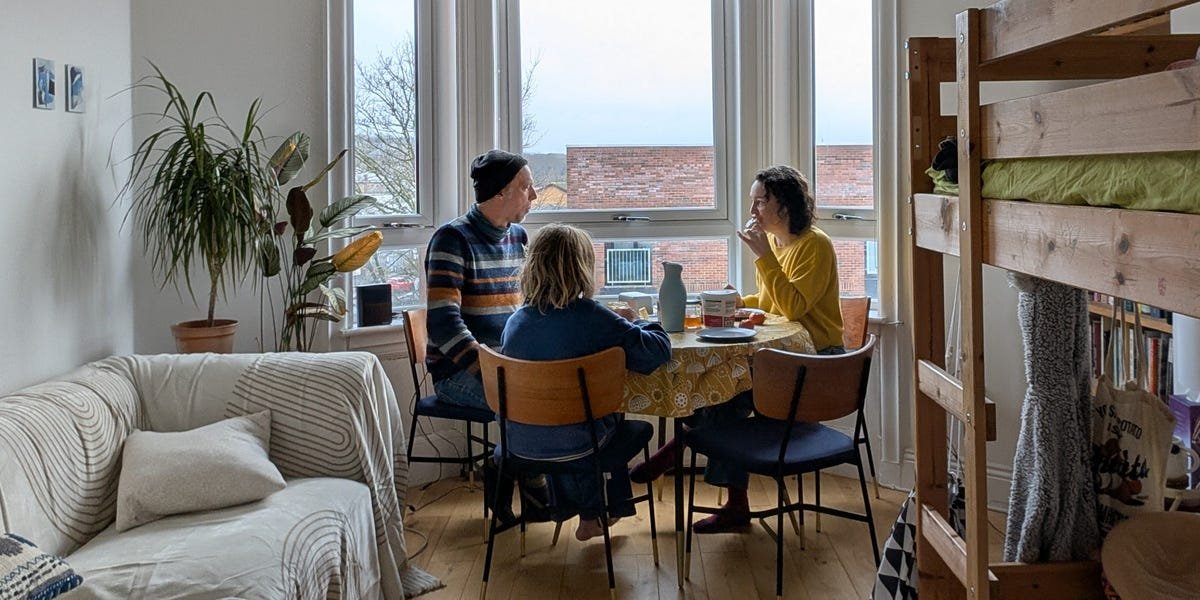
Family sitting around a table in front of windows

We’ve embraced the highs and lows of living this way. 

Julia Clarke


This arrangement can be far from perfect — we do sometimes find ourselves eating breakfast with a snoring teenager next to us.

However, for us, the advantages far outweigh any negatives.

Our neighborhood is great, and we’ve enjoyed the simpler lifestyle and more quality time that’s resulted from this setup. We’re also fortunate to live this way because we’ve chosen to, not necessarily because we have to.

Instead of feeling like a temporary drastic measure, it just feels like our cozy, slightly crazy home.


Source link

They-quit-traveled-and-rethought-their-lives-—-meet-the.jpeg

They quit, traveled, and rethought their lives — meet the adults taking gap years

In my early 30s, I was working long hours as the editor in chief of a magazine, juggling deadlines and the looming “should we have kids?” question — all while feeling completely wrung out. I drafted a resignation email.

When my boss called me in, she surprised me: “Take some time off,” she said. “Come back to manage a new launch later this year.”

My plan for a year off collapsed into two months.

It began quietly in India at a yoga retreat near Kerala and ended with an adventure in Indonesia, climbing Mount Bromo and motorbiking through Yogyakarta.

It wasn’t a true gap year, but it was long enough to reset. The next year, I stepped into my boss’s role, leading the creative team I’d almost left behind.

That experience made me realize that time off doesn’t have to derail a career — it can redefine it.

I wasn’t a student with few obligations or a 20-something who hadn’t settled on a career path. I was an established professional stepping away when the stakes were high.

Extended time off can carry long-term costs — lower earnings, disrupted savings, slower compounding — but for some, the benefits outweigh the risks.

David Burkus, an organizational psychologist and author, began researching sabbaticals in 2015.

“People report better mental and physical health, increased confidence, and a greater sense of purpose after an extended break,” Burkus told Business Insider.

He also notes the benefits for employers: Teams cross-train, share knowledge, and become less dependent on a few “indispensable” people.

Paid sabbaticals are still a rarity in the US. Society for Human Resource Management data showed that 5% of companies offered them in 2019, rising to 7% by 2023.

And despite employers not rolling them out broadly, employees are increasingly seeking time off. In SHRM’s 2025 benefits survey, leave was the second-highest priority for workers — trailing only health benefits — for the fourth year in a row.

A peer-reviewed study published in the Academy of Management in 2022 interviewed 50 professionals who had taken extended time off. All interviewees said they came back as better leaders.

DJ DiDonna, a senior lecturer at Harvard Business School and coauthor of the study, says everyone he interviewed wished they had taken one earlier.

DiDonna told Business Insider that the best times for a sabbatical often coincide with natural life transitions, like a honeymoon, a newly empty nest, or the “twilight career” stage before retirement.

This collection brings together people who took that pause at different ages, for different reasons, and for vastly different lengths of time.

If you’ve taken an adult gap year yourself, I’d love to hear from you at akarplus@businessinsider.com.


Source link

I-thought-downsizing-would-be-hard-for-our-family-of.jpeg

I thought downsizing would be hard for our family of 4. It ended up changing our lives for the better.

In July 2025, my husband, Zach, and I moved our family of four from the suburbs of Ft Worth, Texas, to Denver.

After nearly 10 years of marriage, two kids, and three work-related moves, it was finally time to settle in a place of our choosing. This time, we didn’t just want a change of scenery; we wanted a change of lifestyle.

But finding a house in the bustling city neighborhood of our dreams within our budget meant downsizing — drastically.

Moving from our 3,300-square-foot home to a 2,300-square-foot bungalow with 1,200 square feet of actual living space (the rest being unfinished basement) wasn’t easy. It meant swapping our large kitchen island for a small dining table. It meant no more master bath soaking tub, my refuge from life’s stresses on more occasions than I could count. And it meant my kids giving up their separate rooms to share one.

But what we’ve gained in the quality and quantity of time spent together is worth every bit of lost square footage.

We’re spending our time on what matters

Our bigger house in Texas required more upkeep, and we were more than happy to give that up for extra free time on the weekends. Now, we spend our time visiting attractions such as the Denver Zoo and the Denver Museum of Nature and Science. We’re fostering our kids’ curiosity, exploring new places together. Our everyday life feels more special and meaningful because these shared experiences amplify our family connection.


Dining room

The author’s new house is about a third the size of her previous house.

Courtesy of the author


We’re also getting out in nature more. Aside from weekend hiking and skiing adventures, our days revolve around outdoor living. We walk everywhere we can, including restaurants, parks, and even Trader Joe’s, which is beneficial because driving to Trader Joe’s means parking at Trader Joe’s, and nobody enjoys that. Our moods are lighter, and our stresses are reduced.

The first time we walked to a restaurant instead of driving, it felt like we were on vacation. Our lives had always been car-dependent, but that’s no longer the case. The kids laughed and raced each other down the sidewalk. We marvelled at the mature trees and brightly colored flowers lining 7th Avenue Parkway. There was no timeline or rushing, just the joy of being present. When we made our way home after an alfresco dinner at Postino, I asked my son if he liked walking to dinner. He asked simply, “Can we do this every day?”

We’re finding connections in our community

Zach and I frequently sit on our front porch while our boys play with neighborhood kids, a first for us. Having houses so close together makes it easier to meet people and form real connections. We know almost every household on our block, and we regularly visit with our closest neighbors. We even enjoyed our first block party in August, which fell on my eldest’s birthday, and according to him, it was his “Best birthday ever!”


Birthday party

The author’s child loved his backyard birthday party.

Courtesy of the author


Our boys run between yards while we chat with new friends. They are experiencing a childhood closer to the one we grew up with. They’re building confidence and finding their place, and that’s translating to more smiles and fewer tantrums. Zach and I are finding our village, and parenthood feels less solitary.

On a recent trip back to Texas for Thanksgiving, I texted our next-door neighbor to let her know we’d be out of town. Without even asking, she offered to take in our mail. It may be a small gesture, but that sense of community is priceless to us.

My boys have more freedom

Downsizing has also allowed our kids to play more independently in an outdoor space that feels safe and protected. We have an unobstructed line of sight to the backyard, and no matter where my husband and I are in the house, we can hear them if they need us. The result has been hours of creative play, building campsites and outdoor kitchens, playing soccer and baseball, and having water balloon fights or Nerf battles.


Family at football game

The author’s kids have more freedom and can play outside in their new home.

Courtesy of the author


Most evenings, my kids are in the backyard playing games and getting dirty. When the weather is nice, they run around with their friends down the street. I would never have felt comfortable not knowing every move my kids were making before, but here, where everyone is watching out, and I can wave at my kids down the block to signal when it’s time to come home, less space means more freedom.

Our downsized life isn’t always perfect. Despite all our decluttering efforts, we’re still left with more stuff than we can accommodate. We also struggle with the lack of privacy, and at times, our smaller shared space feels more claustrophobic than cozy. However, downsizing for an urban lifestyle has given us the opportunity to live beyond our four walls, and that’s worth more than any amount of space could ever be.


Source link