
Microsoft-backed-Wayve-raises-15-billion-to-take-its-robotaxis-global.jpeg

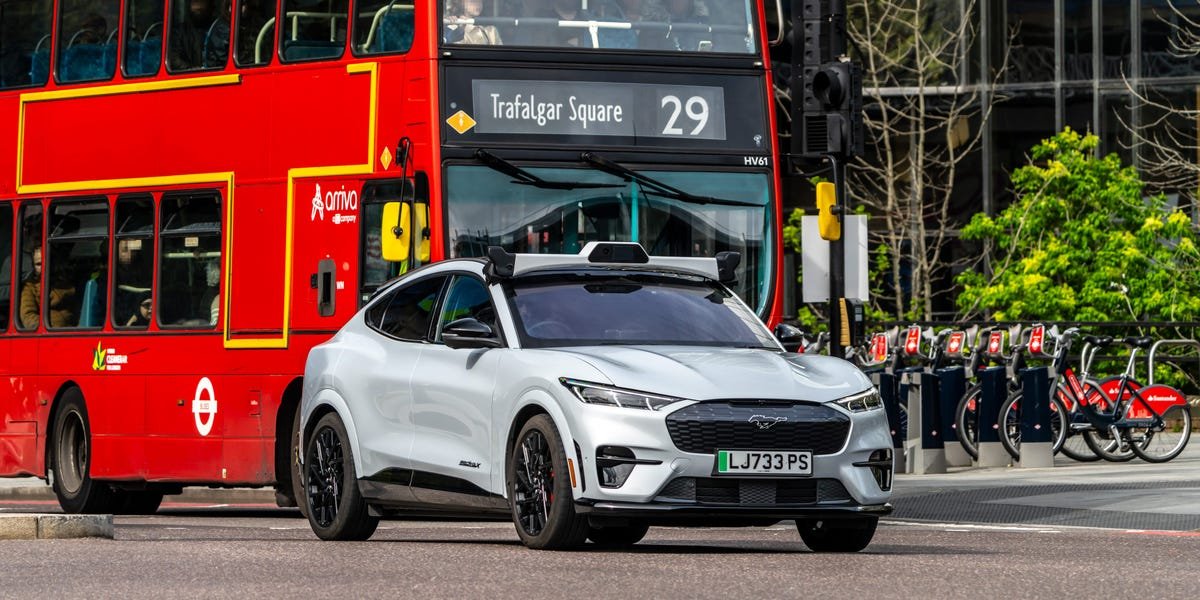
Microsoft-backed Wayve raises $1.5 billion to take its robotaxis global and take on rival Waymo in London

Wayve is revving up its global robotaxi ambitions with fresh funding as it prepares to take on Waymo in London.

The UK-based autonomous vehicle software startup announced early Tuesday in the UK that it had raised $1.5 billion from a host of Big Tech giants and major automakers.

The funding round, which values the startup at $8.6 billion, includes $1.2 billion from investors including Microsoft, Nvidia, and Uber, as well as Mercedes-Benz, Nissan, and Stellantis.

It also includes additional capital from Uber, which is tied to deployments of Wayve-powered robotaxis across the globe. The two companies have a deal to launch self-driving vehicles on Uber’s app in over 10 markets worldwide, starting with London this year.

“We’ve been learning to drive on British roads for the last eight years, and so this is our home turf,” Alex Kendall, CEO of Wayve, told Business Insider in an interview.

The CEO said the latest funding round is key to pursuing the company’s ambition to license its software to major automakers and robotaxi fleet platforms like Uber.

Unlike Tesla or Waymo, Wayve is solely focused on developing software for other companies looking to deploy self-driving cars. It is not building its own fleet of robotaxis.

Kendall said owning a fleet is expensive, and Tesla’s approach to building its own car can be a constraint since it limits the company to one vehicle platform.

“Everyone wants autonomy, but not everyone wants to buy a Tesla,” he said.

Kendall added that Wayve’s AI driver is designed to be generalizable — the same way a human can quickly learn to drive different cars and in new cities.

That allows Wayve’s technology to quickly adapt to new driving environments and learn new road rules, from switching to the opposite side of the road to right turns at a red light, without relying on high-definition mapping and sensors, the approach taken by rivals like Waymo. It also allows the AI driver to be adapted by different automakers, which may have different sensor configurations on their cars, such as lidar or cameras.

“Because that’s what we’ve built, it enables us to take this business model that enables high-margin software revenues,” Kendall said.

Wayve says that over the past year, its fleet of Ford Mach-Es outfitted with its AI driver has driven in more than 500 cities across Europe, North America, and Japan without being trained on city-specific data.

The company is also planning to license its technology to carmakers as an advanced driver-assistance system like Tesla’s Full Self-Driving, which handles most driving tasks with human supervision. Wayve has a deal with Nissan that will see its AI tech power the Japanese carmaker’s ProPilot driver assistance system from 2027.

The UK-based startup has been testing its tech in London since 2017, and its public debut comes as the city’s robotaxi scene gets increasingly crowded.

Waymo is aiming to begin operating its autonomous vehicles in London, its first international location, this year, while Wayve vehicles will be joined on the Uber app by robotaxis from Chinese tech giant Baidu, which is also partnering with Lyft.



Source link

I-moved-in-with-my-girlfriend-in-London-after-only.jpeg

I moved in with my girlfriend in London after only a few months of dating. I was terrified.

I met an incredible woman on a random outing to London while I was living life in slow motion, alone in a quiet English seaside town.

I fell in love in a way that surprised me, both in its speed and its certainty. I knew it was her. The relationship unfolded across train rides, weekends, and the growing realization that what I thought was a temporary chapter in my life was quietly becoming its center.

After a few months together, a practical question emerged. Our rent contracts were ending. Suddenly, there was an opportunity to do something that felt both thrilling and reckless: move in together and move back to London after years in a small town.

It felt risky, especially after years of living alone and so soon after meeting. But it also felt like an invitation to fully embrace a new chapter abroad, without half-measures.

I wasn’t sure I knew how to share my space with a partner

My fear wasn’t about commitment in the abstract. It was far more mundane and, in some ways, more unsettling: I didn’t know if I actually knew how to live with someone.

I had lived with my parents and sisters in Mexico, and I also had roommates during my student exchange in Spain, but that was a long time ago. Ever since leaving my country to see what life had to offer, I had lived entirely on my own.

Living alone abroad had sharpened my sense of independence. I had my routines, my rhythms, and my silence. Sharing a space meant renegotiating all of that in a city as intense as London — while also being a foreigner still figuring out where I belonged, and doing it with someone I was still getting to know.

I worried about losing the version of myself I had worked hard to build over the past two years. I worried about friction, mismatched habits, and what happens when two people bring different expectations into the same kitchen, the same mornings, and the same tired evenings.

Staying separate felt equally wrong, though. At some point, I had to give it a real chance.

I was also afraid we’d lose the magic

Once we made the decision, another fear surfaced, one I hadn’t said out loud at first. I worried that moving in together would flatten the magic of the relationship.

Dating, especially in the early stages, allows for a certain level of curation. You see each other rested, excited, and intentional. Living together removes that buffer almost immediately. There are no intermissions, no reset between interactions.

I worried the romance would dissolve into logistics. That excitement would be replaced by grocery lists, chores, and bad habits. What if the softness of the early months would harden under the weight of constant proximity?

It felt like skipping too far ahead in the story. I wondered if we were rushing something that deserved more time to breathe. What if she realized I wasn’t what she hoped for? What if our energies didn’t align? What if it was simply too much?

But I learned that the honeymoon phase doesn’t end because of shared space. It ends when curiosity stops. Living together, as it turned out, demanded more curiosity, not less.

Moving transformed the relationship

The shift was immediate, but not in the way I expected. Living together didn’t make things smaller. It made them deeper.

We learned from each other in unglamorous but essential ways: how we start our mornings, how we decompress after long days, and how we navigate stress without turning it into conflict. The relationship became less performative and more real.

Living with my girlfriend allowed me to truly know her, not just the version of her that appears on dates. I saw her patience, her habits, her quiet moments, and her resilience. I learned how she shows care when no one is watching.

In that process, I also learned more about myself. I realized that independence doesn’t disappear when you share a life with someone. It evolves. Living together abroad didn’t shrink my world; it expanded it.

I’ve lived in many places and many houses, but this is the first time I can say that, with her, it feels like home.


Source link