
I-stayed-home-while-my-family-traveled-because-I-needed.jpeg

I stayed home while my family traveled because I needed a break. I loved my alone time.

When people asked me what I was doing for the holidays, I responded almost too giddily, “I’m spending it alone.” Their eyes narrowed, “What?”

I told them I was sending my husband and the kids to his family in Massachusetts, and I’d stay back in Pennsylvania. All. By. Myself. I wouldn’t have to answer to anyone or for anything. Not requests for snacks or one more backrub. I wouldn’t have to sit rigid, wondering if one of my three kids was creeping out of a bed that wasn’t theirs. Or defend my parenting style while my oldest yelled about how life wasn’t fair and we must all really hate him, and why should he have to listen to anyone anyway.

After a beat, every single mom (and a few dads) told me: “I’m jealous. I want to do that. How did you swing that?”

I had hit a breaking point

The decision to be alone during the holidays came slowly at first and then all at once. I’d hit a breaking point that most parents, especially moms, are all too familiar with. But the moment I toyed with the idea of staying back — in a quiet, clean, empty house — that was it. It was all I could think about.


Family at the beach

The author’s spouse was supportive of her taking time off.

Courtesy of the author


I broached the topic, gently, with my husband, who couldn’t have been more supportive and emphatic. “You should take a few days away!” But I didn’t want to be away. I wanted to be home alone. That was the key.

As the days ticked closer to The Big Departure, people asked me when Jeff and the kids were leaving. “Wednesday, but I can’t ask when, specifically,” I’d laugh.

I explained to the kids that I needed some alone time; I needed to take a break. They, who are 8, 5, and 3, were relatively unfazed. My middle, big-feeling daughter made me promise to call her every two minutes. I wanted them to know that it was OK for Mom (or Dad) to step away and be alone. It didn’t mean I loved them any less. Something, something about distance making the heart grow fonder.

Self-care is crucial

Mental health experts agree. Solitude can be a crucial form of self-care (unless it makes you truly uncomfortable to be totally alone). “When you seek out intentional solitude, and the demands on your attention and focus melt away, it allows you to have a level of awareness that can support healing and growth,” Emily Moriarty, M.Ed., a licensed professional counselor and director of clinical services at Reset Outdoors, told Business Insider.

Finally, they were off. And I didn’t know what to do with myself. Everything was weirdly quiet. Clean. Empty. I loved it. I had a couple of low-key plans over the next few days, but my goal was to savor the silence and the lack of a schedule.


Living room

The author really enjoyed her time alone.

Courtesy of the author


When 5 p.m. rolled around on the first night, I started making dinner while listening to music. I danced a little. I ate while reading a book. No one argued with me that they didn’t like what was served. Cleanup was easy. I put my dishes away. I didn’t need to sweep — I don’t spill things on the floor.

I turned my phone off; I didn’t need an alarm. No one needed to reach me, and if they did, they could wait. Dad was more than capable. I slept in. I drank coffee on the couch in front of the fire in my pajamas. I forced myself to allow things to move slowly — something I have a hard time doing with or without kids.

“Solitude doesn’t include sitting alone in an office working,” Moriarty said. “It has to be non-work, non-caregiving time.”

When it was time for the Big Holiday Meal, I thought I’d feel a little lonely. But I didn’t, and that, I realized, was because this was my choice. I knew my family was enjoying themselves with relatives they don’t often see and having a little vacation. And I knew that they’d all be home before I knew it.

I had a little mom guilt

By the end of the fourth day, the air was thick with anticipation of the kids and Jeff coming home. I felt like I couldn’t watch TV fast enough. I couldn’t sit in a quiet, empty house fast enough. I couldn’t drink enough coffee fast enough. But when I started making dinner at 5 p.m., awaiting their 8 p.m. arrival, I realized if I had to keep doing this, I might get a little… bored?

I’m sure that has more to do with the stark contrast of raising three kids, co-running a household, and having a (fairly successful) career, and four days of abrupt, near-total solitude. If I didn’t have kids at all, I’m sure I wouldn’t be bored at 7 p.m.

People have since asked me if this will be my new holiday tradition. I did like it, maybe a bit too much, but it feels wrong to indefinitely celebrate the holidays without my kith and kin. Four days weren’t enough to assuage Mom Guilt, apparently.


Source link

My-kids-went-to-an-outdoor-elementary-school-with-no.jpeg

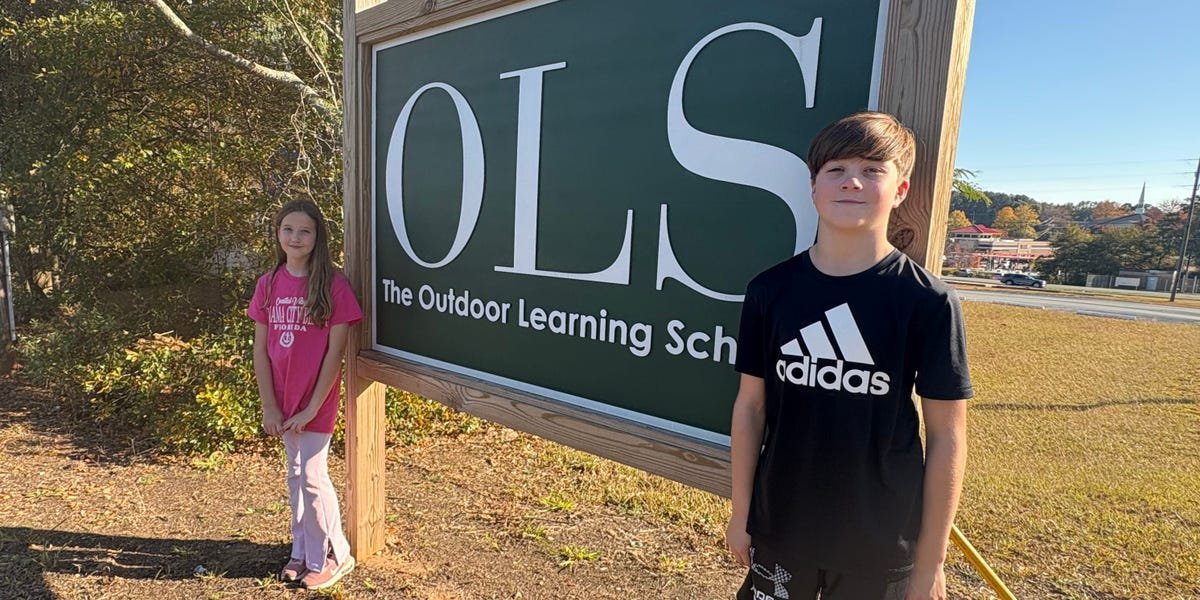
My kids went to an outdoor elementary school with no art, music, or library. They loved it, but adjusting to public school was hard.

In 2019, my 5-year-old son and 4-year-old daughter were excited to start their first year of public school. But like millions of students in March of 2020, they never got to finish the school year.

The COVID pandemic closed the classrooms, forcing my husband and me to rethink how we wanted to handle our children’s education. An outdoor learning school at The Learning Tree, a local day care, became our solution.

The unique education exceeded our expectations in every way.

Why we chose an outdoor learning school

The pandemic made us nervous to send our kids back to school after summer break. We were told that if someone in their class contracted COVID, the entire class would shut down for two weeks. This wasn’t feasible for us as parents with full-time jobs, plus it would disrupt the learning experience for our kids.

That summer, the day care our kids attended prior to starting school announced a new opportunity: a K/1 program focused on interactive, accelerated education. It promised small class sizes (roughly 12 students per class), project-based and student-led learning, and academics balanced with outdoor activities and healthy habits.

Despite the $125 weekly tuition fee per child, we were sold on smaller classes, less exposure to others, and the included after-school care.

We enrolled our kids for the 2020-2021 school year: our daughter in kindergarten and our son in first grade. When the school added second grade the following year and then third grade the year after, we stayed.

We missed out on traditional opportunities, but gained so much more

We didn’t plan on sending our kids to a private program for most of their elementary school years. But after comparing what public school offered that The Learning Tree didn’t, and vice versa, the outdoor learning school was a no-brainer.


Alli hill's children at their outdoor learning school

The author’s kids loved their outdoor school.

Courtesy of Alli Hill


At The Learning Tree, there was no library, computer lab, or even a cafeteria. They didn’t have art, music, or gym classes. The playground was small, and there was no option for gifted testing.

However, they did have an in-ground swimming pool, and swimming was built into the curriculum during warm months. A mile-long nature trail and morning fitness exercises replaced the gym. Students helped to build gardens and grow food, which made its way into their lunches. Most notably, screen time was minimal — almost nonexistent.

There was also more parental involvement. We went kayaking on the river as part of a history lesson, and we always had special celebrations for Thanksgiving and Christmas.

Instead of reading math word problems, they acted them out in real time with things like farmers’ markets and food prep. Projects, not worksheets, were a focal point for each grade. And since students played a role in their own education and pacing, there was no need for a separate “gifted” curriculum.

Transitioning back to the ‘real world’ was a tough lesson

The original K/1 program added a new grade each year, up to fifth grade. However, we pulled our children out when they started fourth grade to give them time to transition back into public education before middle school. Where we live, fifth grade is at the middle school, and we felt like jumping from outdoor learning to a public middle school would be too stressful.

Both of our kids already had lots of friends in public school, so it wasn’t completely unfamiliar to them. Still, it was challenging.

They went from spending most of the day outside to getting only 20 minutes of recess. Classes were much larger, so they didn’t have the opportunity to learn at their own pace. They had more rules and a more rigid structure to follow. There was more sitting and busywork than they were used to.

They missed the kindness and genuine interest of their teachers at their old school. They also lacked the opportunities to guide their own education and pursue their own interests in the classroom.

While we loved our time at the outdoor learning school, all good things must end. Our kids gained a solid foundation of work ethic, self-discovery, and leadership that continues to help them in and out of the classroom, and we’d do it again in a heartbeat — pandemic or no pandemic.


Source link