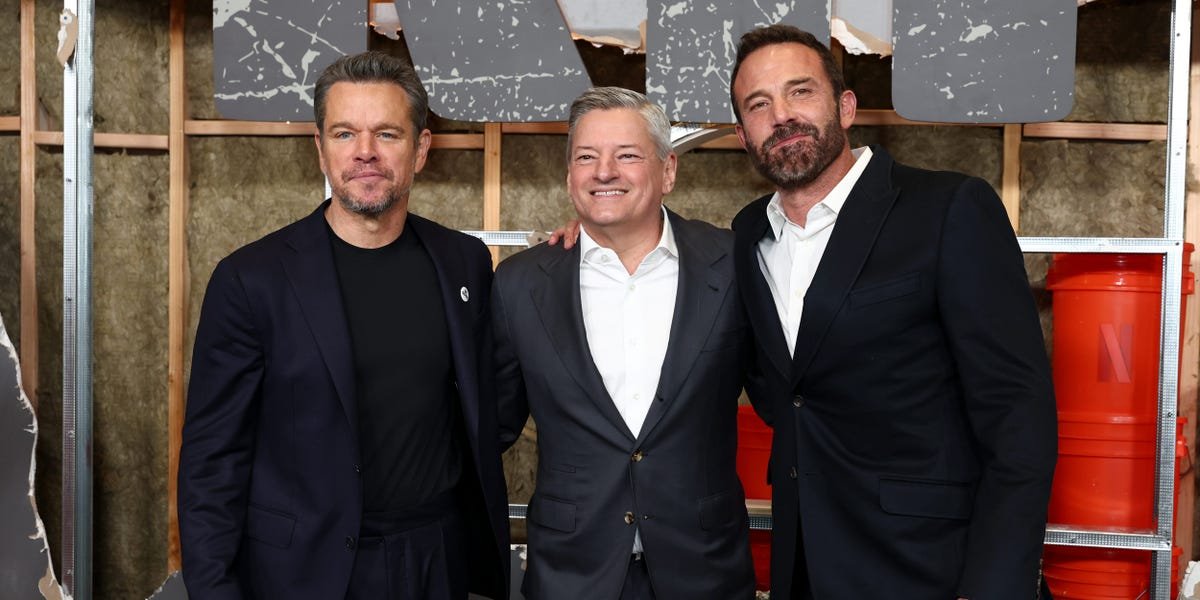
Netflix wants to change the way action movies are made amid the never-ending battle for our sustained attention, according to “Bourne” actor Matt Damon.
In an interview on the “Joe Rogan Experience” podcast, Damon and longtime collaborator and friend Ben Affleck spoke about their latest experience costarring in and coproducing their first Netflix-exclusive heist film, “The Rip,” which was released Friday. The two actors talked about how streaming and short-form video platforms have upended the way movies are consumed, made, and sold to audiences.
Damon said Netflix is now asking for action films to have bigger sequences occur within the first five minutes of the movie and suggesting that actors reiterate the plot line to cater to viewers who are on their phones.
The actor said the “standard way” he learned to make an action film was to have the finale — “the big one with all the explosions” that a production spends most of its money on — occur in the third act.
“Now, they’re like, ‘Can we get a big one in the first five minutes? We want people to stay tuned in. And you know it wouldn’t be terrible if you reiterated the plot three or four times in the dialogue because people are on their phones while they’re watching,'” he said. “And so then it’s going to really start to infringe on how we’re telling a story.”
Damon didn’t specify if Netflix gave the instruction to the actor and producer for his latest heist movie.
A Netflix spokesperson did not respond to a request for comment sent during the weekend.
Affleck added that the suggestions aren’t reflected in every new action film or series coming out on Netflix. The actor pointed to “Adolescence,” a crime miniseries that has episodes shot in one continuous take. The show was released in March.
Damon said he felt the show was an exception.
“My feeling is just that it demonstrates that you don’t need to do any of that” stuff, Affleck said.
He later added, “It’s like supply and demand. People want to look at their phones, they look at TikTok, they’re going to do that. I think what you can do is make shit the best you can. Make it really good.”
Grok will no longer be allowed to create AI photos of real people in sexualized or revealing clothing, after widespread global backlash.
“We have implemented technological measures to prevent the Grok account from allowing the editing of images of real people in revealing clothing such as bikinis,” X’s safety account said in a blog post on the platform on Wednesday. “This restriction applies to all users, including paid subscribers.”
The change was announced hours after California’s top prosecutor, Rob Bonta, said he launched an investigation into sexualized AI deepfakes, including those of children, generated by Grok. Bonta said that there had been a flood of reports in the last few weeks that Grok users were taking pictures of women and minors they found online and using the AI model to undress them in images.
Indonesia and Malaysia suspended Grok because of the images, the first countries in the world to ban the AI tool. Lawmakers in the UK publicly considered a suspension.
In Wednesday’s blog post, the social media company reiterated that image creation and the ability to edit images via Grok on the X platform will now only be available to paid users as an additional safety measure.
Every time Shubhangi publishes a story, you’ll get an alert straight to your inbox!
Stay connected to Shubhangi and get more of their work as it publishes.
The company restricted non-paying users last week after complaints from officials globally, but it was slammed for being insufficient.
A spokesperson for British Prime Minister Keir Starmer said it “simply turns an AI feature that allows the creation of unlawful images into a premium service.”
Elon Musk, who owns xAI, the maker of Grok, said that the UK government wanted “any excuse for censorship” in response to a post questioning why AI tools like Gemini and ChatGPT were not being looked into.
On Wednesday, a few hours before X’s official account posted about the ban on creating sexualized images, Musk asked users to try to get around the AI model’s image restrictions.
Bonta’s office and Starmer’s office did not immediately respond to requests for comment from Business Insider.
Nike CEO Elliott Hill inherited an uphill battle when he took over at the sports giant in October 2024.
Since then, Hill has made changes — both big and small — to the company as part of its turnaround strategy. After retiring from Nike in 2020, the former president of consumer and marketplace returned to guide the company amid declining sales, sluggish growth, and increased pressure from upstart rivals.
During the quarter preceding Hill’s start, Nike’s revenue declined 10% year over year to $11.6 billion, following flat growth in the 2024 fiscal year. Nike shares jumped about 8% on the day Hill’s appointment was announced in September.
The Nike veteran didn’t waste time launching his strategy when he took the helm, reevaluating the existing practices and adjusting them as needed.
“We lost our obsession with sport,” Hill said on a December 2024 earnings call. “Moving forward, we will lead with sport and put the athlete at the center of every decision.”
Every time Jordan publishes a story, you’ll get an alert straight to your inbox!
Stay connected to Jordan and get more of their work as it publishes.
Last week, during the company’s most recent quarter, Hill told investors that the comeback “won’t be a straight line.”
Here’s what Hill has been up to in 2025.
Hill kick-started his turnaround plan
Nike’s “win now” strategy — Hill described it on last week’s earnings call as Nike’s “immediate response to our biggest challenges and opportunities” — focuses on five key areas: culture, product, marketing, marketplace, and in-person presence.
The plan leans on a sports-driven reset that has “realigned” about 8,000 employees around its core sports categories, the company said. Those categories include running, basketball, football, and training, as well as sportswear.
The idea is to put the athlete “at the center of everything that we do,” Hill said in a March earnings call.
The running category is leading the effort and reflects the direction Hill is steering the company. Nike said its running business grew by more than 20% last quarter, which ended in November, marking the second consecutive period of comparable growth.
Nike’s senior leadership team got a revamp
Hill shook up Nike’s leadership this year.
In May, he restructured its consumer, product, and brand leadership to focus on three areas: consumer and sport, marketing, and product creation. As part of that overhaul, Nike’s former president of consumer, product, and brand retired, and Hill promoted four other Nike insiders to senior roles reporting to him: president of Nike (Amy Montagne), chief innovation, design, and product officer (Phil McCartney), chief marketing officer (Nicole Graham), and chief growth initiatives officer (Tom Clarke).
Hill also hired a new communications chief this year, Michael Gonda.
And he made another round of changes in December, eliminating the roles of chief technology officer and chief commercial officer. At the same time, Nike established the role of chief operating officer, which reports to Hill. The new job’s function is to “integrate technology more seamlessly into our sport offense,” Hill said in a note to employees that Nike released publicly. Venkatesh Alagirisamy, a 20-year veteran of Nike, transitioned into the role on December 8.
As part of the shake-up, general managers in all regions now report directly to Hill.
“It’s clear how important it is to stay closely connected to what’s happening on the ground, from intern to CEO, and every role I’ve held in between, I’ve felt that way,” Hill said on last week’s earnings call.
He began mending relationships with wholesale partners
Hill said Nike’s ties with wholesalers such as Foot Locker and Dick’s Sporting Goods had frayed amid its aggressive shift toward direct-to-consumer sales.
Since Hill’s return, he said he’s been mending those relationships. For example, Nike is back on Amazon and has struck partnerships with smaller retailers, such as Urban Outfitters and Aritzia.
Nike’s wholesale revenues increased 8% year over year to $7.5 billion during its most recent quarter, which ended November 30.
Hill pulled back on promotions and raised prices
Hill said that Nike would strive to provide a more “elevated” experience for consumers, speaking in a January interview with Fortune. He said Nike had become “too promotional” on its own site.
“Being premium also means full price,” Hill told Fortune. “We’ll focus on promotions during traditional retail moments, not at the consistent levels we are today.”
He said in March that Nike Digital, which includes its website and app,ran zero promotions in North America in January and February, down from over 30 during the same months in 2024. The cutback on promotions came alongside “surgical” price increases Nike made to mitigate tariffs in 2025.
He gave the House of Innovation concept store a makeover
The House of Innovation is Nike’s six-floor flagship store.
Jordan Hart/Business Insider
Nike’s 68,000-square-foot House of Innovation is the blueprint for its stores. It’s a six-story flagship store that opened in 2018, showcasing the company’s most advanced products. The first floor is dedicated to running, and the rest of the sprawling store is organized by sport, gender, and age.
Hill has frequently pointed to the revamped store in his first year as a model for Nike’s move to sports-driven retail layouts.
“It’s an immersive sport experience, and the refresh has already led to double-digit revenue increases,” Hill told investors in September.
Nike did not respond to a request for comment from Business Insider.
Want a job at Anthropic? It might help to get a hobby.
The AI boom is changing the job requirements for an engineer. Not only do they need to have coding skills, but they also must know how to operate vibecoding tools and stay up to date with new AI models.
Anthropic leader Boris Cherny looks for something else: “Side quests.”
“When I hire engineers, this is definitely something I look for,” he said on “The Peterman Pod.”
Cherny’s definition of side quests includes “cool weekend projects,” like someone who’s “really into making kombucha.” It’s a sign that the engineer is curious and interested in other things, he said.
Every time Henry publishes a story, you’ll get an alert straight to your inbox!
Stay connected to Henry and get more of their work as it publishes.
Much of Cherny’s own growth came from his side projects. Cherny is now a key figure at Anthropic. He created Claude Code, a tool that is now popular with engineers across the country.
“These are well-rounded people,” he said. “These are the kind of people I enjoy working with.”
Cherny also said he prefers that his new hires be “generalists.”
He gave the example of an engineer who can code, but is also able to work on product and design. That all-star engineer also seeks out user feedback.
“This is how we recruit for all functions, now,” he said. “Our project managers code, our data scientists code, our user researcher codes a little bit.”
Cherny isn’t alone in pushing for jobs to become more generalist. Figma CEO Dylan Field said in October that AI was causing job titles to merge, resulting in everyone being a “product builder.”
What else is Anthropic looking for? For some time, it monitored whether candidates use AI in their applications.
In May, Business Insider reported that Anthropic asked candidates for certain jobs not to use AI in their written responses so the company could test their “non-AI-assisted communication skills.”
Anthropic changed its policy in July, allowing candidates to seek out assistance from Claude.
For the younger engineers, a job at Anthropic may be hard to come by. In May, CPO Mike Krieger said on “Hard Fork” that he was focused on hiring experienced engineers — and had “some hesitancy” with entry-level workers.
On the podcast, Cherny said that his love of generalists came from his career trajectory. Working at startups since 18, Cherny had to do everything, he said.
“At big companies, you get forced into this particular swim lane,” he said. “It’s just so artificial.”
The internet is full of interior design aesthetics — Scandinavian, Boho, Country House, Maximalist — each complete with its own set of experts and influencers explaining what must-haves you need to best accomplish the trend.
From quirky pastel candles and oblong mirrors to designer couches and industrial curtain rods, it’s no wonder Americans spend an average of $1,599 on home decor annually, per a 2024 Opendoor survey.
But LA-based content creators Robert Gigliotti and Ethan Gaskill have taken a different approach to interior design influencing.
The friends and collaborators have garnered more than 3.5 million views on TikTok sharing their most disliked interior design and home decor trends in a series called “home decor icks.”
Gigliotti and Gaskill are not designers but have self-taught eyes for design fostered by family experiences.
Gigliotti told Business Insider that his mother flipped houses while he was growing up in Connecticut and he became “tired of them all being builder gray,” so he got involved in helping pick out tiles and other finishes.
Meanwhile, Gaskill was raised in North Carolina and drew inspiration from his father, a custom home builder, and his mother, a real-estate agent.
“My mom was always around the house and really ingrained in my brain the idea of keeping a tidy space and making sure your space is a kind of reflection of who you are, in the way that it sort of impacts your mind,” he said.
Gigliotti and Gaskill said their opinions have resonated with audiences online partly because they’re calling out mistakes they’ve made or seen themselves.
“It’s all things that people kind of agree on or relate to in a way, that they can kind of laugh about,” Gaskill said.
Gigliotti added, “The second anything becomes too serious, it’s not fun anymore, so it’s not like we would actually go in someone’s home and be like, ‘This is disgusting.’ Honestly, it’s amazing effort if you painted everything pink and did your statement wall of floral wallpaper. At least you’re having fun. If you love it, we like it.”
Business Insider spoke with Gigliotti and Gaskill to hear more about what they think you should avoid when decorating each room of your home, from “cringey” art prints and DIYs to overly curated shelving.