
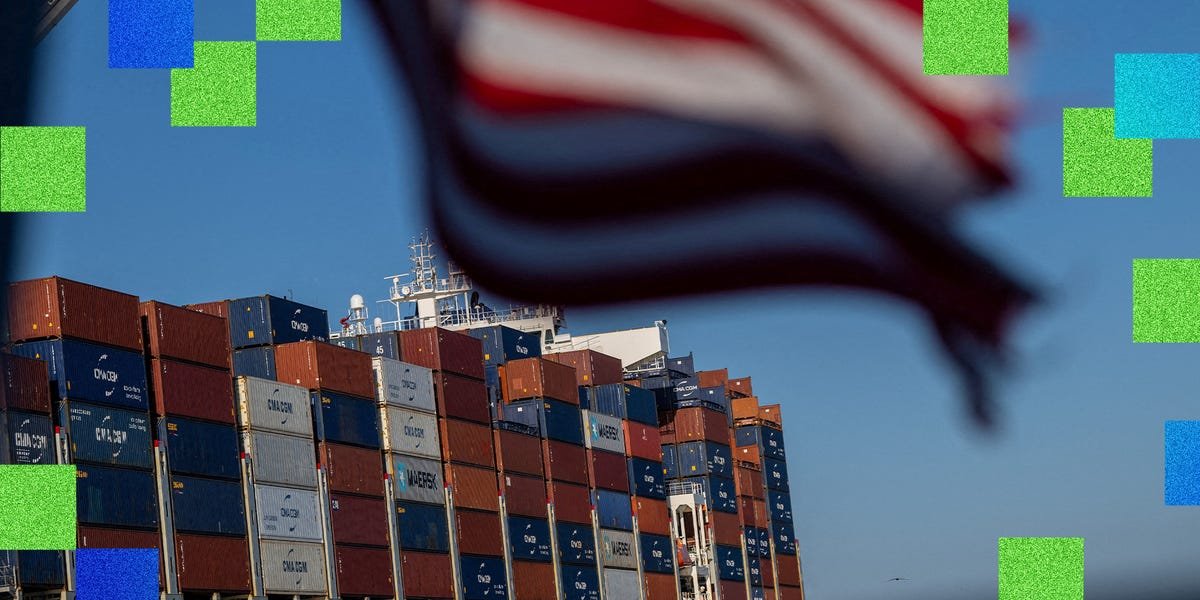
How-US-businesses-are-using-AI-to-manage-tariff-chaos.jpeg

How US businesses are using AI to manage tariff chaos

US businesses have been on a tariff roller coaster over the last year. Sweeping tariffs were implemented at varying levels across different countries. Though some were eventually overturned by the Supreme Court, there is now an added layer of bureaucracy as companies seek potential refunds. Some are turning to AI for help.

Companies like EQI and customs advisory firms like KPMG are using generative AI “to process all that chaos,” said Brendan Connallon, the VP of finance at EQI, a company that supplies metal components and provides supply chain advising services to manufacturers. The technology can rapidly scrape and synthesize vast quantities of data, track tariff changes, model potential supply chain scenarios, and accurately classify goods by their government-assigned tariff codes — a highly nuanced system with more than 17,000 codes.

Emil Stefanutti, the CEO of Gaia Dynamics, a software company that provides AI tools to help companies automate trade compliance, said AI is proving particularly useful in this rapidly changing environment, as it can reduce compliance errors and save businesses time. With the Supreme Court ruling specifically, Stefanutti said importers can use AI to analyze data on where and when they paid tariffs, quantify potential overpayments, and flag areas that need correction.

AI “can continuously track and adapt to new rules in a way humans simply can’t at scale,” Stefanutti said.

AI can shave weeks off pinpointing tariff refunds

The consulting firm KPMG has been advising its clients on trade compliance for decades, but last year in particular, “the tariffs were changing fast and furious,” said Andrew Siciliano, the leader of the Global and US Trade and Customs practices at KPMG.

Company leaders needed real-time data quickly to make decisions, so KPMG launched an AI-powered tariff modeler.

The firm’s clients include many large businesses that import goods ranging from auto parts to retail goods and pharmaceuticals, and that use several ports of entry and customs brokers. KPMG takes its clients’ decentralized customs entries and product information from suppliers and freight forwarders — the intermediaries between importers and their transportation providers — and plugs the data into the tariff modeler, Siciliano said.

This approach has helped KPMG’s clients navigate the process of applying for refunds for tariff overpayments resulting from the policy change that took effect after the Supreme Court overturned some tariffs. Many trade rules have nuanced exceptions, leading some businesses to pay multiple tariffs when they should have paid only one. Siciliano said his firm uses AI to interact with a client’s data and better understand which products came from which factories, narrowing down which qualify for refunds.

Though the refund system is in the works, there could still be confusion and uncertainty, said Connallon. He told Business Insider that he anticipates the process will be “an administrative nightmare.”

Before AI, manually sifting through thousands of custom entry data points to spot overpayments could take weeks or months — or not happen at all because of the complexity, Siciliano said. Now, an importer can prompt AI, which delivers the information right away.

AI can speed up complex scenario modeling

AI also saves weeks of time in scenario planning. An importer might wonder how costs could change if it moved sourcing from China to Vietnam, for example. Instead of taking weeks to update multiple spreadsheets, AI models scenarios with the click of a few buttons, Siciliano said.

Connallon said EQI uses AI in a similar way to model potential sourcing scenarios. The company uses the AI platform Altana, which focuses on supply chain management and trade compliance.

In a potential sourcing move from country A to B, EQI uses AI to model total costs, accounting for tariffs, manufacturing costs, and ocean freight rates. For manufacturing, which sources thousands of different products from myriad locations, “the complexity becomes extremely dense very fast,” Connallon said. “So, AI helps us simplify it.” EQI sends the simplified data to its trade attorneys, who can interpret it within hours, said Connallon.

“We’ve turned something that would take weeks into a same-day thing,” he said.

He added that “AI is not good at critical thinking,” and that humans are essential for sourcing decisions. For example, the AI model might say that sourcing all materials from one country results in the greatest cost savings, but business leaders have to consider the bigger picture, said Connallon. Supply chain executives have learned, especially in recent years, that sourcing solely from one country carries risks, such as product shortages or delays if a geopolitical or economic issue halts trade flows.


Source link

girl with brown hair and blue shirt smiling in front of plain white background

Burnout led me to build Bala — and caught up with me again as we grew. Here’s how I manage now.

This as-told-to essay is based on a conversation with Natalie Holloway, a 37-year-old cofounder of Bala, based in Los Angeles. The following has been edited for length and clarity.

The first time I recognized I was experiencing burnout, my husband and I left our advertising jobs and traveled without any set plans. This trip got me out of the nonstop grind mindset I’d functioned in for too long.

I came back to corporate work refreshed and inspired in October 2016. Our company, Bala, was supposed to be a side hustle, creating cute wrist and ankle weights inspired by our travels. We never imagined it would take off the way it did. I went full-time on Bala in 2019, and my husband joined in 2020.

After building the business for five years, we had to lay off our entire team due to the post-COVID-19 fitness industry downturn. I felt immediate burnout knowing the work that was ahead of me, but this time, I couldn’t take a year off to recover.

Having experienced burnout in multiple stages of my career, I now understand what it looks like, and I can navigate it effectively with the right tools and tactics.

I fell into advertising and burned out quickly without realizing it

After college, I landed a job in advertising and fell in love with that career path. As my career progressed, I would often stay at the office late into the night and miss 9 p.m. dinner reservations. I felt creatively inspired by what I was doing, but the hours were so long that I began to wonder what the point was.

My husband, whom I had met at work and just started dating, suggested that we quit our jobs to recover and travel, and I said yes. We were both experiencing burnout, and I didn’t even realize how bad it was until that moment.

We spent several months saving money and planning before leaving our jobs in March 2016.

We came up with the idea for Bala Bangles on our recovery trip

It was so freeing to leave with no real plan, but also scary. We didn’t have jobs, we didn’t have an income, and our résumés were not being built. But we did finally have the mental space to slow down, look around, and feel inspired.

One day, we were taking a yoga class in Indonesia, and the class was too easy; we wanted to work up a sweat. After the class, my husband, Max, had the idea for wrist and ankle weights that look like cute bracelets. We decided to try creating them when we returned.

This trip taught me that detachment is what helps the most when I’m feeling burned out, and that’s the easiest to achieve through time away from the source of my stress.

We came back and our side hustle became our full-time jobs, but then we had to rebuild again

We got back and both got new jobs in advertising, but started working on Bala on the side. We never thought it would be our full-time jobs, but it started growing.

Once we were carried in stores and had enough orders coming in, we felt we couldn’t keep up with both our corporate jobs and Bala. I left my advertising job first, and my husband followed a few months later.


Two people packing items at tables in a room with scattered boxes and a dog lying on the floor.

Shipping out Bala orders.

Courtesy of Natalie Holloway


Then the COVID-19 pandemic happened, and the fitness industry experienced a surge in demand. However, after the pandemic, the fitness industry experienced a decline, and we had to lay off our entire staff.

I was pregnant and felt like I didn’t have enough stamina to take on the work of 30 people. It was a really demoralizing time, and the burnout hit me immediately because all of our hopes and dreams were on the line.

The second time I experienced burnout, I had to confront my mindset

I was determined not to let burnout destroy my health during my pregnancy. This time, I focused on and learned the value of how I speak to myself.

During my second experience with burnout, I learned that giving myself a mantra helps ground my anxiety. Sometimes it’s something like ‘I’m calm, present, and have an abundance of time.’ Repeating this helps when I’m feeling overwhelmed and burned out.

I can’t control when stress creeps in, but I can control how I talk myself through it because my head is my reality, and I’m trying to create a positive one.


A woman stands holding baby in Bala store.

Natalie Holloway in the Bala store in Los Angeles.

Courtesy of Natalie Holloway


When we started rebuilding the business, my husband and I decided that no matter how long it took for the company to recover, we were determined to see it through to the end. We had to prepare for a marathon, not a sprint.

We’ve started regrowing our team back to its original size.

These small changes have made all the difference

I started working with a life coach, and that’s really helped. They’re helping me understand what’s on my to-do list that aligns with my values, which will give me energy, and what doesn’t align with my values, which will deplete my energy.

Although we can’t travel to cure burnout as we once did, I now take mini recovery trips, either for a weekend, a week, or a month, when I can. We sometimes visit Joshua Tree as a family to escape from LA, unwind, and mentally reset.

We also spend every July in Lakeside, Ohio. We don’t make any plans. It’s just our kids and us. We still do some work, but we’re able to meaningfully downshift our lives in a way that recharges us.

I always have my mantras going now, and I’ve learned how to feel comfortable being kind to myself. I realized that burnout is inevitable, but it’s about how I handle it. I try to prevent it by reminding myself that I’m working toward the long game.


Source link