I-went-to-an-AI-conference-and-got-a-crash.jpeg

I went to an AI conference and got a crash course in middle management

I have seen the future of AI, and we are all managing agents.

We are telling them where to go. What to look at. We are answering their follow-up questions. We are correcting them when they make a mistake.

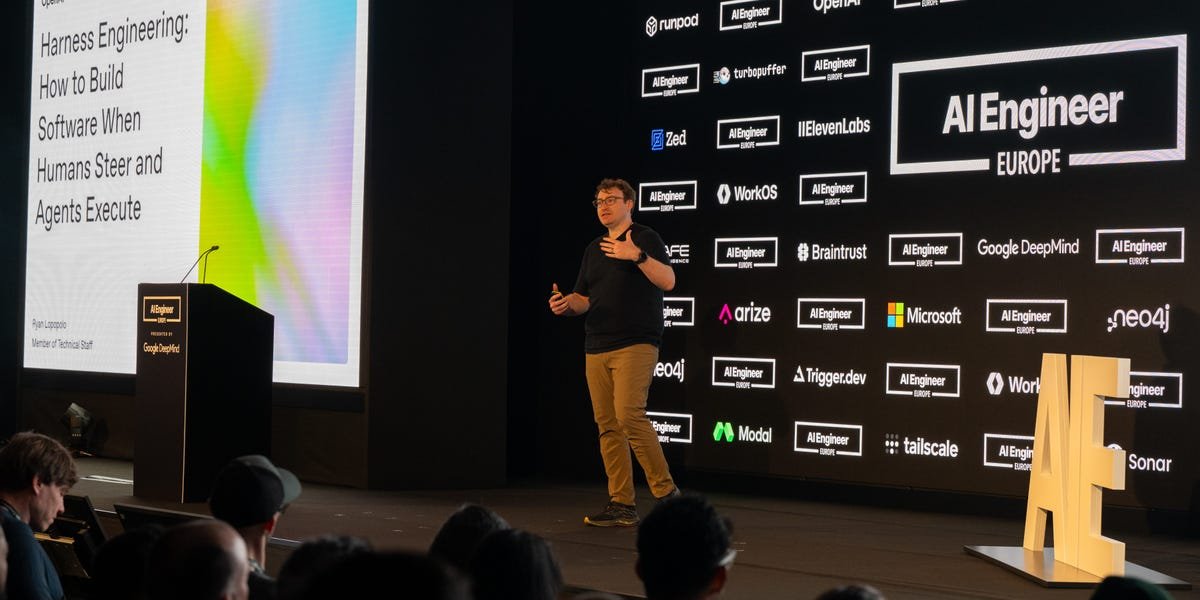
These were some of the talking points at last week’s AI Engineer conference in London, which brought together people from across the industry, including Google, Anthropic, and OpenAI.

The talks were varied, highly technical, and curated for the people steeped deepest in AI right now.

What was striking was how many of the presentations and discussions weren’t so much about the quality and abilities of AI models and agents — software that can perform tasks semi-autonomously — but the humans managing them.

Ryan Lopopolo, a member of OpenAI’s technical staff, called the moment early in the show. He said coding had changed dramatically in late 2025 because of advances in AI tools. The role of today’s software engineers, he said, is to steer and unblock agents.

That prompted several recurring questions: How much control should we cede to agents? What should agents look like? Should they delegate to other sub-agents? Is human language too limiting for telling an agent what you want it to do?


AI Engineer Europe 2026

Anthropic’s David Soria Parra said agents are about to jump from coding to other jobs. 

Hugh Langley


The event quickly started to feel like an MBA for the AGI-pilled. Everyone had a perspective on how agents should be managed. Words like “guardrails” and “context engineering” (a plan to have the agent perform optimally while burning fewer tokens) were everywhere.

These details matter because there’s an emerging consensus that 2026 will be an inflection point, when agents move from the experimental phase into one where they’re more reliable and leap from coding into other domains.

“I think 2025 was all about exploring, and 2026 is all about putting these agents into production,” said Anthropic’s David Soria Parra onstage. It’s not just coders who are going to have to think about these things: Parra said he expects we’ll soon see more “general agents that will do real knowledge worker stuff” such as financial analysis and marketing.

In this utopian work future, the agents are doing the grunt work for us — but they still need oversight. That means they need the right documentation, context, and guidelines to keep them from careening off course and doing things they shouldn’t.

It’s an irony of this moment that companies including Meta, Google, and Amazon are cutting management layers but may also end up turning everyone into AI supervisors. Individual contributors at tech companies, who once coded away without worrying about their direct reports, are now delegating and reviewing work done by AI.

Another big topic of debate was the amount of control we should give to agents — especially given how prone they are to breaking things. There was more than one dig at a recent disruption at Amazon caused by an AI coding assistant.

Mario Zechner, the creator of coding agent Pi, struck a more cautious message than most speakers. Agents learned on the internet, which is filled with a lot of garbage code, he said. He proposed a model for software engineers working with agents: use them sparingly, and don’t let them make decisions for you. “All of the decisions it makes are learned from the internet,” he said.

Agentcraft

Keeping tabs on agents means being able to see them, which prompted another interesting question: what should an agent look like?

One answer came via a showstopping moment from Monday.com’s Ido Salomon, who built a program called Agentcraft that, yes, displays functioning agents in a “Warcraft”-inspired environment.

The user can spawn new agents, prompt them as they would in any other AI interface, and there’s a handy way to cycle through agents with follow-up questions or that need your approval to execute a task. A heat map shows you if your agents are at risk of colliding — a problem that can occur when running multiple agents in parallel. This can happen if two agents are editing the same file at the same time, or both are tweaking different code functions that rely on each other.


AI Engineer Europe

How do you make controlling agents fun? Make it a video game. 

Hugh Langley


Several attendees who spoke to Business Insider weren’t from major AI labs but companies big and small that are embracing agents in the workplace.

Yann Mainier, a senior engineer at Sky UK who attended the event, told Business Insider he wanted to learn more about how he and his team can build better agents.

“It’s more about: once you get agents, how do you make sure they are doing a good job? You can’t check them the same way you are doing with traditional software,” he said. For example, ask an agent to write the same function twice, and it might do it differently. “You need to have other ways,” Mainier said.

Managing agents may also require rearchitecting parts of the web to make it more legible.

Vercel CTO, Malte Ubl, said that in the week leading up to the AI Engineer conference, more than 60% of page views on Vercel.com were from agents.

“We have to consider another shift that the software itself is going to be used by agents now,” he said. When an employee proposes a new feature or interface, Ubl said he now asks a new question: “How does an agent use this?”

Have something to share? Contact this reporter via email at
hlangley@businessinsider.com or Signal at 628-228-1836.


Source link

Jamba-Juices-former-CEO-says-middle-management-is-crucial-for.jpeg

Jamba Juice’s former CEO says middle management is crucial for success.

In the era of America’s “Great Flattening,” one longtime executive still believes that middle management has an important role to play.

Speaking in a Monday episode of Yahoo Finance’s “Opening Bid” podcast, Jamba Juice’s former CEO, James D. White, said companies should not lose sight of the fact that humans and company culture drive bottom-line growth.

And White said that middle managers are crucial for driving a good company culture.

“It’s really hard to drive culture into an organization if you’re not focused on the middle management of the organization,” he told host Brian Sozzi.

White said one reason for this is because most workers report to middle management.

“If that part of the organization doesn’t have the tools, hasn’t bought into the mission and vision, and they’re not being appropriately rewarded or invested in, you don’t have the best chance of getting that message into the heart of the organization,” White said.

White was the CEO of Jamba Juice from 2008 to 2016 and has held executive roles in Gillette, Coca-Cola, and Nestlé Purina. He now sits on the board of directors for several consumer companies, including Cava Group and Simply Good Foods.

White’s advice contrasts with that of other executives, who have sworn by a flat company hierarchy.

In recent years, companies like Microsoft, Meta, Amazon, Intel, and Google have all slashed their middle management head count in the name of efficiency. But it’s not just Big Tech: retail giants like Walmart have followed suit.

And in November, Keily Blair, the CEO of OnlyFans, said her company was making $7 billion in annual revenue with a staff count of only 42.

She said her company thrives from having only “incredibly senior talent” and “incredibly hungry junior talent.”

“We do not have that sort of squidgy layer of middle management in the middle, because nobody’s ever had a really good middle manager in my experience,” Blair said in the interview during a Web Summit technology conference in Lisbon.


Source link

Erica Sweeney

4 new jobs that AI has created in HR and people management

More human resources teams are using artificial intelligence for a variety of functions. Amazon and Siemens, for example, use AI for HR to analyze résumés and make job recommendations based on an applicant’s skills.

Indeed, 31% of organizations this year report using some type of AI technology, according to a 2025 survey of nearly 10,000 HR professionals by Sapient Insights Group.

Many companies are also creating new HR job titles that require AI skills, such as data literacy, analytics, large-language model prompt engineering, and workflow redesign.

Moreover, in 2026, many organizations are willing to offer higher salaries for AI-related skills, including data science, data analytics, and business intelligence, according to a Robert Half report.

“Historically, technological shifts have reshaped some jobs and the way we work, but they’ve also opened doors to new roles and skills,” said Christina Giglio, technology hiring and consulting expert at Robert Half. “AI seems to be continuing that trend.”

Here are four new HR job titles that are appearing in the AI age, according to experts.

1. AI adoption and employee experience lead

This role coordinates the adoption of AI tools, helping people understand the technology’s value, how to use it, and how it benefits them, ensuring that AI rollouts go smoothly.

“AI doesn’t eliminate people,” says Anthony Donnarumma, CEO of the recruiting agency 24 Seven. Companies need individuals to manage the relationship between human and machine work to ensure the technology produces consistent outcomes and meets an organization’s needs, he says.

Humans are needed to oversee how teams adopt AI in their daily work, says Lana Peters, chief revenue and experience officer at Klaar, a performance management software.

The job often includes training managers, redesigning workflows, and connecting company culture and technology while helping employees adapt to the changes.

“Without this role, AI use is at risk of being done in silos or improperly, which is why we’re seeing this position pop up across the job market,” Peters adds.

2. AI trainer or coach

This role trains AI systems, such as chatbots, AI agents, and other tools, to ensure the technology works effectively to produce the desired HR outcome. This might include organizing data and reviewing it for bias.

“Part technical, part editorial, part quality control,” Ronni Zehavi, CEO and co-founder of HR tech platform HiBob, says the individual in this role curates and labels data for AI to use, reviews outputs, and teaches AI systems how to respond to data to meet company goals.

This person “improves AI quality through hands-on review and feedback,” he explains.

3. People data and AI insights lead

Turning “raw people data,” such as from performance reviews and manager check-ins, into insights that leaders can act on is this role’s focus, Peters says.

This individual helps leaders make data-based decisions on their workforce strategy and better understand “how employees are performing, when they are ready to be elevated to a new role, and when they may be a flight risk,” she adds.

Data literacy, analytical thinking, and the ability to interpret AI outputs are crucial skills for this role, says Lauren Winans, CEO and principal human resources consultant at Next Level Benefits.

“Additionally, employers will value soft skills such as ethical awareness, critical thinking, collaboration, and the capacity to translate AI capabilities into strategic decisions, especially in roles that bridge technology, policy, and operations,” Winans says.

4. Responsible AI and people governance manager

Policies and oversight are needed to ensure that AI use is safe, fair, and transparent; this role sets those “guardrails,” Peters says. This individual oversees how employee data is used and ensures there’s no bias that could negatively impact them, she says.

Also referred to as an AI governance and risk lead, the job establishes policies to “keep AI use safe and compliant” and focuses on privacy protection and accuracy monitoring, helping organizations manage regulatory shifts and legal or reputational risks, Donnarumma says.

Essentially, Zehavi says, the role “guides teams on fairness, transparency, and compliance, helping companies use AI in ways that support people rather than unintentionally excluding them.”


Source link