Marines out on the West Coast are discovering that some of the best drone operators aren’t necessarily gamers. Instead, they’re likely to be dirt bikers or boaters, an officer told Business Insider.
Course leaders for the 1st Marine Division drone school at Camp Pendleton in California initially thought their young Gen Z Marines, who began cycling through the new course last fall, would have a natural advantage considering their upbringing in a tech-saturated world and gaming exposure.
But while experience with video games can make it easier to master drone simulators, instructors have found that piloting drones weighed down, even lightly, with explosive payloads comes more naturally to Marines who grew up honing their dexterity in the great outdoors, operating dirt bikes, jet skis, or boats, said Maj. Mike Olivarez, who oversees the division’s drone pilot course.
At the center of the challenge are small toggles on the handheld control system, which dictate a drone’s direction, speed, and altitude and require an unusually soft touch to master.
“It feels heavier as you’re trying to apply that torque,” Olivarez said, comparing the dexterity required to handle armed drones to handling a motorcycle throttle. That torque is influenced by the weight of the explosive payload, which weighs just five pounds but can have a notable impact on flight.
Soldiers with Ukrainian drone units and US Army brigade combat teams have observed that gamers — tech-savvy individuals comfortable with screens and controllers — often possess skills needed to excel as drone pilots, but such findings are anecdotal, not definitive. The Army is still trying to work out what kind of soldier makes the best drone pilot. And the Marines are too.
“If they don’t have anything from their past personal life to relate to that experience, they still continue to struggle with it,” Olivarez said. “If it has anything to do with mechanics and operating outdoors, I would say that sets you up for more success than gaming.”
Over the Marine Corps course’s six iterations, the instructors began noticing that more than 20% of the students were failing due to issues with toggle sensitivity. The problem became especially clear as students transitioned from zero-weight simulator controls to real-world systems, where drones carry payloads that may not be heavy but still require different handling.
To address the gap, Olivarez and his team have asked the simulator’s manufacturer to better replicate the weight of a warhead on a drone. Instructors have also started students on a smaller, five-inch drone with some toggle resistance to help bridge the transition to the Corps’ Neros Archer drone and reduce attrition to around 15%.
The drone training program is a jam-packed three weeks meant to rapidly share the basics of drone operation across as much of the force as possible. For the 1st Marine Division, that could eventually mean 500 troops each year.
Drones are emerging as an integral part of modern warfare, as Russia’s war against Ukraine has demonstrated. On the battlefield in Ukraine, a mixture of quadcopters, fixed-wing drones, octocopters, and more are surveilling enemy positions, striking troops and vehicles, dropping bombs, and even intercepting other drones.
The Marines, like other branches of the US armed forces, are racing to prepare for that growing threat.
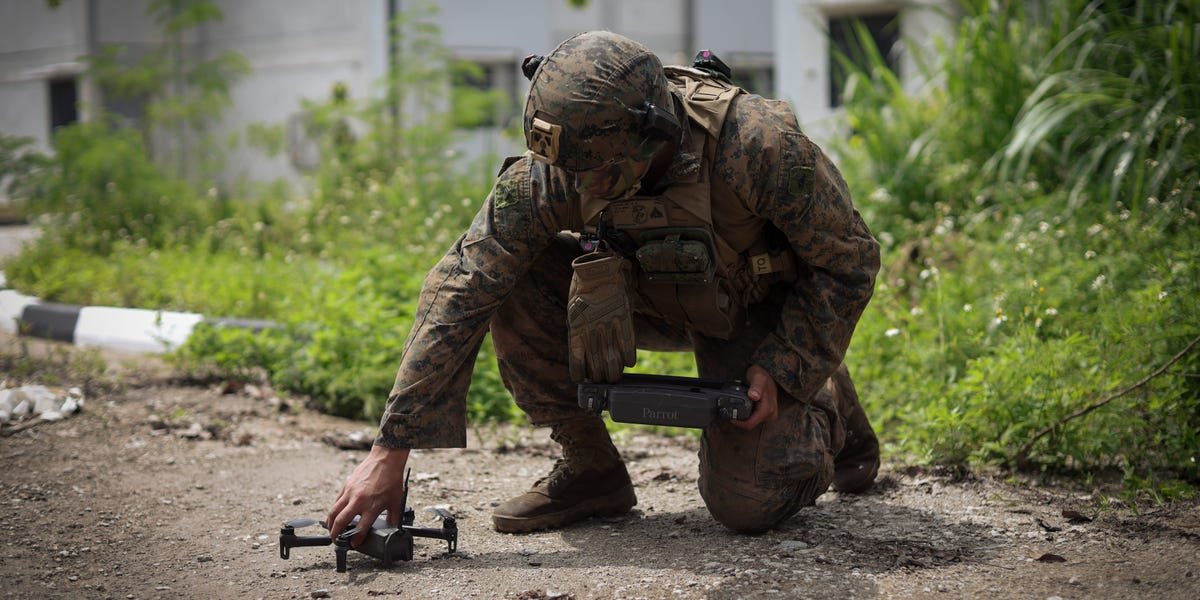
During training at Camp Pendleton, Marines navigate various flight patterns using their drones in teams, often mimicking how the Ukrainians operate, testing their navigation and new flight skills to ultimately strike with an explosive at a marked grid coordinate.
Some Marines are now designated as both drone operators and payload specialists, meaning that they can safely prepare an explosive payload — a change course leaders made to move more Marines through the pipeline, Olivarez said.
For now, the course, which mirrors the Corps’ Attack Drone Team training at its primary weapons hub in Quantico, Virginia, is only open to infantry personnel. That includes riflemen, machine gunners, mortarmen, and anti-tank missile gunners.
The Marine Corps does have a separate designation for Marines who operate larger, more traditional uncrewed aircraft systems used for intelligence, surveillance, and reconnaissance. It does not currently have a stand-alone job field for small drone operators.
Beyond dexterity, Olivarez said the ideal Marine for the course is someone with a natural curiosity about technology and the ability to think creatively about how to employ it.
“You’re looking for someone who has the ability to adapt and understand UAS very quickly,” he said. “Because the technology that we are getting is going to force you to be more technologically savvy.”