Risky lending products could expand as federal student-loan repayment changes begin to roll out, a new report says.
On Tuesday, advocacy group Protect Borrowers and left-leaning think-tank The Century Foundation released a report on how the private student-loan industry will shift once President Donald Trump’s federal repayment overhaul is implemented.
The report found that 40% of Americans would be denied private student loans from traditional, prime lenders due to low credit. It could drive them to consider the “shadow” student debt market, which is made up of subprime lenders, including personal loans, debt owed directly to schools, and “Buy Now, Pay Later” products, all of which can come with high interest rates and aggressive debt collection.
Those products could get a boost from Trump’s “big beautiful” spending legislation, which included new caps on borrowing for advanced degrees. Previously, students could borrow up to the full cost of attendance throughfederal student loans. Under the new caps,programs with highertuition could pushborrowers to seek private financing or forgo thoseprograms altogether.
Jennifer Zhang, Protect Borrowers’ policy, research, and data analyst, told Business Insider that traditional private lending limits will “hurt the people who arguably would stand to gain the most from the federal student loan program” because students from low-income backgrounds and students of color often have limited access to credit.
“The pivot toward private lending is going to deprive students of access to college and to make their choice,” Zhang said. “Either you can give up on the dream of higher education, or try to look for lenders that are increasingly predatory and offer highly predatory and expensive loans to people who are the most desperate.”
During negotiations on Trump’s spending legislation, the Department of Education said that borrowing capsfor advanced degrees would prevent borrowers from taking on unaffordable debt, and could pushcolleges to lower tuition. Major private lenders have said they’re prepared for an influx of federal borrowers; Jonathan Witter, CEO of Sallie Mae, said during a January earnings call that he’s “excited about the opportunity created by the recent federal student lending reforms.”
Some of those lenders also told Democratic lawmakers in February that, in anticipation of the influx, they’re committed to offering borrower protections. Sallie Mae said that its customers face “the highest periods of repayment stress” in their first 12-24 months of repayment, and it offers grace periods for those borrowers. SoFi, another major private lender, said it has “many options,” like grace periods and deferments, to help its borrowers avoid delinquency.
In a time when oversight over private student loans is diminished — includingstaff cuts at the Consumer Financial Protection Bureau, which brought enforcement actions againstthe industry — Zhang said the repayment changes are evenmore “dangerous.”
“The transition toward increased private lending is going to happen in a context where lenders know that the CFPB and the Department of Education are really not doing their jobs and looking for the lenders who are breaking the law,” Zhang said.
A shifting student-loan repayment landscape
With oversight lacking, the report had recommendations to protect borrowers from risky lending products. One is to require private student-loan companies to register with their state financial regulator, which would allow the state access to information on the lender’s performance and portfolio. Only eight states have passed legislation requiring private lenders to register with states, the report said.
The report also called for more federal and state funding toward higher education to prevent borrowers from relying on debt-based systems.
For now, the private student-loan industry could see increased demand. The Department of Education will begin implementing the repayment changes on July 1, including new income-driven repayment plans, and borrowers previously told Business Insider that they’re bracing for higher monthly payments.
At the same time, the department will transition more than 7 million borrowers off of the SAVE student-loan repayment plan this summer, after a recent settlement to end the program early. SAVE would have been phased out in 2028 — now, millions of federal borrowers will be navigating a new repayment system, and some might turn to the private market.
A group of Democratic lawmakers led by Sen. Elizabeth Warren released an analysis in January calling for increased oversight over the industry due to the looming repayment changes.
They wrote that private lenders preparing for an influx of federal borrowers “underscore an urgent need for oversight of the private lending market as these companies prepare to cash in on the Administration’s agenda.”
The great vibe coding war of 2026 isn’t the bloodbath it appears, says a venture capitalist whose firm backed Cursor.
On an episode of the “20VC” podcast released on Monday, Miles Clements, a partner at VC firm Accel, said that the AI-assisted coding industry is big enough for Anthropic’s Claude Code and Cursor.
After Anthropic released its latest model, Opus 4.6, last month, founders and developers said on X that they are ditching Cursor for Anthropic’s Claude Code.
“This market is growing enormously, and I don’t think a lot of these companies are actually experiencing success at the expense of the others,” Clements said.
Cursor, founded in 2022, was valued at $29.3 billion late last year. Accel first invested in the AI coding startup in June and co-led its $2.3 billion Series D round in November.
Every time Shubhangi publishes a story, you’ll get an alert straight to your inbox!
Stay connected to Shubhangi and get more of their work as it publishes.
On the podcast, Clements called Claude Code an “amazing product.” Still, he said, there are two reasons Claude’s latest improvements don’t hurt Cursor.
“First of all, they’re bringing so many new cohorts of users online, so people who would not have been software developers a year ago today can be software developers with these tools,” he said.
Second, the market is expanding because consumption per customer is increasing, Clements added.
Writing code by hand was walking Using Cursor was getting in a car Claude Code in an existing repo is an airplane Claude Code in a new repo is getting in a rocket
Last week, Chamath Palihapitiya, a VC and the founder of software incubator 8090, said that Cursor was one of his company’s biggest AI costs.
“We need to migrate off of Cursor,” he wrote on X. “It’s just too expensive vs Claude Code. The latter is equivalent, and if you use the Pro plan, you eliminate huge Cursor bills for token consumption.”
Cursor did not respond to a request for comment from Business Insider.
On a podcast released in late February, Insight Partners cofounder Jerry Murdock said that Cursor is behind its peers.
“Most of the companies I mentioned, their view is that Cursor is obsolete today,” he said. “I think those guys are going to have to quickly embrace autonomous agents.”
On Monday’s podcast, Clements countered Murdock’s remarks.
“Like, all due respect, I thought about playing in the NFL, but instead I walked onto a college football team and was the fifth-string inside linebacker,” he said.“You’re not looking at any real metrics. Like, who are these people to make these judgments?”
A representative for Murdock did not immediately respond to a request for comment.
This as-told-to essay is based on a conversation with Isaac Casanova, who has worked at Block for nearly three years as a senior software engineer. It has been edited for length and clarity.
I wasn’t even looking at my computer at the time. One of my good friends started spam calling me. I picked up the phone, and he told me to check my email.
I read the email from Jack Dorsey, and I was like, whoa, I guess I don’t have a role anymore.
We were well aware that rolling layoffs were underway. Most people assumed it would be capped at 1,000. I didn’t feel like anything big like that was coming. For it all to happen at once like that is obviously a shock.
I never got a low rating. In my conversations with folks, I was doing fine. That’s why it’s characterized as a layoff, not a performance thing. This is just a change in business direction.
Every time Lee Chong Ming publishes a story, you’ll get an alert straight to your inbox!
Stay connected to Lee Chong Ming and get more of their work as it publishes.
Check your ego — the industry is tough
I’m managing my expectations as I look for work.
It seems like companies are tighter with headcount and more picky about who they want.
There are definitely fewer positions. Companies are doing more with less. These agents are automating some tasks and are slowly improving at understanding concepts.
The compensation is definitely lower. We’re hearing across the industry that stock grants are lower than they used to be. Refresher grants are lower. Bonuses — if they exist.
Once you get in, it’s stack-ranked performance management. Your output is compared to your peers from day one. It’s definitely tougher.
You’ve got to check your ego. That might be the part people struggle with more than their technical ability.
Separate your identity from your job
At the end of the day, companies are beholden to shareholders.
Jack’s memo came across as what someone in that position making a tough decision would say. A call was made, and it had to be communicated. I don’t have any negative feelings about anybody that I worked with or at the company.
The biggest expense of running an organization is employees. The higher you are — senior engineer, engineering manager, head of product — the more expensive you are.
You need to remember that and evaluate your relationship with work. Many people in these positions tie their identity to their jobs. Those are the people most affected when these things happen.
You try not to take it personally. You see it as a new opportunity. There’s a human aspect — you just lost your job, and it kind of sucks for a bit — but you can’t let it hold you down. You can’t let it define you. These things happen, and you need to adjust.
The good thing about when these things happen is the network of people that you’ve met. Build the network so that when things like this happen, you can maneuver.
Be flexible — AI is changing the role
You could tell on the inside that things were changing.
A couple of years ago, I was doing most of the coding by hand. That slowly turned into using interfaces like Cursor, Claude Code, Goose, and ChatGPT. You’d slowly read things internally like, “Let’s speed up.” You were expected to speed up because the agents could make you more productive.
You’d have conversations with some of your colleagues and be like, “I haven’t opened my IDE in a month.” As a software engineer, that’s definitely a shift.
AI turns you from a person who just turns out code into more of an experimenter — a builder.
Software engineering, for a long time, was so by the letter, by the design, by the spec. Exact and precise, but slow.
Now we have these tools, the industry expects you to move fast. You can shift your mindset from that rigid engineering, step-by-step, to more of an exploratory “attack the problem, solve it, refine it later.”
Don’t get too trapped in the domain that you’re working in. Block tended to hire specialists who could also generalize when needed. So, be flexible. Using these tools allows you to get context in areas that you might not have had the opportunity to work in.
Do you have a story to share about tech layoffs? Contact this reporter at cmlee@businessinsider.com or on Signal at cmlee.81.
Buying a first home is generally considered a young person’s game. If your 20s are for stumbling through adulthood, then your 30s are for settling down with a family and a mortgage. Your 40s are for reaping the fruits of that labor: as you watch your home equity swell, maybe you think about splurging for more bedrooms and a bigger yard.
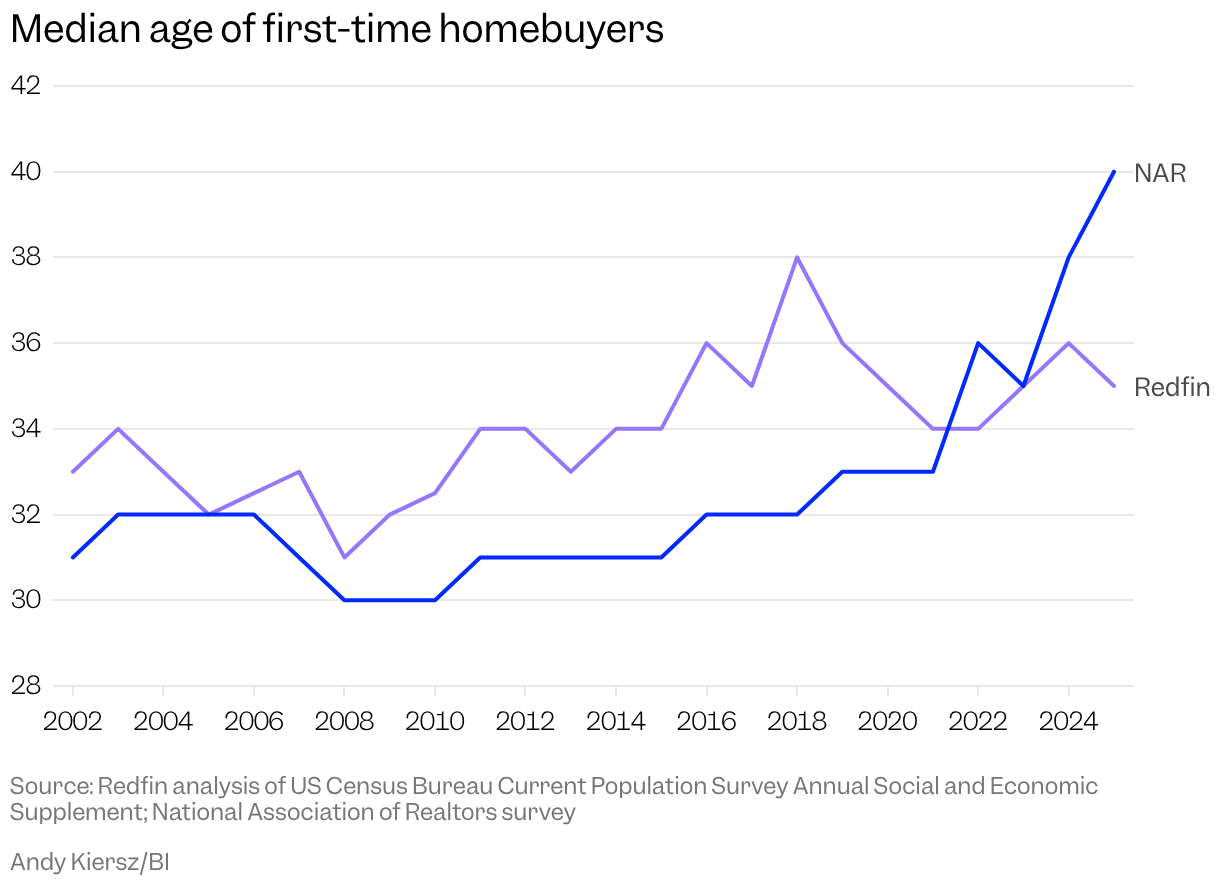
A report released last fall by the National Association of Realtors upended this basic assumption. For several decades, the typical age of first-time homebuyers bounced around the early 30s, never surpassing 33. Last year, though, the group’s annual survey found the median age of first-timers had hit a record high of 40, capping off a four-year surge that began during the pandemic-era housing shuffle. The message was loud and clear: Picking up the keys to your first place is no longer an “early adult” thing. Now it’s part of your midlife crisis.
Cue the hand-wringing. “First-home homebuyers are older than ever,” declared headlines from The New York Times and Axios. “Many would-be buyers are frozen out of the housing market,” warned another. For my own story, I dubbed this new era the “age of the geriatric homebuyer.” I spoke with a woman who placed her first winning bid on a home at 42 and couldn’t shake the feeling that she was behind. In light of the NAR’s latest data dump, however, she appeared to be merely another example of the sea change in real estate.
The splashy number seemed to confirm our worst fears about the housing market: only old, rich people are having any luck, and younger generations are struggling to break in. The optimists’ take was that elder millennials still had some breathing room. For those inclined to doomerism, though, it was more proof that a classic marker of adult success was drifting further out of reach.
“It is very consistent with this idea that housing affordability is very strained,” says Chen Zhao, a senior economist at the brokerage firm Redfin, “and therefore you have to be older to afford a house right now.”
There’s just one problem: The death of the thirtysomething homebuyer may have been greatly exaggerated. A new analysis from Redfin, shared exclusively with Business Insider, found that the median age of the first-time buyer last year was 35 — a slight decrease from the year prior. It adds to the growing pile of evidence that the new median of 40 was a mirage. While millennials, now 29 to 45, generally lag behind boomers on the homeownership front, the purchasing milestone hasn’t shifted nearly as much as the NAR report suggests.
If you want to understand the housing market’s ebbs and flows over the past couple of decades, Redfin’s analysis is a helpful starting point. Economists there found the median age of first-time buyers climbed slowly but steadily from 2008 to 2018, peaking at 38, before bouncing around the mid-30s in the following years. Zhao tells me the trend makes intuitive sense: banks tightened up lending standards after the housing bubble burst in 2008, making it tougher to get a mortgage and buy a house. Then mortgage rates began ticking downward before plummeting in 2020 and 2021, reaching a 50-year low as the Federal Reserve slashed borrowing costs to fight inflation. All those cheap home loans made it easier for younger people to break into the market, and the first-time homebuying age fell to 34 in 2021 and 2022. Then rates jumped, and the median age of first-timers followed suit, rising to 35 in 2023 and 36 the following year. Affordability improved slightly in 2025, thanks to slower home-price growth, rising wages, and marginally lower mortgage rates, which could explain last year’s decrease in the median age.
Every time James publishes a story, you’ll get an alert straight to your inbox!
Stay connected to James and get more of their work as it publishes.
While the NAR and Redfin analyses both point to first-time homebuyers generally getting older, the latter’s numbers are way less dramatic. Redfin isn’t the only one pushing back on the idea that the typical buying age skyrocketed over the past few years. A growing number of economists have chimed in to suggest the situation isn’t nearly so dire. Studies by the Federal Reserve Bank of New York and the American Enterprise Institute found that the median age of first-timers was basically unchanged at 33 between 2019 and 2024, before rising slightly last year to 34. Researchers at the Mortgage Bankers Association similarly found a modest increase from 30 to 33 over the decade leading up to 2024, followed by a dip to 32 in 2025.
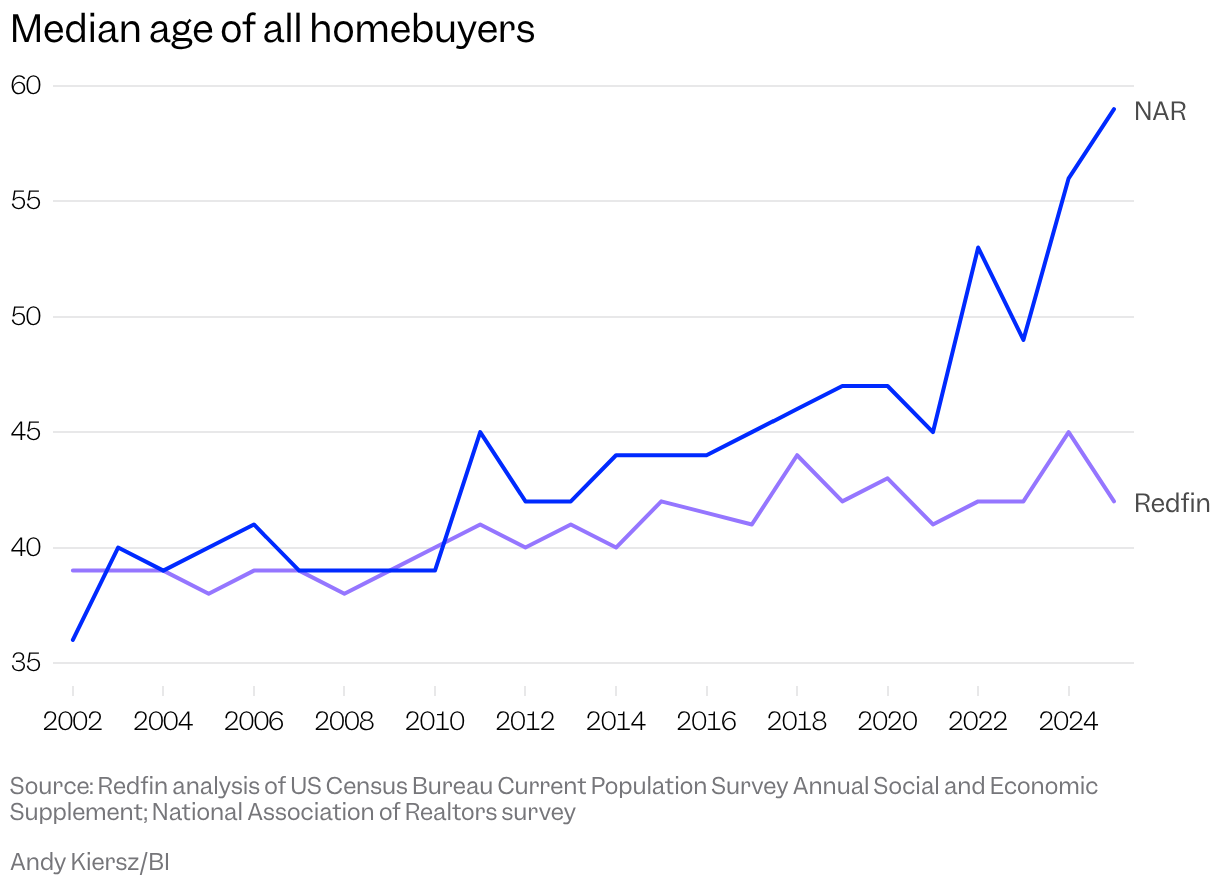
Connor O’Brien, a fellow at the DC-based think tank Institute for Progress, analyzed the Census Bureau’s American Housing Survey and American Community Survey and found that the median age for all buyers had ticked up since 2000 but hovered around 42 in 2023, while NAR reported a median age for all buyers of 49 that year and a stunning increase to 59 just two years later. That Census data only runs until 2023, but O’Brien says he doesn’t see any reason to believe that the typical buying ages would have undergone a seismic shift in two short years, given the housing market’s stasis.
So why the discrepancy? The rebuttals to NAR’s data all draw upon national data sources that researchers say are far more robust than the Realtors’ annual survey of recent homebuyers, which is conducted via mail and text message. In July of last year, the NAR sent the 120-question survey to a nationally representative sample of more than 173,000 recent homebuyers but received just 6,103 back, a response rate of 3.5% (the census’ American Community Survey, by contrast, sees a response rate of more than 80%). The New York Fed and the Mortgage Bankers Association relied on the Consumer Credit Panel and the National Mortgage Database, which sample millions of underlying documents, like mortgages and credit reports, to take the temperature of the American homebuyer.
It seemed totally implausible.Connor O’Brien, fellow at the Institute for Progress
Redfin’s analysis also uses Census data, specifically an annual supplement to its Current Population Survey, which asks households who moved in the past year why they did so. The survey doesn’t separate first-time buyers from repeat buyers, so Redfin used a proxy: it counted respondents as “first-time buyers” if they said they moved because they wanted to own rather than rent, or to start their own household, implying they’d previously been living with roommates or parents.
A Redfin analysis of census data shows the typical age of first-time homebuyers actually decreased slightly last year to 35.
Smith Collection/Gado/Getty Images
Jessica Lautz, the NAR’s deputy chief economist and vice president of research, says in an emailed statement that the organization stands by its methodology. Lautz describes the NAR’s survey as “the only national survey that asks primary residence buyers if they are a first-time buyer or repeat buyer,” and points out that analyses of mortgage and census data must rely on varying degrees of assumptions in order to parse first-timers from the rest of the pack — mortgage data, for example, doesn’t include all-cash buyers. Some of those assumptions, she says, no longer match the reality of the new housing market.
“Marriage and divorce do happen, inheritances are gifted, all-cash buyers happen, and sometimes a household may have to rent temporarily before owning again,” Lautz says in the statement. “Homeownership has become out of reach for the typical young adult in America.”
Redfin’s methodology isn’t perfect — taken on its own, I’m not sure it would unseat the NAR’s estimates. It’s important to pay attention, however, because it adds to the mountain of evidence that first-time buyers aren’t suddenly getting way older.
“Because no data source is perfect, what you really want to do is say, What is the bulk of the evidence showing me?” Zhao tells me. “When we compare our results to analyses that other people have done looking at credit bureau data or mortgage data, it seems to support the idea that the age of the first-time buyer has not increased all that much.”
This might sound like a bunch of bickering and hair-splitting, a squabble among housing nerds. But the conclusion — that people are still buying homes at roughly the same age they were a couple of decades ago — has far-reaching implications.
“People are potentially going to make policy based on their view of how the economy and housing market are developing,” O’Brien tells me. “If their views are fundamentally incorrect, that could be a big problem.”
The homeownership rate for millennials in their early 30s still lags well behind that of baby boomers at the same age.
Eileen T. Meslar/Chicago Tribune/Tribune News Service via Getty Images
The takeaway shouldn’t be that things are fine and dandy for millennial homebuyers, though.
We don’t have enough housing where people want to live, and where people find the job markets that they want to participate in.Ben Glasner, senior economist at the Economic Innovation Group
A recent analysis of census data by Ben Glasner, a senior economist at the Economic Innovation Group, found that while millennials and boomers were about as likely to own homes at 44, the ownership rate among 32-year-old millennials (41.3%) was well below the 54.7% for boomers at that age. And while Redfin and NAR pulled vastly different homebuying ages from their data, both groups advocate for more housing construction. Glasner draws a similar conclusion.
“We don’t have enough housing where people want to live, and where people find the job markets that they want to participate in,” he tells me.
The “40-year-old” finding had all the proper ingredients for virality: a nice, big number that confirmed what everyone already felt to be true about the dismal state of the world. Things are rough out there for millennial homebuyers, no doubt. But the goalposts haven’t moved as much as we thought — at least, not yet.
“I think a lot of times people feel like, Well, if I can’t achieve the homeownership step, it’s kind of like I can’t move forward with my life,” Zhao tells me. “And I think that’s why people are very hung up on this number.”
James Rodriguez is a correspondent on Business Insider’s Discourse team.
This story is available exclusively to Business Insider
subscribers. Become an Insider
and start reading now. Have an account? .
Toys R Us opened pop-up stores at some US malls this holiday season.
The retailer has been the subject of multiple revival efforts since it ended operations in 2018.
Here’s a look at the history of Toys R Us, from its founding to zombie-brand status.
Toys R Us is back — again.
The latest phase of the toy store chain’s comeback came this holiday season as Toys R Us stores popped up at a handful of malls around the US. The temporary stores are part of a broader revitalization opportunity by brand management company WHP and Go! Retail Group.
It’s the latest example of how the once-dominant chain is trying to make a comeback.
Toys R Us used to operate around 700 stores in the US. Then, after years of faltering financial results, the chain filed for Chapter 11 bankruptcy before deciding to liquidate and close its operations in 2018.
Since then, there have been multiple efforts to revive the brand, including opening locations within Macy’s department stores and teaming up with Amazon.
Here’s a closer look at the history of the historic toy company, from its founding just after World War 2 to the revival attempt.
Toys R Us was founded in 1948 by Charles Lazarus after he returned from World War II.
Charles Lazarus in front of an early Toys R Us store.
Mike Derer/AP
Lazarus was inspired by what was then the emerging post-war “baby boom” and sought a way to capitalize.
The company started as a baby goods and furniture store called Children’s Bargain Town in Washington, D.C.
Kids and their parents would line up for hours to meet their favorite stars — and do a little shopping while they were there.
In 1966, Lazarus sold the company to Interstate Sales to help finance a larger national expansion.
Lazarus appears in front of a selection of toys with former President George HW Bush.
AP Photo/File
According to Encyclopedia.com, he transitioned from chief executive to head the Toys R Us division, which was already thriving at profits of $12 million.
In 1969, Toys R Us developed its beloved Geoffrey the Giraffe character.
Lazarus eventually stepped down as chief executive in 1994.
Turtle Mania hit Teesside today, at the opening of the new Toys R Us at Teesside Shopping Park, Sandown Way, Stockton on Tees. 6th October 1990. Pictured, Emma Michelle Todd after opening the store. Getty Images
The move signified a series of woes for the brand, including high executive turnover and the looming pressure of ecommerce.
Building upon the success of Kids R Us, the company expanded into baby clothing with Babies R Us in 1996.
In 2005, a conglomerate of private equity firms — including Bain Capital, Kohlberg Kravis Roberts, and Vornado Realty Trust — purchased Toys R Us for $6.6 billion, taking the company private in the process.
Getty
According to USA Today, the plan was to boost Toys R Us sales and position the company for a stock offering that would allow investors to cash out.
In an attempt to compete with the ecommerce boom, the company purchased Etoys.com and Toys.com in 2009.
Business Insider/Jessica Tyler
That same year, it bought KB Toys and the famed New York City toy store, F.A.O. Schwarz.
In 2010 the company registered once again to go public.
According to Business Insider, the chain lost significant traction to ecommerce giants like Amazon, Target, and Walmart.
The company officially filed for Chapter 11 bankruptcy protection in September 2017.
Richard Drew/AP Images
The chain hoped to gain control of its debt and continue to operate its 1,600 stores around the world as normal, according to the Washington Post.
With its hopes for a financial savior ultimately dashed, Toys R Us announced in March 2018 that it would liquidate and permanently close all of its 700-plus stores across the US.
According to Business Insider, the decision threatened the jobs of the 33,000 people employed by Toys R Us at the time.
That same year, the company issued an emotional goodbye as it prepared to permanently shutter its Toys R Us and Babies R Us websites.
“We encourage you to stop by your local store and take full advantage of the deep discounts and deals available,” the message read. “Thank you for your business and support over the years.”
It was later announced that gift-card holders could use any remaining funds at Bed Bath & Beyond stores, according to Business Insider.
The CEO of the toy company MGA Entertainment issued a last-minute bid of $890 million to save the company.
Shannon Stapleton/Reuters
However, the offer was ultimately rejected by Toys R Us.
Throughout the rest of 2018, stores like Walmart began to position themselves to take over the void left behind in the market by Toys R Us.
Walmart Supercenter in New Jersey Rachel Askinasi/Business Insider
The chain strategized to overtake Toys R Us’s legacy by adding mass amounts of baby-related products to its inventory.
By the fall of 2018, abandoned Toys R Us stores had been temporarily converted into Halloween costume shops across the country.
Business Insider/Jessica Tyler
According to Business Insider, Halloween costume retailers Spirit Halloween and Halloween City set up shop in the abandoned stores but kept most of the remaining Toys R Us signage and wallpaper.
In February 2019, Toys R Us appeared to rise from the dead when Tru Kids Brands purchased the rights to the company.
Courtesy of Tru Kids Brands
Tru Kids Brands also purchased the rights to the Geoffrey the Giraffe mascot with plans to revitalize it.
Later that year, Tru Kids Brands announced it would open a series of holiday pop-up stores under the Toys R Us name.
Toys R Us redesigned store rendering. Tru Kids
The stores would sell popular toys directly from manufacturers, meaning that any sales would directly go to the toy companies rather than Toys R Us.
Read more:Toys R Us is officially back from the dead, but its new stores won’t actually make any money selling toys
In October 2019, the company announced it was back online but with a catch — you couldn’t actually buy anything directly from the Toys R Us site.
Toys R Us would now partner with Amazon as its fulfillment partner, according to Business Insider.
The coronavirus pandemic decimated in-store sales for many retailers, including Toys R Us.
A Toys “R” Us storefront closed during the coronavirus pandemic. Andrew Chin/Getty Images
CNBC reported in January 2021 that the retailer was facing hardships due to dwindling in-store sales amid the coronavirus pandemic. As a result, the chain’s last two remaining stores in the US officially shuttered for good, bringing an end to a years-long ordeal to attempt to revitalize the brand.
The final stores were in Texas and New Jersey, Bloomberg reported.
“Consumer demand in the toy category and for Toys ‘R’ Us remains strong and we will continue to invest in the channels where the customer wants to experience our brand,” a Tru Kids spokesperson told CNBC.
Read more:The last 2 Toys ‘R’ Us stores in the US have closed down after the COVID-19 pandemic hit sales
In 2022, Toys R Us announced it was making yet another comeback, by opening in-store shops at Macy’s around the country.
Macy’s Toys R Us homepage Macy’s
The Toys R Us in-store locations opened in time for the holiday season that year.
In 2025, Toys R Us opened pop-up shops in time for holiday shoppers.
A Toys R Us pop-up location in Maryland Alex Bitter/BI
The stores, operated by Go! Retail Group, include eight flagship locations and 20 seasonal pop-ups around the US.
The stores are different from the original Toy R Us locations.
A selection of calendars sits under a banner at a seasonal Toys R Us store. Alex Bitter/BI
Although the pop-ups use the Toys R Us name and slogans, they also feature a different product selection compared to the Toys R Us stores of years past, Business Insider found during a recent visit to one store in Maryland. The store included a wide selection of calendars, for example.
While Toys R Us technically still exists, the brand is a shadow of what it once was.
Customers wait in line to enter Toys R Us in Times Square on Thanksgiving evening. Yana Paskova/ Getty Images
While some shoppers were able to check out the brand’s pop-up stores, the chain has far fewer locations than it did a decade ago.
Doug Duncan, chief economist of the government-sponsored mortgage finance giant, noted the challenging environment for first-time homebuyers, with mortgage rates hovering near 20-year highs and a dearth of inventory keeping home prices elevated.
“Supply-constrained,” Duncan said of the housing market, speaking to Yahoo Finance on Thursday. “That’s been a theme for several years, it’s kind of repeating the story, but it’s the story.”
Duncan outlined his top tips for homebuyers in today’s market:
1. Have a good credit score
Mortgage rates are elevated, and having a poor credit score makes borrowing costs even steeper, Duncan said.
“No matter who you talk to, there’s different kinds of lenders. All of them are going to look, first of all, at what’s your credit? Do you have a good credit score?” he said. “They want to know, what’s your risk profile?”
Real estate economists say mortgage rates likely won’t come down significantly anytime soon. Mortgage rates are influenced by real interest rates in the economy, and Fed officials aren’t in a rush to cut rates while inflation remains above their target and the economy remains strong.
2. Shop around with multiple lenders
Homebuyers should talk to multiple lenders before locking in their mortgage. Buyers who shop around tend to score better deals and more affordable rates, Duncan said.
“Make them compete. They don’t make money if they don’t make a loan to you, so they have an interest in satisfying you, just like you have an interest in getting a good deal. So shop around for sure,” he added.
3. Don’t try to time the market
You be in the market for a home because you can afford it at the moment — not because you’re waiting for prices or mortgage rates to come down, Duncan said.
“What I always give people as advice when they ask, ‘Is now a good time to buy a house?’ is if you have a family budget or a household budget. That’s the most important clause, because any lender is going to ask you things that’s going to come out of that budget, and if you can budget it all out, you know how to immediately answer those questions and you’ll get a better deal at the end of the day,” Duncan said.
People betting that mortgage rates or home prices will come down soon are taking a gamble. Some homebuyers can afford to speculate on the market, but most first-time homebuyers cannot, Duncan noted.
“You want to take a well-educated financial management approach to that decision because you’d like to be able to sustain it,” he said.
First-time homebuyers accounted for 32% of all home sales in 2023, well below the historical average of 38%, according to data from the National Association of Realtors.
The good news is that some real estate experts see a recovery slowly forming for the housing market. Supply is expanding and home prices are starting to fall in key metros, Charles Schwab said in a recent note.