Zooms-marketing-chief-explains-the-insight-behind-its-revolutionary-campaign.jpeg

Zoom’s marketing chief explains the insight behind its “revolutionary” campaign

When Kimberly Storin joined Zoom as chief marketing and communications officer in April 2025, she did her own research to learn what users thought of the brand. Storin said she discovered a strong affinity for Zoom compared to its competitors. Still, many of the platform’s features are not well known.

That insight inspired a campaign and commercial titled “Zoom Ahead,” created by Saturday Night Live’s Colin Jost’s production company, and featuring former SNL cast member Bowen Yang. In the spot, Yang plays a tyrannical head of IT who is powerless to prevent employees from declaring their love of Zoom.

Zoom extended the theme of worker empowerment with an in-person activation: a Hard Stop Burger Shop pop-up in New York City on March 26-27. The idea was based on research the company conducted with Morning Consult that showed workers are skipping breaks or eating lunch at their desks.

In a video interview, Business Insider spoke with Storin about the strategy behind the campaign and why she’s such a fan of the company’s AI Companion tool.

The following transcript has been edited for length and clarity.

The biggest challenge Zoom has is that ultimately, we are a ubiquitous brand. We have 99% brand awareness, which is a bit of a double-edged sword.

What people don’t realize is the breadth and depth of our portfolio. They don’t realize we have a customer support platform, a marketing platform with events and webinars, a recruiting platform, or a sales platform.

Before I started at Zoom, I talked to about 50 of the company’s customers. Those customers told me, over and over again, about their affinity for the platform.

Then I went down this rabbit hole of Reddit and social media, and I kept seeing this theme in the conversations I didn’t see with any of our competitors — it was really anchored in this preference for the Zoom platform, the simplicity, the ease of use, the fact that Zoom just works.

That was the genesis, the nugget that really inspired our campaign. We wanted to start a revolution.

I had a chief information officer ask me, “Are you trying to encourage shadow IT?” And I said, “No, we’re actually trying to do the opposite.” We’re trying to encourage people to come out of the shadows and share their love for the platform in the ways that they’re sharing it on Reddit, social media, and in our customer satisfaction scores — and we want them to tell you.

Colin Jost was able to find the right humorous tone for the ad

Humor is hard for a brand. And to get humor right really requires people who understand comedy, who understand how humor can play a role in communication, and who can explain something in a way that a straight-faced ad really can’t. And so, of course, we wanted to tap into the best of the best.


Man in suit standing on desk with another man in a suit in front of him pointing in the air.

Bowen Yang stars in Zoom’s recent campaign. 

No Notes Productions for Zoom


Colin Jost really reflects the cultural zeitgeist in a lot of ways. Every single week, he’s writing comedy that resonates and stands up to the news of the week. We felt that with Zoom being such a cultural brand and part of so many people’s cultural experience, having somebody who understands humor in that way would really help elevate us.

So we brought in Colin and his team from his agency called No Notes Productions. They helped us understand a lot of different ways that we could leverage humor and heart to bring this product to life. Some of it was outrageous. Some of it was formulaic in terms of leveraging a celebrity.

Where we ended up landing, and what ended up testing really well with our customers, was this idea that we call “Dead Poets Society” meets “Severance.” It just really worked.

The AI Companion helps connect daily conversations to strategy

I don’t know how many folks are familiar with our AI Companion, but that is absolutely my favorite tool. The reason I love it so much is because I believe that so much of the data and the information that matters to us as executives happens in those conversations.

Unlike a traditional LLM like ChatGPT or Claude, which is really focused on external data, the beauty of Zoom AI Companion is that you can pull in all your meetings.

At the click of a button, you can build an agent that effectively taps into all of the conversations that you’ve had and is able to leverage those conversations to help you build a strategy or to help you build messaging.

Now that we have automated gestures, I often give a thumbs up at very inappropriate times because I’m a very hand-gesturing person. Sometimes I’ll do a hand gesture, and the next thing you know, I’ve got a thumbs up flying across the screen. So that’s my typical go-to embarrassing moment.


Source link
TikToks-global-marketing-head-is-leaving.jpeg

TikTok’s global marketing head is leaving

  • Sofia Hernandez, TikTok’s global head of marketing and commercial partnerships, is leaving.
  • Hernandez oversaw TikTok’s marketing strategy for brands, advertisers, and consumers.
  • Isobel Sita-Lumsden, another TikTok exec based in the UK, will take her place.

Sofia Hernandez, TikTok’s global head of marketing and partnerships, is leaving the company, according to a memo from global business solutions lead Will Liu.

Hernandez worked at TikTok and ByteDance for nearly six years. She initially focused on marketing related to the company’s advertising business before expanding her remit to include consumer marketing. Prior to joining TikTok, Hernandez served as chief customer officer at the consumer-insights platform Suzy. Before that, she worked at a creative agency within Publicis Groupe.

Hernandez is being replaced by Isobel Sita-Lumsden, an exec in the UK who has focused on off-platform marketing partnerships and social, according to the memo.

“Sofia played a defining role in shaping our global go to market approach,” Liu wrote in his memo. “This included expanding our presence across priority markets, and strengthening how brand, product and commercial teams work together.”

Hernandez is the latest in a string of US executives to leave TikTok in the past year. About a year ago, advertising executive Blake Chandlee, who previously oversaw global business solutions, stepped down. In January, Kim Farrell, TikTok’s global head of creators, left the company amid a reorganization of the company’s content division.

Hernandez’s exit comes at a moment of transition for TikTok, which recently split off parts of its US business into a joint venture. While some employees now work for a new US division overseen by managing investors like Oracle, Silver Lake, and MGX, advertising and marketing workers remain under the oversight of ByteDance.

TikTok and ByteDance did not immediately respond to a request for comment.


Source link

Julia Hood headshot

EY’s chief digital officer says marketing is at an AI ‘inflection point’

Lou Cohen, EY’s chief digital officer, said many marketers are not yet taking advantage of the benefits of artificial intelligence.

Cohen, who is also a professor at New York University, Yeshiva University, and Baruch College, said marketing is at an “inflection point,” with investment shifting from general digital innovation to AI transformation.

Cohen said that marketers who understand how to use AI in an assistive way, by focusing on what outcomes it delivers best, will access a deeper level of audience segmenting, targeting, and testing. He was interviewed for CMO Insider at Business Insider’s studio in New York City.

Ultimately, Cohen said, the marketing function will embrace the new opportunity. “Marketers, they’re not afraid to try things,” Cohen said. “We’re going to learn more from the things that we fail with and that don’t work than the things that do.”

The following transcript has been edited for clarity.

We are at an interesting inflection point. In today’s marketing environment, you really need to understand how to make AI work for you; otherwise, you will end up working for it.

There are efficiency and operational gains to be had. But if you think about the outcomes that AI can enable from a marketing perspective, we could be smarter about how we segment our audiences for different campaigns. We could be more efficient in the ways our advertising runs. We could test more rapidly to get better-quality content in front of the right audiences at the right time in the right place.

But most marketing teams are not yet set up to take advantage of this potential. So the investments of the last 15 years in digital transformation are now shifting into AI transformation.

It’s a bit unknown now. Marketers are not totally comfortable with this because we’re so worried that it’s going to hallucinate or give us something that isn’t accurate. Marketers, they’re not afraid to try things. We’re going to learn more from the things that we fail with and that don’t work than from the things that do.

My colleague came up with a great way to evaluate the quality of our content using AI. We can paste in an article that a partner of ours wrote, and it will give us recommendations on how to make that piece of content better. But we’re never — I shouldn’t say never — we’re not likely to use content created by AI. But we certainly can use AI to enhance and give feedback to our content creators.

Hallucinations are real. The challenge is that as consumers of these technologies, we don’t yet understand the difference between probabilistic and deterministic outcomes. Probabilistic is the likely correct response that the AI is trying to give us. Deterministic is “one plus one equals two,” and arguably, one plus one always equals two.

When you’re doing a search on Google or Bing, for example, you are getting a deterministic response. You’re getting what it believes to be the likely to answer your question. Versus with the LLMs, the ChatGPTs, the Llamas, the Geminis of the world, you’re getting a probabilistic response. The model is bringing a bunch of different sources together to determine the answer it thinks you should get based on your prompt.

That means if we were using these tools for their designed purpose, we’d still need search engines to just navigate to the things we’re looking for, or to find the needles in the haystack of the internet. But LLMs give us a different opportunity. They can be assistants. That was some of the original idea behind these AI tools, to assist people in doing different tasks.

I think of these LLMs more as marketing assistants to give me real-time ideas, feedback, or suggestions, rather than doing the task for me. That’s a human putting AI to work to get better outcomes faster than if I were to just do it myself.


Source link

Spotify-Wrapped-is-one-of-the-best-marketing-strategies-going.jpeg

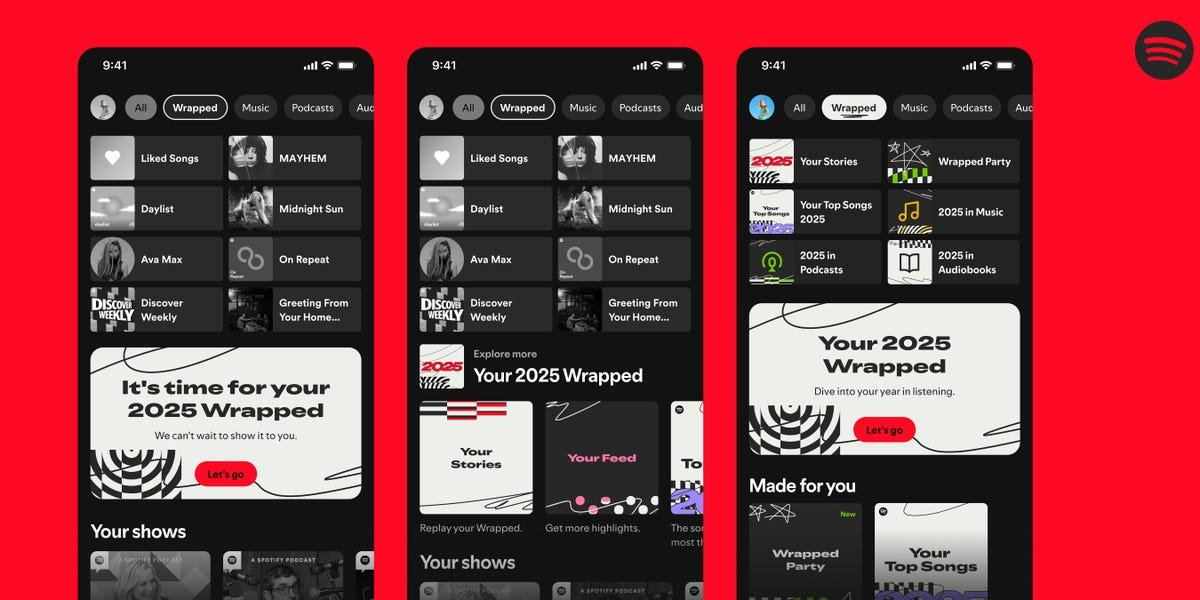
Spotify Wrapped is one of the best marketing strategies going. Good luck trying to replicate it.

“What’s your age?” isn’t typically a fair question, but Spotify’s making it OK.

Spotify Wrapped is back, and the big, new feature for the streamer’s year-end recap for users is the “listening age.” While some weren’t too exciting — my listening age (34) wasn’t far off from my real one (36) — others had a different experience, like newsletter editor Grace Lett, 28, whose listening age was 51.

Grace took the news in stride, but others weren’t so happy, writes BI’s Katie Notopoulos.

The whole thing might seem like a silly gimmick (it is), but it’s also the perfect representation of Spotify Wrapped: a smart marketing tool to get people talking about their Spotify use with each other.

There’s also a method to the madness. Wrapped isn’t just about doing a quick search of users’ top artists and songs. (Justice and “Hate” by ThxSoMch for me, since I know you were dying to know.)

Wrapped takes the entire year, with work for next year’s edition beginning as soon as the current year’s drops. Executives analyze reactions on social media and figure out how to adjust going forward. Three Spotify executives walked BI’s Henry Chandonnet through the whole process.

Spotify Wrapped isn’t easily replicable.

Like most popular things, plenty of companies have tried recreating Spotify’s success. That includes rival YouTube, which launched YouTube Recap this year.

But few, if any, have penetrated the zeitgeist quite like Spotify.

Some platforms don’t deserve a recap. I’d be depressed if I saw how much I spent on takeout this year or the number of hours I logged playing video games.

Others come off as too braggadocious. I would rather gouge out my eyes than see a recap of your Strava or Peloton history.

Music is a sweet spot, though. It’s fun to look back at what you listened to throughout the year, kind of like catching up with an old friend. And there’s a genuine interest in how others’ lists stack up. (It’s always fun finding an undercover Swiftie or a lowkey Deadhead.)

One group still seemed unimpressed on Spotify’s big day: investors. Spotify’s stock finished down almost 3.5%.

And isn’t it ironic? Don’t you think?


Source link