
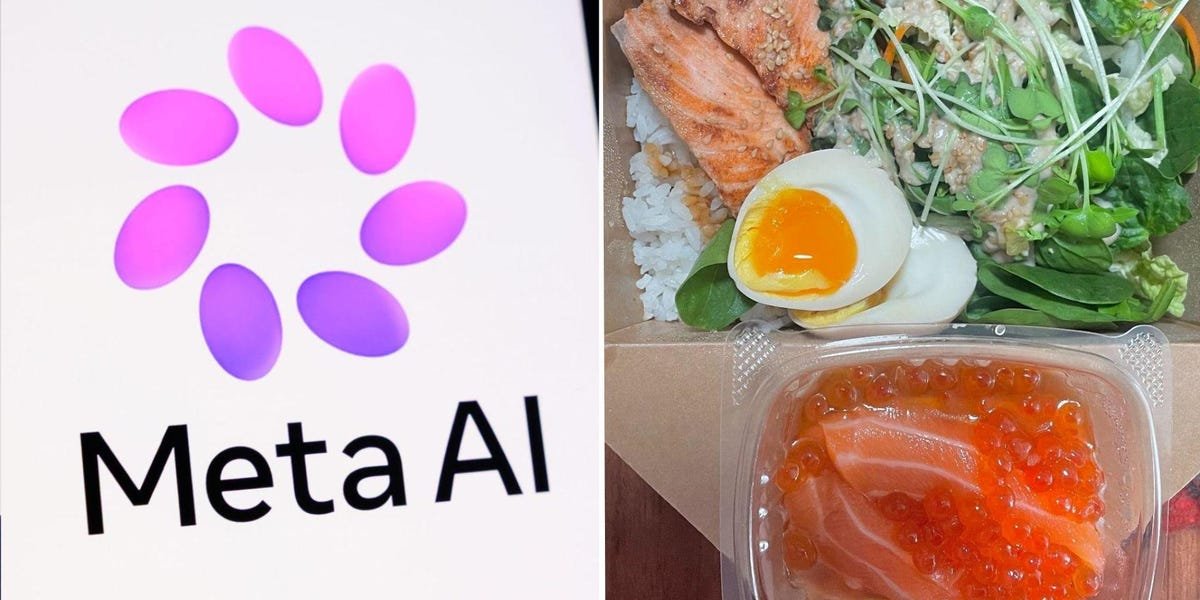
I-asked-Metas-new-Muse-Spark-AI-to-judge-my.jpeg

I asked Meta’s new Muse Spark AI to judge my lunch and give me recipes for dinner, and it mostly delivered

For some of us, cooking is hard, and coming up with nutritious meals with what’s already in the fridge is harder.

I have always struggled with meal prep, often forgoing a meal altogether when I just don’t have the mental energy to decide what to make. So, despite having a healthy dose of skepticism toward AI, I decided to let Meta’s new Muse Spark AI judge the nutritional value of my lunch and help me decide what to make for dinner based on the few items I have in my fridge.

Muse Spark was freshly launched on April 8 after Meta waged a talent war to fuel its AI ambitions. In Meta’s press release, Muse Spark was partly promoted as a personal AI tool that could help you track your health or plan a trip.

“Health is one of the top reasons people turn to AI, so we worked with a team of physicians to develop the model’s ability to provide helpful information on common health questions and concerns,” according to the press release.

With those marketed functions in mind, instead of asking the AI tool to write me a paragraph, I skipped straight to lunch.

Rating my salmon lunch


Bento box with salmon

The author’s bento box lunch with salmon. 

Katherine Li/Business Insider


I got my go-to take-out from my favorite Japanese bento place for lunch near my home. It consists of seared salmon on rice, with an egg, mixed greens, and a side of raw salmon and fish roe.

I uploaded a photo of the meal to Muse Spark and tasked it with creating a detailed breakdown of every type of food and sauce, along with the number of calories for each item. I also asked it to make a labeled image of my meal, give it a score out of 10, and explain how it factors into my nutritional needs of the day based on my biometrics.


Chart

Muse Spark made a clear chart that gave a detailed caloric breakdown of the author’s meal. 

Screenshot/Business Insider


Muse Spark was mostly accurate about what ingredients were in my meal.

It made it clear it didn’t know the weight of the ingredients or the exact type of oil it was cooked in, but it estimated that my salmon bento was around a total of 760 calories. Muse Spark also estimated, based on the photo, that the dressing and sauce I love are extremely high in calories and sodium, leaving me little room for additional sodium intake in my day.

Muse Spark also said that the meal appeared dense in micronutrients like Omega-3, based on the photo. However, the AI thought it was lacking in fiber, vitamin C, and calcium. Overall, it rated my meal a 7.5 out of 10 and reminded me that it is not a licensed nutritionist.

Where Muse Spark struggled was generating a labeled image.


Muse Spark

Muse Spark failed to clearly label the author’s meal. 

Screenshot/Business Insider


The labeled words made no sense. After one more failed attempt to ask it for a labeled image with readable text, I gave up and moved on to the next task.

The dinner challenge


Food in fridge

The author collected leftover and eclectic ingredients in my fridge for a visible photo and asked Muse Spark to suggest some dinner recipes. 

Katherine Li/Business Insider


Now that Muse Spark knew what I had for lunch, I collected leftover and eclectic ingredients in my fridge for a visible photo and asked it if it could suggest some dinner recipes for me.

I explained that I have a wide array of condiments available that aren’t shown in the photo, and I would prefer recipes that are easy to cook and clean. Here are Muse Spark’s suggestions that came with a brief step-by-step recipe:

  • Tomato-braised chicken + roasted potatoes + papaya side
  • Light spaghetti alle vongole + blueberry-oat smoothie
  • Japanese-style oyakodon + papaya-blueberry salad

According to Muse Spark, the meals are designed to make up for its analysis of my lunch, which it said lacked fiber and vitamin C, with the option to moderately increase carb intake. It also suggested that I rinse my canned tomatoes to lower their sodium level and skip any salt and soy sauce.

“Sodium is the main thing to watch — if the rest of your day is also soy-sauce heavy, you’ll likely overshoot 2300mg,” said Muse Spark.

Muse Spark was not able to tell that the package that says freeze-dried strawberries is actually covered in sweet yogurt and far too sugary for a smoothie, but its options gave me sufficient inspiration to cook and taught me clever ways to finish my leftover items, such as the papaya half.

At the end of the day, I decided on the Japanese-style oyakodon meal, and saved the other two recipes for another day.

Will I stop putting soy sauce in everything and skip my favorite condiment options in my bento? Probably not, even if I can hear Muse Spark telling me to stop in my head.


Source link

Chong Ming Lee, Junior News Reporter at Business Insider's Singapore bureau.

I work at Meta’s Superintelligence Labs and used to be at OpenAI. Here’s what the job is like — and what I’ve learned.

This as-told-to essay is based on a conversation with Prakhar Agarwal, an applied researcher at Meta Superintelligence Labs who previously worked at OpenAI. The following has been edited for length and clarity. Business Insider has verified his employment and academic history.

My day-to-day varies a lot depending on what stage of the project we are in versus what the immediate deliverables are.

At OpenAI and Meta, you have these milestones — say, a big training or reinforcement-learning run — in 10 months. It gets intense when we’re approaching the deadline.

Whatever work I identify is always based on the current iteration of the model. If I say the model isn’t good at X and my solution helps fix X, it is based on that version of the model. If I miss the deadline, I don’t know whether the next version will have the same issues or not.

If we are further away from that deadline, then we’re mostly working on evaluations and trying to find failure cases and issues with the existing model.

The work is super dynamic. Sometimes you think something is super easy and you’ll get it done in a day. Other times, it’s the opposite — because there are so many unknowns, it might take a week.

Working at frontier labs feels very different from Big Tech

What we’re limited by in these foundational labs is compute. It’s not like Big Tech or other places where you can keep hiring a bunch of people and give them small pieces of a task to do.

Everyone needs compute to actually do something, and as soon as you have a lot of people, the compute gets divided, so no one will be able to do anything.

You also want high-bandwidth communication between stakeholders — you don’t want 10 different layers of communication. The speed of iteration is much faster. These core groups tend to be much smaller and tighter.

The idea of a “team” is also very fluid. Each person has their own projects, but they collaborate with others to work on joint projects. At Meta and OpenAI, there are a lot of senior people and not a lot of junior people, so everyone has a decent scope of projects.

Sometimes I collaborate more with people outside my immediate team than within it. Your scope isn’t restricted to four or five people. Your scope is the problem you’re trying to solve.

Communication and going deep with coding are key

Communication is the most important aspect in these labs. Because a lot of things aren’t documented, you need to be able to articulate what you’re doing, why you’re doing it, what the next steps are, convey your results, and get feedback on your work.

Becoming comfortable going through the code and identifying the specifics is one of the most important skills I’ve seen. The speed at which the code evolves is much faster than the documentation. If you’re stuck on something, read the code and try to understand it yourself.

Having some understanding of what’s happening across different verticals also gives you a good overview of the ideas and approaches people are trying. Because everything is super related, you might learn something from there or find ways to contribute.

The biggest advantage these labs have is knowing what doesn’t work

A research paper tells you, “I did X, Y, and Z in this specific order, and it works.” But what you don’t see is that before doing X, Y, and Z, I tried 50 different things that didn’t work — and people don’t talk about that.

That, to me, is the real strength of these foundation labs. Because of all the experimentation and all the work that has already been done, the teams have built really strong intuitions. They know which things won’t work or won’t scale, and which are going to work well.

People outside often look for the gains, but they miss the point that even the misses are very valuable.

Advice for those who want to work in top labs

I don’t have a good answer for managing burnout. You’re pretty much just going with the flow. You’re working at the cutting edge, and to put it simply, if you want to be here, you can’t think about it on a strict day-to-day basis.

What I would tell my younger self is to be comfortable exploring new avenues and new ideas. What I’ve seen is that we try to play to our strengths or stay in a deterministic setting where we know we’ll do fine. But in these domains, the speed at which things are moving is so fast that you need to be able to switch to a new topic.

Build the muscle to handle being thrown into something completely new. Sometimes, it’s more psychological than a skill issue.

Do you have a story to share about working at a top AI lab? Contact this reporter at cmlee@businessinsider.com.


Source link

Pranav Dixit

Meta’s metaverse is going mobile — and leaving VR behind

Meta is dialing back the metaverse to mean something far less futuristic: an app on your phone.

The company, which spent billions of dollars to build Horizon Worlds — an immersive, virtual hangout zone on its Quest virtual reality headsets — is “shifting focus” for Horizon Worlds “to be almost exclusively mobile,” according to a blog post published on Thursday.

Horizon Worlds is part of Meta’s Reality Labs division for VR products and smart glasses, a unit that has burned nearly $80 billion since 2020.

“Last year, we began to experiment with Worlds as a mobile platform, and we saw positive momentum,” wrote Samantha Ryan, Meta’s vice president of content at Reality Labs. “Now, to truly change the game and tap into a much larger market, we’re going all-in on mobile.”

The move signals how dramatically Meta has redrawn its VR ambitions.

Last month, Meta laid off roughly 10% of Reality Labs employees, closed three VR gaming studios it owned, and stopped releasing new content for Supernatural, a popular VR fitness app it acquired in 2023.

Meta said it is still committed to virtual reality hardware and supporting third-party developers who create games for it.

“We’re in it for the long haul,” Ryan wrote, and pointed to the company’s “robust roadmap of future VR headsets tailored to different audience segments.”

Meta invested nearly $150 million in VR developer platforms in 2025, Ryan wrote, and she said that popular games like “The Thrill of the Fight 2,” “Hard Bullet,” and “UG” had earned “millions” in revenue.

Still, she wrote that 86% of the time people spend in Meta’s headsets is in third-party apps, not its own. The pivot to mobile effectively pits Horizon Worlds against entrenched competitors like Roblox and Fortnite that cater to casual mobile gamers rather than VR enthusiasts with headsets.

On Meta’s latest earnings call, CEO Mark Zuckerberg pitched Horizon as the natural home for “immersive 3D” content: AI-generated scenes, objects, and mini experiences. Now, rather than putting on a headset, people could just spin up that content with a prompt and then share it straight into Instagram, Facebook, or Threads, he said.

Have a tip? Contact Pranav Dixit via email at pranavdixit@protonmail.com or Signal at 1-408-905-9124. Use a personal email address and a nonwork device; here’s our guide to sharing information securely.


Source link

Metas-new-president-is-a-former-Trump-advisor-—-3-things.jpeg

Meta’s new president is a former Trump advisor — 3 things to know about Dina Powell McCormick

Meta has a new president — and she’s a former advisor to President Donald Trump.

The tech giant named Dina Powell McCormick as its president and vice chairman on Monday. Powell McCormick joined Meta’s board in April before resigning in December.

Before joining Meta, Powell McCormick served as a deputy national security advisor to Trump. The president applauded her appointment on Truth Social: “A great choice by Mark Z!!”

Powell McCormick is the second former Trump official appointed to a Meta leadership position in 2026. Last week, the company hired C.J. Mahoney, a deputy US trade representative during Trump’s first term, as its chief legal officer.

Here are three things to know about Dina Powell McCormick:

She’s served under two Republican presidents

Powell McCormick worked as a Trump advisor during his first term, with a focus on the Middle East.

She had a personal tie to the region. Powell McCormick was born in Cairo, where her father was a captain in the Egyptian army. In 1977, her family moved to Dallas.

During her stint with the Trump administration, Powell McCormick oversaw a $200 billion US-Saudi arms deal, spearheaded Trump’s Middle East tour, and was considered to take over as Trump’s chief of staff or representative to the United Nations.

She left the Trump administration in 2018.


Donald Trump, Elon Musk, and Dina Powell McCormick are pictured at an NCAA wrestling match.

Dina Powell McCormick reunited with Trump — and his friend Elon Musk — at a 2025 NCAA wrestling match.

Mitchell Leff/Getty Images


Powell McCormick also served under President George W. Bush. She started in a personnel role, before rising to senior White House assistant and assistant secretary of state under Condoleezza Rice.

At the time of her resignation in 2007, Powell McCormick was the highest-ranking Arab American in the Bush administration.

She spent 16 years at Goldman Sachs

After leaving the Bush administration, Powell McCormick went to Goldman Sachs, where she was hired as a managing director.

Powell McCormick shot up in stature, making partner in three years. Her rapid rise sparked some bitterness among Goldman’s underclass, according to The New York Times and Vanity Fair.

Under her leadership, Goldman launched its 10,000 Women program. She also oversaw the 10,000 Small Businesses program and served as the president of the Goldman Sachs Foundation.


Dina Powell McCormick is pictured at an event for Goldman Sachs' 10,000 Small Businesses program.

Dina Powell McCormick led Goldman Sachs’ 10,000 Small Businesses program.

Dimitrios Kambouris/WireImage


Powell McCormick was popular among some of Goldman’s biggest names, including Anne Black, the former president of Goldman Sachs Gives and current managing partner at JP Morgan.

“She was really a steadfast champion for me and others of us on the team, who were all promoted thanks to her,” Black told Vanity Fair. “She elevated my game, inspired me to be creative and bold, and expected us to show results.”

Powell McCormick left Goldman Sachs in 2023.

She’s married to Sen. Dave McCormick

While Powell McCormick no longer works in politics, she’s still involved through her husband: Pennsylvania senator Dave McCormick.

The couple wed in 2019. Soon after, Dave began eyeing a Senate run, and Dina became involved in the campaign. She made trips to Mar-a-Lago with her husband and appeared in several ads.

Dave ended up conceding the Republican nomination to Mehmet Oz — also known as television’s Dr. Oz — in the 2022 race. Oz lost the general election to John Fetterman and was later appointed by Trump to lead the Centers for Medicare & Medicaid Services.


Dave McCormick, Dina Powell McCormick, and Kamala Harris are pictured.

Dina Powell McCormick accompanied her husband to his 2024 swearing-in, which was overseen by then-Vice President Kamala Harris.

Alex Wong/Getty Images


In 2024, Dave ran again, narrowly winning a Senate seat and beating incumbent Bob Casey. Dina accompanied him to his swearing-in.


Source link

Metas-Reality-Labs-chief-is-calling-the-most-important-meeting.jpeg

Meta’s Reality Labs chief is calling the ‘most important’ meeting of the year and says employees should show up in person

Meta’s Chief Technology Officer and head of Reality Labs, Andrew Bosworth, has called an all-hands meeting for January 14, describing it as the “most important” of the year.

Bosworth is also strongly recommending that Reality Labs employees attend the division’s meeting in person, two Meta employees told Business Insider.

The emphasis on in-person attendance is unusual for the division, which oversees the company’s wearables, virtual and augmented reality initiatives, and a nascent robotics unit, these employees said. Some managers have told employees to “drop what they’re doing” to attend the all-hands in person, one employee told Business Insider.

Meta did not immediately respond to a request for comment about the meeting.

While the division has seen some success, such as its Ray-Ban smart glasses, Reality Labs has been a costly venture for Meta, incurring losses of more than $70 billion since 2020.

Last year, Meta CEO Mark Zuckerberg shifted the company’s strategic focus toward AI and away from the metaverse. In 2025, Meta invested $14.3 billion in Scale AI and hired its CEO, Alexandr Wang, as part of the major reset of the company’s AI efforts. Meta then embarked on a multibillion-dollar hiring spree, poaching top-tier AI researchers and engineers from rivals such as OpenAI and Google DeepMind.

Reality Labs has faced repeated rounds of cuts over the past year. In December, Business Insider reported that Meta was planning budget cuts up to 30% and considering job cuts in Reality Labs.

Last April, Meta laid off employees in Oculus Studios, its in-house gaming division, and the team behind Supernatural, the VR fitness app Meta acquired for over $400 million. Those cuts followed Meta’s broader January 2025 layoffs that eliminated nearly 4,000 roles companywide, with at least 560 affecting Reality Labs employees.

In a memo obtained by Business Insider earlier last year, Bosworth referred to 2025 as “the most critical” year in his eight-year tenure at Reality Labs.

“This year likely determines whether this entire effort will go down as the work of visionaries or a legendary misadventure,” he wrote.

Have a tip? Contact Pranav Dixit via email at pranavdixit@protonmail.com or Signal at 1-408-905-9124. Use a personal email address, a nonwork WiFi network, and a nonwork device; here’s our guide to sharing information securely.


Source link