I-tested-3-popular-ways-to-batch-cook-eggs-—.jpeg

I tested 3 popular ways to batch cook eggs — there’s just one method I’ll use for all of my future meal prepping

  • I used the same few ingredients to batch prepare eggs three ways, testing each method’s results.
  • During the experiment, I baked egg muffins, cooked a large omelette, and made a sheet pan of eggs.
  • I’d skip the egg muffins and omelette next time but gladly repeat the sheet-pan method.

Every morning, at least one person in my family cooks eggs.

Whether they make them scrambled or sunny-side-up, the results tend to be inconsistent. One day, the eggs are runny; the next, they’re sticky. It’s a complete gamble.

In search of a fail-proof method for making eggs that allows me to avoid chaotic, messy morning breakfasts, I attempted to meal-prep them three different ways: baking them as muffins, frying them into an omelette, and cooking them in the oven on a sheet pan.

For each method, I used the same ingredients — six eggs, ¾ cup egg whites, 1 cup of chopped red bell peppers, a small onion, and 2 ounces of crumbled feta cheese. Each batch yielded between eight and 12 servings.

Here’s how the eggs stacked up in terms of flavor, texture, and cook time.

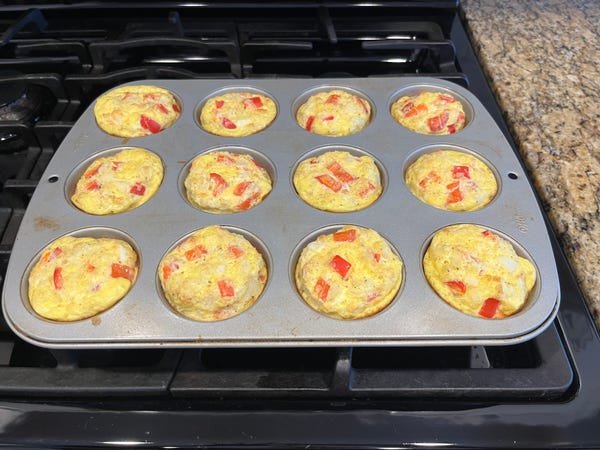
Oven-baked egg muffins seemed like an easy-to-prep meal.

I divided the ingredients into 12 sections using the muffin pan.

Jennifer Messineo

I combined all the ingredients in a bowl, then used a ladle to distribute them evenly into a 12-cup muffin pan.

It proved difficult to distribute the ingredients evenly between the cups without making a mess. Some ended up with extra feta, and others got more peppers.

I planned to cook the muffins for 20 minutes at 350 degrees Fahrenheit, but they were done after 15.

After this test, I’ll never make these egg muffins again.


egg muffin plated

My muffins were too puffy and had too many air pockets.

Jennifer Messineo

I used to make eggs in a muffin tin sometimes, and the results from this test reminded me why I stopped.

Although I liked that they cooked quickly and were easy to portion, the muffins puffed up more than I expected, creating a fluffy egg with a few too many air pockets.

Also, the ingredients didn’t distribute evenly (disappointingly, I had a bite with no cheese!).

The cleanup wasn’t ideal either, as most of the egg stuck to the pan. After soaking it for days, I considered throwing it out.

By the time I finally got it clean, I’d lost the time I saved cooking eggs to scrubbing the muffin pan.

Cooking the eggs into one big omelette should’ve been straightforward.


eggs from meal prep raw but cooking in pan

I kept the eggs cooking over very low heat.

Jennifer Messineo

When it came time to use the stovetop, I decided to make a large omelette in a 12-inch pan using the same five ingredients.

I poured the mixture into the hot, buttered pan and realized how tricky it would be to manage. To accelerate the cooking process and create a fluffy, layered dish, I tilted the pan to lift the edge of the omelette, letting the uncooked egg flow underneath.

I kept the heat low so the bottom wouldn’t overcook. After 10 to 15 minutes, I covered the pan so the center would cook through. Then, I cooked it for about 10 more minutes until the center looked firm.

I ended up having a hard time handling so many eggs in one pan.


eggs from meal prep test in pan

The omelette’s consistency and flavor left much to be desired.

Jennifer Messineo

Lesson learned: Omelettes aren’t meant to be batch-cooked.

I knew cooking a large volume of eggs might be an issue on the stovetop, but I was still surprised that this method took the longest, clocking in at almost 25 minutes from start to finish.

It had an overcooked, eggy smell and taste, and the texture was inconsistent, with a crispy bottom layer and soft center.

Even though I usually fry my eggs on the stovetop, this test made me reevaluate my ways. I also found it difficult to portion the omelette into equal pieces for storage.

I didn’t know what to expect when I pulled out the sheet pan.


sheetpan eggs  in oven

The ingredients spread out evenly in the pan.

Jennifer Messineo

Before this test, I’d never made eggs in a sheet pan. I poured the combined ingredients into the greased, stainless-steel pan and was pleased to see the vegetables and cheese spread evenly.

After baking it for 18 minutes at 350 degrees Fahrenheit, the mixture was cooked through.

It was by far my favorite way to meal-prep eggs.


sheetpan eggs cut into squares

I found it easy to portion and store the sheet-pan eggs.

Jennifer Messineo

The eggs cooked evenly in the sheet pan, and the results had a perfect consistency.

I liked their texture, as they were fluffy but still denser than the airy muffins and omelette. The vegetables weren’t quite as soft as they were in the other methods, but they tasted fine.

I also found it so easy to remove the egg from the pan. The stainless-steel sheet’s surface distributed heat evenly and prevented any crusty edges from sticking to the pan, so cleanup was very easy.

Moving forward, I’ll skip the muffins and omelette and stick with the sheet-pan eggs.


comparison of meal-prepped eggs

I didn’t have to clean very much after making sheet-pan eggs, which I consider a huge bonus.

Jennifer Messineo

As I expected, this test reinforced my belief that eggs are tricky to prepare.

The large omelette I made on the stovetop tasted overcooked and lacked the height I got from the oven. All factors considered, it was my least favorite (although I was nearly as disappointed by the airy, messy egg muffins).

After extensive testing, I can confidently say the sheet-pan eggs were the meal-prep winner. They stayed firm, were easy to divide into 12 even squares, and stayed in one piece when I transferred them to the freezer.


Source link

Matthew Loh Headshot

New Ukrainian method of catching enemy drones looks like a fishing rod in the sky

Ukrainian troops appear to be testing a new drone attachment that uses a cord or line to disable enemy propeller drones in the sky.

The tactic can be seen in a video posted on Monday by the 46th Separate Air Mobile Brigade, which published a video montage of its recent attacks against Russian infantry, vehicles, and drones.

In a caption, the brigade highlighted a “new way of capture of enemy drones in the air.”

As seen from the first-person-view camera of the Ukrainian drone, the new contraption features a rod protruding from the interceptor’s chassis.

Thin rope or cord dangles from the rod, pulled taut by a small weight that sways into view as the Ukrainian drone flies high above the battlefield.

The brigade’s drone then appears to fly over its target — a small quadcopter — entangling the opposing device’s propellers with the attached line.

The brigade published footage of two such interceptions, as well as a third clip of a drone with the rod-like attachment attempting to crash into a fixed-wing drone.

The third target was likely a Russian Molniya one-way attack loitering munition. It’s unclear if the interception in the third clip was successful.

The novel, fishing rod-style device is another example of how the war is pushing militaries to develop new methods of physically disrupting drones as electronic warfare technology adapts.

Ukrainians and Russians have been experimenting with similar counterdrone tactics as a response to anti-jamming features on small attack drones, deploying fishing nets both on the ground and testing them on interceptors.

Some Western companies have also begun trialing drone-mounted and handheld net launchers as a defense against small quadcopters.

As Russia increasingly relies on large-scale attacks with fixed-wing Geran drones that typically fly at speeds of up to 115 mph, and in some cases even 230 mph, the war has led to the growing popularity of small, fast, and inexpensive drones acting as interceptors.

The 46th Separate Air Mobile Brigade’s fishing line apparatus, however, appears to be more suited to disabling quadcopters.


Source link