Microsoft-hires-former-Allen-Institute-for-AI-CEO-under-Mustafa.jpeg

Microsoft hires former Allen Institute for AI CEO under Mustafa Suleyman

Microsoft has hired recent former Allen Institute for Artificial Intelligence CEO Ali Farhadi.

Farhadi will work under Mustafa Suleyman, who recently started an in-house AI team at the company, according to two people familiar with the hiring. Farhadi is listed in Microsoft’s internal system with the title corporate vice president, one of the people said.

After Business Insider requested a comment from Microsoft, Suleyman posted about Farhadi’s hiring on LinkedIn.

Farhadi stepped down earlier this month as Ai2 CEO, where he worked to make AI research open and accessible to the public. He’s was a cofounder of Xnor.ai, an on-device AI model startup that Apple acquired for $200 million.

Suleyman formed the team at Microsoft in November focused on training “frontier models of all scales with our own data and compute at the state-of-the-art level” to make the company “self-sufficient in AI,” he told Business Insider at the time.’

Microsoft recently moved Suleyman to focus all of his “energy on our Superintelligence efforts and be able to deliver world class models for Microsoft over the next five years,” according to an email to employees announcing the changes.

Have a tip? Contact this reporter via email at astewart@businessinsider.com or Signal at +1-425-344-8242. Use a personal email address and a nonwork device; here’s our guide to sharing information securely.




Source link

Microsoft-says-Anthropics-products-can-stay-on-its-platforms-after.jpeg

Microsoft says Anthropic’s products can stay on its platforms after lawyers ‘studied’ the Pentagon supply chain risk designation

Microsoft said Anthropic’s AI tools aren’t going anywhere on its platforms despite the Pentagon blacklisting the startup.

The Pentagon on Thursday formally told Anthropic that “the company and its products are deemed a supply chain risk, effective immediately.” Defense Secretary Pete Hegseth has said the designation effectively bars companies with defense contracts from doing business with Anthropic.

Anthropic has said it plans to challenge the decision in court.

The designation follows a dispute between the AI startup and the Pentagon over how its Claude models could be used. Anthropic has said it will not allow its technology to be deployed for mass domestic surveillance or fully autonomous weapons.

A Microsoft spokesperson told Business Insider on Thursday that the company’s “lawyers have studied the designation and have concluded that Anthropic products, including Claude, can remain available to our customers.”

Claude will still be available to customers through platforms such as M365, GitHub, and Microsoft’s AI Foundry, except for the Department of War, the spokesperson said in a statement.

“We can continue to work with Anthropic on non-defense related projects,” it added.

Microsoft has deepened its ties with Anthropic in recent months. In November, the companies said that Anthropic would spend $30 billion on Microsoft’s Azure cloud services, while Microsoft agreed to invest up to $5 billion in the startup.

Microsoft also said in September that it was integrating Anthropic’s models into Microsoft 365 Copilot alongside systems from OpenAI.

The Anthropic-Pentagon saga

In a statement published on Thursday evening, Anthropic CEO Dario Amodei said the company is in talks with the Defense Department even as it is preparing for court.

“I would like to reiterate that we had been having productive conversations with the Department of War over the last several days, both about ways we could serve the Department that adhere to our two narrow exceptions, and ways for us to ensure a smooth transition if that is not possible,” Amodei wrote.

However, Emil Michael, a Department of War official, said in a post on X following Amodei’s statement that negotiations are off the table.

“I want to end all speculation: there is no active @DeptofWar negotiation with @AnthropicAI,” Michael wrote.

Amodei also offered an apology in his statement after The Information reported that he had privately blasted the White House in a memo to staff after talks with the Pentagon fell apart.

In the memo, Amodei wrote that the administration disliked his company because he had not offered “dictator-style praise to Trump.”

“Anthropic has much more in common with the Department of War than we have differences,” Amodei said on Thursday.


Source link

Microsoft-is-considering-a-new-AI-loaded-software-bundle-for-Microsoft.jpeg

Microsoft is considering a new AI-loaded software bundle for Microsoft 365, sources say

  • Microsoft is considering releasing a new AI revamp of its software bundle, sources say.
  • The bundle could include Microsoft Copilot and its new AI agent hub, Agent 365.
  • The company could charge up to $99 per user.

After years of internal buzz and false starts, Microsoft is considering rolling out its long-rumored E7 enterprise productivity software bundle, a pricier, AI-loaded version of Microsoft 365, according to two people familiar with the plans.

Microsoft 365 is a popular suite of productivity software that includes widely used tools such as Microsoft Word, Excel, and PowerPoint. Microsoft sells this software primarily in bundles called E3 and E5, where the E stands for “enterprise.” E3 is a more basic offering, while E5 has more bells and whistles.

A larger, more expensive “E7” software bundle has long been rumored and has earned a kind of mythical status inside Microsoft, with employees and salespeople debating and guessing whether it will ever appear.

Microsoft’s AI-packed E7 bundle comes as competitors like Google, Salesforce, and nearly every major software-as-a-service company rush to embed AI tools and autonomous agents into their products. Software stocks have taken a significant hit this year as investors worry that generative AI tools will upend traditional software products.

Microsoft declined to comment.

The new E7 bundle under consideration includes everything in the E5 bundle, plus AI features such as Microsoft Copilot and the company’s new AI agent hub, Agent 365, the people said.

Microsoft is looking into per-seat and consumption-based pricing for E7, but could charge up to $99 per user per month, the people said. E5’s current advertised price is $57 per user per month while Copilot is advertised as an add-on for $21 per user per month.

The company previously floated a new AI software bundle in 2024, but paused the plan.

Have a tip? Contact this reporter via email at astewart@businessinsider.com or Signal at +1-425-344-8242. Use a personal email address and a nonwork device; here’s our guide to sharing information securely.


Source link

Ashley Stewart Business Insider

Microsoft just named Asha Sharma as its new Xbox CEO. Read the memos.

Microsoft Gaming CEO Phil Spencer is retiring, according to an email to employees. Microsoft executive Asha Sharma will become the new executive vice president and CEO of Microsoft Gaming, reporting directly to Nadella.

“Over 38 years at Microsoft, including 12 years leading Gaming, Phil helped transform what we do and how we do it,” Microsoft CEO Satya Nadella wrote in the email.

“He expanded our reach across PC, mobile, and cloud; nearly tripled the size of the business; helped shape our strategy through the acquisitions of Activision Blizzard, ZeniMax, and Minecraft; and strengthened our culture across our studios and platforms,” Nadella wrote.

Spencer’s departure marks the end of an era for Xbox. Under Spencer, Microsoft transformed gaming into a subscription- and services-driven business and completed the largest acquisition in its history, paying $69 billion for Activision Blizzard.

Sharma joined Microsoft in 2024 and has worked in the CoreAI group under Jay Parikh. She was previously a chief operating Officer at Instacart and a vice president of product and engineering at Meta before that.

Xbox’s president and chief operations officer, Sarah Bond, is leaving the company, while longtime Microsoft gaming executive Matt Booty will become executive vice president and chief content officer, reporting to Sharma.

Read Nadella’s memo

Gaming has been part of Microsoft from the start. Flight Simulator shipped before Windows, and you can practically ray‑trace a line from DirectX in the ’90s to the accelerated‑compute era we’re in today.

As we celebrate Xbox’s 25th year, the opportunity and innovation agenda in front of us is expansive. Today we reach over 500 million monthly active users, are a top publisher across all platforms, and continue to innovate across gaming hardware, content and community, in service of creators and players everywhere.

I am long on gaming and its role at the center of our consumer ambition, and as we look ahead, I’m excited to share that Asha Sharma will become Executive Vice President and CEO, Microsoft Gaming, reporting to me. Over the last two years at Microsoft, and previously as Chief Operating Officer at Instacart and a Vice President at Meta, Asha has helped build and scale services that reach billions of people and support thriving consumer and developer ecosystems. She brings deep experience building and growing platforms, aligning business models to long-term value, and operating at global scale, which will be critical in leading our gaming business into its next era of growth.

Matt Booty will become Executive Vice President and Chief Content Officer, reporting to Asha. Matt’s career reflects a lifelong commitment to games and to the people who make them. Under his leadership, Microsoft Gaming has grown to span nearly 40 studios across Xbox, Bethesda, Activision Blizzard, and King, which are home to beloved franchises including Halo, The Elder Scrolls, Call of Duty, World of Warcraft, Diablo, Candy Crush, and Fallout.

Together, Asha and Matt have the right combination of consumer product leadership and gaming depth to push our platform innovation and content pipeline forward. Last year, Phil Spencer made the decision to retire from the company, and since then we’ve been talking about succession planning. I want to thank Phil for his extraordinary leadership and partnership. Over 38 years at Microsoft, including 12 years leading Gaming, Phil helped transform what we do and how we do it. He expanded our reach across PC, mobile, and cloud; nearly tripled the size of the business; helped shape our strategy through the acquisitions of Activision Blizzard, ZeniMax, and Minecraft; and strengthened our culture across our studios and platforms. I’ve long admired Phil’s unwavering commitment to players, creators, and his team, and I am personally grateful for his leadership and counsel. He will continue working closely with Asha to ensure a smooth transition.

We have extraordinary creative talent across our studios and a global platform that is second to none. I’m excited for how we will capture the opportunity ahead and define what comes next, while staying grounded in what players and creators value.

Please join me in congratulating Asha and Matt on their new roles, and in thanking Phil for everything he has done for Microsoft and for our industry.

Read Phil Spencer’s memo

When I walked through Microsoft’s doors as an intern in June of 1988, I could never have imagined the products I’d help build, the players and customers we’d serve, or the extraordinary teams I’d be lucky enough to join. It’s been an epic ride and truly the privilege of a lifetime.

Last fall, I shared with Satya that I was thinking about stepping back and starting the next chapter of my life. From that moment, we aligned on approaching this transition with intention, ensuring stability, and strengthening the foundation we’ve built. Xbox has always been more than a business. It’s a vibrant community of players, creators, and teams who care deeply about what we build and how we build it. And it deserves a thoughtful, deliberate plan for the road ahead.

Today marks an exciting new chapter for Microsoft Gaming as Asha Sharma steps into the role of CEO, and I want to be the first to welcome her to this incredible team. Working with her over the past several months has given me tremendous confidence. She brings genuine curiosity, clarity and a deep commitment to understanding players, creators, and the decisions that shape our future. We know this is an important moment for our fans, partners, and team, and we’re committed to getting it right. I’ll remain in an advisory role through the summer to support a smooth handoff.

I’m also grateful for the strength of our studios organization. Matt Booty and our studios teams continue to build an incredible portfolio, and I have full confidence in the leadership and creative momentum across our global studios. I want to congratulate Matt on his promotion to EVP and Chief Content Officer.

As part of this transition, Sarah Bond has decided to leave Microsoft to begin a new chapter. Sarah has been instrumental during a defining period for Xbox, shaping our platform strategy, expanding Game Pass and cloud gaming, supporting new hardware launches, and guiding some of the most significant moments in our history. I’m grateful for her partnership and the impact she’s had, and I wish her the very best in what comes next.

Most of all, to everyone in Microsoft Gaming, I want to say “thank you”. I’ve learned so much from this team and community, grown alongside you, and been continually inspired by the creativity, courage, and care you bring to players, creators, and to one another every day.

I’m incredibly proud of what we’ve built together over the last 25 years, and I have complete confidence in all of you and in the opportunities ahead. I’ll be cheering you on in this next chapter as Xbox’s proudest fan and player.

Phil

XBL: P3

Read Asha Sharma’s memo

Dear team,

Today I begin my role as CEO of Microsoft Gaming.

I feel two things at once: humility and urgency.

Humility because this team has built something extraordinary over decades. Urgency because gaming is in a period of rapid change, and we need to move with clarity and conviction.

I am stepping into work shaped by generations of artists, engineers, designers, writers, musicians, operators and more who create worlds that have brought joy and deep personal meaning to hundreds of millions of players. The level of craft here is exceptional, and it is amplified by Xbox, which was founded in the belief that the power of games connect people and push the industry forward.

Thank you to Phil for his leadership, and to every studio, platform, and operations team that built this foundation. We are stewards of some of the most loved stories and characters in entertainment and bring players and creators together around the fun and community of gaming in entirely new ways.

My first job is simple: understand what makes this work and protect it.

That starts with three commitments.

First, great games.

Everything begins here. We must have great games beloved by players before we do anything. Unforgettable characters, stories that make us feel, innovative game play, and creative excellence. We will empower our studios, invest in iconic franchises, and back bold new ideas. We will take risks. We will enter new categories and markets where we can add real value, grounded in what players care about most.

I promoted Matt Booty in honor of this commitment. He understands the craft and the challenges of building great games, has led teams that deliver award-winning work, and has earned the trust of game developers across the industry.

Second, the return of Xbox.

We will recommit to our core Xbox fans and players, those who have invested with us for the past 25 years, and to the developers who build the expansive universes and experiences that are embraced by players across the world.

We will celebrate our roots with a renewed commitment to Xbox starting with console which has shaped who we are. It connects us to the players and fans who invest in Xbox, and to the developers who build ambitious experiences for it.

Gaming now lives across devices, not within the limits of any single piece of hardware. As we expand across PC, mobile, and cloud, Xbox should feel seamless, instant, and worthy of the communities we serve. We will break down barriers so developers can build once and reach players everywhere without compromise.

Third, future of play.

We are witnessing the reinvention of play.

To meet the moment, we will invent new business models and new ways to play by leaning into what we already have: iconic teams, characters, and worlds that people love. But we will not treat those worlds as static IP to milk and monetize. We will build a shared platform and tools that empower developers and players to create and share their own stories.

As monetization and AI evolve and influence this future, we will not chase short-term efficiency or flood our ecosystem with soulless AI slop. Games are and always will be art, crafted by humans, and created with the most innovative technology provided by us.

The next 25 years belong to the teams who dare to build something surprising, something no one else is willing to try, and have the patience to see it through. We have done this before, and I am here to help us do it again. I want to return to the renegade spirit that built Xbox in the first place. It will require us to relentlessly question everything, revisit processes, protect what works, and be brave enough to change what does not.

Thank you for welcoming me into this journey.

Asha

Read Matt Booty’s memo

I read Phil’s note with much gratitude. He has been a steady champion for game creators and our studio teams, and I’ve learned so much from his leadership over the years. All our games have benefited from his foundational support. I’m also grateful to Satya for his ongoing commitment to gaming and holding a vision of how it can connect back to the larger company.

Looking forward, I’m excited to partner with Asha as our next CEO. Our first conversations centered on her commitment to making great games and the role that plays in our overall success. She asks questions, pushes for clarity, and wants our choices grounded in player and developer needs. That mindset matters as the industry around us is changing quickly: how players engage, how games are made, and how business models and platforms evolve.

We have good reasons to believe in what’s ahead. This organization and its franchises have navigated change for decades, and our strength comes from teams who know how to adapt and keep delivering. That confidence is grounded in a strong pipeline of established franchises, new bets we believe in, and clear player demand for what we are building.

My focus is on supporting the teams and leaders we have in place and creating the conditions for them to do their best work. To be clear, there are no organizational changes underway for our studios.

Thanks for everything you do for players and for each other.

-Matt

Have a tip? Contact this reporter via email at astewart@businessinsider.com or Signal at +1-425-344-8242. Use a personal email address and a nonwork device; here’s our guide to sharing information securely.



Source link

photo-of-Ana-Altchek

Microsoft manager explains how she pivoted from admin to AI — and doesn’t regret her English degree

This as-told-to essay is based on a conversation with Brit Morenus, a 37-year-old senior AI gamification program manager, based in Charlotte, North Carolina. Her identity and employment have been verified by Business Insider. The following has been edited for length and clarity.

I’ve been at Microsoft for a total of 13 years, but for five and a half, I was a contract worker.

I graduated from college with a degree focused on English, communications, and marketing. I first landed a job at Microsoft as a contract executive assistant. I stayed in that role for about eight months, then joined the marketing team.

Eventually, I had the opportunity to take a really special position, but it required knowing gamification. Gamification is about integrating game mechanics and motivators, such as storytelling and reward systems, into learning. So I was going to teach people about our products and sell them in a gamified way.

I spent about a year getting certifications that taught me about gamification. I upskilled and learned how to create games, what game mechanics are, and what motivates someone when they’re learning.

That was the position where I was able to prove my impact, and they decided to bring me on full-time. I stayed in that role for another six years, training the frontline and customer service support to develop the right sales skills.

Eventually, I had the opportunity to start gamifying learning about AI. They wanted someone with gamification skills, and my certifications and experience made me the ideal candidate.

I didn’t know much about AI yet, aside from using it for personal reasons, but transitioning to an AI role was actually faster than pivoting to gamification. Since I held the gamification role for about six years, I became really good at it. It only took about three months for me to upskill in AI.

In my first three months on the team, I made myself knowledgeable about AI to the point where I could teach others about it. That’s when I got a certification in Azure AI Fundamentals. It was a certification specific to how Microsoft’s AI works.

I helped my entire team get it, and then I helped my entire organization start working on it. Then I helped the greater customer service support organization work toward getting it as well.

Get outside your comfort zone

My advice to those who want to transition would be: Don’t let fear keep you from stepping outside your comfort zone. There’s so much ambiguity about changing roles or companies, but there’s no time like the present.

With AI specifically, you just need to learn. Everyone already uses it, but you need to understand how it works, because that’s how you can understand what to do with it.

It’s also important to upskill yourself. You have to be willing to constantly move and learn more, because it’s going to keep changing — and faster than you can grasp it. Sometimes AI makes wrong predictions, but it is using words to make that prediction. So I absolutely need to use my English degree in order to figure out keywords and how to prompt it to do the right thing.

I don’t regret my English degree

Up until this Al role, I always joked that I wasn’t using my English degree. But now I use it everywhere, and it truly does help. It helps with things like talking to executives and also with the role itself.

It’s important to know the language of AI and how it operates. So now, more than ever, I am using every bit of my English degree and understanding English, grammar, and how it all functions.

For example, there’s a tagging process that happens behind the scenes with AI, just like on social media. Looking at an image, it might tag it as a woman, or a supermarket, and that gives it a confidence score and tells you if it’s relevant or not, and if it’s what we’re looking for.

A lot of it is more about understanding how to apply the English language than about AI — so, thanks, Mom and Dad, I am using the degree you paid for.

This is part of an ongoing series about workers who transitioned into AI roles. Did you pivot to AI? We want to hear from you. Reach out to the reporter via email at aaltchek@insider.com or secure-messaging platform Signal at aalt.19.


Source link

Lloyd Lee

Microsoft AI CEO: ‘Most, if not all’ white-collar tasks can be replaced by AI within 12-18 months

Microsoft’s AI CEO is joining a chorus of executives who say they anticipate widespread job automation driven by artificial intelligence.

Mustafa Suleyman, the Microsoft AI chief, said in an interview with the Financial Times that he predicts most, if not every, task in white-collar fields will be automated by AI within the next year or year and a half.

“I think that we’re going to have a human-level performance on most, if not all, professional tasks,” Suleyman said in the interview that was published Wednesday. “So white-collar work, where you’re sitting down at a computer, either being a lawyer or an accountant or a project manager or a marketing person — most of those tasks will be fully automated by an AI within the next 12 to 18 months.”

The CEO said the trend is already observable in software engineering, in which employees are using “AI-assisted coding for the vast majority of their code production.”

“It’s a quite different relationship to the technology, and that’s happened in the last six months,” he said.

AI’s rapid advancement over the past half-decade has brought about real, documented shifts in how some white-collar work is performed.

Business Insider recently reported that “AI fatigue” has hit software engineering: the technology has unlocked productivity but also exhaustion, as workers are expected to take on more work at once.

Some leaders and pioneers in AI say that artificial intelligence will advance far enough to replace entire workforces.

Stuart Russell, a computer scientist who co-authored one of the world’s most authoritative books on AI, said in an interview last year that political leaders are looking at “80% unemployment” due to AI, as jobs ranging from surgeons to CEOs are at risk of being replaced.

Dario Amodei, CEO and cofounder of Anthropic, previously said AI could wipe out half of entry-level white-collar jobs.

“We, as the producers of this technology, have a duty and an obligation to be honest about what is coming,” Amodei told Axios in an interview. “I don’t think this is on people’s radar.”

A spokesperson for Microsoft did not respond to a request for comment.


Source link

Microsoft-says-OpenAI-is-driving-45-of-the-backlog-for.jpeg

Microsoft says OpenAI is driving 45% of the backlog for Azure cloud computing

Microsoft is facing capacity constraints, and OpenAI is driving a large portion of the backlog in its cloud computing business.

The company said its backlog in commercial bookings, a metric referred to as remaining performance obligations, ballooned 110% year over year to $625 billion when it reported earnings for the second quarter on Wednesday.

OpenAI accounts for roughly 45% of those commitments, Microsoft revealed. The company did not say how much OpenAI contributed during the previous quarter.

Some Wall Street analysts on the call expressed concerns about Microsoft’s dependency on OpenAI.

CEO Satya Nadella said acquiring more Azure clients is important to the tech giant, but it can’t come at the expense of neglecting its other services.

“If you think about it, acquiring an Azure customer is super important to us, but so is acquiring an M365 or a GitHub or a Dragon Copilot, which are all, by the way, incremental businesses and TAMs for us,” Nadella said during Microsoft’s second-quarter earnings call. “And so we don’t want to maximize just one business of ours.”

Shares of Microsoft fell more than 6% in after-market trading on Wednesday, even as the tech giant posted an overall earnings beat.

Morgan Stanley’s Keith Weiss said during the call that some on Wall Street may be spooked by slower growth in overall Azure revenue and the increase in capex spending. Microsoft’s capital expenditures rose 66% year over year to $37.5 billion in the second quarter, another record for the company and testament to the sheer amount of money tech companies are spending amid the AI race.

CFO Amy Hood said that Microsoft has to look at many different areas when it allocates the GPUs and CPUs that come online as a result of its capex spending, including investing in the growth of first-party apps like Microsoft Copilot, devoting GPUs to research and development, and the talent they’ve acquired.

“You end up with the remainder going towards serving the Azure capacity that continues to grow in terms of demand,” she said.

Microsoft is not alone in facing capacity issues.

Executives at OpenAI, which has pledged to spend $250 billion on Azure services, have repeatedly said the startup is held back by a lack of compute, forcing tough trade-offs between product and research.

Wednesday’s earnings mark the first quarter since OpenAI completed its restructuring, which included a new agreement with Microsoft, the startup’s largest investor. Microsoft owns 27% of the public benefit corporation.

“It’s a great partnership,” Hood said of Microsoft’s relationship with OpenAI. It’s allowed us to remain a leader in terms of what we’re building and being on the cutting edge of app innovation.”


Source link

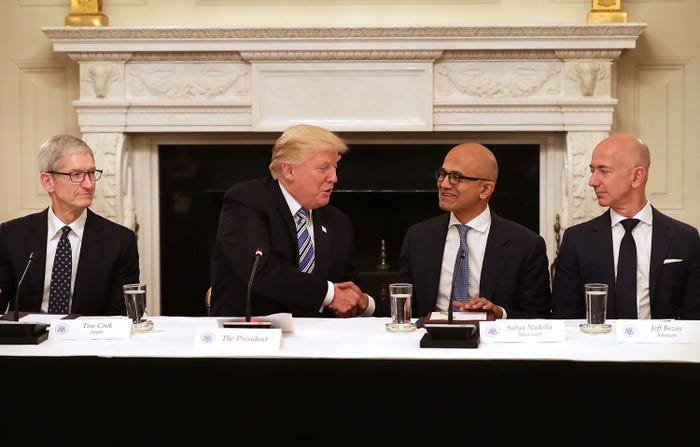
President Donald Trump speaks during an American Technology Council roundtable in the State Dinning Room at the White House in Washington, DC on Monday, June 19, 2017. From left, Tim Cook, Chief Executive Officer of Apple, Trump, Satya Nadella, Chief Executive Officer of Microsoft, and Jeff Bezos, Chief Executive Officer of Amazon. (Photo by Jabin Botsford/The Washington Post via Getty Images)

Trump says that Microsoft will ‘ensure’ Americans don’t ‘pick up the tab’ for its data center power consumption


Chip Somodevilla/Getty Images

  • President Donald Trump asks tech companies to “pay their own way” for their data centers.
  • Data centers drove up utility bills in at least 13 states, Business Insider previously reported.
  • Trump says that Microsoft will be the first to work with the White House to keep utility bills down.

President Donald Trump said on Monday that even though data centers are “key” to the AI boom, tech companies must “‘pay their own way,'” so that Americans don’t have higher utility bills.

“First up is Microsoft, who my team has been working with, and which will make major changes beginning this week to ensure that Americans don’t ‘pick up the tab’ for their POWER consumption, in the form of paying higher Utility bills,” Trump said on Truth Social, hinting at additional announcements “in the coming weeks.”

Data centers drove up utility bills in at least 13 states, Business Insider previously reported.

Over the past year, Microsoft has been planning for data centers in Wisconsin, Atlanta, Texas, and Michigan.

The White House and Microsoft did not immediately respond to a request for comment.

This is a developing story; check back for updates.


Source link

Pranav Dixit

Read the memos Google, Apple, Microsoft, and ServiceNow sent visa workers warning them not to travel

The world’s largest technology companies are scrambling to manage a growing crisis affecting thousands of their employees on work visas, as new social media screening requirements trigger delays at US embassies and consulates worldwide.

Google, Apple, Microsoft, and ServiceNow have all sent advisories to visa-holding employees in recent days, warning them against international travel and describing appointment delays stretching up to a year.

The memos, sent by immigration law firms representing these companies or by their internal legal teams, paint a picture of mounting uncertainty for foreign workers who form a critical part of the tech industry’s workforce.

The warnings come as American embassies have postponed routine visa stamping appointments, leaving some employees already abroad unable to return to work in the US for extended periods.

For H-1B holders, the primary work visa used by tech companies, the situation creates a particularly difficult bind. If their visa stamp expires and they travel abroad, they must obtain a new stamp at a consulate before re-entering the US. With appointments now being rescheduled months into the future, what would typically be a routine trip home has become a potential career disruption lasting up to a year.

On Friday, a spokesperson for the Department of State told Business Insider it was now conducting “online presence reviews for applicants.” The department said it may move appointments as resources change, with applicants able to request expedited slots on a case-by-case basis.

“While in the past the emphasis may have been on processing cases quickly and reducing wait times, our embassies and consulates around the world, including in India, are now prioritizing thoroughly vetting each visa case above all else,” the State Department spokesperson said. Appointments in Ireland and Vietnam have also been postponed, according to immigration firm Reddy Neumann Brown PC.

Below are the full texts of the internal memos sent to employees at these companies, obtained by Business Insider, which reveal how corporate America is responding to the visa processing slowdown.

Google declined to comment, while Microsoft, Apple, and ServiceNow did not respond to requests for comment from Business Insider.

Microsoft


Microsoft

Microsoft has advised its visa-holding workers not to travel.

Matthias Balk/picture alliance via Getty Images


Below is the text of a memo sent by Jack Chen, Microsoft’s associate general counsel for immigration.

Update #1 on H-1B/H-4 Visa Appointment Rescheduling and Stamping Delays
Hi everyone,
As shared yesterday, some U.S. consulates are rescheduling existing H-1B/H-4 visa appointments and pushing dates out by several months. Here’s what we know:
  • Rescheduling notifications are concentrated in Chennai and Hyderabad, with some unverified reports from other consulates. New dates are as far out as June 2026.
  • The delays stem from operational constraints tied to the new online presence review for H-1B/H-4 visas, effective December 15, which reduces daily processing capacity. We’re also hearing that these consulates needed time to implement new vetting procedures.
  • We have no confirmed reports of rescheduling for other visa types yet. While only H-1B/H-4, F, J, and M visas are subject to the online presence review, we think secondary impacts on overall processing may emerge.
  • We don’t know if rescheduling is ongoing, for those whose original visa appointments have not been changed.
Some employees have already traveled for appointments and received rescheduling notices without warning; others are getting notices before departure. To set expectations, it is highly unlikely emergency appointments will be granted, given the circumstances.
This is a rapidly developing situation. Here is our preliminary guidance, which we’ll update as we learn more. Please read this next section carefully—I’ve tried to simplify it, but the details do matter:

For those currently outside the U.S.:

  • You need a new visa stamp + your H-1B visa appointment was rescheduled months later: We will contact you. Please follow the instructions below to report your situation (even if you’ve already contacted AskUSI).
  • Your H-1B visa appointment was rescheduled BUT you still have some validity left on your current visa stamp: If your visa is for the proper work-authorized category, return before your current visa expires. This situation applies for people who had scheduled visa appointments because their visas are expiring soon, not before the return to the U.S. is planned.

For those still in the U.S.:

  • You have upcoming travel + will need a new visa to return + your H-1B visa appointment was rescheduled months later: You should strongly consider changing your travel plans. You cannot return until your new visa stamp is issued, and it’s highly unlikely that the appointment can be moved earlier. And there are limitations to your ability to perform work for your U.S. role during that period. See Microsoft Global Mobility Payroll and Tax Compliance Policy.
  • You have upcoming travel + will need a new visa to return BUT your H-1B visa appointment has not been rescheduled: There is risk your appointment could be moved during your trip and result in you being stuck abroad. Factor this into your decision. We are still learning more about how widespread and significant delays are in other consulates.
For other visa categories (not H-1B/H-4, F, J, M): Proceed as planned for now, but note things can change quickly.

HOW YOU CAN HELP US IDENTIFY TRENDS

To track real-time impacts, we need data from employees whose appointments have been rescheduled or may be soon. This will help us identify:
  • Which consulates are affected
  • When notifications of rescheduling are being sent
  • Length of delays
  • Whether other visa types are impacted
If you have a visa appointment scheduled with a U.S. consulate for any visa category, we’ve created a survey where you can share these details with us. And importantly, the survey allows you to update your responses—for example, if you haven’t been rescheduled when you originally complete this survey, but subsequently receive a rescheduling notification. This form is also the clearest way for us to identify employees who are currently outside the U.S. and cannot return until a new visa stamp is issued: Census of Upcoming Visa Stamping Appointments — Fill out form
We’ll share out insights based on these responses and further information we’re able to gather by the end of the week.
For employees currently stuck abroad—we know this is an anxious moment. We will provide clear and orderly guidance to you directly as soon as we can.

Google


Google

Lawyers for Google told the company’s visa-holding staffers that visa processing is facing delays as long as a year.

Cheng Xin/Getty Images


Below is the text of an email sent by Berry Appleman & Leiden LLP (BAL), the immigration firm that represents Google.

Hi everyone,
Please be aware that some U.S. Embassies and Consulates are experiencing significant visa stamping appointment delays, currently reported as up to 12 months.
Due to high demand and enhanced screening for H-1B, H-4, F, J and M visas, visa processing is taking longer than usual. If you require a new visa stamp to re-enter the U.S., we recommend avoiding international travel at this time as you risk an extended stay outside the U.S.
We encourage you to review go/bal-travel-advisory. If you have any questions, reach out to schedule a consultation with a BAL attorney at go/getsupport.
Thank you,
BAL

Apple


Apple

Apple also sent memos to visa-holding workers warning them of extended delays in visa processing.

Andrej Sokolow/picture alliance via Getty Images


Below is the text of an email sent by Apple’s immigration team.

Given the recent updates and the possibility of unpredictable, extended delays when returning to the US, we strongly recommend that employees without a valid H-1B visa stamp avoid international travel for now. If travel cannot be postponed, employees should connect with Apple Immigration and Fragomen in advance to discuss the risks.

ServiceNow


ServiceNow

ServiceNow, an IT automation firm, told its visa holders that a new immigration policy requiring the vetting of social media is causing delays in processing.

Smith Collection/Gado/Getty Images


Below is the text of an email sent by ServiceNow’s Global Mobility Team.

Potential cancellation of US consulate appointments for H-1B and H-4 visa holders

Global Mobility update

What to know
The US State Department has announced that some consulate appointments for individuals holding H-1B and H-4 visas are being canceled due to a newly implemented review process that examines applicants’ online presence, including social media activity.
This change primarily affects foreign nationals with appointments scheduled on or after December 15, 2025, at US consulates in India who require visa stamps to return to the United States. However, it could also impact other visa types and consulates in the future.
Please see the Fragomen client alert here.
Notification process
If your appointment is affected by this process change, you will receive an email from the consulate with a cancellation notice and a new appointment, which in some cases could be as late as November 2026.
If you’re outside the U.S. right now
  • If you need a new visa stamp and your H-1B visa appointment has been delayed by several months: Reach out to your manager as soon as possible to discuss whether an exception to the 30-day Work from Anywhere policy is warranted.
  • If your H-1B appointment has been delayed, but your current visa stamp is still valid: If your visa category allows you to work in the U.S., we recommend you return before your current visa expires.
Exceptions and emergency appointments
If your appointment has been cancelled or rescheduled, you may apply for an emergency expedited appointment if you meet one of the following criteria:
  1. Death in the family
  2. Medical need / Family Emergency
  3. Potential loss of substantial revenue, profits, or contracts for the company
We have heard that the expedited consulate appointment process is resulting in an earlier appointment, so you are encouraged to try this approach by completing the request form. Please review the Expedited Consulate Appointments site for additional details.
Working from India or any location using the Work from Anywhere exception
If delay would materially impact revenue/contracts or there’s a medical/family emergency, ServiceNow will review and approve exceptions to the 30-day Work from Anywhere guidelines on a case-by-case basis.
Travel guidance
If you’re planning travel, please consult with Fragomen for guidance before making any arrangements. If you have upcoming trips to India that require a consulate appointment for visa stamping to return to the U.S., we recommend cancelling those plans. Otherwise, you risk significant delays in securing an appointment to apply for a visa stamp.
Support
If you have questions about consulate appointment cancellations or upcoming travel, you can reach out to Fragomen through the Fragomen Messenger feature within the Fragomen Connect Portal or submit a request to the Global Mobility team.
The Global Mobility Team

Have a tip? Contact Pranav Dixit via email at pranavdixit@protonmail.com or Signal at 1-408-905-9124. Use a personal email address, a nonwork WiFi network, and a nonwork device; here’s our guide to sharing information securely.


Source link