A Russian governor has ordered large firms in his region to shortlist employees as “candidates” for military service, in a rare push for businesses to get involved with recruitment.
The order — signed by Pavel Malkov, the governor of Ryazan, a region 130 miles southeast of Moscow — instructed companies with 150 or more workers to select their employees by September 20.
These employees would be candidates for “military service under contract” with the Russian military, the noticesaid. In Russia, contract military service contributes to the bulk of recruitment for the Ukraine war and is meant to be voluntary.
The new legislation, dated March 20, was reported this week by Russian independent media and open-source intelligence groups.
The order is addressed to all business entities “regardless of their form of ownership,” indicating that private and state-owned organizations are subject to the requirements.
According to Malkov’s order, businesses and institutions with 150 to 300 workers must submit two candidate employees, while those with 300 to 500 workers must designate three. Firms and entities with 500 or more workers must submit five names.
Malkov’s order did not specify penalties for failing to submit the quotas on time. His directive cited two decrees signed in 2022 by Russian President Vladimir Putin putting the country under heightened readiness amid the full-scale invasion of Ukraine.
Ryazan local law says businesses that obstruct those decrees could be fined up to 1 million rubles, or about $12,300.
The candidacy mandate comes as Russia has been aggressively pushing new ways to find fresh troops while taking heavy losses in Ukraine, offering large sign-up bonuses to its citizens and increasingly leaning on informal or covert overseas recruitment networks.
Moscow said that over 420,000 people signed up for military contracts last year. But the recruitment rate has been repeatedly reported to be dwindling in larger cities, where residents are now more wary of joining the brutal conflict.
The heavy military focus is likely to come at a high cost to Russia’s already struggling economy. The country is facing labor shortages, for example, that its officials have warned could reach 11 million workers by 2030.
Russia hopes to eventually grow its active-duty force to 1.5 million soldiers, with a total force of 2.38 million when including support and civilian service personnel. In 2025, it spent about 6.3% of its GDP on defense.
This story is available exclusively to Business Insider
subscribers. Become an Insider
and start reading now. Have an account? .
President Donald Trump said the US has destroyed military targets on Kharg Island.
The island, located off the coast of Iran, is central to the country’s oil empire.
Trump said the strikes did not damage the island’s oil infrastructure.
President Donald Trump said late Friday that the US had “totally obliterated” military targets on Kharg Island, an island off the coast of Iran that is central to its oil empire.
“Moments ago, at my direction, the United States Central Command executed one of the most powerful bombing raids in the History of the Middle East, and totally obliterated every MILITARY target in Iran’s crown jewel, Kharg Island,” Trump wrote.
“Our Weapons are the most powerful and sophisticated that the World has ever known but, for reasons of decency, I have chosen NOT to wipe out the Oil Infrastructure on the Island,” he added.
“However, should Iran, or anyone else, do anything to interfere with the Free and Safe Passage of Ships through the Strait of Hormuz, I will immediately reconsider this decision,” Trump continued. “Iran has NO ability to defend anything that we want to attack — There is nothing they can do about it!”
Representatives for CENTCOM and the White House did not immediately respond to requests for comment from Business Insider.
What is Kharg Island?
Kharg Island is a small island in the Persian Gulf, located roughly 300 miles from the Strait of Hormuz, which is known for its significance to Iran’s oil production.
Refineries on the island process nearly all of the nation’s oil exports. Disruption to the facilities there could have a significant impact on the global oil shortage, further driving up costs.
This is a developing story. Please check back for updates.
This story is available exclusively to Business Insider
subscribers. Become an Insider
and start reading now. Have an account? .
A KC-135 refueling aircraft “went down” in Iraq, the US military announced Friday evening.
A second unidentified aircraft was involved but landed safely.
The status of the refueling aircraft’s crew is unknown.
A US military KC-135 refueling aircraft involved in Operation Epic Fury has crashed in Iraq, US Central Command said in a statement on Friday evening.
“Central Command is aware of the loss of a US KC-135 refueling aircraft,” the command, which oversees US military operations in the Middle East, said, adding that the incident involved two aircraft operating in friendly airspace in support of Epic Fury.
One aircraft “went down” in western Iraq, while a second unidentified aircraft landed safely. The aircraft loss “was not due to hostile fire or friendly fire,” CENTCOM said.
This marks the fourth American aircraft loss since the start of Operation Epic Fury, the Pentagon’s name for US operations against Iran, nearly two weeks ago. Just days into the war, CENTCOM announced that three American F-15E Strike Eagles were downed by friendly fire over Kuwait. The aircraft were lost, but all six aircrew members were able to eject safely.
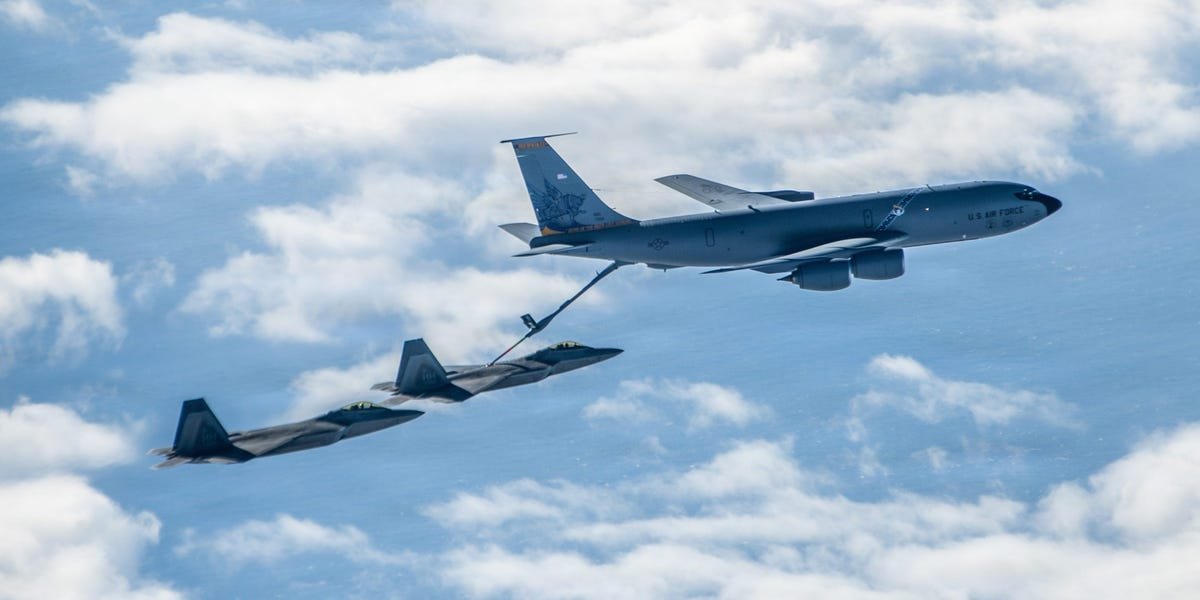
The KC-135 Stratotanker is an Air Force asset that supports the broader joint force by refueling other aircraft — including fighter jets, bombers, and cargo aircraft — in notoriously complex midair refueling operations. It’s essentially a flying gas station that executes fuel transfers at high speed with aircraft in close proximity.
The KC-135 typically carries a three-person crew — a pilot, co-pilot, and boom operator. The status of the crew is not known at this time. CENTCOM said rescue operations are ongoing.
The US has been battling Iran for more than 24 hours, and the scale of what the American military brought into the fight is now coming into focus.
After a slow but steady drip of details, we now have a clearer, more comprehensive picture of the kind of US combat platforms involved and the targets struck on the opening day of combat, executed alongside the Israeli military.
US Central Command said forces involved in Operation Epic Fury struck over 1,000 Iranian targets with destroyer-launched Tomahawks, stealth B-2 Spirit bombers armed with 2,000-pound bombs, and US-made drones modeled after Iranian Shaheds, among other assets and munitions. It called the drones “American-made retribution” as the US struck Iran with a weapon Tehran designed.
Here’s the breakdown from US Central Command, which oversees US operations in the Middle East, on what went into the fight. It’s extensive, though some things are left off, covered by a note that says the operation also includes “special capabilities we can’t list.”
A graphic breaking down the weapons used in Operation Epic Fury from US Central Command
US Central Command
Beyond the B-2 bombers, the list of aircraft includes fifth-generation fighters like the F-35 Lightning II Joint Strike Fighter and F-22 Raptor, as well as a mix of attack aircraft and fourth-gen fighters.
There are also electronic attack planes, airborne early warning and control aircraft, surveillance platforms, and logistics aircraft, such as airlift and refueling planes, listed. The Airborne early warning aircraft can detect and track targets that can be passed off in real-time to fighter jetss like the F-22 and F/A-18.
Drones include the MQ-9 Reaper, a combat and reconnaissance system, and the new Low-Cost Unmanned Combat Attack System, or LUCAS, drones. The former is intended to return home, while the latter is purposefully expendable.
Suppression operations aimed at breaking down Iranian defenses set the conditions for air superiority and permitted damaging strikes across Iranian territory. There have been no credible reports of aircraft losses.
Other assets involved include High Mobility Artillery Rocket Systems, or HIMARS, weapons that can fire both guided rockets and missiles. They gained notoriety for their combat effectiveness in Ukraine. In addition to destroyers, American aircraft carriers are in the area, launching fighter aircraft like the F/A-18 Super Hornet and F-35C, the carrier-based variant of the stealth fighter.
While much of the weaponry on the list is offensive or intended to support offensive operations, some assets are strictly defensive. These include Patriot surface-to-air missile systems and Terminal High Altitude Area Defense, or THAAD, batteries. These have been used in air defense battles as Iran launched its missiles.
Prior to the beginning of “major combat operations” against Iran, which President Donald Trump announced early Saturday morning in a video message, the US spent weeks building up its military presence not seen in the area in decades.
The impact of operations, in which the US has suffered some personnel losses, has been felt across Iran. The US has hit command and control centers, operational centers of Iran’s Islamic Revolutionary Guard Corps, missile sites, navy warships, and critical communication sites.
The Israeli military, as part of Operation Roaring Lion, has also struck hundreds of targets across the country, which has seen much of its military and political leadership killed.
There are an estimated 7,800 children on US military childcare waitlists. Military families and advocates saythe numbermasks deeper shortfalls that continue to sideline working spouses and strain service members.
Lawmakers raised the issue during a recent congressional hearing, calling the persistent backlog a quality-of-life problem, even as the waitlist has notably dropped from 12,000 children in 2024.
Advocates told Business Insider that the number isn’t the whole picture and excludes families who’ve given up out of frustration or can’t use base centers that lack evening, weekend, or specialized care.
“We can’t say that we are a military that cares about our families if we pretend to provide childcare and then we’ve got a waitlist that’s got 7,800 babies waiting on it,” Massachusetts Democratic Sen. Elizabeth Warren said to service senior enlisted leaders during last week’s hearing.
None of the service leaders present disputed that figure.
Every time Kelsey publishes a story, you’ll get an alert straight to your inbox!
Stay connected to Kelsey and get more of their work as it publishes.
Master Chief Petty Officer of the Navy John Perryman acknowledged that the Navy still has roughly 1,400 children in unmet need status, while Chief Master Sergeant of the Air Force David Wolfe said his service’s waitlist stands at around 2,700, though there are efforts underway to open new spots.
It is not clear how the remaining waitlisted children are divided between other services.
In 2022, the Air Force had 95,000 children under 5 but space for only about 23,000 in its child development centers, a 2023 service report on childcare found.
An Air Force spokesperson attributed that disparity to the number of children entering and leaving care throughout the year. “The annual number served will not correlate with daily capacity and can be significantly higher,” they said.
Not all families require on-base care. But the report added that more facility construction alone would not be a “viable solution to meet all potential demand.”
Kayla Corbitt, a military spouse and the founder of a nonprofit dedicated to helping military families find reliable childcare, told Business Insiderthat many families lose hope amid long waits. Staying on the waitlist, she said, requires logging on every couple of months to reconfirm before families are automatically disenrolled.
And for some families, the barriers extend beyond backlogs.
“Anyone needing evening care, weekend care, shift work care, which is a lot of the military, they aren’t going to try to get on that waitlist,” Corbitt said, explaining that most child development centers, or CDCs, on bases don’t offer late evening or very early morning care needed for troops on 24-hour duty or for deployed service members with spouses who work unusual hours.
Additionally, children with special needs face significant obstacles in finding care, Corbitt said, as many CDCs are not equipped to provide care, and the policies sometimes vary from facility to facility, making it hard for families to know what to expect when they move.
Brigit Schneider, an Air Force spouse and mother of three children, wants to return to work as a financial planner to better support her family, but because her local childcare center won’t accept children with feeding tubes, one of her young children is shut out.
“From a special needs mom perspective, it’s an extra layer of challenge,” she told Business Insider.
Schneider pays nearly $1,000 a month for one child to receive on-base childcare, another child is receiving private care due to the severity of their disability, and a third is at home. Schneider says the third should be able to receive base care.
“A G-tube really is not a hard medical device to learn how to use,” she said.
Generally, though, military CDCs won’t accept children with gastrostomy tubes. Facilities are often unable, or unwilling, to provide higher levels of care, Corbitt said.
Air Force childcare programs are “supported by a multidisciplinary team of experts who provide consultation and support to ensure the highest quality of inclusive care,” an Air Force spokesperson told Business Insider following a query regarding the service’s childcare.
The service “offers a network of on- and off-installation care options and works closely with families to identify the appropriate setting for their child,” said the spokesperson, adding that waitlist data helps inform future allocation requirements.
Staffing shortages are another obstacle to reliable access for military personnel. Military childcare workers face unusually high attrition rates, around 50%, Warren said at last week’s congressional hearing, driven largely by meager pay.
Compounding the issue is the lack of a clear pathway that would allow qualified providers to move easily between states.
Nearly 40% of childcare workers are military spouses, said the Marine Corps’ top enlisted leader, Sergeant Major Carlos Ruiz, during the hearing. “If we can just be a little bit more smart about transferring folks and directly hiring from one CDC to another, we can reduce the attrition,” he said.
Government watchdogs have repeatedly flagged childcare accessibility as a point of concern for the US military. A 2024 Government Accountability Office report found that while the services focus heavily on recruiting new childcare workers, they do not consistently measure whether employee retention efforts are effective.
The military’s childcare shortages aren’t unique to the armed forces. Many Americans in the civilian world struggle to find reliable, reasonably priced childcare.
Often, a year of childcare amounts to an entire average salary, costing tens of thousands of dollars. The cost of childcare in the US has increased by over 150% over the last quarter-century and continues to climb, often outpacing inflation. In some areas, childcare costs can exceed rent or mortgage payments.
The US is mounting its largest military buildup in the Middle East since 2003. Here’s a list of the weapons and hardware that it’s sent to the region as the Trump administration pressures Iran to strike a deal that would limit its nuclear and military capabilities.
At least a dozen warships collectively worth an estimated $50 billion have been deployed to the region. Satellite imagery shows the US Navy aircraft carrier USS Abraham Lincoln in the Arabian Sea, and a second carrier strike group led by the USS Gerald R. Ford is on the way. The buildup also includes a variety of military aircraft and missile defense systems.
The Marine Corps has again done what the rest of the US military has repeatedly failed to do with its finances — account for its money.
The Corps, the only US military service to pass a clean financial audit, announced its third successful audit on Monday.
The Department of Defense, which was recently authorized to receive a new annual budget of nearly $840 billion a year and could see a substantial increaseto $1.5 trillion under the current Trump administration, has consistently failed to pass an audit since audits became legally required for the military in 2018.
Pentagon officials hope the military can get its books in order across the services and pass one by 2028.
“The Marine Corps’ audit process enabled accurate global tracking and reporting of financial transactions, inventory of facilities, equipment and assets, and accounting for taxpayer dollars spent during the last fiscal year,” read a Marine Corps release, “The auditors also tested the Marine Corps’ network, key business systems, and internal controls.”
The result reflects years of effort to modernize financial and logistics systems that have long been siloed across units, making audits agonizingly challenging, said Lt. Gen. James Adams III, the deputy commandant for programs and resources, during a media roundtable. Such bottlenecks have been a long-standing problem across the Defense Department and are a major focus of Pentagon reforms.
“We want to modernize our systems so they’re digitally connected, so that we can do audits in the future that are controls-based,” said Adams, who is set to depart his position soon to lead the Defense Intelligence Agency.
Historically, fragmented military networks have made everything from force-wide equipment tracking to financial oversight difficult, requiring tedious manual reconciliations. While the Corps still relies heavily on human review, officials say automation and artificial intelligence are already reducing the burden.
“Right now, we still take a lot of data and move it onto a macro spreadsheet that our accountants are reviewing, and that’s just a lot of work,” said Edward Gardiner, the assistant deputy commandant for programs and resources. AI tools can help flag discrepancies and pinpoint errors, he said. Officials pointed to one automation system that saved 20,000 hours of painful reconciliation work.
Auditors still found seven “areas of weakness” in the audit, a common feature even among organizations with clean audits, though Adams told reporters the Corps has prioritized fixes to those areas that pose the greatest risk to financial accuracy after its audits, rather than trying to eliminate all concerns at once.
“Passing our third consecutive audit is a direct reflection of who we are as Marines,” the Corps’ commandant, Gen. Eric Smith, said in a statement. “Discipline, accountability, and stewardship are not administrative tasks; they are part of our warfighting culture.”
China’s drive to modernize its military to rival the US armed forces is running parallel with an aggressive purge of its senior leaders.
The People’s Liberation Army has been repeatedly shaken by a massive anti-corruption campaign led by Chinese leader Xi Jinping. Now, the military leadership is under renewed scrutiny after one of China’s most senior generals was placed under investigation.
The latest disruptions within the PLA,the world’s largest military and one of its most powerful, raise questions about who is leading the force and how the shake-ups are affecting the military as an organization and impacting readiness.
This past weekend, China’s defense ministry announced investigations into Gen. Zhang Youxia, vice chairman of the Central Military Commission, and Liu Zhenli, the chief of staff of the commission’s joint staff department. Zhang was widely believed to be one of Xi’s trusted military advisors.
An editorial published in official PLA media said the two had “seriously betrayed the trust and expectations” of both the Communist Party and the CMC and “fostered political and corruption problems that undermined the party’s absolute leadership over the military and threatened the party’s ruling foundation.”
Analysts Business Insider spoke with said the accusations suggested more than just financial corruption, which has been the case for others. Rather, the language indicates Zhang and Liu challenged Xi’s authority, whether through disagreements on modernization goals, failures to meet expectations, or power and influence struggles within the ranks. The reasons may never be known, as China’s “black box” opacity increasingly blurs realities inside its government.
A report from the Wall Street Journal raised the possibility Zhang leaked nuclear weapons data to the US. Business Inside is unable to independently verify the information.
Xi and other official are now the only two remaining members of the Chinese Military Commission.
Xinhua News Agency/Xinhua News Agency via Getty Images
Of the seven officials appointed to the Central Military Commission in 2022, only two — Xi himself and Zhang Shengmin, the commission’s anti-graft officer — remain in power. The rest are either under investigation or have been expelled.
Two defense ministers have been ousted, and last October, nine top PLA commanders were purged. The exact number of senior military leaders affected is unknown, but there are indications the purge has deeply impacted the senior officer corps.
Zhang is the highest-ranking official affected by Xi’s crackdown on the military. And across the lower ranks of the PLA, dozens of other officers have been removed from their positions.
“This is kind of the ultimate crescendo of this anti-corruption campaign in the military,” Jonathan Czin, an expert at the Brookings Institute who previously served as a top China analyst for the Central Intelligence Agency and director for China at the United States National Security Council, told Business Insider.
“It sends a very clear sign throughout the system that nobody is safe regardless of what kind of relationship you had or have with Xi Jinping,” he said.
More investigations may follow those of Zhang and Liu. Officials with ties to the two men could come under suspicion as well, analysts said. Other senior people have been notably absent from important meetings in recent months, suggesting more shakeups.
That leaves Xi with a difficult next step: deciding who can credibly fill the vacancies.
Because so many senior officers have been removed or face investigations, “the pool of candidates for refilling top positions has been winnowed,” Brian Hart, the deputy director and fellow at the Center for Strategic and International Studies’ China Power Project, told Business Insider. “Xi could continue to use the existing command structure of the CMC and fill it with new people loyal to him,” he added. “It is also possible Xi could try to start over with a bit of a blank slate by more fundamentally remaking the PLA’s leadership structure.”
Experts assess the immediate consequences of the most recent corruption investigation will impact combat readiness.
GREG BAKER/AFP via Getty Images
Fewer experienced commanders could slow coordination across China’s military — a serious challenge for complex operations like a blockade or invasion of Taiwan.
Some PLA watchers argue Xi appears willing to accept those short-term costs if the result is a force that is more politically loyal and disciplined over time. The PLA Daily editorial framed the campaign as a net positive, arguing that “the more the People’s Army fights corruption, the stronger, purer, and more combat-capable it becomes.”
A senior Pentagon official previously speculated that the extensive corruption in China’s military was hindering its modernization.
Amid disruptions in the force, China may seek to send a signal that shake-ups aren’t affecting military readiness.
“You could actually see an uptick in the number of major exercises around Taiwan, but internally it could mask significant upheaval and disarray within the PLA,” Lyle Morris, a senior fellow for foreign policy and national security at the Asia Society Policy Institute’s Center for China Analysis, told Business Insider.
China staged large joint exercises around Taiwan following earlier purge waves. Such actions could project readiness despite leadership turmoil.
The internal upheaval is likely having an effect, though, China watchers said.“It is hard to deny that this creates challenges for the PLA in the short term,” Hart said. “Any leader deciding on using force would want senior leaders and commanders in place who are loyal, experienced, and effective in their roles. The immense turnover within the PLA’s highest ranks complicates that.”
US planning for the high-risk raid to apprehend Venezuela’s former president, Nicolás Maduro, centered on a time when much of the country’s military would be on holiday leave, a newly released memo reveals.
The December 23 memorandum from the Department of Justice’s Office of Legal Counsel offers fresh details about how the US planned to pull off the daring nighttime raid to capture Maduro in his fortified compound and transport him to New York to stand trial. The former leader has pleaded not guilty to the drug and weapons charges he faces.
The raid began late on January 2 and ran into the next day. President Donald Trump said on January 3 that the initial plan was for the operation to occur four days earlier, on December 30, but he decided to wait for better weather.
“The expected duration of the operation within Venezuelan territory is [redacted] hours,” wrote T. Elliot Gaiser, a US assistant attorney general, wrote in the late December DOJ memo, which looks into the legality of the raid and was made public this week. Much of the planning section is blacked out.
“In order to minimize casualties, the strike will take place at 0100 am (local time) on a date where a maximum number of Venezuelan military would be on leave for the holidays,” Gaiser wrote.
The US attacked Venezuelan military targets as part of its raid earlier this month.
Federico PARRA/AFP via Getty Images
It’s unclear how many soldiers were away when the US actually executed the operation in January. Dozens of Venezuelan and Cuban security personnel were killed, the two countries said after Operation Absolute Resolve concluded.
The DOJ memo, which cited Pentagon planning information and details how the US could effectively present the action as a law enforcement operation rather than an act of war, said that the US expected to encounter “significant resistance” from Venezuela’s air defenses.
That anticipated resistance includes several dozen anti-aircraft systems on the approach to Fuerte Tiuna, a major military installation in Caracas where Maduro and his wife were believed to be and, indeed, were at the time of the operation.
The memo outlined how US aircraft would strike air defense systems to clear a path for assault forces to reach Tiuna. It said that the Pentagon aimed to target a local power switching station to keep the power off, which could explain Trump’s post-raid remarks that a “certain expertise” was used to turn off the lights in Caracas.
The US could have also carried out a cyberattack or employed electronic warfare capabilities. “Kinetic operations will be preceded by non-kinetic action,” the memo said.
More than 150 US aircraft participated in the operation.
Eva Marie Uzcategui/REUTERS
The memo was published several days before the raid, so it’s unclear how US planning may have changed between the time it was written and the actual operation.
Dan Caine, the chairman of the Joint Chiefs of Staff, said on January 3 after the raid that more than 150 US aircraft participated in the operation, including stealth jets, electronic attack aircraft, surveillance and reconnaissance planes, airborne early warning aircraft, bombers, and drones.
Many of these aircraft targeted and engaged Venezuela’s air defenses to clear a path for low-flying helicopters carrying the forces that stormed Maduro’s compound and apprehended the former president and his wife, consistent with the planning memo.
The US didn’t lose any aircraft during the raid. A helicopter took a hit but still remained operational, and a defense official said seven American service members were wounded during the night.
“Risks to the mission are significant,” the memo said, adding that its “success will depend on surprise.” In the aftermath, Caine said the US achieved “totally the element of surprise.”