

Millions-of-student-loan-borrowers-risk-being-driven-into-a-shadow.jpeg

Millions of student-loan borrowers risk being driven into a ‘shadow’ market of costly private lenders, a new report says

Risky lending products could expand as federal student-loan repayment changes begin to roll out, a new report says.

On Tuesday, advocacy group Protect Borrowers and left-leaning think-tank The Century Foundation released a report on how the private student-loan industry will shift once President Donald Trump’s federal repayment overhaul is implemented.

The report found that 40% of Americans would be denied private student loans from traditional, prime lenders due to low credit. It could drive them to consider the “shadow” student debt market, which is made up of subprime lenders, including personal loans, debt owed directly to schools, and “Buy Now, Pay Later” products, all of which can come with high interest rates and aggressive debt collection.

Those products could get a boost from Trump’s “big beautiful” spending legislation, which included new caps on borrowing for advanced degrees. Previously, students could borrow up to the full cost of attendance through federal student loans. Under the new caps, programs with higher tuition could push borrowers to seek private financing or forgo those programs altogether.

Jennifer Zhang, Protect Borrowers’ policy, research, and data analyst, told Business Insider that traditional private lending limits will “hurt the people who arguably would stand to gain the most from the federal student loan program” because students from low-income backgrounds and students of color often have limited access to credit.

“The pivot toward private lending is going to deprive students of access to college and to make their choice,” Zhang said. “Either you can give up on the dream of higher education, or try to look for lenders that are increasingly predatory and offer highly predatory and expensive loans to people who are the most desperate.”

During negotiations on Trump’s spending legislation, the Department of Education said that borrowing caps for advanced degrees would prevent borrowers from taking on unaffordable debt, and could push colleges to lower tuition. Major private lenders have said they’re prepared for an influx of federal borrowers; Jonathan Witter, CEO of Sallie Mae, said during a January earnings call that he’s “excited about the opportunity created by the recent federal student lending reforms.”

Some of those lenders also told Democratic lawmakers in February that, in anticipation of the influx, they’re committed to offering borrower protections. Sallie Mae said that its customers face “the highest periods of repayment stress” in their first 12-24 months of repayment, and it offers grace periods for those borrowers. SoFi, another major private lender, said it has “many options,” like grace periods and deferments, to help its borrowers avoid delinquency.

In a time when oversight over private student loans is diminished — including staff cuts at the Consumer Financial Protection Bureau, which brought enforcement actions against the industry — Zhang said the repayment changes are even more “dangerous.”

“The transition toward increased private lending is going to happen in a context where lenders know that the CFPB and the Department of Education are really not doing their jobs and looking for the lenders who are breaking the law,” Zhang said.

A shifting student-loan repayment landscape

With oversight lacking, the report had recommendations to protect borrowers from risky lending products. One is to require private student-loan companies to register with their state financial regulator, which would allow the state access to information on the lender’s performance and portfolio. Only eight states have passed legislation requiring private lenders to register with states, the report said.

The report also called for more federal and state funding toward higher education to prevent borrowers from relying on debt-based systems.

For now, the private student-loan industry could see increased demand. The Department of Education will begin implementing the repayment changes on July 1, including new income-driven repayment plans, and borrowers previously told Business Insider that they’re bracing for higher monthly payments.

At the same time, the department will transition more than 7 million borrowers off of the SAVE student-loan repayment plan this summer, after a recent settlement to end the program early. SAVE would have been phased out in 2028 — now, millions of federal borrowers will be navigating a new repayment system, and some might turn to the private market.

A group of Democratic lawmakers led by Sen. Elizabeth Warren released an analysis in January calling for increased oversight over the industry due to the looming repayment changes.

They wrote that private lenders preparing for an influx of federal borrowers “underscore an urgent need for oversight of the private lending market as these companies prepare to cash in on the Administration’s agenda.”



Source link

Millions-of-student-loan-borrowers-are-kicked-off-of-Bidens-key.jpeg

Millions of student-loan borrowers are kicked off of Biden’s key affordable repayment plan in a surprise court reversal

The roller coaster ride for borrowers enrolled in a key affordable repayment plan continues.

On Monday, the 8th Circuit directed a district court to approve President Donald Trump’s proposed settlement with the state of Missouri to eliminate the SAVE student-loan repayment plan.

The plan has been embroiled in a legal back-and-forth for years. Most recently, a district court declined to rule on the proposed settlement, which some advocates and lawmakers saw as a win for borrowers and urged the Department of Education to carry out relief under SAVE.

However, the 8th Circuit’s ruling means that, once approved, the department will move forward with the settlement and require enrolled borrowers to transition to a new plan.

“In the coming weeks, the Department will issue clear guidance on next steps for borrowers enrolled in the illegal SAVE Plan, including details regarding how borrowers can move into a legal repayment plan,” Nicholas Kent, the undersecretary of education, told Business Insider in a statement. “The Trump Administration will continue to realign the federal student loan portfolio to better serve students and taxpayers.”

The settlement would give borrowers “a limited time” to select a new repayment plan and begin repaying the loans. Once the settlement is approved, the department will not enroll any new borrowers in SAVE, it will deny pending applications, and move all enrolled borrowers to existing plans.

Advocates criticized the 8th Circuit’s ruling, saying it will push borrowers into unaffordable monthly payments.

“The millions of borrowers who had a right to lower monthly student loan payments and relief through SAVE will now face thousands of dollars in higher bills every year thanks to the right-wing campaign against borrowers,” Winston Berkman-Breen, legal director at advocacy group Protect Borrowers, said in a statement.

SAVE was created by former President Joe Biden in 2023 and intended to give borrowers cheaper monthly payments and a shorter timeline to debt relief. The plan has been blocked since the summer of 2024 due to litigation from GOP-led states, including Missouri, which said that the relief through SAVE was unconstitutional.

This ruling pushes SAVE borrowers off the plan earlier than scheduled. Trump’s “big beautiful” spending legislation called for the plan to be phased out by 2028, giving enrolled borrowers more time to prepare for higher payments on a new plan.

Have a story to share? Contact this reporter at asheffey@businessinsider.com.


Source link

Paul Squire Headshot

Logan Paul’s Pokémon card investment pays off; he just sold it for millions in profit

Logan Paul just made millions off a Pokémon card.

The influencer turned wrestler sold his one-of-one Pikachu Illustrator card — one of 41 ever distributed and the only one graded the highest quality by collectibles company PSA — at auction Monday for a jaw-dropping $16.492 million.

The winner? AJ Scaramucci, the founder of venture capital firm Solari Capital and the son of former White House communications director Anthony Scaramucci.

Scaramucci appeared on Logan Paul’s livestream early Monday after auction house Goldin announced him the winning bidder in the auction, which closed at 1:14 am ET.

“My ambition for the card is just a small story,” Scaramucci said at the event. “The real story is that I’m on a planetary treasure hunt. I’m planning to buy a T. rex dinosaur fossil, the Declaration of Independence, and I’m not stopping there. This is only the beginning.”

“You’re just starting?” Paul replied. “Bro. Bro, that is so epic.”

Paul also used the livestream to open packs of Pokémon cards and announce RipIt, a new collectibles business he’s launching.


This Pikachu illustrator Pokémon card set a new record for the most expensive Pokémon card sold privately.

This Pikachu illustrator Pokémon card set a record for the most expensive Pokémon card sold privately.

Goldin


In a statement, Goldin described the Pokémon card, which was originally given to winners of an illustration competition in Japan, as “one of the Holy Grails of the collectibles industry.”

Paul previously set the world record back in July 2021 when he purchased the same card for $5.275 million, meaning he will make millions in profit.

The card also came with a diamond-encrusted chain appraised at $75,000, Goldin said. Paul wore the card during his WWE debut at WrestleMania 38 in 2022.

In an Instagram post on Saturday, Paul bid farewell to the card.

“Goodbye my friend 😢 What a privilege it’s been to be the owner of the greatest collectible in the world,” he wrote.

The markets for Pokémon cards, along with other collectible card sets like Magic: The Gathering and Yu-Gi-Oh!, have become huge in recent years among collectors — especially Gen Z — with the rarest cards selling for tens of thousands of dollars, if not more.

Some people are even forgoing stocks and investing in Pokémon cards instead.


Source link

Head-of-LA-homeless-nonprofit-charged-with-pocketing-millions-splurging.jpeg

Head of LA homeless nonprofit charged with pocketing millions, splurging on luxuries including a Hermès jacket and a trip to Vegas

Authorities have found that some funding to combat homelessness in California has instead ended up in Greece.

The Federal Bureau of Investigation has accused Alexander Soofer, manager of LA-based housing organization Abundant Blessing, of “a years-long scheme to defraud the City and County of Los Angeles and other public entities providing funding for homeless housing.”

According to a complaint filed on Friday, while paying his staff “minimal wages” and feeding residents at his housing sites “ramen noodles, canned beans, and breakfast bars,” Soofer pocketed at least $10 million “through bank accounts associated with other businesses in his and his wife’s names” for personal expenses after “fraudulently obtaining” $23 million in public funding.

Federal officials said that between 2018 and 2025, Soofer’s organization received more than $5 million directly from the Los Angeles Homeless Services Authority and over $17 million through other nonprofits.

Investigators found Soofer’s misuse of funds includes $47,000 in luxury home purchases from stores like Restoration Hardware, $15,000 at Hermès, $15,000 at Chanel, $1,000 for cosmetic dermatology, and $4,500 for a four-night stay at the Wynn Las Vegas.

Authorities said they have yet to determine what Soofer bought at Chanel, but listed his purchases at Hermès as including a $1,250 pair of men’s Paris calf-skin loafers, a $910 pair of women’s Chypre sandals, a $455 Chevaux en Symetrie tie, and a $2,450 men’s trotting jacket.


Screenshot

The same Hermes trotting vest that the authorities listed in the photo section of the complaint.

Screenshot


In addition to luxury brands, the complaint said there is at least one property under his name associated with the misappropriated funds. That property in question is located in Greece and relates to “a $475,000 check issued from an Abundant Blessings bank account.”

The case against Soofer feeds into concerns that California’s efforts to combat homelessness may be ineffective and inconsistent despite large spending. According to the Public Policy Institute of California, as of 2024, the state had over 187,000 homeless people, representing about 24% of the nation’s total.

State Auditor Grant Parks wrote in a 2024 report to Gov. Gavin Newsom and lawmakers that, when his department analyzed five housing programs that received approximately $13.7 billion in combined funding, only two were “likely cost-effective.”

Parks also added in the report that, between fiscal years 2018-2023, California cities lacked reliable data to track cost efficiency and outcomes needed to fully understand why the problem didn’t improve, despite the billions spent by more than 30 housing programs.

The attorney’s office of the Central District of California referred Business Insider to the press release and did not comment further. An attorney for Soofer and the Governor’s office did not immediately respond to a request for comment.


Source link

Photos-show-empty-supermarket-shelves-as-millions-across-the-US.jpeg

Photos show empty supermarket shelves as millions across the US brace for Winter Storm Fern

Preparations are underway as over half of all US states brace for what could be a historic winter storm this weekend.

Across the country, Americans are stocking up on essentials and picking store shelves clean as they brace for Winter Storm Fern, which is expected to span from the South and Mid-Atlantic to the Northeast and Midwest, starting Friday morning.

Local authorities have begun salting roads and establishing emergency protocols in anticipation of potential power outages and limited travel.

Experts and authorities are advising people in affected states to stock up on food items that don’t need to be cooked or refrigerated, and to have at least one gallon of water per person or pet per day. They are also recommending that people charge all electronic communication devices in case of power outages. They’re warning to watch out for pipes bursting, snow blocking exhaust vents, and iced-over roads.

The Weather Channel predicted Thursday that wintry conditions, including ice, snow, and dangerous wind chills, could affect up to 230 million people — or two-thirds of the country’s population — across the US.

The Midwest will experience the coldest temperatures as a polar vortex dips south, with lows possibly reaching -50 degrees Fahrenheit in states like North Dakota, Minnesota, and Wisconsin, the Associated Press reported Thursday.

The Appalachians and the Northeast Corridor could see the most snow accumulation, with the mountains of Maryland, Virginia, and West Virginia expected to receive at least a foot of snow over the weekend.

From Texas to the Carolinas, the South and Southeast can expect ice accumulation on roads and power lines. Local authorities are warning of potential multi-day power outages in the region.

See how Americans are preparing for what could be a historic storm, from stocking up on necessities to salting roads.

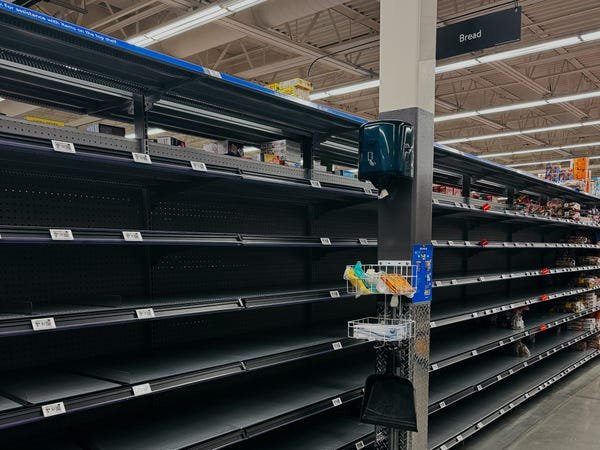
Shelves in a North Carolina Walmart were almost completely empty on Thursday as residents stocked up ahead of the storm.

A Morganton, North Carolina, Walmart had empty bread aisles by Thursday afternoon ahead of winter storm Fern.

Jesse Barber for BI

In Marietta, Georgia, residents also cleared a store’s shelves of bottled water.


A shopper searches for water on near empty shelves in grocery store ahead of winter weather, Wednesday, Jan. 21, 2026, in Marietta, Ga.

Experts advise storing at least 1 gallon of water per person or pet per day during the storm.

AP Photo/Mike Stewart

In Nashville, locals are following the “bread, milk, eggs” approach in their pre-storm shopping.


A shopper buys groceries Wednesday, Jan. 21, 2026, in Nashville, Tenn., ahead of a winter storm expected to hit the state over the weekend.

Eggs often sell out before winter storms, even though they require refrigeration and power to cook.

AP Photo/George Walker IV

Experts recommend stocking up on items that don’t need to be cooked or refrigerated.


A loaf of bread sits on empty shelves in the bread isle in grocery store ahead of winter weather, Wednesday, Jan. 21, 2026, in Marietta, Ga

Shoppers in Marietta, Georgia, are selling out bread from local supermarkets in preparation.

AP Photo/Mike Stewart

This supermarket in Nashville was also low on fresh produce on Wednesday.


A shopper buys groceries Wednesday, Jan. 21, 2026, in Nashville, Tenn., ahead of a winter storm expected to hit the state over the weekend.

Bananas are selling out in Nashville ahead of Winter Storm Fern.

AP Photo/George Walker IV

Many are preparing to be stuck at home for days, with forecasts warning of roads icing over.


Luz Lopez shops for groceries Wednesday, Jan. 21, 2026, in Nashville, Tenn., ahead of a winter storm expected to hit the state over the weekend.

Travel will likely be limited in places like Nashville during the storm.

AP Photo/George Walker IV

A sign outside a Lowe’s in North Carolina listed storm-supply items that had sold out.


Lowes store in Morganton, North Carolina, has a sign announcing different products they are out of on Thursday, January 22, 2026, ahead of winter storm Fern.

A sign outside a Lowe’s in North Carolina announced to shoppers that the store had run out of a variety of storm-prep supplies.

Jesse Barber for BI

Other hardware stores advertised available supplies.


ACE Hardware store in Morganton, North Carolina, ahead of winter storm Fern on Thursday January 22, 2026.

Residents of the North Carolina town rushed to buy supplies before the storm hit on Friday.

Jesse Barber for BI

Shoppers in Morganton, North Carolina, bought up supplies like ice melt ahead of the storm.


Shoppers buy ice melt salt in Morganton, North Carolina, ahead of winter storm Fern on Thursday, January 22, 2026

Many North Carolina residents went to stores like Ace Hardware in preparation for heavy snow.

Jesse Barber for BI

Lines for gas also formed as residents stocked up.


Shoppers refuel gas in Morganton, North Carolina, ahead of winter storm Fern on Thursday, January 22, 2026

Residents in Morganton, North Carolina, stocked up on cooking gas ahead of the storm.

Jesse Barber for BI

Others bought up wood as the storm threatened power outages across multiple states.


Shoppers in Morganton, North Carolina, buy lumber ahead of winter storm Fern on Thursday, January 22, 2026

Morganton residents stocked up on lumber and gas as alternative heating methods in case of power outages.

Jesse Barber for BI

A “Winter storm special” was even available at one North Carolina store.


Fuel inside store in Mroganton, North Carolina, ahead of winter storm Fern on January 22, 2026

In the North Carolina town, some hardware stores ran specials for supplies like fuel.

Jesse Barber for BI

In Richardson, Texas, authorities were salting roads on Wednesday in anticipation of the storm.


A digital billboard along Highway 75 warns of road preparations for upcoming inclement weather expected in the region Wednesday, Jan. 21, 2026, in Richardson, Texas.

Texas is expected to see freezing rain and sleet beginning Friday.

AP Photo/Tony Gutierrez

Illinois and other Midwestern states could be hit with life-threatening wind chills.


A plow clears snow from a snow-covered sidewalk during a cold day in Lake Forest, Ill., Wednesday, Jan. 21, 2026.

Wind chills in the Midwest are expected to drop to -30°F in some areas, posing a threat of frostbite in exposed skin in as little as 10 minutes.

AP Photo/Nam Y. Huh

Nashville was also mobilizing salt trucks as of Thursday.


A Nashville Department of Transportation truck applies salt brine to a roadway Thursday, Jan. 22, 2026, in Nashville, Tenn. ahead of a winter storm expected to hit the state over the weekend.

Nashville could see heavy snow, ice accumulation, and record-low temperatures during the storm.

AP Photo/George Walker IV

Salt brine helps prevent roads from icing ahead of snowstorms.


A Nashville Department of Transportation truck applies salt brine to a roadway Thursday, Jan. 22, 2026, in Nashville, Tenn. ahead of a winter storm expected to hit the state over the weekend.

The National Weather Service said that travel during the storm could be “impossible” in Nashville.

AP Photo/George Walker IV

Some parts of New York are expected to see heavy snow accumulation in the double digits.


A snowplow works among piles of snow in Lowville, N.Y., on Thursday, Jan. 22, 2026.

In Lowville, New York, snow has begun to accumulate as of Thursday, before the storm arrives.

AP Photo/Cara Anna


Source link