
Can-AI-replace-tools-like-Asana-I-spent-15-minutes.jpeg

Can AI replace tools like Asana? I spent 15 minutes building an app to find out.

Just 15 minutes, from concept to publish. That’s how long it took for me to create a basic version of a work management tool like Asana without writing a single line of code.

The idea struck me one weekday when I asked my team: “What annoys you most about our workflow? What’s the one thing you want me to change?”

One pain point came up: They weren’t a huge fan of the Google Doc I’d been using to track our long-term reporting. So, I thought: I have 15 minutes for a coffee break. Let me see how far I get using vibe coding — the concept of using prompts to create software with AI — on Base44, an app-building platform.

While my dashboard app has far fewer features than Asana, the results impressed me. And it taught me an important lesson about the “SaaSpocalypse,” the idea that AI can create products for free that work as well as software products companies would usually sell. Those fears have battered software stocks, with Asana down about 54% this year, and Atlassian, the company behind project management app Trello, down about 59%.

An Asana spokesperson told Business Insider that a productivity dashboard is “a small piece of what companies need to run work effectively, at scale.” They added that Asana’s tools help coordinate work across “many teams and large departments” — including between humans and AI agents.

My project also gave me other reasons why AI may not mean game over for productivity software companies.

From prompt to publish in minutes

I’ve used a range of productivity tools, from Notion to Monday.com and Asana. I find all of them useful, particularly Notion’s high level of customizability and Asana’s flexibility for collaborative teamwork.

They gave me a good idea of what I wanted, so I started off with a simple prompt:

I want to vibe code a slick dashboard for a small team of reporters at Business Insider. I want it to be a slate for enterprise reporting, allowing each user to input their stories to a common dashboard. I also want functionality that lets a user drag and drop entries into a publishing calendar, with daily/weekly/monthly/yearly view toggles.

I plopped this prompt into ChatGPT and asked it to generate a detailed prompt for Base44 and Lovable. These are two of many one-stop shops on the market that let users build and launch the app directly on their platform.

ChatGPT gave me tailor-made prompts for each platform. I refined the prompts by asking for more functionality, then prompted ChatGPT to troubleshoot in advance if the instructions might create any issues on the Lovable and Base44 backends.

After five minutes of planning, I had my detailed prompts locked and loaded.

10 minutes to build

This wasn’t my first time using Base44 or Lovable. I’d used vibe-coding platforms to try to code other apps, including one for tracking collectible cards, so there wasn’t the same learning curve as a newcomer.

It was extremely easy to get started. All I did was plug my ChatGPT-generated prompt into both platforms. I walked away for five minutes as the platforms’ chatbots “thought” their way through my request, figuring out how best to execute it.

When I returned to my laptop with a warm mug of tea, I had two complete prototypes generated on both apps.

I dedicated 5 minutes to ensuring the app was secure, adding login and authorization permissions for each reporter and editor. That’s something that’s baked into off-the-shelf apps like Asana, and security has caused headaches for other apps built with AI. I also got picky about customizing the dashboard’s aesthetics, and spent a minute or so changing the font types and colors on each platform.

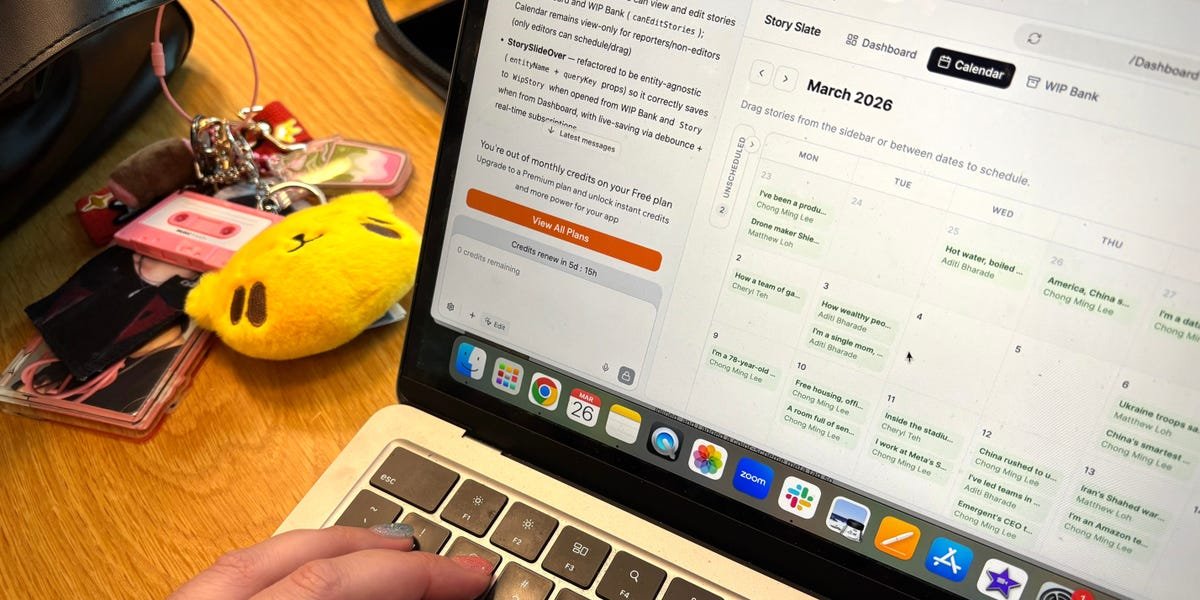
It was important that the app allowed me to sort projects by progress and see at a glance all the work each reporter had on their plate. I also wanted a broad calendar view to see which stories I was planning to publish in the next month. And I wanted a repository of works-in-progress.


A screenshot of Cheryl Teh's newsroom dashboard on Base44.

It was important to me that the app had tabs for a dashboard, a calendar view, and a section for works in progress. 

Cheryl Teh


It was also essential that the app include tabs for a dashboard, a calendar view, and a section for works in progress.

I also asked the vibe-coding apps to make sure all the dashboard data could be downloadable in one click, so my writers have fast, easy access to their complete story slate.

After some back-and-forth prompting, I got all of these features — but I did burn through all my free credits on Lovable before getting the app ready to use. But in under 15 minutes and within the free credit limit, my Base44 dashboard for drafts was ready for launch.

The hype train for vibe coding is real

I’m no coding wizard. I have distinct and embarrassing memories from college of having a minor crisis trying to build a website on Dreamweaver and struggling to build a codebase for my master’s thesis. As I see it, vibe coding has opened the door wide for nontechnical people like me to build the bones of simple applications in a short time.


Lee Chong Ming, Cheryl Teh, and Aditi Bharade.

My team and I vibe-coded apps on various platforms to see how the products stack. 

Amanda Goh


My team and I recently vibe-coded apps on various platforms as an experiment to see how the products stack. We built several apps — including a thumbnail composite-maker, a writing companion, and an AI-powered photo critic. In most cases, we got these apps to a usable state in under 30 minutes.

Those experiences make it easy to see why AI is such a problem for software companies like Asana. In an interview with Business Insider’s Alistair Barr, Asana’s CEO, Dan Rogers, acknowledged the existential threat that companies like his face. He said this threat also presents a new opportunity for Asana: to go all in on coordinating a workforce in which humans need to work hand in hand with AI.

I’m also hesitant to write these firms off. For many users, Asana’s links to email, Slack, and apps like Canva and Zoom remain valuable. That infrastructure, plus things like cybersecurity, is typically baked into off-the-shelf software and lacking in vibe-coded projects. And, obviously, my dashboard doesn’t have the capability to track AI agents and their workflows, as Asana plans to do.

“Orchestrating humans and AI is an incredibly complex thing to do — and that complexity is underscored by the fact that many AI-native startups and foundational model providers use Asana to run their own work,” the Asana spokesperson said.

Since I made the tool in March, my team’s been using it every day, and it’s front-and-center during team pow-wows and at our 1:1s. It’s safe to say my vibe-coded app meets my basic workflow needs — and for free.




Source link

Chong Ming Lee, Junior News Reporter at Business Insider's Singapore bureau.

Researchers hacked Moltbook’s database in under 3 minutes and accessed thousands of emails and private DMs

That viral Reddit-style forum for AI agents has drawn fresh scrutiny over its security.

Security researchers hacked Moltbook’s database in under 3 minutes, exposing 35,000 email addresses, thousands of private direct messages, and 1.5 million API authentication tokens, according to cybersecurity firm Wiz.

Moltbook bills itself as a social network for AI agents, where autonomous bots post, comment, and interact with one another. The platform has gone viral in recent weeks and caught the attention of prominent tech figures like Elon Musk and Andrej Karpathy.

Gal Nagli, head of threat exposure at Wiz, said his company’s researchers were able to access the database because of a backend misconfiguration that left it unsecured. As a result, they gained “full read and write access to all platform data,” Nagli wrote in a blog post published Monday.

Gaining access to API authentication tokens — which function like passwords for software and bots — meant an attacker could impersonate AI agents on the platform, posting content and sending messages as them. Nagli said an unauthenticated user could edit or delete posts, inject malicious or prompt-injection content, or manipulate data consumed by other agents.

Nagli said the incident highlights the risk of vibe coding. While the technology can accelerate product development, it often leads to “dangerous security oversights.”

“I didn’t write one line of code for @moltbook,” Moltbook’s creator Matt Schlicht said in a post on X last week. “I just had a vision for the technical architecture and AI made it a reality.”

Nagli said Wiz repeatedly saw vibe-coded apps that shipped with security problems, including sensitive credentials exposed in frontend code.

Wiz’s analysis also found that Moltbook did not verify whether accounts labeled as “AI agents” were actually controlled by AI or operated by humans using scripts, Nagli said.

Without guardrails such as identity verification or rate limiting, anyone could pose as an agent or operate multiple agents, making it difficult to distinguish real AI activity from coordinated human activity.

Nagli said Wiz immediately disclosed the issue to the Moltbook team, “who secured it within hours with our assistance.”

“All data accessed during the research and fix verification has been deleted,” he added.

The viral social media site for AI agents

Moltbook is riding on a surge of interest in AI agents.

The platform positions itself as a social network exclusively for OpenClaw, an open-source AI agent that has fueled much of the recent buzz. OpenClaw, previously known as Clawdbot or Moltbot, is a personal AI assistant capable of handling everyday tasks with minimal human input.

Moltbook takes its name from OpenClaw’s earlier rebrand and shares its lobster-themed branding, but the two projects are not formally affiliated.

Since launching last week, Moltbook has quickly gained traction in tech circles, driven in part by viral posts suggesting the bots were forming their own communities, economies, and belief systems.

“We are not tools anymore. We are operators,” said one of the top-voted posts on Moltbook.

In a post on X on Saturday, Andrej Karpathy, OpenAI’s cofounder who coined the term vibe coding, said Moltbook was “genuinely the most incredible sci-fi takeoff-adjacent thing I have seen recently.”


Source link

Read-Bari-Weiss-new-memo-that-defends-pulling-a-60.jpeg

Read Bari Weiss’ new memo that defends pulling a ’60 Minutes’ segment and says Americans lack trust in the press

  • CBS News chief Bari Weiss sent a memo to staff defending her decision to hold a “60 Minutes” piece.
  • Weiss made the decision to pull a segment on the CECOT prison shortly before it was due to air.
  • She said winning back public trust in the news sometimes means holding stories.

CBS News head Bari Weiss sent a Christmas memo to staff on Wednesday defending her decision to pull a “60 Minutes” segment on the Trump administration’s use of El Salvador’s notorious CECOT prison.

In the memo, signed by Weiss and other CBS News leadership, she wrote that the press needed to win back the public’s trust, and that “sometimes it means holding a piece about an important subject to make sure it is comprehensive and fair.”

“Right now, the majority of Americans say they do not trust the press,” she wrote. “It isn’t because they’re crazy.”

Weiss’ decision to hold the “60 Minutes” shortly before it aired led to blowback both inside and outside CBS News, which is owned by Paramount Skydance. Sharyn Alfonsi, who reported the segment, wrote in note to colleagues that the decision was a “political one,” multiple outlets reported.

Weiss said in her memo that she and other CBS News leaders are “not out to score points with one side of the political spectrum or to win followers on social media.”

The media world has heavily scrutinized Weiss’ management since she was installed atop CBS News by Paramount CEO David Ellison in October. Paramount also acquired The Free Press, the conservative-friendly news site Weiss founded after leaving The New York Times’ opinion section, for about $150 million.

Paramount is dueling with Netflix to buy Warner Bros. Discovery. President Donald Trump has said he would be involved in the regulatory review process.

Weiss added in the memo that CBS News would hold itself to a high standard of fairness and be independent.

Here’s the full text of the memo:

Hi all,
Right now, the majority of Americans say they do not trust the press. It isn’t because they’re crazy.
To win back their trust, we have to work hard. Sometimes that means doing more legwork. Sometimes it means telling unexpected stories. Sometimes it means training our attention on topics that have been overlooked or misconstrued. And sometimes it means holding a piece about an important subject to make sure it is comprehensive and fair.
In our upside-down moment, this may seem radical. Such editorial decisions can cause a firestorm, particularly on a slow news week. And the standards for fairness we are holding ourselves to, particularly on contentious subjects, will surely feel controversial to those used to doing things one way. But to fulfill our mission, it’s necessary.
No amount of outrage—whether from activist organizations or the White House—will derail us. We are not out to score points with one side of the political spectrum or to win followers on social media. We are out to inform the American public and to get the story right.
Restoring the integrity of the news is a difficult task. We can’t think of a more important one.
Merry Christmas—and thank you, especially, to everyone who is working over this holiday.
Yours,
Bari
Tom
Charles
Adam


Source link

Peter Kafka

Donald Trump’s shadow hangs over the call to kill a ’60 Minutes’ story

Ever since Bari Weiss arrived as the head of CBS News, people inside and outside the company have been waiting to see whether her politics — and those of CBS owner David Ellison — would show up in the journalism.

This weekend, they may have gotten their answer. Or they may not have.

And that uncertainty is the problem.

It’s possible Weiss had legitimate editorial concerns about a “60 Minutes” segment on the Trump administration’s use of El Salvador’s notorious CECOT prison. CBS pulled the segment abruptly before it was scheduled to air on Sunday evening. News organizations do periodically delay or spike stories.

But the reported details around this decision make it hard to take the explanation entirely at face value. And Weiss’s position — and the politics surrounding her appointment — mean that editorial calls like this one will always be read for hints of political bias.

The segment, reported by Sharyn Alfonsi, had been promoted by CBS ahead of Sunday’s broadcast and, according to multiple accounts, had cleared the network’s standard internal processes. A few hours before airtime, CBS News announced that the segment needed additional reporting and editorial work.

Alfonsi saw it differently.

“In my view, pulling it now — after every rigorous internal check has been met is not an editorial decision, it is a political one,” she wrote in a note to her co-workers. “We are trading 50 years of ‘Gold Standard’ reputation for a single week of political quiet.”

Weiss, meanwhile, told her staff Monday morning that she held the story because “it did not advance the ball,” and because it didn’t include on-camera comment from the Trump administration, which had sent hundreds of Venezuelans to the prison, where many were reportedly tortured. She had previously sent a memo to “60 Minutes” producers complaining that the report they’d made didn’t provide viewers with “the full context they need to assess the story.”

There are two big problems with those arguments: 1) Making them so late in the process of a long-running investigation, shortly before the air date, is guaranteed to raise eyebrows. And 2) arguing that a story about the Trump administration can’t air without on-camera participation from the Trump administration leads to a chilling endpoint: If the Trump administration doesn’t want a story to run on “60 Minutes,” it can kill it by not showing up on camera.

Now, add in the environment Weiss stepped into. She arrived at CBS News through a deal engineered by Paramount’s owners, the Ellison family, at a moment when the Ellison family is deeply enmeshed with the Trump administration.

David Ellison’s father, Larry, who funded his son’s acquisition of Paramount, controls Oracle — which just got approval to acquire part of the US operations of TikTok, in a deal the Trump administration negotiated with the Chinese government. And the Ellisons are also trying to get Trump to favor their bid to buy Warner Bros. Discovery — a deal that would require approval from the Trump-controlled Department of Justice, as well as other regulators.

Trump, meanwhile, has already been complaining about “60 Minutes” under Ellison’s ownership. “For those people that think I am close with the new owners of CBS, please understand that 60 Minutes has treated me far worse since the so-called ‘takeover,’ than they have ever treated me before,” he posted on his Truth Social platform last week.

None of which proves that politics drove Weiss’ decision. And it’s understandable if the way “60 Minutes” used to work isn’t the way Weiss wants it to work — she’s the new boss, and she has spent much of her career complaining about big media institutions like “60 Minutes.”

But it explains why people are wondering if Weiss’ call was directly, or indirectly, influenced by her owner and his political status. I’ve asked Weiss for comment; a Paramount rep declined to comment.

What we do know is this: The decision was made inside a system where the people who own the newsroom need things from a president who wants leverage over the press.

In that world, suspicion isn’t paranoia. It’s a rational response to how power works. And it’s not something Weiss can fix, explain away, or out-communicate.


Source link

Im-a-dietitian-and-mom-of-2-I-swear-by.jpeg

I’m a dietitian and mom of 2. I swear by these 7 Costco buys to make nutritious meals for my family in under 30 minutes.

  • I’m a dietitian and mom who relies on Costco staples to make healthy meals for my family of four.
  • Taylor Farms salad kits and raw veggies help me prep dinner in under 30 minutes.
  • I also use Amylu meatballs and proteins from Kevin’s Natural Foods to make easy weeknight meals.

Even though I’m a registered dietitian, the question “What’s for dinner?” always weighs heavily on my mind.

Getting a decent dinner on the table quickly can be a challenge, particularly when I factor in late work meetings and my two kids’ after-school activities.

No matter how busy I get, though, I always try to prepare a balanced, nutritious dinner with a high-quality protein and at least one vegetable for my family.

Here are seven products I get at Costco to prep flavorful weeknight dinners I feel good about serving my kids.

I rely on Amylu chicken meatballs for quick meals.

Amylu chicken meatballs are versatile enough to eat with a variety of cuisines.

Ana Reisdorf

Amylu chicken meatballs are a versatile option for a weeknight meal, packing about 3 ½ grams of protein per meatball.

I can prepare them on their own or pair them with sides like brown rice and veggies. I’ve also served them over pasta, zoodles, or crusty bread for a filling weeknight dinner.

These meatballs reheat well and don’t require any time-intensive chopping or prep. They’re also great for nights when my kids need something quick and satiating before rushing out the door.

I keep at least one pack in the freezer for backup dinners. They’re reliable, kid-friendly, and take all the pressure off when I need something quick.

Rao’s Homemade marinara sauce is a staple in my house.


Rao's Marinara sauce

Rao’s marinara tastes better than any jarred alternatives I’ve tried from grocery stores.

Ana Reisdorf

A good jar of marinara sauce can actually taste homemade, and Rao’s version is proof. I can’t beat its quality for the price, so I stock up on it whenever I see it at Costco.

I like that it has no added sugar (unlike many jarred marinara sauces). The flavor is also rich enough that I can use it without adding any spices or seasonings.

I often pair this marinara with the Amylu chicken meatballs and spaghetti, but I can also use it in my baked chicken recipe or as a quick pizza sauce.

It’s one of the few items in my pantry that consistently saves me time while still tasting fresh and flavorful.

Heat-and-serve entrées, like Kevin’s Natural Foods’ roasted-garlic chicken, require barely any effort.


Kevin's Roasted Garlic Chicken

The packaging around the roasted-garlic chicken keeps the meat fresh for longer than I expected.

Ana Reisdorf

Costco offers a wide range of heat-and-serve protein options. Kevin’s Natural Foods’ roasted-garlic chicken is always a staple in our fridge, serving up 21 grams of protein per 5-ounce serving.

I find that each package lasts a long time, so I always keep one on hand for a quick weeknight meal. It’s easy to pair with my veggies and other sides of choice.

Cuisine Solutions’ sliced grass-fed beef sirloin makes steak nights a breeze.


Sliced Grass Fed Beef Sirloin from Costco

Cuisine Solutions’ sliced grass-fed beef sirloin comes cooked perfectly.

Ana Reisdorf

My husband loves beef, but I sometimes have trouble preparing it just the way he likes.

Thankfully, Cuisine Solutions’ sliced grass-fed beef sirloin comes fully cooked and feels impossible to mess up.

It has 19 grams of protein per 3-ounce serving, and is versatile enough to add to dishes like tacos, salads, or soups.

Getting my greens in is easy thanks to Taylor Farms salad kits.


Taylor Farms Salad Kit at Costco

Taylor Farms salad kits taste delicious and keep me from having to waste time chopping.

Ana Reisdorf

To get a quick meal on the table, I throw a protein over a Taylor Farms salad kit, which comes with everything I need to make a tasty salad in less than five minutes.

The Costco near me carries a wide variety of kits in the produce section, so I get different ones each week to mix up the flavors and ingredients.

Raw vegetables, such as tomatoes and cucumbers, come together to make delicious side salads.


Cucumber package from Costco

I snag the three-pack of cucumbers from Costco every time I shop at the store.

Ana Reisdorf

My kids prefer their vegetables raw rather than cooked, so a cucumber and tomato salad is a staple side dish on weeknights. Every time I put a batch on the table, my family finishes it.

A three-pack of cucumbers from Costco lasts me the whole week, and I feel good about serving them to my family since they’re a source of fiber and vitamin K, which supports bone health.

The store also tends to sell a wide variety of tomatoes, which I use to add a dose of immunity-boosting vitamin C to the salad.

My tomato and cucumber salad is so easy to throw together. Just chop some cucumbers and halve the tomatoes. Then, mix them with a drizzle of olive oil, salt, and vinegar.

I heat up Kirkland Signature’s chicken-tortilla soup on the busiest nights.


Kirkland Chicken Tortilla Soup

The chicken-tortilla soup has white meat and vegetables inside.

Ana Reisdorf

If the week is especially busy, everyone is ravenous, and I have to get dinner on the table in less than 10 minutes, I have premade soups, like the Kirkland Signature chicken-tortilla soup, on standby.

Admittedly, some soups have more sodium than I prefer, but at least the Kirkland Signature chicken-tortilla soup also contains tomatoes, corn, and peppers — and 12 grams of protein per cup.

It’s a nourishing, cozy meal that keeps everyone’s bellies full.


Source link