

Matthew Loh Headshot

The US has less than 1 month left of its THAAD and PrSM missile stockpiles amid Iran fight: analysts

US stockpiles of advanced air defense interceptors and ground-attack missiles will run dry in weeks if the fighting pace with Iran continues, three analysts have warned.

Their commentary, published on Tuesday by the UK-based think tank Royal United Services Institute, indicated that the US would have depleted its Terminal High Altitude Area Defense, or THAAD, interceptors by April 17.

Munitions stockpiles for its Army Tactical Missile Systems and Precision Strike Missile, or ATACMS and PrSM, would run out more quickly, by April 12, they said.

The three analysts — independent researcher MacDonald Amoah and The Payne Institute of Public Policy’s Morgan D. Bazilian and Lt. Col. Jahara Matisek — projected a more dire situation for Israel’s Arrow 2 and Arrow 3 anti-ballistic missile stockpiles. Those would last only until Friday, they estimated.

“While the war could proceed with other munitions, this implies accepting greater risk for aircraft and tolerating more missile and drone ‘leakers’ damaging forces and infrastructure,” the analysis said.

Such stockpiles have long been a concern for the US, with fears that depleting them would undermine the Pentagon’s ability to maintain deterrence in other theaters, such as the Indo-Pacific.

The THAAD is considered one of the best missile defense systems in the world, with the touted rare ability to intercept long-range ballistic missiles and other threats inside Earth’s atmosphere.

Two to three of these US-operated batteries are believed to be in the Middle East, out of a total of five known to be deployed outside the continental US. Their interceptors can cost up to $15 million each.

Meanwhile, the ATACMS and the PrSM are precise, ground-launched missiles for striking other ground targets more than 180 miles away.

The PrSM is a newer munition, intended to eventually replace ATACMS, and made its combat debut in the Iran war. Defense Department records show that the US has manufactured at least 328 of these missiles in the last two years, with another 124 planned for this year.

“Our analysis shows that the coalition can continue fighting Iran, but with increased risk to forces in-theatre,” the analysts wrote. “The bigger risk, however, is what continued fighting against Iran does to deterrence and defence elsewhere.”

The Pentagon did not immediately respond to a request for comment sent outside regular business hours by Business Insider.

Replacing 11,000 munitions

Overall, the researchers said they tracked the US and its allies in the Middle East expending 11,294 munitions in the initial 16 days of the war. Roughly 5,000 of these — both for offensive strikes and air defense — were fired in the first four days of the conflict, they said.

When it comes to air defense, Iran’s retaliatory drone and missile attacks have since dropped sharply. After the war’s first four days, Gen. Dan Caine, the chairman of the Joint Chiefs of Staff, said ballistic missile launches and drone attacks plunged 86% and 73%, respectively.

The researchers said they tracked a daily average of 33 Iranian missile attacks and 94 drone strikes after the initial drop. And defeating one of these threats can take multiple munitions.

“Given that Iran has damaged at least a dozen US and allied radars and satellite terminals, the efficiency of interception decreases; using 10 or 11 interceptors for one missile or 8 Patriot missiles for one drone becomes unsustainable,” the researchers wrote.

They especially warned of challenges the US faces in its defense industrial base and rare-metal supply when replenishing those stocks. If the US wants to do so at speed, the total bill so far is likely to reach $50 billion, they said.

As an example, the trio estimated that the US fired more than 500 Tomahawk missiles against Iran, saying they would take “at least five years” to replace.

Meanwhile, restocking the roughly half a million 20mm rounds fired from air defense systems during the war also requires about 8,800 pounds of tungsten, they added. China is known to control over 80% of the global supply of the metal.

Besides recommending that the US invest heavily in its industrial base, the researchers urged building a “patchwork shield” by layering cheaper and more advanced air defenses that can be mixed and matched on the fly.

“Command of the commons remains necessary, but Epic Fury demonstrates it is increasingly insufficient without ‘Command of the Reload,'” they wrote.



Source link

Passengers-evacuated-Dubai-airport-after-it-was-hit-with-a.jpeg

Passengers evacuated Dubai airport after it was hit with a missile

  • Dubai International Airport was damaged in an attack on Saturday.
  • The airport said four staff members sustained injuries.
  • A passenger told Business Insider they’d received a missile warning before the incident.

One of the world’s busiest airports was just evacuated after a suspected air strike.

Dubai International Airport (DXB) said that the airport had “sustained minor damage in an incident, which was quickly contained.”

Videos online show debris on the ground and smoke filling the terminal as travelers rush to the exits. Others show emergency vehicles on site.

“Four staff sustained injuries and received prompt medical attention,” the airport said. “Due to contingency plans already in place, most of the terminals were previously cleared of passengers.”

The airport said more updates will be provided “as they become available.” It’s unclear if there were other injuries.

The attack came as Iran continues to send missiles across the Middle East in response to joint US-Israel strikes on Saturday, which Trump said had killed Iran’s Supreme Leader, Ayatollah Ali Khamenei.

Dubai’s other airport, Dubai World Center — Al Maktoum International (DWC), said its operations were suspended until further notice and told passengers not to go to the airport.

Kuwait’s Public Authority for Civil Aviation said a drone hit Kuwait International Airport earlier Saturday, causing injuries and damage. It added that the site was secure as the airport assessed the damage and needed repairs. It’s unclear if it was an Iranian drone.


Screenshot of alert.

A screenshot of Jaiveer Cheema’s phone showing the alert.

Courtesy of Jaiveer Cheema


Emirates passenger Jaiveer Cheema, who has been stuck in Dubai for hours after his flight was canceled amid the air strikes, told Business Insider that he got an alert on his phone around 12:30 a.m. local time that there was a potential missile threat.

The attack on DXB happened soon after. Cheema was at a hotel by then, but said “everyone is taking shelter in the bottom floor of the hotel.”

This is a developing story…


Source link

The-Pentagon-says-China-has-fielded-a-new-long-range-missile.jpeg

The Pentagon says China has fielded a new long-range missile. Here’s why the DF-27 is unusual.

China appears to have fielded a new intercontinental ballistic missile, the DF-27, which can range the continental US and, unlike other ICBMs, serve a mix of missions, including targeting ships, a new Pentagon report says.

The Department of Defense’s annual report on the Chinese military, the latest of which came out last week, is the first public assessment that the missile is operational. The missile is said to have a land-attack and anti-ship role.

The latter role is unusual for an intercontinental-range ballistic missile, as is its conventional strike role documented in the new Pentagon report. ICBMs are primarily for nuclear strike.

The latest report offers little on the new missile beyond a map showing China’s “fielded conventional strike.” The DF-27, identified as an ICBM with a range of 5,000 to 8,000 km, shorter than some other systems built for strategic nuclear strike, is a new addition to that map showing Chinese missile ranges.

That range completely covers Hawaii and Alaska, and it also extends into parts of the continental US. The exact reach might vary depending on the launch site, but broadly, the weapon puts naval forces and US military installations across the Pacific at risk in a new way.

A “long-range” DF-27 missile was first mentioned in the 2021 Pentagon report. It said that indications on the range hinted at either an intercontinental- or intermediate-range missile. That uncertainty persisted until the 2025 report identified it as an ICBM.

The 2024 Pentagon report notably offered the most detail, stating that the DF-27 had been “deployed” to the Rocket Force. It added that this weapon likely has an option for an HGV, a hypersonic glide vehicle, “as well as conventional land-attack, conventional antiship, and nuclear capabilities.” The 2025 report, however, did not put the weapon under “fielded nuclear capabilities.”

According to the Missile Defense Advocacy Alliance, the DF-27 carries potentially significant strategic implications.

In an early assessment of the Chinese missile published two years ago, the group cited a leaked intelligence briefing indicating the missile was tested in February 2023 and warned that it could give China another means to hold targets at risk beyond the second island chain, with a high likelihood of being able to penetrate US ballistic-missile defenses and the potential to serve as a “carrier killer.”

China has not publicly commented on the DF-27, though local media have at times approached the topic indirectly.


A map showing estimated ranges of Chinese missiles outside of the mainland and towards other regions.

The estimated ranges of Chinese missiles across the region and towards the US.

US Department of Defense


Fielding the new DF-27 makes China the first to have an operational, conventionally armed ICBM. The US and Russia have not fielded similar capabilities; however, both have been pursuing new intermediate-range capabilities since the collapse of the Intermediate-Range Nuclear Forces Treaty, which the US walked away from in 2019 after accusing Russia of non-compliance.

The DF-27 is the latest example of China’s efforts to develop and field varied, flexible strike options for a potential conflict. The missile branch of its military, called the People’s Liberation Army’s Rocket Force, has grown exponentially, and Chinese military doctrine emphasizes the need for it to possess the ability to quickly, precisely, and, in some cases, preemptively strike targets.

With the new DF-27 ICBM, “China became the first to field an analogous capability: a conventional ICBM—with an ASBM variant—that can conduct rapid, long-range precision strikes out to intercontinental distances, including against its ‘strong enemy’s’ homeland and its naval forces at sea,” Andrew Erickson, a professor at the US Naval War College’s China Maritime Studies Inistitute, wrote last week.

Since the Pentagon’s annual reports cover only developments from the previous year, the newest one doesn’t include other notable missile developments in China from this year. An important development in September was Beijing’s reveal of the DF-61 and DF-31BJ, both ICBMs, at a military parade.

It’s unclear whether those missiles are operational, but even if they’re still in development, the implications of the presentation in the Chinese capital are that these missiles will eventually be additions to China’s already sizable land-based ICBM arsenal.


Source link

New-Pentagon-maps-show-the-reach-of-Chinas-expanding-missile.jpeg

New Pentagon maps show the reach of China’s expanding missile force

China’s missile arsenal is expanding rapidly, and new maps and data from the Pentagon show its size and reach.

China’s missile branch, known as the People’s Liberation Army Rocket Force, has seen substantial growth in recent years as Beijing builds new platforms for conventional and nuclear strike. Its capabilities threaten US, allied, and partner forces.

The latest Pentagon report on China’s military offers estimates for the number of launchers and missiles in the Chinese arsenal, including the country’s intercontinental ballistic missiles, key parts of its nuclear deterrent.

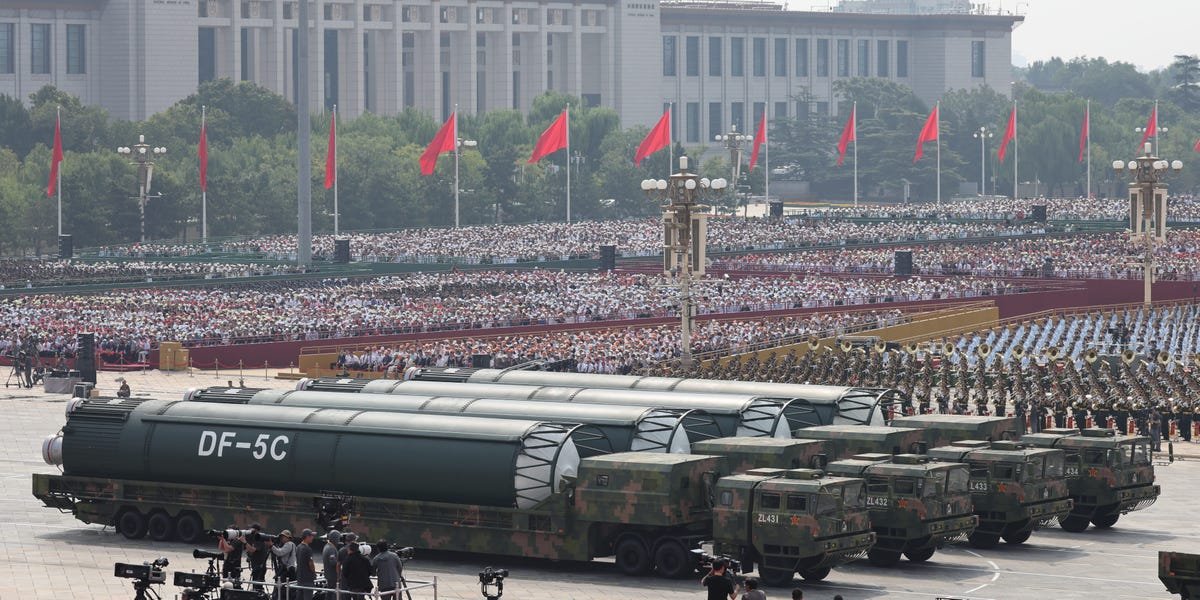
Chinese ICBMs include missiles like the DF-5 and DF-41. The Pentagon estimates China has 550 ICBM launchers and 400 missiles with estimated ranges beyond 5,500 km, the threshold for classification as an ICBM.


A chart showing the estimated ranges, missile numbers, and launcher numbers based on each system and class of China's missiles.

Estimated numbers of missiles and launchers for Chinese missiles, specifically ground-launched cruise missiles (GLCMs), short-range ballistic missiles (SRBMs), medium-range ballistic missiles (MRBMs), intermediate-range ballistic missiles (IRBMs), and ICBMs.

US Department of Defense


For China’s medium-range ballistic missiles, such as China’s DF-21s or hypersonic DF-17, the Pentagon assesses that China has 300 launchers for 1,300 missiles with ranges between 1,000 and 3,000 km. The report also documented increases in the number of launchers and missiles for some notable systems. China’s intermediate-range ballistic missiles, like the DF-26 missile, jumped from 250 launchers in last year’s report to 300 this year, and the number of IRBMs total went from 500 to 550.

These figures illustrate how heavily Beijing has invested in a powerful, diverse missile arsenal. The Pentagon highlighted in its report that the Rocket Force could play an important role in a Chinese invasion of Taiwan or other regional conflict.

According to the latest report, China’s rocket force “is prepared to conduct missile attacks against high-value targets, including Taiwan’s C2 [command and control] facilities, air bases, and radar sites” as well as deter or delay the US or its allies and partners from coming to Taiwan’s aid.

The Pentagon said that the Rocket Force has continued to rehearse strikes in recent military exercises, including 2024 drills simulating an invasion or blockade of Taiwan.


A map showing missile ranges in the Taiwan Strait.

The estimated ranges of Chinese missiles relevant to a Taiwan fight.

US Department of Defense


One map in the report shows the estimated reach of Chinese missiles that could be particularly relevant in a fight over Taiwan, weapons such as ship- and shore-launched surface-to-air missiles for knocking out hostile aircraft, as well as anti-ship cruise missiles fired from naval platforms like Chinese destroyers and land-based close- and short-range ballistic missiles.

Another Pentagon map shows the estimated reach of China’s conventional strike missiles, including the DF-17 and DF-21 MRBMs, the DF-26 IRBM, and the newly fielded DF-27 ICBM, which, like the DF-26 and some DF-21s, has an anti-ship role in addition to land attack.

Many of these systems can reach across the first island chain, which includes Japan, Taiwan, and the Philippines, while longer-range missiles extend toward the second island chain and beyond.

The DF-26 is concerning for US planners. The weapon, nicknamed the “Guam Express,” can be armed with either conventional or nuclear warheads and reach US installations on Guam. It can target US aircraft carriers and other surface ships as well.

Bombers, like China’s H-6, carrying CJ-20 cruise missiles could threaten parts of Alaska. And then the ICBMs can range significantly further. The DF-27 can, for instance, range parts of the continental United States.


A map showing estimated ranges of Chinese missiles outside of the mainland and towards other regions.

The estimated ranges of Chinese missiles with regional reach.

US Department of Defense


The Department of Defense report also looks at China’s nuclear strike options, such as land-based ICBMs and submarine-launched ballistic missiles.

China test-launched an ICBM, specifically a DF-31B missile, in September 2024, firing it from a position on Hainan Island into the Pacific. The test was the first beyond the country’s borders since the 1980s and allowed China to verify ICBM performance. The Department of Defense suspects weapons tests like these may become more regular.

This year, at a military parade in Beijing, China unveiled new, previously unseen ICBMs, shocking China watchers. Those weapons, including the new DF-61 and DF-31BJ, are not included in the Pentagon’s assessments.

China also continues to bolster its nuclear warhead count, estimated at over 600 warheads. Although 2024 saw a slower rate of production than previous years, the Pentagon still assesses that the Chinese military is on its way to 1,000 warheads by 2030, only a fraction of the US and Russian stockpiles.


A map showing the estimated ranges of China's missiles from Asia over the North Pole.

The estimated ranges of Chinese nuclear missiles.

US Department of Defense


A Pentagon map estimating the ranges of Chinese missiles available for nuclear strike indicates that three — the DF-5, DF-41, and DF-31 — all have the continental US well within range, while the submarine-launched JL-3 missile can hit most of it from waters near China. On a submarine positioned farther out, more targets could be within striking distance.

Despite these continued advancements, questions remain on the differences in quality and capabilities of Chinese weapons and training compared to the US. The Pentagon also believes China is still navigating the impacts of a vast anti-corruption campaign in the military that has particularly targeted PLARF officials.

The campaign could be detrimental if driven by political agendas, or it could deliver long-term improvements if it addresses actual problems within the force. At this point, it’s unclear how the changes will affect it.


Source link