NASA’s Artemis II mission reached a defining milestone on April 6, when its crew officially traveled farther from Earth than any humans in history.
The record-breaking moment came at around 1:57 p.m. ET, as the Orion spacecraft moved behind the moon and surpassed the distance set by the Apollo 13 mission. That earlier mission reached 248,655 miles from Earth under extraordinary circumstances after an oxygen tank explosion forced astronauts to abandon a planned landing and loop around the moon instead.
As Artemis II crossed that threshold, Mission Control played a prerecorded message from Jim Lovell, who was a part of the Apollo mission. He died last year at age 97
“Hello, Artemis II, this is Apollo astronaut Jim Lovell. Welcome to my old neighborhood,” he said. “I’m proud to pass that torch on to you as you swing around the moon and lay the groundwork for missions to Mars for the benefit of all.”
“It’s a historic day, and I know how busy you’ll be, but don’t forget to enjoy the view,” Lovell added. “So, Reid, Victor and Christina and Jeremy, and all the great teams supporting you, good luck and Godspeed from all of us here on the good Earth.”
From aboard Orion, Hansen responded.
“As we surpass the furthest distance humans have ever traveled from planet Earth, we do so honoring the extraordinary efforts and feats of our predecessors in human space exploration,” Hansen said.
President Donald Trump shared vivid details Tuesday night of the firefight that erupted as an American helicopter reached Nicolás Maduro’s compound during the US raid into Venezuela last month.
As the Chinook helicopter carrying elite US ground troops and piloted by Chief Warrant Officer 5 Eric Slover approached what the president had previously described as a fortress, “enemy machine guns fired from every angle,” Trump said during his State of the Union Address.
“Eric was hit very badly in the leg and hip,” the president said as he awarded the military’s top valor award, the Congressional Medal of Honor, to Slover.
Immediately following the January 3 raid to capture the then-president of Venezuela, Trump said that a helicopter got hit “pretty hard” and that “a couple of guys were hit.” Official details of the injuries were limited. His speech on Tuesday shed new light on what happened that night.
Stealth fighters and supersonic bombers were among the aircraft involved in the mission.
US Air Force Photo
After numerous American warplanes, including advanced stealth fighters, suppressed Venezuela’s air defense network, helicopters carrying ground troops moved in, approaching Maduro’s fortified compound.
Every time Kelsey publishes a story, you’ll get an alert straight to your inbox!
Stay connected to Kelsey and get more of their work as it publishes.
Slover’s helicopter encountered “two machine gunners who escaped the wrath of the previous planes,” Trump said. As the bullets hit the aircraft, Slover “absorbed four agonizing shots, shredding his leg into numerous pieces,” he continued. “He was gushing blood.”
Helicopter pilots rely on both a control stick and floor pedals for maneuvering. Most helicopters have one main rotor and a small tail rotor to keep them from spinning, but a Chinook has two large rotors that balance each other.
Despite his serious wounds, Slover managed to maneuver his helicopter into position so that onboard gunners could “take care of business” and “eliminate the threat,” the president said, crediting Slover with “saving the lives of his fellow warriors from what could have been a catastrophic crash, deep in enemy territory.”
After landing, Slover told his co-pilot, who was also wounded but not as gravely, to “take over,” saying, “I’m about ready to pass out.” A total of seven US troops were injured during the raid.
US First Lady Melania Trump was involved in presenting US veteran Captain E. Royce Williams with the Medal of Honor.
ANDREW CABALLERO-REYNOLDS / AFP via Getty Images
During his State of the Union address, Trump also presented a second Medal of Honor to centenarian US Navy pilot E. Royce Williams, a veteran of World War II and the Korean and Vietnam Wars.
Three years ago, Williams was awarded the Navy Cross for “extraordinary heroism” in a Korean War air battle in which he was outgunned and outmatched in his F9F Panther by Soviet MiG-15 fighters but still managed to shoot down four of them.
The 1952 dogfight was classified for decades.
The Congressional Medal of Honor is usually awarded in solemn, less politically charged ceremonies at the White House. The award can take years, or even decades, as was the case for Williams, to be bestowed. It requires eyewitness accounts and has strict criteria. Other valor awards, such as the Navy Cross or Silver Star, can occasionally be upgraded to a Medal of Honor, a notoriously lengthy process.
The top award is bestowed upon troops engaged against an enemy of the US or an “opposing foreign force,” according to the military’s awards manual.
That the medal was awarded during the State of the Union elicited reactions from some veterans online who felt that the timing dampened the gravity of the award’s significance.
During the event, Trump reiterated his previously stated desire to receive the Medal of Honor.
“I’ve always wanted the Congressional Medal of Honor, but I was informed, I’m not allowed to give it to myself,” Trump told the crowd. “I wouldn’t know why I’d be taking it, but if they ever open up that law, I will be there with you someday.”
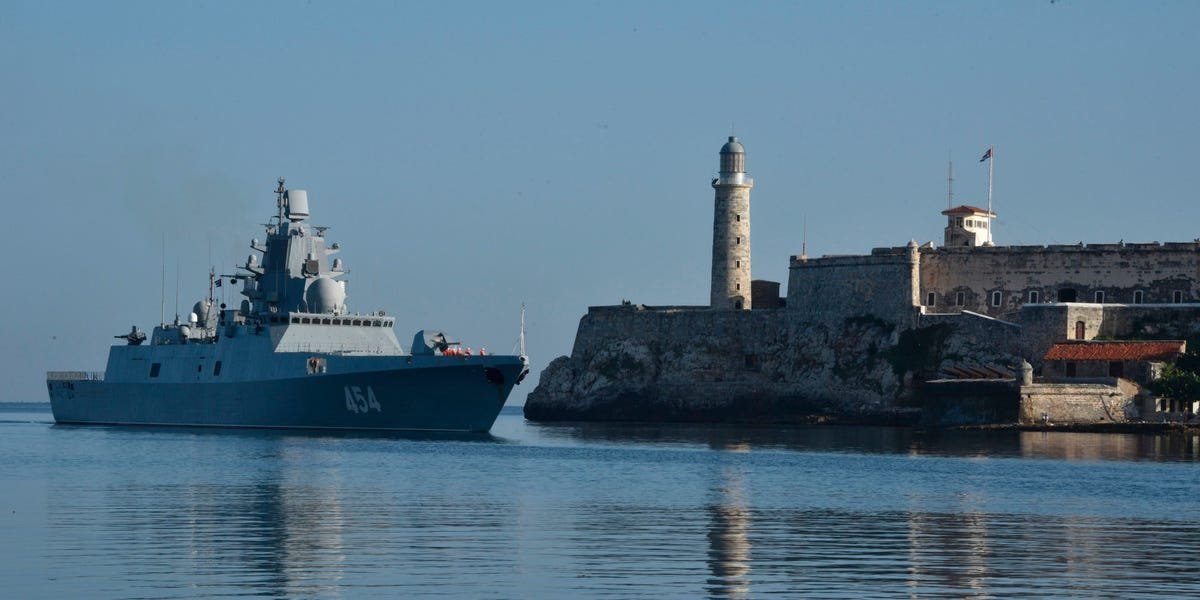
Russia sending warships to Cuba next week is an attempt to show its navy is still a global power after losses in the Black Sea, an unnamed US official told reporters, according to the Associated Press.
On Thursday, Cuba’s Ministry of Foreign Affairs said Russia was deploying four warships to Cuba, including a nuclear-powered submarine, with the vessels expected to be in Havana between June 12 and 17.
“Russia has sailed the Black Sea since 1783 but is now forced to constrain its fleet to port,” UK Defence Minister Grant Shapps wrote. “And even there Putin’s ships are sinking!”
This week, it was reported that Ukraine was using its exploding naval drones to go after smaller Russian vessels after Moscow pulled back its larger warships to reduce their vulnerability to attacks.
Not everyone agreed on Russia’s motive.
The visit of the ships, none of which will carry nuclear missiles, does not represent a threat to the region, the Cuban statement read, but was instead part of the historically cordial relations between the two countries.
But according to the US official, the deployment is an effort by Russia’s navy to flex its muscles on the world stage, after suffering losses in the Black Sea.
“This is about Russia showing that it’s still capable of some level of global power projection,” they said, per Reuters.
Russia’s navy has suffered a series of embarrassing setbacks in the Black Sea, where Ukraine claims to have destroyed a third of its fleet.
Ukraine has used drones, missiles, and other weaponry to take out many Russian warships, and has forced its fleet to seek safer ports further away from Crimea.
In March, the UK’s defense ministry declared Russia’s Black Sea Fleet “functionally inactive” after Ukraine claimed to have struck another two of its vessels.
Russia also shuffled its naval leadership earlier this year.
According to the unnamed US official, while the US expects “heightened” Russian naval and air activity this summer, and more going forward, deployments like those to Cuba incur costs for the Russian navy, which is “struggling to maintain readiness and conduct deployments with an aged fleet.”
In a military assessment on Thursday, the Washington DC-based think tank the Institute for the Study of War said it was likely part of an effort to bring back memories of the Cuban Missile Crisis, and dissuade the US from offering further support to Ukraine.
The deployment also comes after Putin threatened to send long-range weapons to “regions around the world” that want to strike Western targets.
Meanwhile, Russia’s Ministry of Defence said its goal was to keep a Russian naval presence in operationally important areas of the “far ocean zone,” RBC-Russia reported.