This story is available exclusively to Business Insider
subscribers. Become an Insider
and start reading now. Have an account? .
Faye Bradley was born and raised in Hong Kong with a Chinese mom.
When she first started seeing “Chinamaxxing” on social media, she felt a surprising sense of pride.
Even though these habits are trending now, they’ve been part of her life for years.
When I first saw “Chinamaxxing” on my feed, I was surprised by how happy it made me.
The viral trend — where people share Chinese lifestyle hacks, from wearing red for luck during Lunar New Year to banning outdoor shoes indoors — felt like watching the world embrace the culture I grew up with.
Around the same time, another phrase was everywhere: “You met me at a very Chinese time in my life.” The line went viral after Hong Kong-born stand-up comedian Jimmy O Yang posted a video of himself singing the well-known Chinese song “Yi Jian Mei” on Instagram in November, with those words splashed across the screen. The clip has since drawn more than 6.5 million views.
It was around the same time that New Jersey TikTok creator Sherry Zhu started sharing wellness tips with her “Chinese baddies.”
Summers in Hong Kong get hot, but Bradley’s mom always discouraged cold water. Proivded by Faye Bradley
Growing up in Hong Kong, I followed these habits long before they had a name. My mom talked constantly about balance: hot versus cold foods, drying your hair before bed, and the little miracles of White Flower Oil.
Watching the internet embrace these traditions made me reflect. Some explanations oversimplify centuries-old practices — feng shui isn’t just moving your desk, and traditional Chinese medicine (TCM) isn’t just a trendy tea. But the curiosity feels genuine.
Here are four simple things my mom taught me years ago that I still swear by.
1. The herbal ointment is a cure-all
Bradley’s mom would use White Flower Oil for aches, pains, and motion sickness; she now does the same. Provided by Faye Bradley
Growing up, my mom would reach for a tiny bottle of White Flower Oil, a concentrated ointment, whenever my brother or I complained about tummy aches.
A dab of the concentrated herbal ointment — that has a sharp smell that combines menthol, eucalyptus, and a hint of lavender — on my belly, temples, or behind my ears, and relief would follow almost instantly.
Today, I carry a small bottle whenever I travel and keep one at my bedside.
It’s also a staple for motion sickness, muscle aches, or even mild stomach pain.
2. Start every morning with a hot cup of water
Hot water helps her with digestion and circulation. Provided by Faye Bradley
My mom had firm rules about drinks. Hong Kong summers are stifling — often 90 degrees Fahrenheit and humid — yet anything cold in the morning was discouraged.
In TCM, hot water is believed to support digestion and circulation, while cold drinks can “shock” the body and disrupt internal balance.
Switching to hot water first thing in the morning may sound trivial, but it transformed my mornings. My energy feels steadier, my stomach calmer, and I start the day feeling grounded instead of jolted awake.
I used to brush off her advice, but after seeing my friends do the same, I began incorporating it into my routine in my late teens.
To think she was right all along.
3. Never go to bed with wet hair
She avoid going to sleep with wet hair. Provided by Faye Bradley
“You’ll get sick!” my mom would yell every time I tried to crawl into bed with damp hair.
I used to roll my eyes, but now, decades later, I have to admit she was right. Sleeping with wet hair often leaves me stiff, chilled, and inexplicably irritable — not just uncomfortable, but subtly disruptive to my body’s rhythm and sleep quality.
For me, blow-drying signals closure: a pause at the end of the day and a small act of respect for my body. By keeping warm and dry before bed, I wake up more rested, my muscles looser, and my mind calmer.
4. Don’t underestimate the rice cooker
Rick cookers can do more than make rice. Provided by Faye Bradley
I remember heading off to university in the UK and asking my future British flatmates in a group chat whether anyone was bringing a rice cooker. “What’s that?” they replied. “We just boil rice in a pan.” I was stunned. When I moved in, I quickly realized I couldn’t live without one. It makes the rice taste better.
And my rice cooker isn’t just for rice. My mom taught me it’s perfect for complete meals: chicken, vegetables, and rice all in one pot. The magic isn’t just convenience — steaming keeps food tender, flavorful, and healthy, locking in nutrients while reducing oil. It’s practical, too, with fewer pots to scrub.
It’s heartening to see these traditions embraced more widely. For me, they’ve always been simple acts of care; practical, grounding habits shaped by generations before us.
This as-told-to essay is based on a conversation with Cheska Hull, 40, a British reality TV star and PR professional who relocated to Phuket. Her words have been edited for length and clarity.
My move to Phuket was about choosing a fabulous place to live while continuing my freelance career.
I feel like I’ve been part of the island’s community for years. I’d visit annually for a couple of weeks at a time, maintain friendships, and get to know local business owners.
Every trip had me dreaming about potential jobs and interesting opportunities. I’m a PR specialist who has always worked in the luxury sector, across food, beverage, and hospitality. In London, I specialized in private members’ clubs.
That work also led me into radio and television, where I starred in the reality show “Made in Chelsea” for nearly four years. It helped me understand the evolving world of influencers and celebrities. Having lived on both sides of the PR and fame spectrum, I gained a deep understanding of that industry.
Every time Andre publishes a story, you’ll get an alert straight to your inbox!
Stay connected to Andre and get more of their work as it publishes.
In May 2011, Hull was a member of the original cast of the reality show “Made in Chelsea.”
Provided by Cheska Hull
I happened to be born in Thailand
My parents lived in Phuket in the 1980s, when my dad was head of Standard Chartered Bank for Phuket, which is why I was born here. We moved back to England when I was young.
Being born in Thailand didn’t simplify moving back as an expat. I still had to go through all the same steps as everyone else.
Initially, I came on a DTV digital nomad visa while freelancing for my UK clients. I told all of them, “I want to live in Thailand. That’s my dream.”
I wanted the best of both worlds.
There were a few reasons for the move
I’ve always been drawn to the famous Thai “sabai sabai” — take-it-easy — lifestyle. But when it comes to business, I’m driven. I could never just move to Phuket and not work.
Even between projects, I was constantly networking, talking to people, and pushing for collaborations with brands I’d worked with before. Now, I get to do what I’ve always loved in a place I love.
My son was also at the right age for a big change. As a single mom, the stress came from knowing how significant the move was and wondering, “Have I made the right decision?” My main priority in life is his happiness.
If he hadn’t been happy, I don’t think we would have stayed. But he’s 8, and he was able to fit in quickly — learning some Thai at school and thriving.
There was another catalyst, too. At the time, I was engaged to be married and realized that wasn’t the path for me anymore. Once I called off the wedding, the door felt wide open.
Nothing was holding me back.
She says her 8-year-old son is learning Thai at school and has fit in quickly.
Provided by Cheska Hull
Finding my career groove in Thailand
Browsing jobs in Phuket started as a guilty pleasure. Through meeting people and networking, someone told me about a new opening at Anantara, a hotel I already knew well. It seemed perfect. And so now, as cluster director of public relations, I have a work permit.
I’ve had to quickly learn Thai workplace customs, like addressing colleagues respectfully using “khun” before names or navigating the widespread use of nicknames. It’s about understanding a different culture and being respectful within it.
One of my favorite rituals happens every Friday during my team’s morning meeting. We go outside to a huge tree in front of the hotel with two spirit houses. We all take incense, make a prayer, and privately speak to the spirits. It’s so different and unique, I find it special.
It’s a meaningful part of their culture that I’ve come to love. I can’t imagine trying to get everyone in London to do that, they’d laugh.
She plans to stay in Phuket.
Provided by Cheska Hull
Thailand is my long-term plan
There haven’t been many hard parts to settling in. The main challenge of living on a small, seasonal island like Phuket is traffic. You get used to a calm pace, and then suddenly there’s a massive influx of people. But that comes with the territory in hospitality and tourism, which is ultimately what we want here.
My move to Thailand is long-term. Looking back, there was an element of risk. I came with a bit of an “Eat, Pray, Love” vision. I knew I loved it here and wanted it to work, but I also told myself, “If it doesn’t, you can just go back.”
For me, the quality of life, the people, the food, the weather — just about everything about Phuket — makes it a place I want to call home forever. Island life simply couldn’t be better right now.
Do you have a story to share about living abroad? Contact the editor at akarplus@businessinsider.com.
After five years in Qatar, Elisa Orsi and her husband, David Sleight, knew they were ready to leave the desert behind.
They had moved from Australia to the Middle Eastern country in 2019 with their three kids — all under 6 — after Sleight accepted ajob there.
Already big travelers before they had kids, the couple used school holidays to see the world after starting a family, before later leveraging Sleight’s teaching career to travel even more.
The family moved to Qatar from Australia because they wanted to experience more of the world.
“Usually when people have children, it deters them from travel, but we went completely the other way,” Orsi, 37, a stay-at-home mom, told Business Insider.
Life in Qatar felt safe and comfortable, and it served as a base from which they could explore the region, traveling to places like Jordan, Turkey, and Egypt.
Every time Amanda publishes a story, you’ll get an alert straight to your inbox!
Stay connected to Amanda and get more of their work as it publishes.
Gradually, the couple found themselves looking for something new.
“By the time we came back from our summer holiday in 2024, we said, ‘OK, we’re done. We need a change,'” Orsi said.
In August 2024, the family packed up their bags and moved to Hangzhou, a bustling city in eastern China.
Moving to China
China had been on their radar for a long time, though neither of them had visited before.
It wasn’t until Sleight came across an online job ad for a teaching role in Hangzhou that they began looking into the city.
The family had traveled through other parts of Asia and always wondered what life in China was like.
“I was impressed with the natural beauty and how modern the city appeared. I knew China was very well connected by the railway infrastructure, so I wasn’t overly concerned about the location,” Sleight, 45, told Business Insider.
The couple looped their kids, who are now 11, 9, and 7, into the conversation about moving to China early. “We wanted to give them lots of time to process and to get an understanding of what was happening,” she said.
“We have a philosophy that we talk to our children, and we keep them informed about the decisions we make,” Orsi said.
The couple involved their three young children in conversations about the move early on.
To ease the transition, they showed their kids YouTube videos about China and the school they would attend.
When they arrived in Hangzhou, Orsi said their first impressions quickly put any lingering nerves at ease.
“We were actually quite shocked to see how clean, how modern, how organized, and how convenient everything is,” Orsi said. “Sometimes you watch videos, but unless you’re actually in it, you can’t really understand it to that degree until it affects your life.”
Their children attend an international school, and Sleight teaches English in the school’s bilingual program.
House-hunting was a breeze because the school put them in contact with a real-estate agent ahead of their move.
They live in an apartment about five minutes away from the school.
“We wanted to have a bedroom for each of the kids, and we were looking for amenities,” she said. “Most importantly, we wanted to be close to the school.”
Within 10 days of arriving in China, the family moved into a four-bedroom apartment. It’s about a five-minute drive from the school and roughly 50 minutes outside the city center, in a neighborhood dominated by local Chinese families.
Rent is 5,500 Chinese yuan, or about $790 a month, and is covered by the school as part of Sleight’s employment contract.
Life in Hangzhou
Moves like the couple’s have become more common in recent years. China’s latest national census shows that 845,697 foreigners were living in the country in 2020, up from 593,832 a decade earlier.
Even with a growing foreign community, the transition isn’t always easy.
The biggest challenge has been the language barrier, though translation apps have helped. Orsi is learning Mandarin through online apps, while the children learn it at school.
Sleight relies on support from bilingual teachers and staff, and many parents at the school speak English.
“During staff meetings and presentations, I wear an earpiece and listen to a live translation provided by the school’s professional translator,” he said. Sleight added that parents and staff also communicate through a messaging app with built-in translation.
In China, the family also had to get used to a system in which nearly everything, including payments, is done on a smartphone.
Despite those adjustments, Orsi said safety has been one of the most striking aspects of life in China. She said she’s often asked about the presence of surveillance cameras, but sees them as a positive.
Orsi said the level of safety in China has given her children more freedom to move about on their own.
“If anything were to go wrong, the issue would be resolved very, very quickly. So the children, they can be outside on their own,” Orsi said. She added that she probably wouldn’t feel comfortable giving her kids the same level of freedom even in Townsville, a city in North Queensland, where they lived before moving to Qatar.
It’s also common to see children wearing kid-friendly smartwatches, which let them be more independent.
“You can see their location, they can call you, they can pay for things, and so they can go anywhere. They’ll organize their own play dates and go and meet their friends,” she said.
As a woman, Orsi also feels safe walking alone, including from the train station late at night. “I have not thought about it twice. I wouldn’t do it in Australia. And I wouldn’t do it in Argentina, where I’m from,” she said. Orsi moved to Australia in her teens and later met Sleight while working at a telecommunications company.
The family has been using school holidays to travel around China, including to the Great Wall.
It took a year, but Orsi says the family finally feels settled in their new home. Most of their social circle has grown out of the school community, including other parents and foreign teachers.
The longer school days have also given Orsi more time for herself. She said she’s picked up new hobbies, including learning to play the piano, going to the gym, and focusing on content creation for their YouTube channel, where she and Sleight document their family life in China.
Sleight is on a three-year contract at the school. As for what comes next, Orsi said the family hasn’t made any firm decisions.
“I think we would probably like to move elsewhere and go to another country when our contract is up, but that could change,” she said. “We may very well decide to stay in China and move to another school or experience a different city.”
Do you have a story to share about relocating to a new city? Contact this reporter at agoh@businessinsider.com.
I’ve seen multiple articles lately about the boomer avalanche — all this stuff people have — and their kids not wanting it. I’m not a boomer, but at 46, I’m already aware that I have too much stuff.
Three recent events made me think about the burden our possessions would place on our kids if something happened to us. So I started decluttering so they don’t have to deal with my stuff.
I helped my mom downsize
The first event was helping my mom downsize.
She moved from a 2,000-square-foot townhome into a much smaller rental home. Doing a pre-move assessment, it was clear that all her stuff wouldn’t fit in the new place.
The author’s mom downsized from a two-story, 2,000+ square-foot townhome to a 900-square-foot home.
Courtesy of the author
She saw it as an opportunity and spent two months purging, donating, and selling items.
Every time Trisha publishes a story, you’ll get an alert straight to your inbox!
Stay connected to Trisha and get more of their work as it publishes.
When scoping out storage spots in her new home, my mom shared that she has a stack of boxes of stuff from her mom’s house. She doesn’t want it, but doesn’t feel like she can get rid of it, and has been holding onto it since her mom passed over 10 years ago.
My kids made sure grandma didn’t get rid of her little rocking chair. They both have memories of climbing on it at Grandma’s house. It’s now in our living room.
Sometimes, there are memories wrapped up in stuff
Decorating our house for the holidays was the second event that confirmed we have too much stuff.
Every year, my husband goes into our crawl space and hauls out a full 19 boxes of holiday decor — trees, lights, ceramic villages, wrapping paper. Our house ends up covered with holidays.
This holiday season, the author started a new tradition, donating decorations her family no longer uses.
Courtesy of the author
This year, when decorating, I decided to downsize and packed a giant box with ornaments, tablecloths, mugs, and random decorations we haven’t put up in years.
During this process, I was reminded how important it is to check before donating. My husband noticed a few decorations from his mom in the “donation box.” We’re keeping them. We may not display them, but there are memories in those figurines.
I asked my kids what they wanted us to keep for them. Stockings, our Advent calendar, and the holiday village — each of them had items they associated with their holiday memories. These things will never go into the donation box.
Our stuff can be so valuable to others
During our remodel last year — event three — my youngest and I learned how much the things we have sitting on a shelf can mean to someone else. My child’s donation of stuffed animals made a huge difference to volunteers and children at a local soup kitchen.
The author says she has way too many tablecloths.
Courtesy of the author
We had a repeat experience this year, but this time with tablecloths. I have too many tablecloths. The last count was over 20. Even if I can’t get laundry done for weeks, that is many more than we need. I challenged myself to get rid of half of them.
A friend who volunteers at a shelter and soup kitchen happily took the donation. A few weeks later, we learned those tablecloths had a new life as blankets for a family of four who were living in their car at the time.
I have a process to downsize my wardrobe
Remodeling our house was the most eye-opening demonstration of how many things we have. Our storage space is still crammed with stuff that didn’t make it back into the house after the remodel.
Finding a place for everything during the renovation was a huge challenge. We quickly realized we couldn’t fit 50% of our belongings (three bedrooms and my office) in the other 50% of our house.
Hooking hangers on seat belts maximized space and kept the clothes in place when driving.
Trisha Daab
Taking up the most space — the items in my closet, which filled my entire soccer-mom-sized SUV.
So today, for every new thing I add, I donate at least two items. I’ve designated a section of my closet for things I haven’t worn, and when the seasons change, anything in that section goes. And — the most fun — I invite friends to come “shop” in my closet.
Some things are my memories, not my kids’
In my office are multiple items that remind me of my grandma.
One of my favorite memories is being at her house, spending hours poring over her high school and college yearbooks.
Yearbooks from my grandma’s high school and college years are items I won’t be getting rid of.
Courtesy of the author
When it was clear the end was near for her, she had me take those yearbooks from the nursing home. She barely remembered who she was, but she remembered how much those books meant to me.
Seeing those yearbooks evokes memories of her, keeping her alive in my mind. But they are my memories of her, not my kids’.
And that’s really the thing, isn’t it? Wrapped up in all this stuff are memories and maybe a bit of guilt about getting rid of it.
So, I will keep cleaning out that closet, clearing out the storage unit, and reducing our holiday decor, but one day, my kids may have to get rid of those yearbooks.
This story is available exclusively to Business Insider
subscribers. Become an Insider
and start reading now. Have an account? .
Police have detained an individual in connection with Nancy Guthrie’s disappearance.
The Pima County Sheriff’s Department said the subject was being questioned about the case.
Nancy Guthrie, mother of “Today” show host Savannah Guthrie, has been missing for over 10 days.
The police have detained a person linked to the disappearance of “Today” show host Savannah Guthrie’s mother, Nancy Guthrie.
In a statement on X on Tuesday, the Pima County Sheriff’s Department said that earlier in the day, officials had detained an individual “during a traffic stop south of Tucson.”
“The subject is currently being questioned in connection to the Nancy Guthrie investigation,” the statement said.
This comes hours after the FBI and the sheriff’s department released videos of an individual in a full-faced ski mask arriving at Nancy Guthrie’s home in Tucson, Arizona, on the morning of her disappearance.
Officials described the individual as being armed and said that they had tampered with the camera on Nancy Guthrie’s front door. The videos were taken via her Google Nest doorbell.
The statement did not specify whether the detained individual was the one filmed in the Nest doorbell video. It added that additional information will be released as it becomes available.
Nancy Guthrie, 84, has been missing since February 1. Chris Nanos, the sheriff of Pima County, told the media that officials believe she was “taken out of her home against her will.”
Officials confirmed that the blood found on the porch of Nancy Guthrie’s home belonged to her.
A week after her disappearance, Savannah Guthrie said her family had received a message linked to her mother’s disappearance, and the family was willing to pay a ransom to get her back.
“We beg you now to return our mother to us so that we can celebrate with her,” Savannah Guthrie said in a video she posted on Instagram. “This is the only way we will have peace. This is very valuable to us and we will pay.”
In a 2019 graduation speech at George Washington University, she said leaving law was “one of the biggest, craziest jumps” she ever made.
“It wasn’t a cliff; it was the federal courthouse here in Washington, DC,” she said.
Months before she was due to start as a law clerk for a federal judge, she had an epiphany.
“It wasn’t my dream,” she said. “What I really wanted was to go back to my roots in journalism. I still had that nagging hope that one day I could really make it in television news.”
Guthrie spoke with the judge. He asked why she didn’t come work for him for a year, since it would help her career, especially since she didn’t have a job lined up.
“And that’s when I looked at him and told him: ‘I know you’re right. What you say makes perfect sense,'” she said. “‘But I also know myself, and if I don’t do this, right this minute, I will never have the guts again.'”
From 2004 to 2006, she was Court TV’s legal-affairs correspondent.
She covered cases like the Zacarias Moussaoui trial, the Boston clergy sex-abuse scandal, and the Scooter Libby case.
When Motolani Adedipe moved from Oklahoma to Seoul, South Korea, in August, she didn’t just pack her suitcase — she brought along her 6-year-old daughter, newborn baby, and mom.
Adedipe, who is from Nigeria and moved to the US to attend grad school in Texas, first grew curious about South Korea while interning at a biotech firm in Boston, where she shared an apartment with a Korean roommate.
“For that summer, I ate a lot of Korean food. She put me on K-dramas,” Adedipe, now 39, told Business Insider. That early curiosity soon grew into an interest in Korea’s history, economy, and language.
She became interested in Korean culture after sharing an apartment with a Korean roommate in Boston.
Provided by Motolani Adedipe.
Adedipe began learning Korean nine years ago online and continued after she moved to Oklahoma for work, where she became an associate professor at the University of Oklahoma Health Sciences Center.
In September 2024, Adedipe applied for a Fulbright scholarship to extend her research in prostate cancer survivorship. She already knew she wanted to go to South Korea — even as she prepared to give birth to her second child that November.
Every time Amanda publishes a story, you’ll get an alert straight to your inbox!
Stay connected to Amanda and get more of their work as it publishes.
She made it through the first review in December, but when months passed with no update, she figured she hadn’t made it. So when the acceptance came through in April, the moment felt surreal.
Winning the Fulbright scholarship gave her a chance to further her research in South Korea.
Provided by Motolani Adedipe.
“It was like the best news and almost the worst news at the same time. Best because finally I get to do this. But of course, the anxiety, how do we start planning now?” Adedipe said.
Thankfully, her family was supportive, especially her husband.
“It required faith, sacrifice, structure, and for both of us to really imagine a life that looked very different from what we had planned,” she said.
Moving to Seoul
Her physician husband couldn’t accompany her to South Korea, but they agreed that she would bring both daughters along.
“How many of her peers would ever say, ‘Oh, I took a gap year in Korea’?” she said, referring to their 6-year-old.
Knowing the scholarship would last just one year made the decision easier. Her husband has visited them in South Korea several times and plans to make more trips over the coming months.
“I saw it as an opportunity for my children to experience another culture, language, and way of life, while still having a clear sense of return,” Adedipe said.
Now, she homeschools her daughter in the morning before sending her to a “hagwon,” a type of private academy that many Korean students attend after school.
She says she sends her daughter to an after-school academy in Seoul.
Provided by Motolani Adedipe.
“Not all of her friends speak English, so they kind of communicate through play,” she said.
Adedipe’s mom, who had traveled to Oklahoma to help out with the kids, joined them in Seoul.
As she searched for housing, Adedipe had a long checklist: enough space for her family, easy access to the subway, flat streets her mother, in her early 60s, could navigate, and a neighborhood that felt safe for kids.
She found a two-bedroom, one-bathroom apartment in Mapo-gu, a district in western Seoul home to several universities.
Her two-bedroom apartment is about a 30-minute commute to her office.
Provided by Motolani Adedipe.
Although the apartment was smaller than she initially hoped for, it turned out to be a great fit: It’s surrounded by greenery and about a 30-minute commute to her workplace.
Her scholarship includes a housing stipend that covers her rent, which she declined to share.
Per the latest December data from the Korea Real Estate Board, the median monthly rent for an apartment in Mapo-gu is 1.39 million Korean won, or about $940.
Adedipe says her schedule varies from week to week, but her work typically starts in the afternoons. She goes into her office at Seoul National University Hospital several times a week, while continuing to supervise her lab in Oklahoma remotely at night.
Forging closer relationships with her loved ones
Data from the Ministry of Justice showed that the number of foreigners living in South Korea at the end of 2024 stood at 2.65 million, a 5.7% increase from the previous year.
A US veteran who had retired in South Korea previously told Business Insider that he appreciated the country’s safety and culture of respect. Meanwhile, a millennial who moved from Switzerland to Seoul said she valued the convenience of city life, including how most stores stay open late.
She says she has been surprised by the kindness of strangers in the city.
Provided by Motolani Adedipe.
One of the biggest adjustments, Adedipe said, has been the extent to which technology is deeply woven into daily life in Seoul. Nearly everything is tied to having a registered phone number.
“Once I got my card and I got a bank account and I got a phone number that was registered, life became easy,” she said.
Even though the city is known for its fast-paced lifestyle, Adedipe says she’s been surprised by its human side.
“I lost my stylus in the bus, and I was able to get it back. It was tagged, and they verified they found it. That could never happen in the US,” she said.
Watching her daughter flourish and adapt to their life in Seoul has been especially meaningful.
“Now that I’m seeing where she’s shining. My goal is to keep encouraging her to find her passion in life and do that,” she said.
Being able to live and work in South Korea felt like a “full circle moment” for her.
Provided by Motolani Adedipe.
In addition to learning Korean, her daughter takes part in extracurricular activities, such as piano, inline skating, and Taekwondo.
“She’s doing everything that I never could have been able to give her because in Oklahoma, if you’re doing all those classes, you have to drive your kids to all those classes,” she said. “But here in Korea, because of how the education is structured, she does all of that in a school, and she loves it.”
Living abroad with her mother has brought them closer. After leaving Nigeria for the US in her 20s, Adedipe went nearly eight years without seeing her mom because of visa issues.
“And now that I get to live with her again, it’s like a dream come true,” she said.
Looking back on her own experience, Adedipe says living and working in South Korea has felt like a “full circle moment,” after years of interest in the country.
“It felt like all the pieces of my life — research, storytelling, culture, and well-being — were suddenly being invited into the same room,” she said.
Do you have a story to share about relocating to a new city? Contact this reporter at agoh@businessinsider.com.
I should have sensed the judgment the minute I arrived at the first playdate with four kids in tow and another on the way. Instead, I was thrilled to finally find my “village” that I’d heard so much about — a group of moms who met a few times a month at nearby play spaces and coffee shops to commiserate and encourage each other.
I even brushed off the first comment I was met with, which, in hindsight, should have been a warning sign. “Wow, are they all yours?” It wasn’t the first or last time someone had a “witty” one-liner about my family size, which was completely on purpose and by choice, if they must know. My kids jumped into the playground with the others, and I settled in to find my new besties.
The author felt her parenting style didn’t match that of her moms’ group.
Courtesy of the author
The thing about mom groups, though, is that they often aren’t obviously terrible. In fact, they check all the boxes — moms at similar ages, stages, and struggles, getting together for camaraderie and community. We all had similar jogger set mom uniforms and extra-strong lattes on hand, hidden in the pockets of diaper bags to make it past “no food or drink” signs at indoor parks (no? Just me?).
But they aren’t always necessarily a good fit. All the feelings from this almost-perfect mom group I was once a part of resurfaced when Ashley Tisdale wrote an essay in The Cut, talking openly about how her mom group turned toxic.
I’m a free-range parent
My first feelings that I was “different” came when two of the younger kids had a small collision at the bottom of a slide. They tripped, fussed a bit, and in my parenting world, were ready to get back up and carry on. I’m used to being around people with widely differing parenting styles, but not used to being judged for mine.
I felt like my free-range parenting was judged by other moms who were more helicopter parents. The mom of the other kid who collided picked the child up, brushed them up, and performed a full check-up. Meanwhile, my own child popped up, whined a little, and ran off.
The author needed a safe space to vent and felt like the group she found was not it.
Courtesy of the author
Band-Aids and tissues were coming out to counteract tears, and a full-scale breakdown of the situation, complete with apologies and moment-by-moment recaps, had commenced. I enjoyed my coffee and didn’t give it much thought. I hadn’t noticed yet that my parenting style was a mismatch. To be clear, this is just my perception.
I needed a place to vent and feel safe
Slowly but surely, questions about my family size began to infiltrate conversations. I was used to one-liners from grannies at the grocery about having my hands full, but it felt like an onslaught.
It was the same thing with my career.After the group learned I was a working mom, running my own business full-time, I started to feel like an outsider. People spoke a lot about the negative sides of daycare, and the perks of being able to be a full-time mom, Their comments made it seem they weren’t interested in a different perspective, nor was there a question about why I work (because I want to) or about the immense benefits my kids have gotten through day care. I felt like there was an assumption that I was stuck in this terrible world of working motherhood against my will, with no way out.
Over time, I felt like the circus spectacle, and felt I had to have all the i’s dotted and t’s crossed on parenting topics, to show the naysayers that I was doing just fine with many kids, rather than finding a soft landing place to vent and share.
Parenting can be so isolating
I was lonely and desperate, so I clung to my mom group. The alternative was too scary. Nobody to hang out with on a boring Saturday or text when things get tough. It’s not just me — two-thirds of parents find the role isolating and lonely. But one day, I realized the abyss was better than the alternative.
This was the day they moved all the get-togethers to 10 a.m. on weekdays. They knew exactly where I’d be at 10 a.m. every weekday — working.
Although I haven’t found a similar style group, I realized that instead of looking for a whole village of besties, my village was already around me. It just didn’t look like 10 moms with lattes at play group. Instead, it involves the trainer who asks if my kid is over his third bout of strep, or my mom’s friend who texts me with some press-on nails she likes that would look good on me.
My real friends don’t demand we have precisely only 1.5 children, helicopter around our babies, or only wear pink on Wednesdays.
This story is available exclusively to Business Insider
subscribers. Become an Insider
and start reading now. Have an account? .
I’m a personal trainer and mom of four, and I love using my air fryer to make meals and snacks.
Homemade tortilla chips and stuffed peppers are some of my favorite things to make in an air fryer.
I also use my air fryer to make baked apples, breakfast bowls, and kale chips.
My health-centered, active family focuses on nutrient-dense foods that provide us with energy.
We don’t shy away from less nutritious foods (everything in moderation), but most of our meals are centered on lean protein, whole grains, fruits, vegetables, dairy, and healthy fats.
On top of that, I also face the ever-pressing need to appease all four of my kids. Making nutritious foods that appeal to everyone’s palate can be challenging, but using an air fryer helps.
I love that air fryers help create that crunchy, fried appeal without adding a ton of fat to a dish. Though fats can be nutritious, they are better consumed in proportion to the carbs and protein in your meal.
Plus, my air fryer doubles as another cooking tool when the stove or oven is in use, and my kids can use it to make food on their own without having to navigate burners and dials.
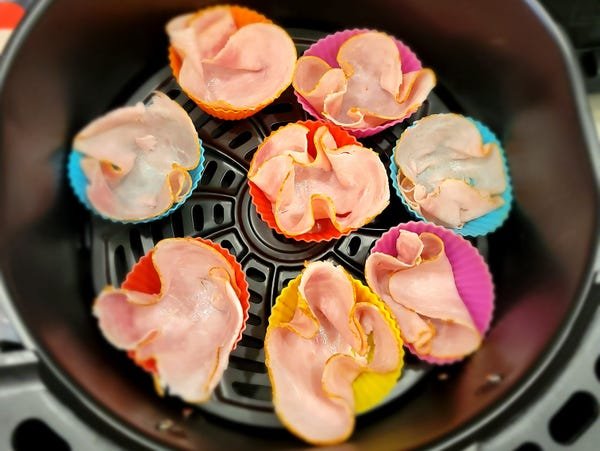
I make these breakfast bites in silicone cups. Rachel MacPherson
Breakfast cups are nothing new in our house, but they require less time and effort to make because of the air fryer.
Plus, we can make them in small batches to suit each person’s tastes — and my kids have no problem creating their personalized mini egg cups.
The number of cups you can make at once may depend on the basket size of your air fryer. Usually, I can make eight at a time using silicone baking cups.
The ham-and-egg cups take about 15 minutes to make.
You can easily customize the ham-and-egg cups. Rachel MacPherson
Preheat your air fryer to 300°F.
Line each baking cup with a slice of ham or prosciutto for a fancier option. Mix eggs with salt, pepper, and any additional seasonings of your choice, such as Worcestershire sauce and red-pepper flakes.
Carefully place the ham-lined cups into the air fryer and pour the egg mixture into each. Add any veggies you prefer, such as chopped asparagus or cooked spinach. Sprinkle on a cheese of your choice.
Let the egg cups cook for about 15 minutes. Serve hot, or let them cool slightly and store in the fridge to reheat later.
I like making breakfast bowls with air-fried veggies.
You can use any vegetables you have on hand. Rachel MacPherson
It can be challenging to have a vegetable-packed breakfast, but it’s a great way to better ensure you’ll get enough nutrients throughout your day.
With the air fryer, I can easily cook fresh produce in the morning. I like to use asparagus and tomatoes, pairing them with eggs that I’ve poached or “boiled” in the air fryer.
This produce-filled breakfast takes about 12 minutes to make and pairs well with toast.
I like to use toast to sop up any juices. Rachel MacPherson
Line your air fryer with foil and preheat it to 300°F.
Clean and snap asparagus, chopping it into bite-sized pieces. Add cherry or grape tomatoes to a bowl with asparagus, spritz with olive oil, and season with salt and pepper.
Place the produce in the preheated air fryer for 10 to 12 minutes. If you prefer crunchy asparagus, leave it out until the last four to six minutes, and then place it on top of the tomatoes to finish cooking.
Serve with eggs and some toast for mopping up all the yummy juices.
I make chicken Parmesan without frying my cutlets in a ton of oil.
I bread my chicken (not pictured) before I cook it. Candice Bell/Shutterstock
Chicken Parmesan is one of my favorite comfort foods, and the air fryer helps me make it without having to pan-fry my protein in oil.
For two 8-ounce chicken breasts, you’ll need about ¼ cup of Parmesan cheese and 1 cup of breadcrumbs. You’ll also need two eggs, marinara sauce, and mozzarella for topping.
Air-fryer chicken Parmesan pairs well with pasta.
My chicken Parmesan is usually served with pasta. Nancy Salmon/Shutterstock
First, pound the chicken breasts until they are a uniform thickness, about 1/2 inch. Then set your air fryer to 360°F.
Combine the Parmesan and breadcrumbs in one dish and add any desired seasonings, such as garlic powder, salt, pepper, oregano, and red-pepper flakes. Whisk your eggs in a separate bowl. Coat each piece of chicken in egg, then in the crumb mixture.
Place the breasts in the preheated air fryer and cook for six minutes. Flip and top with marinara sauce and mozzarella. Cook an additional four minutes or so until the internal temperature of the chicken reaches 165°F.
We like to serve the cutlets on top of pasta with more marinara sauce.
Seasoned pumpkin seeds are a great snack.
Making your own seasoned nuts and seeds in the air fryer is game-changing. Rachel MacPherson
We buy a lot of seeds in bulk, so switching up the flavor profile helps turn them into coveted snacks. We especially enjoy using seeds from squash, such as pumpkins, for this recipe.
Cumin, salt, cayenne pepper, garlic powder, and smoked paprika are all excellent choices for seasoning seeds, though you can experiment with other flavors you enjoy.
You can season the seeds to be sweet or savory.
Sometimes, I use cumin, garlic powder, and onion powder. Rachel MacPherson
Toss your seeds with a bit of olive oil and salt. Place them in the air fryer at 320°F, periodically opening the machine to shake the seeds to ensure even cooking.
Cook for about 15 minutes or until the seeds are crispy. Then, toss the seeds in a bowl with a bit of oil and your preferred seasonings.
Baked apples are a favorite of ours, and they’re easily adaptable to most dietary preferences.
We use our air fryer for more than just savory foods. Rachel MacPherson
One of my family’s favorite air-fryer desserts is a fruity crumble that we usually make with apples.
After all, baking fruit is a delicious way to bring out its natural sugars and create a deeply comforting dessert that’s both nutritious and satisfying.
You can make this dessert in under 30 minutes.
You can pair the baked apples with whipped cream. Rachel MacPherson
Simply combine 1 or 2 tablespoons of a fat, such as butter or coconut oil, with the same amount of oats, chopped nuts, and shredded coconut.
Add a sweetener, such as monk fruit, brown sugar, honey, or maple syrup, and some warming spices like cinnamon and nutmeg.
Cut the apples in half and top them with spoonfuls of the mixture you’ve created. Cook them in a preheated air fryer at 350°F for 20 minutes.
Top with vanilla frozen yogurt, ice cream, or whipped cream.
This recipe can also be made with bananas or pears, though you may need to adjust the cooking time accordingly.
Polenta pizzas are an excellent snack, mini meal, or appetizer that can be dressed up or down.
I use polenta rounds as my base for the mini pizzas. Rachel MacPherson
My kids love the idea of mini pizzas — and if you use fresh mozzarella, basil, and a balsamic reduction, you’ve got a fancy-ish hors d’oeuvre.
For the base, I slice up a tube of precooked polenta. From there, you can use whichever sauces, cheeses, and extra toppings you’d like.
These rounds can be customized with any toppings.
I often make my own marinara sauce. Rachel MacPherson
Preheat your air fryer to 400°F, then spritz the basket with olive oil.
Create 1-inch-thick polenta slices, and place them in the air fryer, topping them with another spritz of oil.
Sprinkle with salt and pepper. After five minutes, top the polenta with marinara sauce and your choice of cheese, as well as any other cooked toppings you desire.
Cook for another five minutes, then plate with fresh basil and balsamic glaze, if desired.
Pro tip: You can make a quick marinara using tomato sauce, a splash of balsamic and/or Worcestershire sauce, oregano, basil, garlic powder, salt, and pepper. Heat this in the microwave (lightly covered) to blend the flavors.
I make my own tortilla chips in the air fryer.
You can use corn tortillas to make chips. Rachel MacPherson
We make a lot of tacos with corn tortillas, but they go stale quickly. To avoid food waste while creating a tasty snack, we turn them into chips in our air fryer.
The chips can be ready in under 10 minutes.
I use a strainer to cool chips so they don’t get soggy. Rachel MacPherson
Preheat your air fryer to 350°F. Cut small corn tortillas into quarters, spray with olive oil, and season with salt.
Place your pieces in the air-fryer basket, ensuring they’re not overlapping. Cook in batches for five to seven minutes at a time, flipping each chip halfway through.
Use a strainer to cool your batches of chips so they don’t get soggy.
I use leftover produce to make a rich air-fryer salsa.
“Roasting” the vegetables adds flavor. Rachel MacPherson
Fresh salsa is incredible, but roasted salsa is an easy way of using up bits and pieces to create a deep, rich dip for your air-fried tortilla chips.
The best part is you can adjust the heat, garlic, and seasonings to your preferences.
To make the salsa, I use an air fryer and a food processor.
I usually add cumin and cayenne pepper to my salsa. Rachel MacPherson
Preheat your air fryer to 400°F.
Add garlic cloves, hot peppers of choice, tomatoes, and onion to the preheated air-fryer basket and spritz with olive oil. Sprinkle with salt.
You may want to remove the stems and seeds from your peppers before cooking them. Leave garlic cloves in their skin, as they will roast and become deliciously mushy and caramelized.
Cook everything for about 15 minutes, or until your veggies look slightly charred. Then, pulse your ingredients in a food processor to your desired chunkiness.
Add cilantro and fresh lime juice, then season with salt and pepper to taste. Cumin and cayenne pepper make excellent additions.
For a protein-packed dish, I stuff peppers with tuna salad.
I can usually fit two whole peppers in my air fryer. Rachel MacPherson
Tuna salad is the star of many protein-packed dishes in our house. It’s quick and requires no thawing or cooking.
However, sandwiches can become boring after a while. When we crave something warm, we stuff tuna into bell peppers.
You can also easily customize these stuffed peppers.
You can customize this recipe however you want. Rachel MacPherson
Preheat your air fryer to 360°F.
Cut your bell pepper in half and remove the seeds. Then, top each pepper slice with your favorite tuna salad — we make ours with mayo, Greek yogurt, green onions, diced pickles, and hot peppers.
Cook for 10 minutes, and then sprinkle with mozzarella or your favorite cheese. Cook for another two or three minutes until the cheese melts and bubbles.
Lastly, we love to snack on air-fried kale chips.
You can season kale chips however you want. Rachel MacPherson
This is another crunchy and quick savory snack that provides a ton of nutrients in a snap.
Strip the leaves off the stems from a bunch of kale and rip them into pieces. Place them in a bowl and spritz with olive oil, then sprinkle with sea salt.
Massage the kale until it turns softer and becomes a brighter green. Place in the air fryer preheated to 370°F and cook for about five minutes.
Remove the leaves when they appear crispy and have a slight color. Season the kale chips as desired. We use garlic powder, salt, and pepper.
This story was originally published in 2021, and most recently updated on January 2, 2025.
This as-told-to essay is based on a conversation with Kim Izaguirre-Merlos, an ICF Certified Coach and founder of How We Won. It’s been edited for length and clarity.
I’ve been in a caretaking role for most of my life. We lost my dad when I was 11, and my mom had a stroke soon after. As the only girl in a Latino immigrant family, I grew up carrying responsibility early. That early experience of taking care of my family members, coupled with my take-charge personality, has shaped every stage of my life, including my decision not to have children.
I never saw myself on a traditional path
In the town I come from, it’s really common to stay here, fall in love, get married, and start a family. But it was never a path I saw for myself, partially because my upbringing had provided me with very strong lessons about what it takes to raise kids. In high school, when everyone was dating, I remember thinking marriage and kids weren’t interesting to me.
Then, in my mid-20s, I had a spinal injury that left me learning how to walk again. The chronic pain that followed, combined with severe menstrual issues I’d spent years normalizing, made me unsure whether my body could handle pregnancy and birth. I was already living with so much pain that the idea of adding more felt like too big a sacrifice.
Kim Izaguirre-Merlos with her mom on her birthday in the early 2000s.
Courtesy of Kim Izaguirre-Merlos
I wanted to live a life where I could be there for my immediate family
I didn’t consider motherhood until my mid-30s, when I finally fell in love. For the first time, I considered building a family of my own. But going off to start my own family felt like leaving my family behind in some sense. Then my mom got really sick, and that was the crux moment for me.
Every time Tiffany publishes a story, you’ll get an alert straight to your inbox!
Stay connected to Tiffany and get more of their work as it publishes.
I ended my personal relationship, initially telling myself it was because my mom needed me. However, I quickly admitted the truth to myself: Being a mother wasn’t what I wanted for myself. I wanted to live a life where I could be there for my immediate family and their needs, especially my mom. While I could have chosen to rise to the occasion and try to carry this double load like many other women do, I didn’t want to.
Looking at the circumstances and being truly honest with myself showed me that becoming a mother wouldn’t let me show up at my best in this life. For me, being responsible meant making a different decision from starting a traditional family. It meant caring for my current one.
Kim Izaguirre-Merlos with her siblings during the holidays in the 90s.
Courtesy of Kim Izaguirre-Merlos
I live with my family because it’s where I’m needed
Later, I learned that my former partner had a child. The amount of relief I felt after learning that told me I had made the right decision for both of us. I knew this person should be a father, and that I couldn’t provide that kind of life for him. I’m so glad he has found his path, and that I’m on mine.
It amazes me the capacity women have to care for their children, and there are times when I don’t fully feel like I’m meeting the measure of a woman in society. But I watched my mom make sacrifices for us, and while I admire her deeply, I know that I couldn’t live that way. Instead, my fulfillment comes from making sure the person who raised me can age with support and love. These days, I live with my mom and family members, not out of financial necessity but because this is where I’m needed and where I feel most fulfilled.
Choosing not to have children isn’t always about not wanting them. Sometimes it’s about opting for a different kind of family, or protecting your health, or recognizing where you’re most needed. While it’s easy to judge women who don’t have kids, we have no idea what experiences in life led to this moment. Even if we are on different paths in life, my hope is that we can all offer each other compassion in our choices.