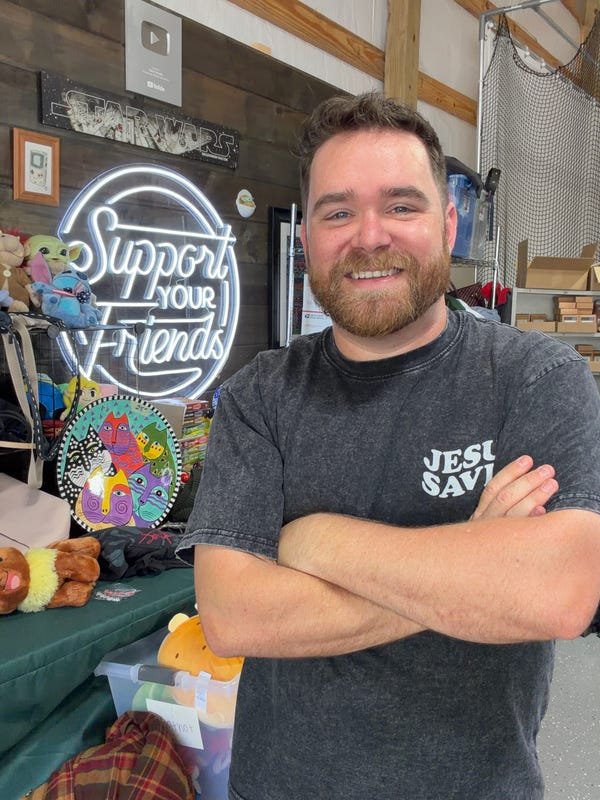
Chris Hatfield is a self-described “fast nickel, not slow dime” seller. This emphasis on speed makes sense given the eye-popping amount of product he moves: Hatfield, 43, spends five days a week digging through Goodwill bins in Texas. He and his wife, Stacy, aim to scoop up 150 to 200 pounds of clothes, bags, and other items — priced at $1.99 per pound — each day. He calls her strategy for grabbing merchandise “the claw machine,” snagging anything decent in sight. By contrast, he says he’s more judicious — he doesn’t wear gloves so he can feel quality out. At night, they flip their finds on Whatnot, a livestreaming auction site. Their average sale price is $11.21 per item, which doesn’t sound like a lot, but when you’re selling 150 pieces at a time, it adds up. “Our typical goal is to make $1,000 profit every day,” Hatfield tells me, on the phone from the Goodwill parking lot.
The resale economy has exploded in recent years. The US secondhand apparel market is expected to reach $79 billion by 2030 and is growing four times as fast as the retail clothing market, according to a new report from consignment platform ThredUp and retail analytics firm GlobalData. Per Morning Consult, nearly half of American consumers say they’ve made a secondhand purchase over the past three months.
The boom has led to an influx of professional or professional-ish resellers looking to make a buck. They hawk large amounts of merchandise on platforms such as eBay, Depop, and Whatnot. They say they add value to the items they turn, by fixing them up before selling them or having a discerning curator’s eye. Critics, however, argue that they cause arbitrary price inflation in secondhand markets and create artificial scarcity by scooping up in-demand merchandise. Are these people service providers saving clothes from landfills, or are they middlemen extractors taking affordable goods away from those who need them? Depends who you ask.
Hatfield, a former pest control guy who’s been in the reselling business for a decade, used to go live directly from inside a Goodwill outlet and auction off merchandise before buying it, but that location closed, and the new one’s hours make the logistics impossible. He estimates that about three-quarters of his customer base is other resellers, which is fine by him. They’ll sometimes tag his brand, Flip the World, on social media, which gives him a boost. The other night, he saw that a woman who bought a dress from him for $39 went on to sell it for $140. “I’m not trying to get max dollar because I know the next day I’m going to be right back here digging,” he says.
It’s not lost on Hatfield that his activities can sound a little icky. He’s seen posts online calling him a “creepy guy that sells dirty clothes” and readily admits that the bin digging can get aggressive when a swarm of resellers is trying to get their hands on goods. “I’m OK with it,” he says of the noise. After all, he tells me, he’s covered head to toe with tattoos. “I’m that weird guy.”
Chris Hatfield/Flip the World
Reselling is hardly a new phenomenon. The Salvation Army was founded in 1897, Goodwill in 1902, as large-scale production made it possible to accumulate so much stuff that people needed to part with their older possessions. In the 1920s and 1930s, flea markets became popular among artists and musicians, and the term “vintage” began to appear by midcentury, partly as a rejection of the middle class. Thrift stores flourished during the economic turmoil of the ’70s, and then came ’90s grunge. Across generations, shopping secondhand is perpetually being rediscovered.
“Periodically, young people think, ‘Oh, wow, this is a really cool resource, why hasn’t anyone thought of this before?’ And they do, they have, and every generation kind of makes it their own,” says Jennifer Le Zotte, an associate professor of history at the University of North Carolina, Wilmington, and the author of “From Goodwill to Grunge: A History of Secondhand Styles and Alternative Economies.”
The internet and the sheer scale of modern mass production have pushed the resale market into its latest iteration. You no longer have to go to a thrift store to buy something secondhand — you can do so with a few taps on your phone. Instead of hauling an old coat to a local consignment shop, you can upload it to Depop in a few minutes. And the world is swimming in merchandise: In textiles alone, over 100 billion garments are produced each year, double the amount made in 2000.
Chris Hatfield/Flip the World
“There’s just so much more supply out there,” says Haley O’Sullivan, vice president of customer experience at Depop, an online fashion marketplace that’s being sold by Etsy to eBay.
It’s made it easier and more appealing than ever to become a supplier.
It’s hard to suss out how many resellers are professionals or rely on it as a significant source of income, but the cohort is certainly growing. Small and medium-sized businesses account for 70% of eBay’s sales in its largest markets (in the US, the platform defines a small business as anyone doing over $10,000 a year in sales). James Reinhardt, the CEO of ThredUp, tells me there are “degrees” of professionals. “I think about Uber — there are people who drive for Uber, and they do it full-time. And then there are people who drive for Uber for three hours on the weekends,” he says. “And are they professionals? Are they casual?” Many resellers start out casual and later move into it in full force.
That’s what happened with Crystal Maus, a South Dakota mom whose first flip was a Burberry coat that someone donated to a community organization supporting the homeless while she was volunteering. (She donated the proceeds back to the organization.) Recognizing the potential opportunity, she bought $100 worth of items at her local thrift store, “none of which were good buys,” but eventually got better and expanded what’s now her full-time eBay business from there. Maus’ is a volume play — she lists 350 items a week and grosses $15,000 to $20,000 a month. She sources in bulk, from online auctions, liquidations, and inventory offloaded by buy, sell, trade stores. “If I could find a pallet of Chanel bags for a good price, I would love that, but everybody would love that,” she says, adding that there’s “almost zero barrier to entry” for getting into reselling.
Rob and Melissa Stephenson, in Florida, have gotten so heavily into reselling that their main source of income is no longer reselling — it’s selling courses that teach others to resell. Their free intro video series promises to help pupils make $100 in seven days. “There’s so much stuff everywhere, there is not any near future where we’re creating crazy, crazy competitors,” Rob says.
When they do resell, the couple goes for individual items they can turn around for large profits — they’ll buy something for cheap on Facebook Marketplace, for example, and then sell it on eBay, where they’ve got access to a broader base of potential buyers. “It’s really easy to sit in your La-Z-Boy, find something on Marketplace, do the comps on eBay to figure out what it’s worth, send an offer on Marketplace, and then just go pick it up, bring it back, list it on eBay, and sell it,” Rob says. He describes a recent trip to Boise, Idaho, during which he found a steam oven in the back of a thrift store, picked it up for $1,000, and sold it on eBay for $15,000. “I don’t buy anything unless I can 10x it,” he says. They recently bought a house with an eight-car garage underneath it to store their inventory.
In the popular imagination, thrifting exists as a couple stumbling upon a buried treasure at a quaint Main Street shop, a teenager scoring a vintage concert T-shirt to impress their friends, or someone in need finding used office clothes to wear for a much-needed new job. The current reality is much thornier: The secondhand industry has come to reflect our global capitalist churn and the good, bad, and ugly that come with it.
If the tradeoff is reseller vs. landfill, the moral calculation is straightforward, but when it’s bin-diving reseller vs. in-need consumer, it’s not so clear-cut.
Daniel Burkett, a philosophy professor at Binghamton University, tells me resellers can divert resources from where they would have a better impact. “If I go and buy a nice suit jacket and then I flip it for a $20 profit on eBay, look at the good that’s bringing me, but then look at the good that might bring somebody who needs to go for a job interview,” he says.
Chris Hatfield/Flip the World
Some resellers told me they worry about their comrades’ tactics. Hatfield and a fellow reseller host a free weekly Q&A to try to steer people interested in the field in the right direction — or at least not in the wrong one. He worries some sellers get too aggressive on their streams and try to guilt customers into buying or run items so low that they’ll never be able to make money. “If you do a bunch of giveaways, you’re only going to get people to come to your shows because they want to win something for free, not because they want to invest into your business and your lifestyle and to support you and your family,” he says.
To be sure, there’s no shortage of, for example, cheap clothing or housewares. But the conflict isn’t just about need, it’s about want. Spending an hour in line at a sample sale to watch five resellers at the front bag everything up is infuriating. When you’re shopping at an estate sale or a thrift store, you don’t want resellers pushing you out of the way to get their hands on items they ultimately want to sell back to you for four times the price. The same goes for trying to get Pokémon cards at Target. One reseller I spoke to for this story had gotten into a fistfight with another reseller the same day we spoke.
To ensure regular customers get a fair shot, some retailers and sellers limit how much merchandise people can buy. On the other hand, some companies have relationships with resellers that allow them to offload their merchandise. When the name of the game is to sell, it’s hard to be too concerned about who to.
Onney Crawley, Goodwill Industries International’s chief marketing officer, says resellers contribute “meaningfully” to their stores’ performance, but they’re aware of the frustrations that come when some shoppers see them “quickly moving through and cherry-picking” merchandise. “Our challenge is to ensure we maintain an environment where everyone can have a good experience,” she says, which includes keeping the inventory flowing.
Professional resellers do offer benefits to consumers. Many of them curate their selections, saving end customers legwork and taking the time to evaluate value and quality. Even if they’re mainly focusing on volume, they’re doing the work to dig stuff up. Expertise can take different forms, whether it be spotting a vintage designer bag or being willing to wake up at 6 am to stand in line at a sample sale.
“It’s a fair game at the end of the day,” Elias Marte, a vintage watch dealer and one of the partners for Alfargo’s Marketplace, a menswear pop-up in New York.
The pros are also versed in the blocking and tackling of selling. Dealing with a pro-reseller may lead to a better overall buyer experience with shipping, listings, and returns, as well as faster customer service responses. Avritti Khandurie Mittal, vice president of product at eBay Services, tells me the pros “raise the baseline for reliability across the marketplace.”
The resale business is almost certain to accelerate going forward, bringing professionals and side hustlers with it. There’s no slowing in the production of new stuff, and trend cycles are hastening — a lot of what many resellers make their money on isn’t vintage finds, it’s fast fashion, random merchandise, and items that have quickly cycled into the “uncool” graveyard. AI could further speed things up by making it easier for sellers to list items and field customer questions. The reselling space has grown so much that it’s creating its own crop of influencers who make more money talking about flipping than actually doing it.
That’s indeed the case for Joshua Varnell of South Carolina, who, with his wife Hayley, runs Hairy Tornado. Their YouTube channel has nearly half a million subscribers, and the content they post there and on Facebook accounts for about 70% of their revenue. Their videos about hitting up flea markets, Goodwill bins, and Amazon overstock stores consistently rack up thousands of views. As to what they do still sell — largely on Whatnot — Varnell laughs and says it’s basically anything they think they can make money on. They made $10,000 selling a collection of rocks and crystals they got from a guy at a flea market who had them in the back of his truck. “I guess our rocks were good,” he says.
Joshua Varnell on the set of his Whatnot show.
Joshua Varnell/Hairy Tornado
A peek behind the scenes.
Joshua Varnell/Hairy Tornado
Clutch for looking and selling your best: a ring light.
Joshua Varnell/Hairy Tornado
This doesn’t sound like the most grueling work, but it’s not for the faint of heart, either. Even with the YouTube money rolling in, Varnell and his wife still go out to buy three or four days a week. He knows people who go to the thrift store multiple times a day and describes seeing other Whatnot sellers who livestream from clearance sections at Disney Springs in Florida and offer to buy and ship their finds to bidders for a profit — creating a convoluted form of online shopping.
“You have the haters that just think resellers mark everything up to some crazy price, but every item has a market value. Your job as a reseller is to find it at a place that is underpriced,” he says. “I don’t control what the market is willing to pay for some vintage L.L.Bean sweater, but if I can find it for a dollar, that’s obviously going to be profitable.”
Reselling may be somewhat of a meritocracy, but it’s one that’s been warped by rampant consumerism and the ruthless desire to make money. As long as the machine keeps running, there will be people like Hatfield and Varnell (who are friends, by the way — the former has a tattoo of the latter on his thigh). And they’ll be sitting in the parking lot, waiting to turn the excess into profit.
Emily Stewart is a senior correspondent at Business Insider, writing about business and the economy.
Business Insider’s Discourse stories provide perspectives on the day’s most pressing issues, informed by analysis, reporting, and expertise.