

Taylor-Swifts-latest-business-move-is-another-attempt-to-hack.jpeg

Taylor Swift’s latest business move is another attempt to hack the charts — and it’ll probably work

Taylor Swift is the biggest-selling artist in the world by most reliable measures, so when she makes an unconventional business move — no matter how random or trivial it may appear — it’s worth paying attention.

On Friday, Swift unveiled the self-directed music video for “Opalite,” her latest single from “The Life of a Showgirl.” Upon release, the cameo-laden clip was available exclusively on Spotify and Apple Music, with its YouTube premiere scheduled for a two-day delay.

Streamers like Spotify and Apple Music specialize in hosting songs, albums, podcasts, and playlists — not visual works. Meanwhile, YouTube is famously a destination for music video lovers. So what gives?

As usual, when it comes to Swift, the answer seems to lie with her bottom line. In December, YouTube announced it would withdraw its streaming data from Billboard’s chart formulas because the music company tweaked its methodology so that streams from YouTube subscribers were weighted even more heavily than free streams. YouTube’s stance is that the ratio is unfair to fans.

Swift recently scored her longest reign yet on the Billboard Hot 100 with “The Fate of Ophelia,” the lead single from “Showgirl,” which charted at No. 1 for 10 weeks. With “Opalite” officially serving as its follow-up, Swift appears to be making moves to boost the song’s chart performance.

If fans were flocking to YouTube today to watch her new music video, none of those views would help “Opalite” reach No. 1 — and nobody wants to follow a personal best with a personal flop, least of all an athlete-style competitor like Swift.

Of course, this savvy tweak to the song’s promo schedule was paired with a physical release: a seven-inch vinyl single in “pearlescent blue,” only available in Swift’s online store for 48 hours.

How Taylor Swift moves, other artists tend to follow

Swift’s unyielding commitment to commerce isn’t just something to behold. It’s something to study. Swift’s sales tactics often become instructive for other artists.

Much has been made about Swift’s push to sell physical albums, for example, but many fellow pop stars have followed suit. Charli XCX released about two dozen vinyl variants for her 2024 album “Brat” and its deluxe editions. Sabrina Carpenter, a self-professed disciple of Swift’s work, released 13 vinyl variants last year for “Man’s Best Friend,” in addition to seven-inch singles, cassettes, and CDs. As a result, “Man’s Best Friend” scored the ninth-biggest vinyl sales week of the modern era, according to Billboard. (Seven of the top eight slots on that list belong to albums by Swift.)


Taylor Swift in the music video for

“The Fate of Ophelia” reached No. 1 on the chart dated October 18, 2025.


Taylor Swift/YouTube


So, it could very well mean that Swift’s strategic video rollout will start a trend as well. Although YouTube is the customary platform for music videos, customs can be changed, and she isn’t the only artist who cares about climbing the charts.

It could also be that Swift’s premiere delay will inspire YouTube to rethink its attitude toward Billboard. If one of the most influential celebrities in the world is delaying their content to your product, that could be bad for business — and it wouldn’t be the first time Swift convinced a major company to change its tune. Back in 2015, she criticized Apple Music for refusing to pay artists during a new user’s free trial. Within 24 hours, Apple updated its policy and tagged Swift in the announcement online.

It remains to be seen whether “Opalite” will affect the music industry beyond Swifties, but if the song’s lyrics are any indication, Swift is content to manufacture success on her terms — or, in her words, to make her own sunshine.



Source link

Tom Carter headshot

Tesla just made an ‘unusual’ move — and it could mean a rough end to the year

Tesla had a surprise Christmas present for investors this year: more bad news about its EV business.

Elon Musk’s automaker published a press release on Monday with a consensus of analyst predictions for the company’s latest quarterly sales, the first time it has publicly given Wall Street such a heads-up.

The delivery consensus, which is a compilation of predictions from analysts selected by Tesla, estimated that the EV giant sold 422,850 vehicles in the last three months of 2025, around 14.6% fewer than the same period last year.

That’s lower than Wall Street’s wider expectations. Analysts were expecting Tesla to sell 440,907 EVs, according to data compiled by Bloomberg.

It’s also a surprising move from Tesla, which typically does not issue public communications ahead of critical sales announcements.

Tesla, which is expected to report its latest quarterly sales as soon as Friday, did not respond to a request for comment.

“This is highly unusual for Tesla to send out a press release with quarterly consensus delivery estimates,” said Gary Black, managing partner at Future Fund, which sold its Tesla holdings in May.

Black wrote in the Tuesday post on X that the release suggested Tesla’s Q4 sales were lower than the Bloomberg consensus and were, in his view, likely closer to 420,000.

Investors remain bullish

Tesla’s stock price hit a record high this month amid investor optimism over the company’s robotaxi push, but the Cybertruck maker’s core EV business has had a difficult year.

Tesla was hit hard by the collapse in electric car sales after the $7,500 federal tax credit expired in September.

The company’s US sales reportedly fell to their lowest level since 2022 in November, despite the launch of cheaper versions of Tesla’s bestselling Model 3 and Y EVs.

Things haven’t gone much better outside the US. Tesla has been buffeted by fierce competition from local rivals in China, where an army of EV startups has rolled out high-tech electric vehicles at rock-bottom prices.

In Europe, meanwhile, the US automaker’s sales have collapsed nearly 30% so far this year amid backlash over Musk’s political interventions.

The slump has left Tesla facing a race against time to avoid its second consecutive annual sales decline.

Tesla has rolled out a range of incentives in the US and is pushing to introduce its Full Self-Driving tech in China and Europe, but the surprise delivery consensus estimated that Tesla will end the year having sold over 100,000 fewer EVs than in 2024.


Source link

Unjammable-drones-are-leaving-wires-everywhere-forcing-Ukrainian-troops-to.jpeg

Unjammable drones are leaving wires everywhere, forcing Ukrainian troops to move with caution

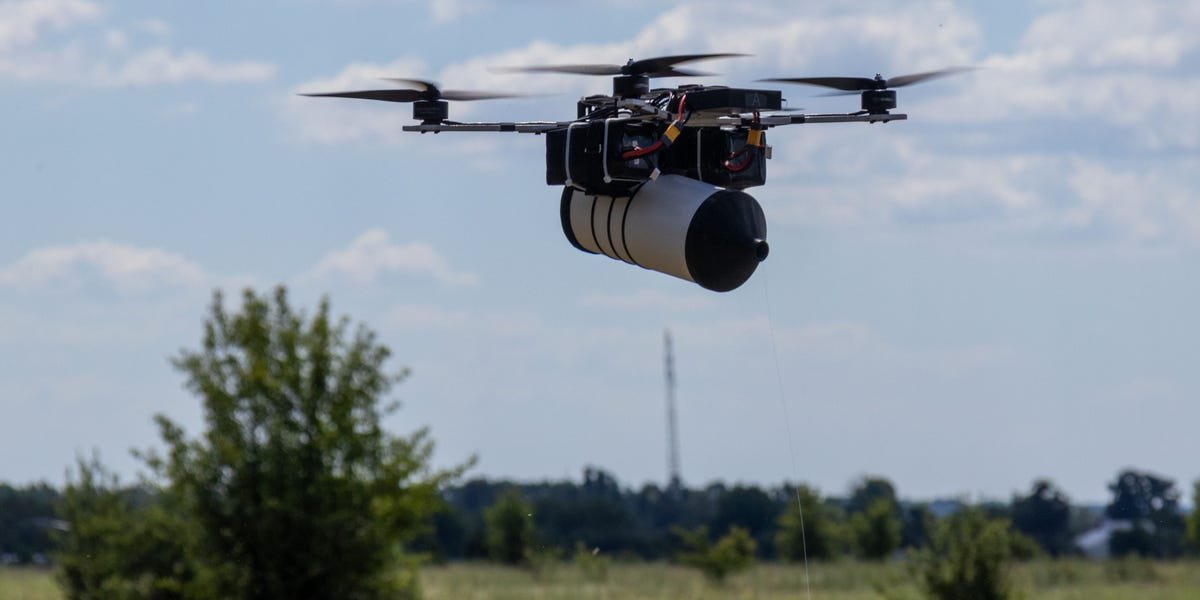
Small unjammable drones controlled by fiber-optic cables have become so integral to Russian and Ukrainian combat operations that they are leaving trails of cabling everywhere, turning areas of the battlefield into a tangled web.

As a counter to extensive electronic warfare, fiber-optic drones are becoming increasingly prevalent on both sides. And with sprawling cables stretched across the battlefield, soldiers are moving with greater caution.

“You see the little webs, and you never know — is it from the fiber-optic drone? Or it’s a part of a booby trap,” Khyzhak, a Ukrainian special operator who for security reasons could only be identified by his call sign (“Predator” in Ukrainian), told Business Insider. Mines and traps have also been prominent threats in this war.

Earlier in the war, first-person-view (FPV) drones — small quadcopter-style drones fielded by both Russia and Ukraine that often carry explosive warheads — relied on radio-frequency connections. However, both sides quickly figured out how to use signal jamming to stop them.

In response, Russia and Ukraine began developing fiber-optic FPV drones that connected to their pilots using spools of long, thin cables. The cables preserved a steady link and made the quadcopters resistant to traditional electronic warfare tactics.

The best chance that soldiers have to stop the fiber-optic drones is by shooting them out of the sky, but that requires precision, quick reaction times, and a lot of luck.


A drone armed with a warhead is flown as pilots of the 28th mechanised brigade of the Armed Forces of Ukraine test a fibre optic FPV drone with RPG munition on June 18, 2025 near Kostiantynivka, Donetsk Region, Ukraine.

Fiber-optic drones are connected to their operators by long, thin cables.

Kostiantyn Liberov/Libkos/Getty Images


The fiber-optic cables that provide these drones with their greatest advantage are also their greatest vulnerability, as they can get tangled in the environment and bring the flight to an abrupt stop. And even if they don’t get tangled, the cabling is still left draped across the battlefield after use.

Khyzhak, a soldier in the 4th Ranger Regiment, a Ukrainian special operations unit modeled after its US Army counterparts, said it is very common to see fiber-optic cables everywhere because there are more and more of these drones in use, and the cables frequently get stuck in trees and fields.

The 4th Ranger Regiment shared combat footage earlier this month showing Khyzhak, along with two other operators and their driver, narrowly avoiding a Russian fiber-optic drone strike while speeding back to base after a front-line mission.

The footage shows fiber-optic cables strewn in the field next to the road and even on Khyzhak’s gun.

“It was everywhere,” he recalled, speaking about the September incident, where the driver skillfully maneuvered out of the path of the Russian drone, which detonated on the side of the road.

Other video footage taken from the battlefield shows how fiber-optic cables crisscross like spider webs, sometimes only visible in direct sunlight or when viewed from a certain angle.

Khyzhak said the cables are particularly annoying during nighttime missions, when special operators can’t use a lot of light. He described them as a “tactical issue.”


Fiber-optic cables on the side of the road in Ukraine's Sumy region in September.

Fiber-optic cables are seen on the side of the road in footage shared by Ukrainian special operators earlier this month.

4th Ranger Regiment of the Special Operations Forces of Ukraine/Screengrab via X


Soldiers can’t always tell right away if it’s a harmless fiber-optic cable or something far more dangerous, like a booby trap. This forces them to think carefully about whether they should call an engineer, destroy the web with explosives, halt, or proceed forward.

It can definitely slow down the mission, Khyzhak said, and becomes a bigger concern the closer special operators get to the front lines, or if they’re working covertly in Russian-held territory.

Ukraine and Russia have expanded production of fiber-optic drones over the past year, and both sides are racing to develop variants that can fly farther across the front lines.

Russia, for instance, has begun to employ fiber-optic drones with a 50-kilometer (31-mile) range, which exceeds the distance that most known variants can travel. Cable length typically limits their range to between 10 and 25 kilometers (roughly 6 and 15 miles).

In Ukraine, fiber-optic drones have become such a threat to critical supply routes that soldiers have covered the roads with netting to protect vehicles from attacks, although it doesn’t always guarantee their safety.

Meanwhile, Ukraine’s defense industry is developing new countermeasures to defend against these drones. The innovations have also caught the attention of NATO leadership, which has been using lessons from the war to inform its own military planning.


Source link