

callie ahlgrim headshot 2023

The UK just banned Kanye West from entering the country, forcing a music festival to cancel

Ye, formerly known as Kanye West, has been blocked from traveling to the UK in light of his history with antisemitism.

The UK government told the BBC on Monday that Ye applied for an Electronic Travel Authorization (ETA) to travel to the UK but was denied on the grounds that his presence “would not be conducive to the public good.”

Ye had been scheduled to headline all three days of London’s Wireless Festival in July, which has since been canceled.

“As a result of the Home Office banning YE from entering the United Kingdom, Wireless Festival has been forced to cancel,” the event’s website reads as of Tuesday morning. “All ticket holders will receive an automatic full refund.”

The government’s decision comes after several of the festival’s sponsors, including Pepsi and Anheuser-Busch InBev, withdrew from the event. Although neither brand explicitly cited Ye as the reason for their withdrawal, UK Prime Minister Keir Starmer had recently spoken out against Ye’s scheduled performances.

“It is deeply concerning Kanye West has been booked to perform at Wireless despite his previous antisemitic remarks and celebration of Nazism,” Starmer said in a statement to the British newspaper The Sun.

After the UK government confirmed that Ye would not be allowed to enter the country, Starmer cosigned the decision in a post on X.

“Kanye West should never have been invited to headline Wireless,” Starmer wrote. “This government stands firmly with the Jewish community, and we will not stop in our fight to confront and defeat the poison of antisemitism. We will always take the action necessary to protect the public and uphold our values.”

Ye did not respond to a request for comment.

Over the past decade, Ye has regularly been criticized for offensive and bigoted remarks, especially those described as antisemitic. In 2022, he peddled conspiracy theories about Jewish people controlling the entertainment industry and openly praised Adolf Hitler. Although Ye lost numerous business deals and brand partnerships in the fallout — reportedly losing his billionaire status as a result — he doubled down in 2025, when he wrote “I am a Nazi” on X and released a song titled “Heil Hitler.”

More recently, Ye took out a full-page ad in The Wall Street Journal for a public apology, linking his outbursts to a 2002 car accident and what he described as an undiagnosed brain injury. He also said his bipolar disorder caused him to lose touch with reality.

“In that fractured state, I gravitated toward the most destructive symbol I could find, the swastika, and even sold T-shirts bearing it,” Ye wrote. “I regret and am deeply mortified by my actions in that state, and am committed to accountability, treatment, and meaningful change. It does not excuse what I did though. I am not a Nazi or an antisemite. I love Jewish people.”

The apology was published shortly before Ye’s newest album was expected to be released. After multiple delays, “Bully” arrived on streaming platforms in late March.

Ye returned to the stage last week for a two-night stint at SoFi Stadium in Los Angeles. Both shows were sold out and reportedly grossed $33 million, proving that despite the UK government’s objections, there is still an appetite for Ye’s volatility among his loyal fans.


Source link

My-kids-went-to-an-outdoor-elementary-school-with-no.jpeg

My kids went to an outdoor elementary school with no art, music, or library. They loved it, but adjusting to public school was hard.

In 2019, my 5-year-old son and 4-year-old daughter were excited to start their first year of public school. But like millions of students in March of 2020, they never got to finish the school year.

The COVID pandemic closed the classrooms, forcing my husband and me to rethink how we wanted to handle our children’s education. An outdoor learning school at The Learning Tree, a local day care, became our solution.

The unique education exceeded our expectations in every way.

Why we chose an outdoor learning school

The pandemic made us nervous to send our kids back to school after summer break. We were told that if someone in their class contracted COVID, the entire class would shut down for two weeks. This wasn’t feasible for us as parents with full-time jobs, plus it would disrupt the learning experience for our kids.

That summer, the day care our kids attended prior to starting school announced a new opportunity: a K/1 program focused on interactive, accelerated education. It promised small class sizes (roughly 12 students per class), project-based and student-led learning, and academics balanced with outdoor activities and healthy habits.

Despite the $125 weekly tuition fee per child, we were sold on smaller classes, less exposure to others, and the included after-school care.

We enrolled our kids for the 2020-2021 school year: our daughter in kindergarten and our son in first grade. When the school added second grade the following year and then third grade the year after, we stayed.

We missed out on traditional opportunities, but gained so much more

We didn’t plan on sending our kids to a private program for most of their elementary school years. But after comparing what public school offered that The Learning Tree didn’t, and vice versa, the outdoor learning school was a no-brainer.


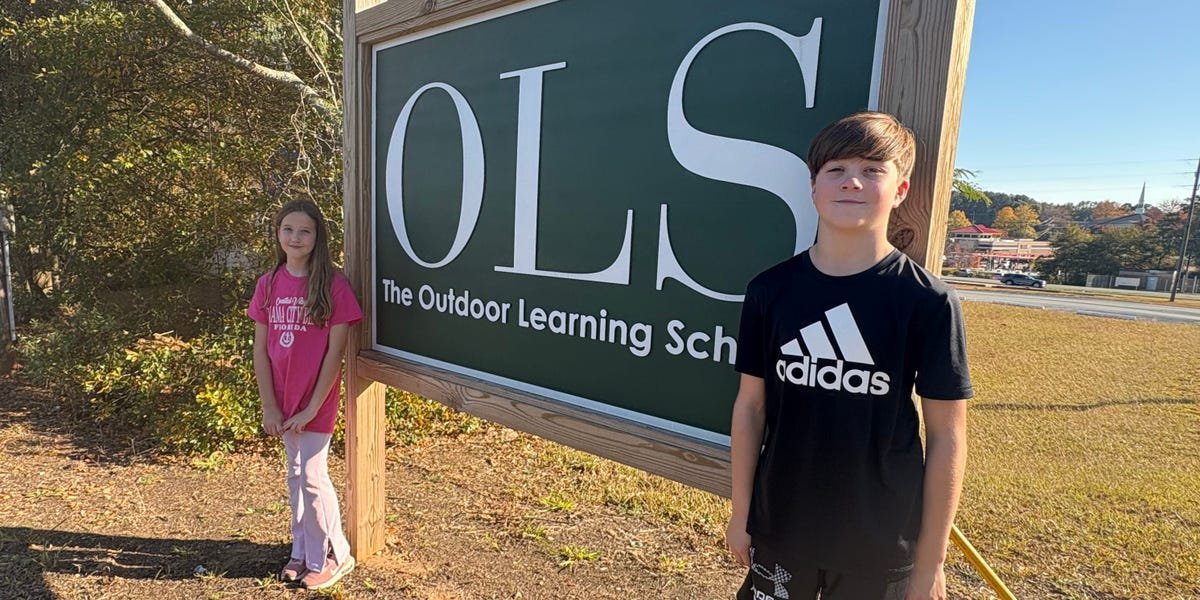
Alli hill's children at their outdoor learning school

The author’s kids loved their outdoor school.

Courtesy of Alli Hill


At The Learning Tree, there was no library, computer lab, or even a cafeteria. They didn’t have art, music, or gym classes. The playground was small, and there was no option for gifted testing.

However, they did have an in-ground swimming pool, and swimming was built into the curriculum during warm months. A mile-long nature trail and morning fitness exercises replaced the gym. Students helped to build gardens and grow food, which made its way into their lunches. Most notably, screen time was minimal — almost nonexistent.

There was also more parental involvement. We went kayaking on the river as part of a history lesson, and we always had special celebrations for Thanksgiving and Christmas.

Instead of reading math word problems, they acted them out in real time with things like farmers’ markets and food prep. Projects, not worksheets, were a focal point for each grade. And since students played a role in their own education and pacing, there was no need for a separate “gifted” curriculum.

Transitioning back to the ‘real world’ was a tough lesson

The original K/1 program added a new grade each year, up to fifth grade. However, we pulled our children out when they started fourth grade to give them time to transition back into public education before middle school. Where we live, fifth grade is at the middle school, and we felt like jumping from outdoor learning to a public middle school would be too stressful.

Both of our kids already had lots of friends in public school, so it wasn’t completely unfamiliar to them. Still, it was challenging.

They went from spending most of the day outside to getting only 20 minutes of recess. Classes were much larger, so they didn’t have the opportunity to learn at their own pace. They had more rules and a more rigid structure to follow. There was more sitting and busywork than they were used to.

They missed the kindness and genuine interest of their teachers at their old school. They also lacked the opportunities to guide their own education and pursue their own interests in the classroom.

While we loved our time at the outdoor learning school, all good things must end. Our kids gained a solid foundation of work ethic, self-discovery, and leadership that continues to help them in and out of the classroom, and we’d do it again in a heartbeat — pandemic or no pandemic.


Source link