
Elon-Musk-says-Europes-biggest-airline-will-lose-customers-without.jpeg

Elon Musk says Europe’s biggest airline will lose customers without Starlink

The CEO of Europe’s biggest airline is in an escalating war of words with Elon Musk over Starlink.

Ryanair CEO Michael O’Leary isn’t convinced by Starlink, Musk’s satellite internet provider, which is becoming more popular among airlines.

For example, Lufthansa — the German flag carrier which runs the continent’s second-largest airline group — announced on Tuesday that it would introduce the service. The following day, Scandinavian Airlines operated its first flight with Starlink.

However, as a budget airline, Ryanair is known for its no-frills offering.

“We don’t think ‍our ⁠passengers are willing to pay for WiFi for an average ⁠one-hour flight,” O’Leary told Reuters on Wednesday.

His comments sparked a debate on X. Musk said in a post: “They [Ryanair] will lose customers to airlines that do have internet.”

In a subsequent interview on Irish radio on Thursday, the outspoken Ryanair boss said adding Starlink would cost the airline between $200 million and $250 million a year.

“In other words, about an extra dollar for every passenger we fly, and the reality for us is we can’t afford those costs,” he told Newstalk.

“Passengers won’t pay for internet usage; if it’s free, they’ll use it — but they won’t pay one euro each to use the internet.”

He then hit back at Musk, saying people should “pay no attention whatsoever to Elon Musk.”

“He’s an idiot. Very wealthy, but he’s still an idiot,” O’Leary added.

Ryanair and its subsidiaries operate a fleet of 643 airplanes, which handled 206 million passengers last year. 2024’s statistics showed that it was the world’s third-largest airline group, behind American Airlines and Delta Air Lines.

The Irish airline’s low-cost business model allows it to offer tickets as low as 15 euros, or about $17.40. It focuses on quick turnarounds between flights, charging for add-ons like sitting next to your friends, and on-board sales, including scratchcards and duty-free cigarettes.

Every airline that’s announced Starlink deals so far has included free in-flight internet for everyone on board. So, even if O’Leary changed his mind, it seems unlikely that Musk’s company would let him charge Ryanair passengers to use Starlink.

SpaceX executives also took umbrage at what they said was incorrect information about the fuel costs incurred by installing Starlink.

“You need to put [an] antenna on [the] fuselage — it comes with a 2% fuel ⁠penalty because of ​the weight and ​drag,” O’Leary told Reuters.

Michael Nicolls, the VP of Starlink engineering, said in an X post that Starlink terminals have a more fuel-efficient profile than other airplane internet providers. He added that SpaceX’s analysis showed a Starlink terminal instead increased fuel costs by 0.3% on a Boeing 737-800, the model that makes up the bulk of Ryanair’s fleet.

“Hmm, must be a way to get that down under 0.1%,” Musk replied to him.

Ryanair declined to comment on Musk’s and Nicolls’ remarks when contacted by Business Insider. SpaceX did not immediately respond to a request for comment.

While US budget airlines have recently pivoted to offer more premium options under intense financial pressures, Ryanair has little reason to do so. Adding an amenity like Starlink would be at odds with its business model, especially if it were free for passengers.

Post-pandemic, more American travellers have been paying extra for more luxurious flights. Budget airlines have also struggled to compete on price with legacy carriers.

But on the other side of the Atlantic, Ryanair has managed to balance a spartan approach with financial success.

In its latest quarterly earnings, Ryanair posted after-tax profits of 1.72 billion euros, about $2 billion — a 20% increase from a year earlier. Southwest Airlines’ latest quarterly earnings were down nearly 20% year-over-year to $54 million.


Source link

Chong Ming Lee, Junior News Reporter at Business Insider's Singapore bureau.

Elon Musk says China will ‘far exceed the rest of the world in AI compute’

Elon Musk says China is on track to outpace every other country in the computing power needed to run AI.

The Tesla and SpaceX CEO said in an episode of the “Moonshots with Peter Diamandis” podcast published Tuesday that “China’s going to have more power than anyone else and probably will have more chips.”

“Based on current trends, China will far exceed the rest of the world in AI compute,” he added.

Musk said China’s decisive advantage in the AI race lies in its ability to scale electricity generation. He estimated that China could reach about three times the electricity output of the US by 2026, giving it the capacity to support energy-hungry AI data centers.

Electricity generation is the limiting factor to scaling AI systems, Musk said.

“People are underestimating the difficulty of bringing electricity online,” he added.

While the US has focused on restricting China’s access to advanced semiconductors, Musk suggested those constraints may matter less over time. China will “figure out the chips,” he said.

Musk added that diminishing returns at the cutting edge of chip performance might make it easier for China to catch up, even without access to the most advanced designs.

Musk has previously pointed to China as a model in areas beyond AI infrastructure.

In an episode of the “People by WTF” podcast published in November, Musk said he wants to turn his social media platform X into “WeChat++,” referencing China’s dominant super app.

“I also like the idea of sort of having a unified app or website or whatever, where you can do anything you want there,” he said. “China has this with WeChat.”

AI’s next bottleneck is power — and China is leading

Musk’s comments come as energy supply and data infrastructure emerge as key constraints in scaling AI, rather than chips or algorithms.

Companies worldwide have rushed to build AI data centers, many of which require as much electrical power as small cities.

A report from Goldman Sachs in November said that an electricity shortage could slow US progress in the AI race.

“As AI demands massive power, a reliable and ample power supply is likely to be a key factor shaping this race, especially because power infrastructure bottlenecks can be slow to solve,” wrote Goldman’s analysts.

The report added that while pressure on the US power grid is increasing, China has been steadily expanding its energy capacity.

By 2030, China could have about 400 gigawatts of spare power capacity, according to Goldman. That’s more than three times the total electricity demand data centers worldwide need.

“We expect China’s spare capacity to remain sufficient to accommodate data center power demand growth while supporting demand in other industries,” the analysts wrote.

In his annual New Year’s address last week, Chinese leader Xi Jinping praised his country’s progress in AI in 2025, saying China had “integrated science and technology deeply with industries, and made a stream of new innovations.”

“Many large AI models have been competing in a race to the top, and breakthroughs have been achieved in the research and development of our own chips,” he said in his speech in Beijing.

“All this has turned China into one of the economies with the fastest-growing innovation capabilities,” he added.


Source link

Inside-xAIs-all-hands-Elon-Musk-says-if-the-company-can.jpeg

Inside xAI’s all-hands: Elon Musk says if the company can survive the next 2 to 3 years, it will come out on top

Elon Musk appears to be feeling upbeat about the future of his AI company.

At a companywide meeting at xAI’s San Francisco headquarters last week, Musk told staff that if the company could survive the next two to three years, xAI would triumph over its competitors, several sources with knowledge of the meeting said.

The xAI CEO said that the company’s ability to rapidly scale its power and data capacity would be a key ingredient in the race to achieve superintelligence — which surpasses human intelligence — and become the most powerful AI company.

Musk said that xAI could achieve artificial general intelligence, which matches or exceeds human intelligence, in the next few years, even as soon as 2026, sources said.

Musk said in November that xAI had a 10% likelihood of achieving AGI with its Grok 5 model, which he has said the company plans to release early next year.

The CEO also told staff that xAI would have an advantage over other AI companies because it would have access to around $20 billion to $30 billion in funding per year, and it could benefit from its proximity to his other companies, sources said. Tesla integrated Grok into its vehicles earlier this year.

Overall, workers said Musk appeared happy with the company’s progress. One insider described the meeting as “peppy.”

Musk also theorized about building data centers in space and his plans to colonize Mars, the sources said. He said that Tesla’s Optimus humanoid robot could eventually man such extraterrestrial data centers, the people said.

Musk has previously said that Optimus could provide support for SpaceX missions as soon as next year. Google CEO Sundar Pichai and OpenAI CEO Sam Altman have publicly talked about the possibility of building data centers in space, though Pichai acknowledged that it is a “moonshot.”

In response to Business Insider’s request for a comment, the company responded with an automated message: “Legacy Media Lies.”

Over the past year, xAI has rapidly expanded the footprint of its data centers, a project it has named Colossus. Earlier this year, the company said it had around 200,000 GPUs, and Musk has said it plans to expand to 1 million GPUs.

xAI is one of many companies racing to build AGI and justify valuations worth hundreds of billions of dollars. Despite Musk’s outsize profile, xAI is still a relatively new player in a race dominated by giants like OpenAI and Google.

The AI race shows no signs of slowing down. Earlier this month, OpenAI entered a state of emergency as it raced to push out its latest model, according to reports. Google released a new Gemini model in November, and xAI has pushed new versions of Grok in rapid succession.

During the all-hands, xAI leads demonstrated several updates to existing products, such as Grok Voice, the company’s app for Tesla owners, and its agents, sources said. Some of the updates included improvements to Grok’s ability to predict outcomes, better listening functions for Grok voice, and video editing, the people said.

Do you work at xAI or have a tip? Contact this reporter via email at gkay@businessinsider.com or Signal at 248-894-6012. Use a personal email address, a nonwork device, and nonwork WiFi; here’s our guide to sharing information securely.


Source link

Elon-Musk-just-hit-Sam-Altman-with-an-800-billion.jpeg

Elon Musk just hit Sam Altman with an $800 billion counterpunch

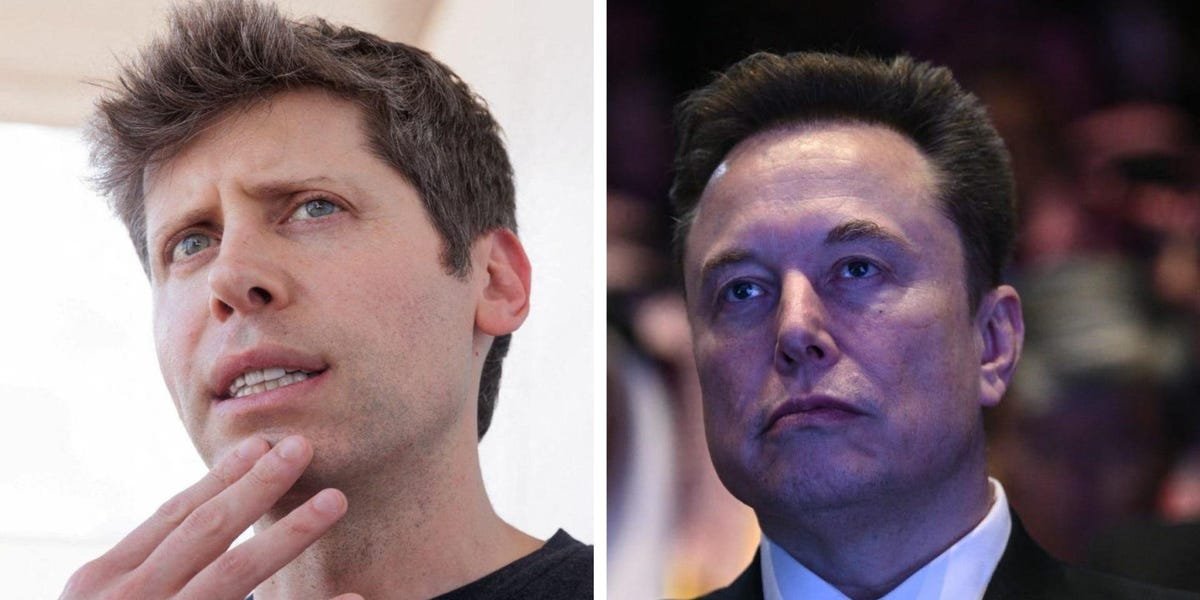
If Elon Musk and Sam Altman like each other, they hide it well.

In the latest turn in the rivalry, the two are battling over the top spot on the list of the world’s most valuable private companies.

While the two cofounded OpenAI together back in 2015, the partnership has frayed spectacularly since.

Musk left OpenAI in 2018 and later founded rival startup, xAI. Musk or his company, xAI, has filed lawsuits against OpenAI.

OpenAI held a secondary share sale in October that valued it at $500 billion, taking the lead from Musk’s SpaceX by a cool $100 billion.

Not one to cede ground to a rival, Musk is now planning his own secondary share sale at SpaceX, according to an internal letter to employees seen by multiple outlets. It would value the company at a whopping $800 billion. If that happens soon, it means Musk would have only let Altman hold the mantle for a couple of months.

Musk also confirmed on X this week that the company is exploring a blockbuster initial public offering, which might be the only way OpenAI can regain its lead as a private company. OpenAI this year restructured its business, which would allow it to also pursue its own eye-watering IPO in the future.

While this valuation battle between the two billionaires is maybe cringeworthy theater for the average earner, it underscores a significant shift: investors are pouring unprecedented money into technologies once viewed as speculative science projects.

SpaceX, which aims to make life multi-planetary and colonize Mars, and OpenAI, which seeks to develop a theoretical AI that can reason like humans, are two of the most visible examples, but they are part of a broader surge in frontier-tech valuations. AI, robotics, and defense tech startups have all notched multibillion-dollar valuations in the past year — bubble be damned.


Source link

The-history-of-Elon-Musk-and-Sam-Altmans-relationship-and.jpeg

The history of Elon Musk and Sam Altman’s relationship and feuds, which date back to the early days of OpenAI

SpaceX is planning a secondary share sale, according to an internal message to employees seen by multiple outlets, which would value the company at $800 billion, reclaiming the top spot among the world’s most valuable private companies from OpenAI.

OpenAI executed its own secondary share sale in October, valuing the company at $500 billion.

The letter to employees also says SpaceX is exploring an initial public offering to “raise a significant amount of capital,” The Wall Street Journal and other outlets reported. It would be the largest IPO in history.

“The thinking is that if we execute brilliantly and the markets cooperate, a public offering could raise a significant amount of capital,” SpaceX Chief Financial Officer Bret Johnsen told staff in the December 12 message.

Musk also hinted at an IPO earlier this week.

After journalist Eric Berger published an op-ed arguing that SpaceX is likely to go public soon, Musk replied, “as usual, Eric is accurate.”

The company is aiming to raise more than $25 billion through an initial public offering, a move that could push its valuation above $1 trillion, Reuters reported.


Source link

Some-Tesla-shareholders-say-diverting-Nvidia-chips-is-further-proof.jpeg

Some Tesla shareholders say diverting Nvidia chips is further proof that Elon Musk doesn’t deserve a multibillion-dollar pay package

Several institutional shareholders of Tesla told Business Insider that Elon Musk’s decision to redirect a shipment of valuable Nvidia chips away from the EV company is further proof the CEO doesn’t deserve a multibillion-dollar pay package.

In May, a group of eight Tesla shareholders wrote a letter urging other investors to vote against Musk’s compensation package. The group is just one faction of a growing number of investors who said they plan to vote against the deal.

This package, now roughly worth $46 billion, was struck down in January by Delaware Chancery Court Chancellor Kathaleen McCormick, who said that the process to reach this “unfair price” for Musk was “deeply flawed.”

Tesla shareholders will vote on June 13 on whether to reinstate Musk’s deal.

But less than two weeks ahead of the shareholder vote, CNBC reported that Musk diverted a $500 million shipment of Nvidia chips, which are essential for powering artificial intelligence technology, away from Tesla and to his social media platform X instead.

The internal memo from Nvidia indicating Musk’s delay of the Nvidia chips procurement was from December, CNBC reported — months before the April earnings call in which the Tesla CEO insisted the automaker is an AI company. He also stated in the call that he would aggressively expand the number of Nvidia chips at Tesla from 35,000 to 85,000 units by the end of 2024.

In response to the CNBC report, Musk said on X that “Tesla had no place to send the Nvidia chips to turn them on, so they would have just sat in a warehouse.”

“The south extension of Giga Texas is almost complete. This will house 50k H100s (Nvidia chips) for FSD training,” Musk added, referring to Tesla’s Full Self-Driving feature — a key component of the company’s promise to deliver autonomous taxis.

But some of the shareholders behind the effort to strike down Musk’s big payday are not convinced.

“The diversion of Nvidia’s processors to X and xAI is just another example of Tesla’s CEO reallocating Tesla’s resources in favor of his other businesses and treating Tesla as though it is his own coffer as a result of the lack of oversight by Tesla’s board,” Tejal Patel, the executive director of SOC Investment Group, wrote in an email to BI.

Patel added: “The key questions are why were these valuable processors ‘just sitting there’ in the first place, and if it was an operational issue, why was that not foreseen by management? Whatever decision-making there was for the processors to go unused by Tesla would have been up to CEO Musk.”

Musk did not respond to a request for comment from Business Insider.

SOC Investment Group is one of the eight shareholders that co-signed a letter urging investors to vote against the ratification of Musk’s stock options package and against the reelection of Musk’s brother, Kimbal, and James Murdoch for seats on Tesla’s board.

The group — made up of pension fund managers, an asset management firm, and a bank — also includes Amalgamated Bank, AkademikerPension, Nordea Asset Management, New York City Comptroller Brad Lander, SHARE, Unison, and United Church Funds.

In a statement to BI, Lander wrote that Musk’s decision to divert Nvidia chips away from Tesla “should be a “red flag to investors.”

“This sudden move adds to the growing concerns about Musk’s commitment to Tesla and highlights his glaring conflicts of interest,” he wrote. “There is a pressing need at Tesla for a genuinely independent board that will ensure Musk prioritizes company interests.”

Matthew Illian, the director of responsible investing for United Church Funds, similarly criticized Musk’s move to delay the shipment of Nvidia chips, stating that it was “further evidence” that the pay package “never achieved its purpose of maintaining the attention of Tesla’s CEO.”

“This is all about Elon building an empire for himself with investor money and we can’t let this happen,” he wrote in an email to BI.

It’s not immediately clear how much Tesla stock the eight shareholders own altogether.

Five of the eight shareholders, including Amalgamated Bank, Unison, Nordea, the New York City Retirement System, and United Church Funds, represent more than 4.9 million shares of Tesla stock.

As of Thursday, those shares are worth more than $878 million.

Spokespersons for SHARE, Nordea, and Unison could not be reached for comment or did not immediately respond for comment.

In addition to the eight shareholders, the California Public Employees’ Retirement System (CalPERS), which owns about 9.5 million shares of Tesla stock, signaled it would vote against Musk’s pay package.

“We do not believe that the compensation is commensurate with the performance of the company,” CalPERS CEO Marcie Frost told CNBC.

A CalPERS spokesperson declined to comment when asked about Musk’s decision to divert the shipment of Nvidia chips.


Source link