
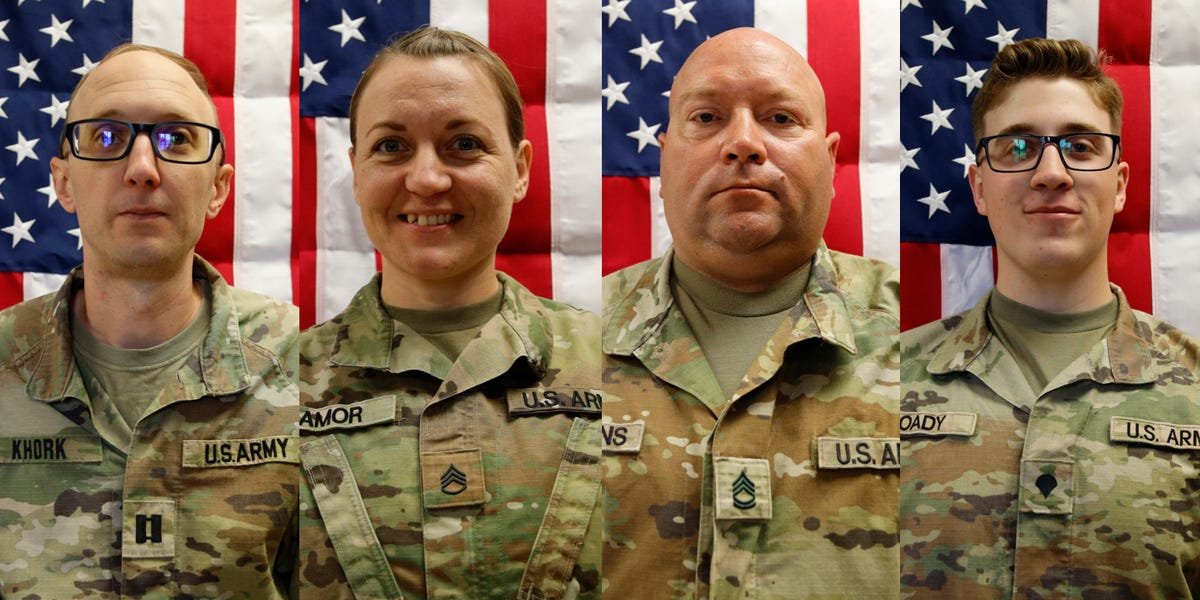
US-releases-names-of-4-service-members-killed-in-the.jpeg

US releases names of 4 service members killed in the Iran conflict

  • The Defense Department has released the names of 4 service members killed in the Iran conflict.
  • The servicemembers were identified as Cody Khork, Noah Tietjens, Nicole Armor, and Declan Coady.
  • The identities of two additional fatalities of US troops remain unknown.

The names of four US Army Reserve soldiers who were killed by a drone attack during the US conflict with Iran were released on Tuesday.

The fallen servicemembers were identified as:

  • Capt. Cody Khork, 35, of Winter Haven, Florida
  • Sgt. 1st Class Nicole Amor, 39, of White Bear Lake, Minnesota
  • Sgt. 1st Class Noah Tietjens, 42, of Bellevue, Nebraska
  • Sgt. Declan Coady, 20, of Des Moines, Iowa

The soldiers died on March 1 in Kuwait at the Port of Shuaiba during an incident that remains under investigation. They had each been assigned to the 103rd Sustainment Command, Des Moines, Iowa.

Two additional US troops have been killed since American forces alongside Israel began striking Iran on Saturday. Their names have yet to be released.

“Our Soldiers relentlessly, consistently, and fearlessly served with sincere dedication and pride,” Brig. Gen. Clint A. Barnes, Deputy Commanding General, 1st Theater Sustainment Command, Operational Command Post, said in a statement. “They represent the best of what our country stands for. May God grant their families peace and comfort in their memories. We will never forget them.”


Source link

The-biggest-names-in-AI-are-gathering-for-a-summit.jpeg

The biggest names in AI are gathering for a summit in India. Here are 5 of the biggest takeaways.

Google CEO Sundar Pichai said the world must not let the digital divide “become an AI divide.” He said expanding access to compute infrastructure, connectivity, and training is essential as AI reshapes economies.

Pichai said AI represents “the biggest platform shift of our lifetimes” and could drive “hyper progress” across science, healthcare, and economic development. But its benefits are neither “guaranteed nor automatic.”

“We must be equally bold in tackling problems in regions that have lacked access to technology,” Pichai said. “We cannot allow the digital divide to become an AI divide. That means investing in compute infrastructure and connectivity.”

Governments must act both as regulators and innovators to ensure AI improves public services and broadens opportunity, he added.

Anthropic CEO Dario Amodei said that while AI capabilities are advancing rapidly, there’s a gap between those capabilities and real-world impact.

“There is this duality between the fundamental capabilities of the technology and the time that it takes for those capabilities to diffuse into the world,” he said.

“There are just frictions to adopt things through enterprises, and I think even more so in the developing world,” he added.


Source link