

Judge-temporarily-blocks-the-Pentagon-from-declaring-Anthropic-a-national.jpeg

Judge temporarily blocks the Pentagon from declaring Anthropic a national security risk

A federal judge has granted Anthropic a major reprieve as the AI company challenges the Pentagon’s effective blacklisting.

On Thursday, US District Judge Rita Lin granted Anthropic’s request for a preliminary injunction to temporarily block the “Presidential Directive” that ordered federal agencies to stop using Anthropic’s technology, and Defense Secretary Pete Hegseth’s decision to formally label the AI frontier model maker as a “supply chain risk.”

Lin also stayed the effective date of the supply-chain designation, meaning that it cannot take place while the injunction is in place.

The decision is a victory for Anthropic and its CEO Dario Amodei, who refused to bow to Hegseth’s demands. It is not immediately clear if the Justice Department will appeal the decision. In the hours after talks with Anthropic fell apart, the Pentagon struck a deal with OpenAI.

“We’re grateful to the court for moving swiftly, and pleased they agree Anthropic is likely to succeed on the merits,” an Anthropic spokesperson said in a statement. “While this case was necessary to protect Anthropic, our customers, and our partners, our focus remains on working productively with the government to ensure all Americans benefit from safe, reliable AI.”

Spokespeople for the Pentagon and White House did not immediately respond to a request for comment.

In court filings, Anthropic officials said the risk designation could jeopardize potentially billions in revenue. If the injunction remains, Anthropic will be able to continue to do business with defense contractors.

Lin wrote in her decision that the injunction does not require the Defense Department to use Anthropic’s products or services.

Many in tech are closely watching the California case, since it tests whether the federal government can use some of its most severe powers to force a major AI company to agree to contractual terms. Microsoft, which filed an amicus brief in support of Anthropic, also said it was concerned about potential repercussions if companies like itself continued to partner with Anthropic.

Ahead of her ruling, Lin grilled the Justice Department over what she said looked like “an attempt to cripple Anthropic.” She said that the Pentagon could have simply discontinued using Claude, but instead, the Trump administration made repeated actions that appeared to be designed to “punish” the company.

“One of the amicus briefs used the term ‘attempted corporate murder.’ I don’t know if it’s murder, but it looks like an attempt to cripple Anthropic,” Lin said during the hearing. “And specifically, my concern is whether Anthropic is being punished for criticizing the government’s contracting position in the press.”

Beyond the California case, Anthropic has a separate suit pending in the D.C. Circuit over the supply chain risk designation.

It also remains to be seen how the White House and the broader Trump administration will treat Anthropic beyond the actions Lin’s ruling compels.

During the hearing, Deputy Assistant Attorney General Eric Hamilton repeatedly said that the Pentagon questions Anthropic’s “reliability and trustworthiness.” Hamilton said that defense officials are concerned Anthropic may try to improperly skew its AI models or shut off access.

In recent weeks, Hegseth, who met with Amodei, said the AI startup put “Silicon Valley ideology above American lives.” President Donald Trump decried the “WOKE COMPANY” run by ” Leftwing nut jobs” in a Truth Social post that was also part of the California lawsuit.

“Their selfishness is putting AMERICAN LIVES at risk, our Troops in danger, and our National Security in JEOPARDY,” Trump wrote on Truth Social on February 27.


Source link

I-saw-11-national-parks-in-one-30-day-trip-Using.jpeg

I saw 11 national parks in one 30-day trip. Using a few smart strategies and helpful apps, it only cost me $1,500.

America’s national parks are as magnificent as they are diverse, and in a single road trip, it’s easy to marvel at arid desert mountains one day and sky-high conifer forests the next.

I’ve visited all 63 national parks within the US, all on a shoestring budget, and I can attest that exploring “America’s best idea” is well worth the effort and drive time.

For those hoping to take an extended (and wallet-friendly) vacation, the national parks are a great place to look.

With my van and some careful budgeting, I was able to travel to Joshua Tree, Grand Canyon, Petrified Forest, Carlsbad Caverns, Guadalupe Mountains, Big Bend, Zion, Bryce Canyon, Capitol Reef, Arches, and Canyonlands over the course of 30 days and only spend about $1,500.

Here are a few strategies and resources that helped me pull this 11-park trip off without a hitch, plus the one thing I’d do differently next time.

The key to this trip was planning far in advance


Van parked near Teepees Petrified Forest

Teepees Petrified Forest was one of many stops on my trip.

Emily Pennington


Going on a trip of this magnitude took loads of research and preparation, and I started planning several months before I headed out.

First of all, many reservations and permits within the US national parks open up six months in advance and are available on a first-come, first-served basis.

This means you’ll want to have a clear picture of where you’ll be hiking, camping, or backpacking on every day of your journey at least six months before your trip, so you can take advantage of subsidized park campgrounds.

Sure, websites like Hipcamp make it easy to book a last-minute campsite near natural wonders, but you’ll often pay double or triple the price on bookings. For example, I’ve seen campsites listed for $50 or $60 a night that national parks and forests initially charged $20 for.

Oh, and don’t forget to nab an annual America the Beautiful Pass before starting your grand adventure.

For just $80, the pass gives access to all national parks, forests, and federal recreational lands for a calendar year — it’s an easy way to avoid entrance and standard amenities fees.

Groceries and homemade meals helped me stick to my budget


Joshua Tree at night with full moon, purple skies

I spent some time enjoying Joshua Tree on my trip.

Emily Pennington


One of the strictest cost-cutting measures I implemented was a $100 a week grocery budget. I slept inside my kitchenless minivan each night, meaning that I’d have to get up and go outside to boil water or cook evening meals.

Since I didn’t have a fridge or much in the way of electricity, I ate a lot of simple meals, like peanut butter and jelly sandwiches, mac and cheese, and carrot sticks with hummus.

As a treat, I gave myself a $50 a week restaurant budget so I could enjoy quirky roadside cafés and food trucks along the way.

Some of my favorite memories from the trip were discovering DB’s Rustic Iron BBQ, a tiny hole-in-the-wall near Big Bend, and Sweet Cravings Bakery, just outside of Arches, in Moab.

A few apps helped me save money on gas, overnight stays, and entertainment


Tent and table with benches in Bright Angel Campground - Grand Canyon

I stayed at a campground in the Grand Canyon.

Emily Pennington


Gas and lodging are likely to be your biggest expenses, and I definitely used the GasBuddy app every day to plan where I could fill up for the best price.

I also made sure to drive a fuel-efficient vehicle for the entire road trip, which saved me hundreds of dollars in gas alone.

As much as I could, I tried to camp in free campsites and sleep in Walmart parking lots for the duration of my monthlong road trip.

I used apps like AllStays and Campendium to find free, legal places to bed down in my minivan. Sometimes this meant I was sleeping an hour’s drive away from any given national park, but that seemed worth it to me at the time to skip the $20 to $30 park campgrounds typically charge.

The National Park Service app is also worth downloading before any trip. It’s filled with things like free guided audio tours, maps, ranger program schedules, and top attractions. In addition, popular parks, such as Zion and the Grand Canyon, offer free in-person ranger talks and activities that are open to all visitors.

These proved to be invaluable assets to my trip when I couldn’t afford guided hikes and bus trips.

Looking back, though, I wish I’d stayed at a few more campgrounds


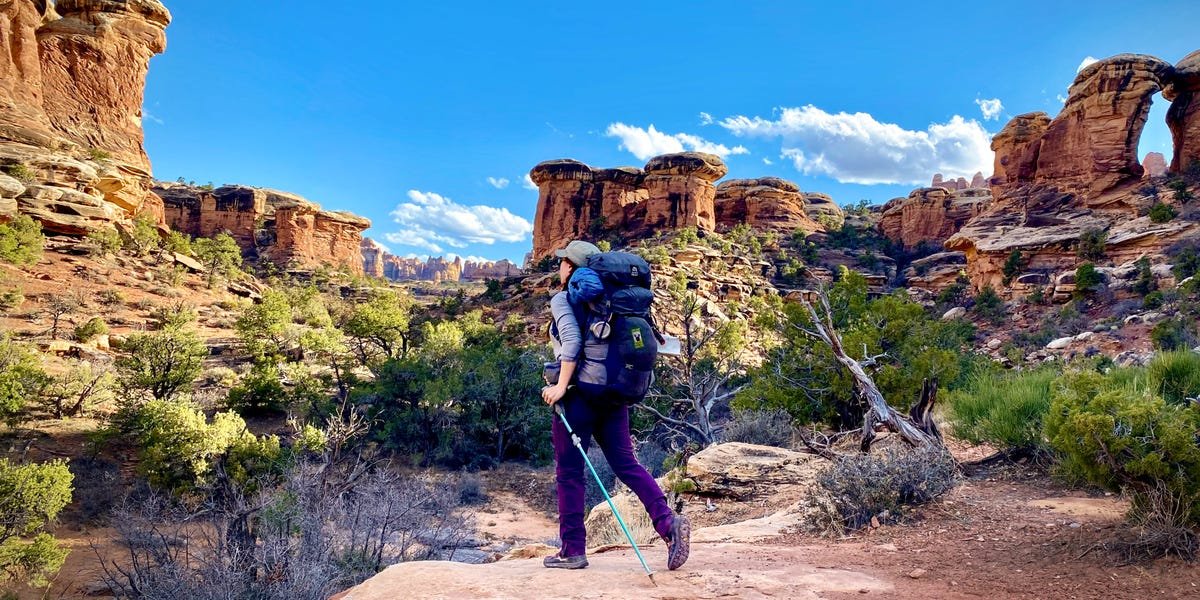
Author Emily Pennington standing wih backpack in GRand Canyon

I learned a lot about myself on this epic trip through US national parks.

Emily Pennington


Even though I had the time of my life exploring America’s national parks for a month straight, there’s one thing I’d do differently next time.

In the interest of saving money, I slept in the parking lots of many truck stops and Cracker Barrels, rather than driving a bit farther to sleep on federal lands or spending $20 to camp closer to a park.

As a solo female traveler, I tended to feel safer when I was camping outside cities. I slept better, too, because the woodsy environments always proved to be quieter and more soothing.

If I had a tiny bit more in my budget, I would’ve happily booked more national park and national forest campgrounds during the planning phase of my trip.

Still, I learned so much about my own ability to do more with less on this epic journey across the US national parks, and I can’t wait for my next long road trip into the wilderness.


Source link

I-visited-the-National-Air-and-Space-Museums-lesser-known-second.jpeg

I visited the National Air and Space Museum’s lesser-known second location. One exhibit stopped me in my tracks.

  • I visited the National Air and Space Museum’s second location, the Steven F. Udvar-Hazy Center.
  • The Virginia museum has over 200 aircraft and spacecraft in 340,000 square feet of exhibit space.
  • The space hangar featuring the space shuttle Discovery was a highlight of my visit.

The National Air and Space Museum’s flagship location in Washington, DC, is one of the most-visited museums in the US, but the building isn’t large enough to display all of the aircraft and spacecraft in its collection.

That’s where the Steven F. Udvar-Hazy Center comes in. The National Air and Space Museum’s lesser-known second location, a hangar-like structure in Chantilly, Virginia, offers 340,000 square feet of exhibit space with over 200 aircraft and spacecraft on display.

“What you’re going to see are the first, the last, the only, the last remaining, the most significant. So it’s an A-plus, as far as the collection,” Holly Williamson, the museum’s public affairs specialist, told Business Insider.

Here are the coolest things I saw during my visit.

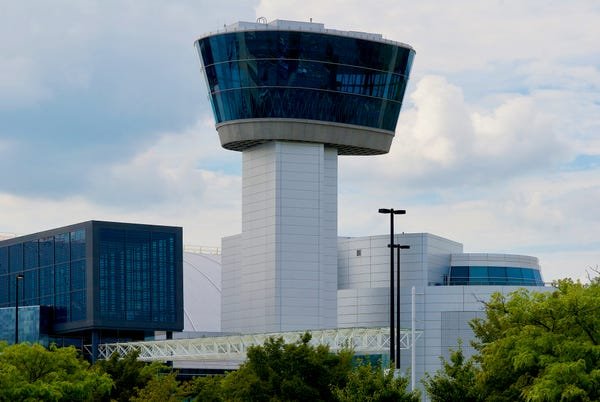
The Steven F. Udvar-Hazy Center in Chantilly, Virginia, is located on the property of Washington Dulles Airport.

The Steven F. Udvar-Hazy Center in Chantilly, Virginia.

John M. Chase/Getty Images

Unlike at the National Air and Space Museum’s flagship DC location, where timed-entry tickets help manage large crowds in the smaller space, reservations are not required at the Udvar-Hazy Center.

Admission to the museum is free, and parking costs $15.

The museum takes advantage of its proximity to the airport with the Donald D. Engen Observation Tower.


Inside the Donald D. Engen Observation Tower.

Inside the Donald D. Engen Observation Tower.

Talia Lakritz/Business Insider

At 164 feet tall, the observation tower educates visitors about the history of Air Traffic Control and provides a 360-degree view of the modern airport in action.

Inside the tower, I watched planes take off and land at Dulles Airport while listening to live Air Traffic Control audio.

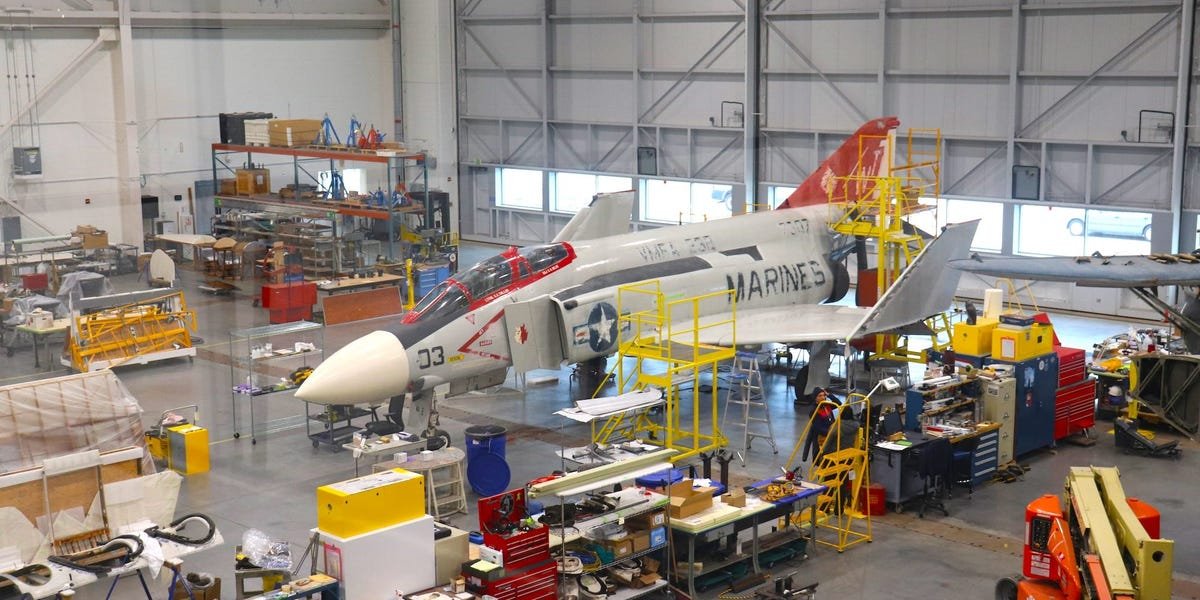
The Mary Baker Engen Restoration Hangar gives a behind-the-scenes look at how the museum restores historic aircraft.


The Mary Baker Engen Restoration Hangar at the National Air and Space Museum's Steven F. Udvar-Hazy Center in Chantilly, Virginia.

The Mary Baker Engen Restoration Hangar.

Talia Lakritz/Business Insider

Visitors can watch restoration work happen in real time from a balcony with floor-to-ceiling windows overlooking the hangar.

Among the works-in-progress are “Flak-Bait,” a Martin B-26 Marauder that flew 202 combat missions during World War II and participated in D-Day, and a Sikorsky JRS-1 seaplane that was present at Pearl Harbor when it was attacked on December 7, 1941.

The B-29 bomber Enola Gay, which dropped the atomic bomb on Hiroshima during World War II, is in the museum’s collection.


The Enola Gay viewed from an elevated platform at the National Air and Space Museum's Steven F. Udvar-Hazy Center.

The Enola Gay.

Talia Lakritz/Business Insider

On August 6, 1945, the Boeing B-29 Superfortress bomber Enola Gay dropped the first-ever atomic bomb used in warfare on Hiroshima, killing at least 70,000 people.

The “Little Boy” atomic bomb weighed 9,700 pounds, forcing the aircraft to remove most of its protective and defensive armament in order to carry the enormous weight.

The Enola Gay exhibit sparked controversy when the plane was first displayed in 1995, as veterans’ groups and anti-war activists debated how the historical narrative around the use of the atomic bomb should be presented.

The Boeing 367-80 Jet Transport, the only model of its kind ever built, was the prototype that led to the development of the Boeing 707 jetliner.


The Dash 80.

The Boeing 367-80 Jet Transport.

Heritage Images/Heritage Images via Getty Images

In the 1950s, Boeing set out to build a jet aircraft that could function as a passenger aircraft, a cargo plane, or a tanker used for mid-air refueling.

Boeing began building this prototype jet in 1952, and it flew for the first time two years later. It traveled 100 miles per hour faster than the de Havilland Comet, the world’s first jetliner developed in the UK, and had a range of over 3,500 miles, revolutionizing the air travel industry.

Known as “Dash 80,” the developed version of the aircraft entered service as the first jetliner in the US, the Boeing 707.

The museum also featured a Concorde supersonic commercial jet that was operated by Air France.


An Air France Concorde supersonic passenger jet.

An Air France Concorde supersonic commercial jet.

Talia Lakritz/Business Insider

The governments of Britain and France collaborated to create the first supersonic commercial jets, which operated commercially from 1976 to 2003.

Traveling at twice the speed of sound allowed the planes to cross the ocean in record time. Concorde’s fastest flight from New York City to London lasted just 2 hours, 52 minutes, and 59 seconds.

The museum’s Concorde jet, which flew for Air France, measures 202 feet and 3 inches long with a wingspan of 83 feet and 10 inches.

One of the museum’s centerpieces is a Lockheed SR-71A Blackbird, the world’s fastest aircraft propelled by air-breathing engines.


A Lockheed SR-71A Blackbird.

A Lockheed SR-71A Blackbird.

Talia Lakritz/Business Insider

The Lockheed SR-71A, a supersonic reconnaissance aircraft, was designed to fly high and fast enough to avoid Russian missiles during the Cold War. It was capable of flying at an altitude of over 85,000 feet at speeds of over three times the speed of sound, or approximately 0.7 miles per second.

The aircraft became known as “Blackbird” for its black paint that was capable of absorbing radar signals.

This Blackbird logged 2,801.1 hours of flight time over 24 years of service before retiring in 1990.

The entrance to the James S. McDonnell Space Hangar, with the space shuttle Discovery placed front and center, stopped me in my tracks.


The space shuttle Discovery.

The space shuttle Discovery.

Talia Lakritz/Business Insider

It’s hard to capture the full scale of Discovery in a photo, but I found it awe-inspiring to see such an enormous, historically significant spacecraft in person.

The shuttle measures 122 feet long, 78 feet wide, and 57 feet tall, towering over the other artifacts in the hangar. When fully loaded for missions, the orbiter weighed around 250,000 pounds.

Discovery was NASA’s longest-serving orbiter and flew 39 missions — more than any other space shuttle orbiter.


The space shuttle Discovery at the National Air and Space Museum's Steven F. Udvar-Hazy Center.

The space shuttle Discovery.

Talia Lakritz/Business Insider

Discovery flew its first mission in 1984 and returned from its last in 2012, spending a total of 365 days in space.

Among its many historic accomplishments, Discovery deployed the Hubble Space Telescope in 1990 and became the first space shuttle to dock with the International Space Station in 1999.

Hanging above Discovery was the Manned Maneuvering Unit that astronaut Bruce McCandless used during the first untethered spacewalk in 1984.


The Manned Maneuvering Unit, then and now.

The Manned Maneuvering Unit in action.

Talia Lakritz/Business Insider ; Encyclopaedia Britannica/UIG Via Getty Images

The backpack propulsion device, powered by nitrogen jets, allowed McCandless to fly around 300 feet away from the space shuttle Challenger. His untethered spacewalk was immortalized in an iconic photo of the lone astronaut floating above the Earth.

The Udvar-Hazy Center is worth the detour from the National Mall.


The space shuttle Discovery at the National Air and Space Museum's Steven F. Udvar-Hazy Center.

The space shuttle Discovery at the National Air and Space Museum’s Steven F. Udvar-Hazy Center.

Talia Lakritz/Business Insider

My phone’s step counter recorded nearly 10,000 steps on the day I visited the museum. There’s an incredible amount of ground to cover and objects to see.

I can’t believe I didn’t know that the National Air and Space Museum even had a second location when I started planning my visit to Washington, DC. Now, I’m recommending it to all of the air and space enthusiasts I know.


Source link

Lucia Moses

Who is Susan Rice, the former national security advisor in Trump’s crosshairs?

President Donald Trump has demanded that Netflix remove former US ambassador and national security advisor Susan Rice from its board, stepping up his criticism of the streaming giant as it seeks to merge with Warner Bros. Discovery amid antitrust scrutiny.

Rice, who served in senior roles in the Obama and Biden administrations, recently warned companies against aligning with Trump. Speaking on the “Stay Tuned with Preet Bharara” podcast published Thursday, she said corporations that “take a knee” to the president and skirt the law should expect consequences, predicting an “accountability agenda” if Democrats take back power.

“There is likely to be a swing in the other direction,” and these companies are “going to be caught with more than their pants down,” Rice said.” They’re going to be held accountable by those who come in opposition to Trump and win at the ballot box.”

Rice, a Democrat, has a long career in US foreign and domestic policy, working under Democratic presidents.

She served in the Clinton administration from 1993 to 2001, including roles at the National Security Council and as assistant Secretary of State for African Affairs.

Under Obama, Rice served as US ambassador to the UN, becoming the second-youngest person at 44 and the first Black woman to represent the US at the UN. She later served as head of the Domestic Policy Council under Biden.

She was born in Washington, D.C., and graduated from Stanford with a degree in history. She worked in management consulting for McKinsey and Company before entering government.

Rice has previously faced criticism from the right. In her 2019 memoir, “Tough Love: My Story of the Things Worth Fighting For,” she wrote that she was a frequent “villain” for conservative media.

After the 2012 killing of four Americans in Benghazi, Libya, Republicans accused her of misleading the public in interviews discussing the attacks. She was later cleared by subsequent investigations.

She also faced scrutiny by Trump and his allies for “unmasking” senior Trump officials to understand why the crown prince of the United Arab Emirates was in New York in 2016.

Unmasking is when senior government officials ask to learn the identity of a US citizen whose name has been withheld in intelligence reports about communications, such as intercepted calls. In some situations, national security officials argue that knowing the person’s identity is necessary to interpret and assess the intelligence information.

As UN Ambassador, Rice supported US intervention against Muammar Gaddafi.

Rice has written op-eds supportive of the Biden administration and accusing Trump of undermining democracy. In a 2025 column in The New York Times, Rice accused members of Trump’s national security team of “reckless negligence” after they discussed sensitive national security matters on Signal.

Disclosure: Mathias Döpfner, the CEO of Business Insider’s parent company, is a Netflix board member.


Source link

Inside-the-restoration-hangar-where-the-National-Air-and-Space.jpeg

Inside the restoration hangar where the National Air and Space Museum repairs and preserves historic aircraft for display

When a one-of-a-kind aircraft from World War II needs work done, not just any body shop will do.

At the National Air and Space Museum’s Steven F. Udvar-Hazy Center in Chantilly, Virginia, staff members repair and preserve historic aircraft in an in-house restoration hangar that offers a behind-the-scenes look at the work that goes into maintaining the museum’s collection.


The Mary Baker Engen Restoration Hangar at the National Air and Space Museum's Steven F. Udvar-Hazy Center in Chantilly, Virginia.

The Mary Baker Engen Restoration Hangar at the National Air and Space Museum’s Steven F. Udvar-Hazy Center in Chantilly, Virginia.

Talia Lakritz/Business Insider


The Smithsonian museum’s second location, situated about 30 miles from the National Air and Space Museum’s flagship site in downtown Washington, DC, offers an expansive setting with 340,000 square feet of exhibit space.

The Mary Baker Engen Restoration Hangar, which is connected to the exhibits, can accommodate several aircraft at a time and houses everything workers might need, including a sheet-metal shop, a welding room, a paint room, and a fabric shop.

It also features floor-to-ceiling windows overlooking the hangar, allowing visitors to watch the work happening in real time.


Observation windows overlook the Mary Baker Engen Restoration Hangar at the National Air and Space Museum.

Observation windows overlook the Mary Baker Engen Restoration Hangar.

Talia Lakritz/Business Insider


Holly Williamson, public affairs specialist at the National Air and Space Museum, told Business Insider that visitors shouldn’t expect to see planes being built with the speed of a factory assembly line. Progress can be slow, with some restoration projects spanning months or years.

“This kind of will look like paint drying if you just sit here for the whole day,” Williamson said. “It’s a lot of research. It’s very detail-oriented.”

Despite the slow pace, there’s still plenty to see. One of the museum’s longer-term projects is “Flak-Bait,” a Martin B-26 Marauder that flew 202 combat missions during World War II, including D-Day.


“Flak-Bait,” a Martin B-26 Marauder.

Talia Lakritz/Business Insider


When the museum first opened in 1976, visitors were allowed to touch the aircraft’s nose, which wore down the paint. Workers have focused on restoring its appearance while preserving its authentic combat damage.

“It flew more missions than any other aircraft in World War II for the US, so we want it to look like it’s been through hundreds of missions,” Williamson said.

Another striking display is a Sikorsky JRS-1 seaplane, the only aircraft in the museum’s collection that was present at Pearl Harbor when it was attacked on December 7, 1941. After Pearl Harbor, the Sikorsky JRS-1 patrolled for Japanese submarines. It arrived at the Mary Baker Engen Restoration Hangar in 2011.


A Sikorsky JRS-1.

A Sikorsky JRS-1.

Talia Lakritz/Business Insider


Staff members are also working to restore a McDonnell F-4S Phantom II, a fighter and bomber that shot down an MiG-21 during the Vietnam War. After the Vietnam War, it underwent modernization and was redeployed in 1983, remaining in service until its last squadron duty in 1987.


A McDonnell F-4S Phantom II in the Mary Baker Engen Restoration Hangar.

A McDonnell F-4S Phantom II.

Talia Lakritz/Business Insider


The rest of the hangar floor is a maze of tools, machinery, aircraft parts, and storage bins, indicators of just how intricate the museum’s restoration efforts are.

Certainly more interesting than watching paint dry.


Source link