
Headshot of Chris Panella.

Ukraine says its ‘red’ team forces beat NATO’s ‘blue’ team forces in every combat scenario during recent naval drone drills

Off the coast of Portugal, a Ukrainian-led team went up against NATO forces in a naval combat drill targeting ships and ports with naval drones. The Ukrainian “red” team, operating the naval drones, won in every scenario.

Ukraine has employed a range of naval drones throughout the ongoing war with Russia, continuing to invest in the development of its naval drones, critical innovations that have provided its forces with a tremendous asymmetric advantage over Russia’s large traditional navy.

The recent exercise, part of efforts to learn from the war in Ukraine, examined how NATO allies ought to plan and prepare for the threat posed by uncrewed surface vessels.

Ukraine’s defense ministry said Friday that its team defeated NATO forces in a military exercise off the coast of Portugal. Across five scenarios, a Ukraine-led “red” team — which also included US, British, Spanish, and other units — beat the “blue” team made up of NATO forces.

“In all five scenarios, Ukrainians struck the ports and convoys of the simulated adversary,” Ukraine said.

The red aggressor team used Magura V7 drones, a class of USVs developed by Kyiv and capable of fulfilling intelligence, surveillance, and reconnaissance roles, as well as combat and mine countermeasure duties. In one scenario, the red team used the drones to simulate the targeting and sinking of a NATO frigate.

Ukraine said a NATO spokesperson acknowledged the threat of naval drones had been previously underestimated.


tk

Lacking traditional naval combat power, Ukraine has relied on its naval drone fleet. 

Global Images Ukraine/Global Images Ukraine via Getty Images


The annual REPMUS/Dynamic Messenger exercises are part of NATO’s Operational Experimentation series in which allies test and evaluate new maritime capabilities. Last fall’s Robotic Experimentation and Prototyping using Maritime Uncrewed Systems (REPMUS) drill included two dozen allied navies and also tested Ukraine’s naval drones.

NATO said in a press release that these tests allowed the alliance to learn lessons on the use of drones from Ukraine, including how NATO navies can integrate drones into their naval forces as well as defend from enemy uncrewed systems.

The REPMUS/Dynamic Messenger exercises also aim to simulate realistic combat conditions with electronic warfare interference, jamming, and other drone countermeasures.

Ukraine lacks the ships necessary for traditional naval combat power, so it has, instead, relied heavily on missiles and naval drones to confront Russia’s Black Sea Fleet.

Its drones have damaged or destroyed dozens of Russian warships and vessels throughout the war. Kyiv has also used its naval drones to target infrastructure, such as ports, bridges, and offshore oil platforms.

Kyiv continues to invest in new naval drone capabilities, modifying them with new weapons like surface-to-air missile launchers, large-caliber machine guns, and even smaller quadcopter drones that can launch from drone boat motherships.



Source link

Images-show-destruction-at-Irans-drone-bases-naval-sites-radars.jpeg

Images show destruction at Iran’s drone bases, naval sites, radars

Newly captured satellite imagery shows destruction and damage to infrastructure at military installations across Iran after waves of US and Israeli airstrikes.

The images, collected on Sunday by the US spatial intelligence firm Vantor and obtained by Business Insider, show that a wide range of targets have been struck since Saturday, including a drone base, a naval facility, and a radar system.

The US involvement is more widespread than the brief round of American strikes in June 2025, which primarily targeted Iran’s nuclear sites.

In the southern coastal city of Konarak along the Gulf of Oman, the images reveal destroyed and damaged buildings, storage bunkers, and aircraft shelters at Iranian drone and air bases.


A close-up view of destroyed buildings in Konarak, Iran.

Destroyed buildings at a drone base in Konarak.

Satellite image ©2026 Vantor.


A close-up view of destroyed storage bunkers in Konarak, Iran.

Destroyed storage bunkers in Konarak.

Satellite image ©2026 Vantor.


At a nearby naval facility in Konarak, the imagery shows destroyed and sinking vessels and damaged buildings adjacent to the pier. The US military confirmed on Sunday that it had struck a Jamaran-class corvette and said it was “sinking to the bottom of the Gulf of Oman.”

President Donald Trump said on Sunday that the US has “destroyed and sunk” nine Iranian naval vessels and would continue to target the remainder of the fleet.

At the Zahedan airbase in eastern Iran, near the country’s borders with Afghanistan and Pakistan, imagery reveals an obliterated radar system.


A close-up view of strikes on aircraft shelters at an airbase in Konarak, Iran.

Strikes on aircraft shelters at an airbase in Konarak.

Satellite image ©2026 Vantor.


A close-up view of destroyed and sinking vessels and damaged buildings at a naval base in Konarak, Iran.

Destroyed and sinking vessels and damaged buildings at a naval base in Konarak.

Satellite image ©2026 Vantor.


The US military said on Saturday that it had targeted Iran’s Islamic Revolutionary Guard Corps (IRGC) command and control facilities, air defenses, missile and drone launch sites, and military airfields. B-2 stealth bombers struck fortified missile sites with 2,000-pound bombs.

In contrast, the US focused its attacks in June 2025 — the first direct American strikes against Iran in decades — on fortified sites associated with Iran’s effort to enrich uranium.

The Israeli military said it has targeted Iranian air defense systems, missile launchers, and fighter jets in strikes that began Saturday and have continued into Sunday. Israel said it has killed 40 senior Iranian commanders, as well as the country’s Supreme Leader Ayatollah Ali Khamenei.

Despite these blows, Iran has managed to launch a steady pace of drones and missiles, damaging buildings and ships across the region.

Israeli fighter jets have dropped thousands of munitions over more than 700 aircraft sorties. More than 200 people have been killed or wounded in the joint strikes, according to local reports.


A view of destroyed buildings at Khamanei's compound in Iran.

Destroyed buildings at Khamanei’s compound.

Satellite image ©2026 Vantor.


A view of a destroyed radar system at Zahedan airbase in Iran.

A destroyed radar system at Zahedan airbase.

Satellite image ©2026 Vantor.


Iran has retaliated to the strikes by launching hundreds of missiles and drones at Israel and more than half a dozen other countries across the Middle East, including at major US military bases in several Gulf states.

The retaliatory fire has killed and wounded dozens of people in Israel and the United Arab Emirates, officials said, and caused significant damage to civilian infrastructure across the Gulf.

US Central Command, which oversees Middle East operations, said on Sunday that three service members have been killed and five more seriously wounded as part of combat operations against Iran. It said several other American personnel sustained minor injuries.

The announcement marks the first time the US has acknowledged casualties during the operation. Trump warned of potential losses on Saturday when he announced the start of the strike campaign.

“The lives of courageous American heroes may be lost, and we may have casualties. That often happens in war,” Trump said in a video address to the nation. “But we’re doing this — not for now — we’re doing this for the future, and it is a noble mission.”


Source link

Russias-latest-naval-mission-is-a-flex-to-cover-for.jpeg

Russia’s latest naval mission is a flex to cover for its embarrassing losses in the Black Sea, US official says

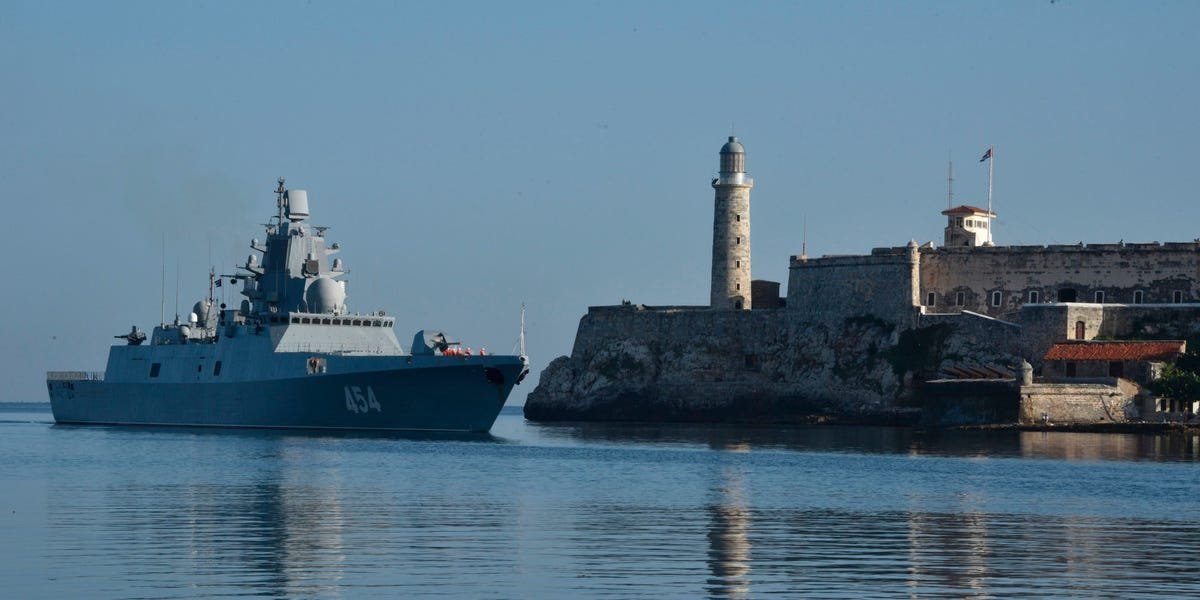
Russia sending warships to Cuba next week is an attempt to show its navy is still a global power after losses in the Black Sea, an unnamed US official told reporters, according to the Associated Press.

On Thursday, Cuba’s Ministry of Foreign Affairs said Russia was deploying four warships to Cuba, including a nuclear-powered submarine, with the vessels expected to be in Havana between June 12 and 17.

“Russia has sailed the Black Sea since 1783 but is now forced to constrain its fleet to port,” UK Defence Minister Grant Shapps wrote. “And even there Putin’s ships are sinking!”

This week, it was reported that Ukraine was using its exploding naval drones to go after smaller Russian vessels after Moscow pulled back its larger warships to reduce their vulnerability to attacks.

Not everyone agreed on Russia’s motive.

The visit of the ships, none of which will carry nuclear missiles, does not represent a threat to the region, the Cuban statement read, but was instead part of the historically cordial relations between the two countries.

But according to the US official, the deployment is an effort by Russia’s navy to flex its muscles on the world stage, after suffering losses in the Black Sea.

“This is about Russia showing that it’s still capable of some level of global power projection,” they said, per Reuters.

Russia’s navy has suffered a series of embarrassing setbacks in the Black Sea, where Ukraine claims to have destroyed a third of its fleet.

Ukraine has used drones, missiles, and other weaponry to take out many Russian warships, and has forced its fleet to seek safer ports further away from Crimea.

In March, the UK’s defense ministry declared Russia’s Black Sea Fleet “functionally inactive” after Ukraine claimed to have struck another two of its vessels.

Russia also shuffled its naval leadership earlier this year.

According to the unnamed US official, while the US expects “heightened” Russian naval and air activity this summer, and more going forward, deployments like those to Cuba incur costs for the Russian navy, which is “struggling to maintain readiness and conduct deployments with an aged fleet.”

In a military assessment on Thursday, the Washington DC-based think tank the Institute for the Study of War said it was likely part of an effort to bring back memories of the Cuban Missile Crisis, and dissuade the US from offering further support to Ukraine.

The deployment also comes after Putin threatened to send long-range weapons to “regions around the world” that want to strike Western targets.

Meanwhile, Russia’s Ministry of Defence said its goal was to keep a Russian naval presence in operationally important areas of the “far ocean zone,” RBC-Russia reported.


Source link