I-gave-my-marriage-a-2-day-mental-health-break-and.jpeg

I gave my marriage a 2-day mental health break and explored a nearby city solo. It was just what I needed.

Don’t get me wrong — I love my husband, and we’re great companions — at home and on the road. But I was thrilled when he decided not to join me on a trip to Querétaro, a city two hours from where we live part of the year in Mexico.

Barry was afraid it would be too hot. A Brit, he considers anything above 75 degrees a heat wave. And I was not-so-secretly thrilled to be on my own, even if it was only for 48 hours.

This was my chance to explore without worrying if anyone else was tired, annoyed, or hungry. This was my chance to do things my way.


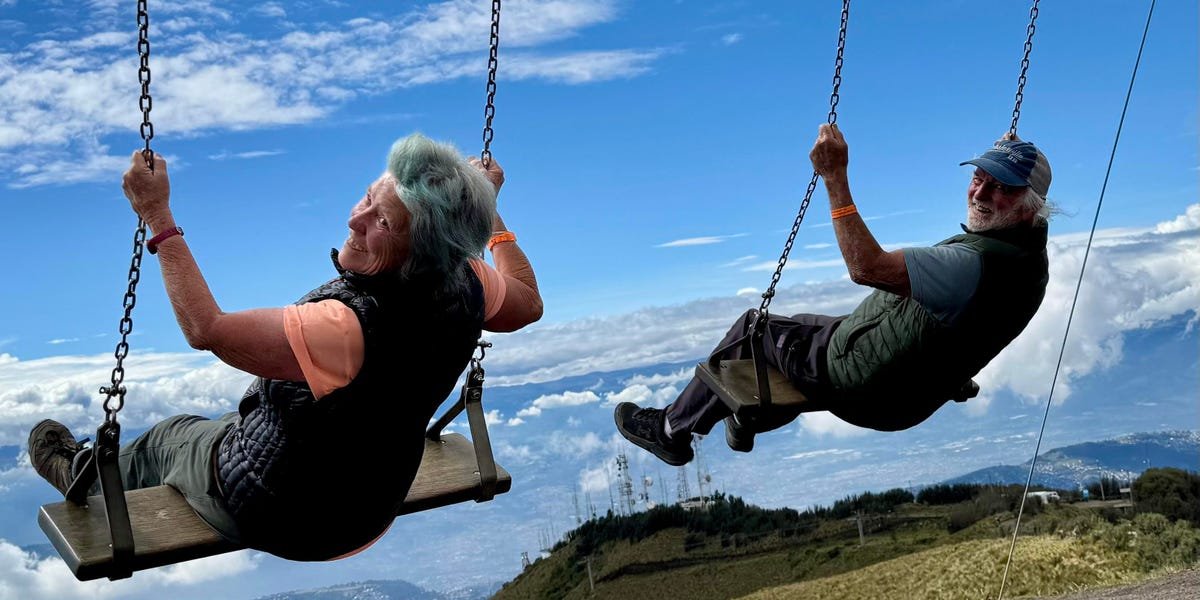
The author and her husband at Canada de Virgen.

The author said she and her husband (shown at Canada de Virgen) have a lot of fun when they travel together. 

Courtesy of Louisa Rogers.


I was excited to explore on my own

Querétaro is one of several Mexican colonial highland cities known for its well-preserved 18th-century architecture and silver-mining history. It’s a UNESCO World Heritage site, with over 1,400 protected buildings, churches, plazas, and a historic aqueduct. Barry and I have been there several times, but always on the way to somewhere else.

The adventure started when I boarded a bus from Guanajuato to Querétaro. The long-distance buses, with reclining seats, wifi, audio, and video entertainment, feel like flying in business class. My hotel room was also spacious, with two classy balconies.

Since I paint watercolors, the first thing I did was visit the Querétaro Museum of Art, which showcased a series of vibrant acrylic paintings by a Yucatán artist. At another art gallery, I enjoyed an immersive exhibition of erotic sculptures, where visitors were invited to touch the art. I took photos and sent them to Barry, who was just as intrigued. Just because he wasn’t with me didn’t mean I didn’t want to share a few moments with him.


Outdoor Sculpture in Queretaro

While exploring Querétaro on her own, the author visited an art museum and enjoyed painting at restaurants after finishing her meals. 

Courtesy of Louisa Rogers.


Later that day, I strolled around, eventually finding a restaurant near a park with a pianist playing. The waiter recommended zucchini and walnut soup. Divine! After I was done eating, I whiled away an hour painting, with a glass of wine (well, two). Waiters never rush you in Mexico.

My husband wasn’t with me, but I still wanted to share things with him

The next morning, I took another bus, passing the railway maintenance crew working on the train that will eventually go from Mexico City through Querétaro and beyond. Then I explored a Toltec ruins on the outskirts of the city.

My Uber driver into town told me a long story about his other job, burying dead people, sharing many descriptive details about the smells. I told him I had once been attracted to working for a funeral home, but after hearing the visceral details of his job, I’m glad I decided to pass.

I probably would have had the same conversation with the driver if Barry had been there, but like other aspects of the trip, it felt very refreshing to chat on my own. This was another story I’d share with Barry as soon as I could.

When I’m traveling with my husband, I’m not always as focused and aware. For instance, he has a better sense of orientation than I do, so I let him lead. Since I was by myself in Querétaro, I couldn’t be passive; I had to pay attention, which was good for me.

I enjoyed the chance to linger

The best part of my two-day break was not a place, but the freedom of dawdling. For instance, on Sunday, I couldn’t find the restaurant where I’d eaten the day before, so I checked out others. The first three were no-gos: one was mainly meat, which I don’t eat; one was too noisy; and the last had the kind of high tables and chairs where my feet don’t reach the floor, and I feel like I’m in preschool.

When Barry’s ready to eat, he gets irritated checking out restaurants, so he usually sits on a bench while I decide. I often feel a whiff of anxiety knowing I’m keeping him waiting. This time, though, I took my time and finally found an Italian restaurant where I ordered ciabatta, once again laying out my supplies and painting when I was done.


Dancing in the Queretaro plaza.

The author said she enjoyed lingering in the streets of Querétaro, which gave her time to take in the sights. 

Courtesy of Louisa Rogers.


That evening, there was dancing to live music at one of the nearby plazas. I positioned myself near two women who turned out to be a mom and a daughter, and we chatted during the break.

On the bus going home, I kept daydreaming about all the different parts of my weekend escapade, puzzling over why it had taken me so long to go somewhere by myself. After all, Barry and I thrive on time apart, and, in fact, consider it one of the secrets to our long (52 years!) relationship. Every year, I fly to Mexico before him and return after him. Next year, I vowed, I’ll go to Zacatecas, another UNESCO World Heritage city in Mexico that I like more than Barry does — on my own. I can hardly wait.


Source link

When-I-got-my-cancer-diagnosis-I-had-to-cancel.jpeg

When I got my cancer diagnosis, I had to cancel 3 planned vacations. A 1-night staycation in nearby Santa Cruz gave me the reset I needed.

The winter months were a blur of holiday activities and family gatherings. It felt like I was running on a treadmill from Thanksgiving into the new year, without the opportunity to get off.

As the unofficial “bringer of cheer” in my family, I feel a heavy burden to make sure we have enough fun over the holidays and work hard to create all the memories. Cookies must be baked, and decorations must be put up. And then they need to come down and get put away as I ready the family for the new year and the months ahead.

On top of that, I’m doing weekly chemo for breast cancer, which didn’t let up throughout the holiday madness. Life doesn’t stop for cancer. Eventually, I learned I needed to stop and do something for myself, though.

My diagnosis meant a change of plans

When I got my cancer diagnosis, I had to cancel planned trips to St. Maarten, Boston, and Dollywood. Not having those to look forward to was hard for me. As a travel writer, I love getting out of my regular routine for a few days to snorkel with sea turtles and dine on new cuisines.

With only my weekly chemo sessions on the calendar, I was feeling down. I knew that limiting my exposure to germs was important, but I missed my time spent enjoying Guinness in Ireland and kayaking near glaciers in Alaska. I knew I had to go somewhere, even if it was nearby.

I booked a one-night staycation near home

My solution: I booked myself a night away at West Cliff Inn, a boutique hotel by the beach in Santa Cruz that’s just a 30-minute drive from my home. I knew this wouldn’t be the same as a week in the Caribbean, but it was the perfect combination of time by myself and relaxation.


The author poses with a glass of wine while outside in Santa Cruz.

The author said she enjoyed having time and space to herself while on this solo trip.

Courtesy of Kate Loweth.


When I checked in, I found that my room was extra spacious and could have accommodated a friend or two. Did I think maybe I should have brought someone with me? Yes. But that thought vanished as soon as I set out to explore the area on my own

Simple moments helped me reset

I took a long walk on the beach and hiked along the cliffs, watching surfers just offshore. I enjoyed an umbrella drink and coconut shrimp at a tiki restaurant on the water, where I sat in the rotating bar area. A friend texted me at the perfect time with some gossip, and it felt like we were enjoying the vibrant sunset together.


A picturesque shot of the beach in Santa Cruz at sunset.

The writer said she enjoyed a long walk on the beach during her stay in Santa Cruz.

Courtesy of Kate Loweth.


Before it got too dark, I headed back to the hotel and enjoyed a salt soak in my massive tub before cozing up in my king-size bed at an early hour to enjoy the latest episode of “Below Deck.”

The next day, I visited a nearby spa and enjoyed a massage and a dip in a private hot tub before heading back home. Few things are perfect, but these 36 hours came pretty close.

I learned I don’t need a big trip to feel refreshed

This trip wasn’t about avoiding my family. It was about giving myself something to look forward to and acknowledging the difficult time I am going through.

I got home and felt ready to tackle what comes next, and I’m going to keep that in mind as I continue to move forward.


Source link

Safety-advocates-say-GOP-effort-wont-mandate-needed-cockpit-alarm.jpeg

Safety advocates say GOP effort won’t mandate needed cockpit alarm

Lawmakers appear to be at an impasse after the failure of a bipartisan bill that would have mandated something most airline cockpits still lack: a real-time view of other aircraft.

The ROTOR Act failed in the House by a single vote. It had passed with bipartisan support in the Senate and backing from families of crash victims of the January 2025 collision involving an American Airlines jet. It also had the support of pilot and flight attendant unions, airlines, and the National Transportation Safety Board.

Advocates say they will oppose a new GOP bill that does not mandate cockpit monitors.

Families were unhappy with the bill’s failure to garner the two-thirds majority needed to pass a procedural measure on Tuesday: “It was defeated by eleventh-hour objections built on misleading technical claims the NTSB’s own investigators have publicly refuted,” they said in a joint statement.


Rep. Don Beyer, D-Va., speaks during a news conference to discuss aviation safety reform legislation

Rep. Don Beyer, a Virginia Democrat who supported the ROTOR Act, speaks during a news conference to discuss aviation safety legislation. He’s surrounded by families of the victims.

AP Photo/Mariam Zuhaib


The bill split House Republicans, with some of the 132 opponents saying the additional monitoring systems would be expensive and were unproven; some are advocating for an alternate bill, the ALERT Act, that leaves air traffic controllers primarily responsible for collision alerts and allows some military flights to opt out of transmitting their positions.

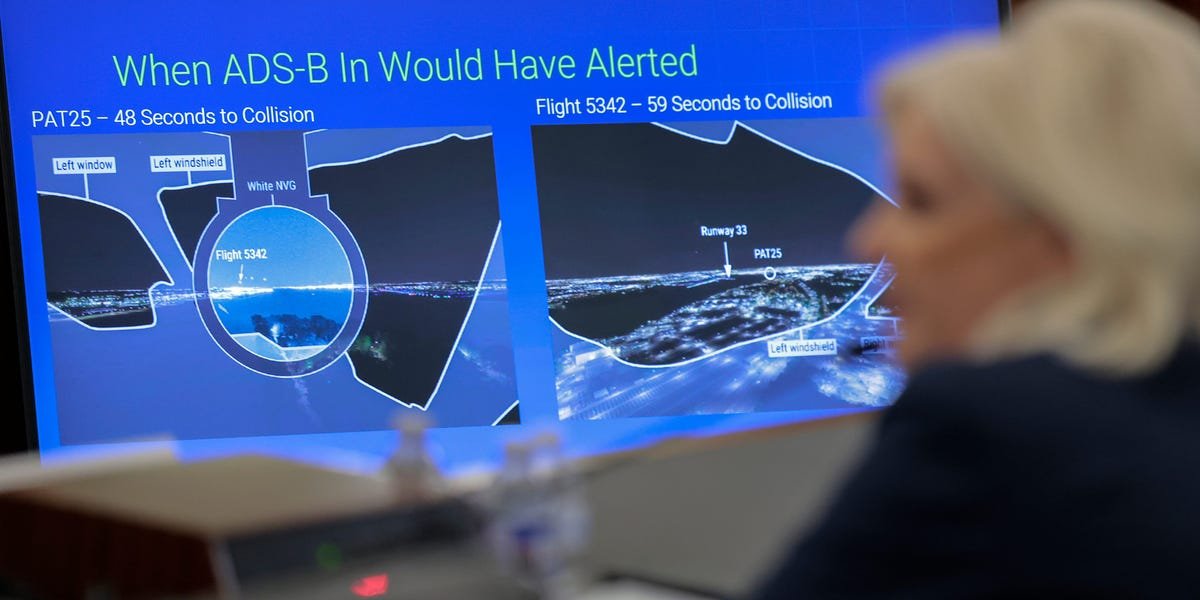
At the heart of the debate was a proposed requirement to equip commercial aircraft with GPS-based “ADS-B In,” which would display nearby air traffic on the flight deck screen — potentially closing the gap revealed by last year’s AA crash with an Army helicopter near Ronald Reagan National Airport that killed 67 people. Overstretched air traffic controllers had struggled to track the mix of commercial and military flights in DC’s crowded airspace that day.

Commercial aircraft have been required to carry the sister technology, “ADS-B Out,” since 2020, which feeds their position to air traffic control. Think of it like ADS-B Out is talking and ADS-B In is listening. ADS-B Out has drastically improved safety by being more precise than radar and enhancing pilot situational awareness.


Example of ADS-B

Example of a generic Garmin ADS-B traffic monitor in an aircraft.

Garmin


Supporters of the ROTOR Act — which would also require certain military planes to broadcast their position in civilian airspace — argued that adding these monitors would allow pilots, as the last line of defense, to react to hazards when seconds count.

In comments shared with Business Insider, Syracuse University professor and aviation safety expert Kivanc Avrenli said the use of ADS-B In on the American jet would have given its pilots 59 more seconds to react before impact. In reality, the traffic-avoidance collision alert came only 19 seconds before, he said, and maneuver instructions weren’t possible due to altitude limits.

“In dense airspace, that extra 40 seconds can be the difference between having time to sort out a conflict and having no real options left,” he said. “Delaying these upgrades means continuing to rely on systems that simply were not built for this kind of scenario.”

ADS-B In would not only help in flight but also on the ground, where a series of runway incursions has exposed the limits of what controllers can handle in real time. In the months after the January accident, two separate military aircraft had close calls with US passenger jets.

The Pentagon initially supported the original bill. On Monday, it changed its position and said the technology risks “significant unresolved budgetary burdens and operational security risks affecting national defense activities.” Some Republicans came out against the bill and threw their weight behind a different effort.

House Republicans Mike Rogers and Sam Graves, who voted no to ROTOR, have instead pushed a revised version of the bill.


Families of the victims at sante hearing.

Families of the victims supported the ROTOR Act.

Heather Diehl/Getty Images


During a Senate hearing on Monday, Graves said ALERT would be a “comprehensive package” that would enhance military coordination and pilot training and address all 50 NTSB recommendations. He said the ROTOR Act only addresses two of the recommendations.

ALERT would not require ADS-B use — essentially maintaining the current system that relies on air traffic controllers to detect potential conflicts in and around airports and communicate with pilots. It would also absolve military aircraft of having to use the anti-collision technology in certain airspaces, citing security risks.

Graves added that ADS-B In would be a burden to implement on the 5,500 planes in the sky, would “unintentionally lead to an operational crisis in 2031,” and be an “unworkable” mandate.

NTSB Chair Jennifer Homendy — who oversees the research and writing of the agency’s recommendations — said on Thursday that the House’s ALERT bill is “watered down” and won’t do enough to prevent future accidents, adding that the bill doesn’t address all of the NTSB’s recommendations because it takes out the ADS-B In requirement.

The NTSB has recommended ADS-B In on cockpit displays since 2008. The Federal Aviation Administration has never mandated it, partly because it lacks a clear funding mechanism. Regulators have argued that the system, which provides visual and audio alerts, would impose a cost burden on airlines and on private plane owners who may not operate in congested airspace.

Homendy told a Senate Committee in February that American Airlines paid less than $50,000 per plane to retrofit roughly 300 Airbus A321s, as an industry example. That adds up fast across hundreds of aircraft. She said general aviation planes could carry portable receivers that cost as little as $400.

Some airlines, including American and JetBlue, have voluntarily added ADS-B In to their planes.


Source link

Headshot of Chris Panella.

US Army leaders say soldiers are drowning in so much battlefield data that AI is needed to make sense of it all

Army leaders say the modern battlefield is so saturated with sensors and networked weapons generating more data than soldiers can realistically process on their own that artificial intelligence is needed to meaningfully sort it all.

For years, the Army’s focus was on fielding more sensors for battlefield information and awareness, but now the service is also having to think about information overload and managing the massive amounts of data coming in.

During a recent US Army and NATO exercise in Europe, troops used a homegrown AI system to consume and sort data. The value wasn’t strictly that the AI could do it faster but rather that it could remember context and patterns that humans couldn’t.

The case from the Dynamic Front exercise is another example of how the US military is increasingly implementing AI and automation into everything from enemy attack simulations to paperwork.

“The modern battlefield, what we’re already seeing across the globe, it is swimming in sensors, and we are drowning in data,” Col. Jeff Pickler, the Army 2nd Multi-Domain Task Force commander, said at a media roundtable on Dynamic Front.

There aren’t enough people to decipher all the available information, he said. “They will never be able to fully process all of that.”


Two soldiers stand near an artillery piece about to fire in a wintry landscape.

This year’s Dynamic Front included almost 2,000 US personnel and almost 4,000 personnel from allies and partners.

US Army photo by Kevin Sterling Payne


The software aimed at addressing that problem remains in beta testing. In the next iteration of Dynamic Front — which will merge with another exercise, Arcane Front, to pair technology experimentation with theater-level combat rehearsals — Army leaders say they intend to test the AI at a larger scale.

“If we’re looking at a target set in the European theater where we think we’re going to need to process upwards of 1,500 targets a day, that’s beyond the human scope,” Pickler said. “The answer to the equation there is in AI and automations.”

During a potential large-scale conflict in Europe, AI could assist in locating and assessing those targets.

The system can do this quickly, but the speed isn’t the main benefit. AI can remember patterns that humans might forget or not even notice. Pickler gave an example of AI realizing that unrelated shipping reports, a local power outage, and a fertilizer delivery together might suggest missile fueling activity.

“So the difference isn’t seconds versus minutes — it’s minutes instead of months. Not because the machine scans quickly, but because it keeps context across sources that humans can’t hold in memory,” Pickler said after the roundtable.

“It doesn’t replace analysts by reading faster,” he said, “it replaces the weeks analysts spend reconnecting information spread across thousands of reports.”


Two soldiers sit at a table working on laptops.

AI, autonomy, and machine learning are at the forefront of the Army’s modernization efforts.

US Army photo by Capt. Regina Koesters


In a conflict scenario, that could mean analysts reach a clearer picture of the battlefield faster. Correlations between data gathered from different sensors could surface more quickly. If an adversary were fueling, arming, or moving weapons in ways that were not immediately obvious, AI could help flag those links.

Humans, though, would still decide how to respond.

Soldiers have seen success with iterating on the current AI model, the Army said. It’s been retooled during testing, and humans remain in the loop, reviewing outputs at multiple stages.

The goal is to continue increasing the overlap the model would have with human-produced information. In a targeting example, a milestone would be if AI achieved 90 to 95% agreement with humans on 100 target sets.

The Army’s push for AI and automation is also driving the development of its Next Generation Command and Control software, a priority initiative.

The technology being developed by vendor teams including Anduril, Palantir, and Lockheed Martin uses AI and machine learning to provide commanders and soldiers with real-time data on ammunition levels, maintenance needs, intelligence feeds, targeting, and simulated enemy attacks.

But AI is also changing other aspects of how the Army works. Autonomous features in drones, weapons, and targeting might be at the forefront, but behind the scenes, personnel are using new tools, redesigned workflows, and data integration for recruiting, maintenance, and inventors. These are manual tasks that the service believes can be improved with AI.


Source link

Expedia-says-its-cutting-some-roles-as-it-assesses-skills.jpeg

Expedia says it’s cutting some roles as it assesses skills needed for the future and simplifies its structure

  • Expedia is cutting jobs, the company confirmed to Business Insider.
  • Expedia said it’s focusing on skills needed for the future and simplifying its structure.
  • The scope of the cuts was unclear, but several affected employees posted about it on LinkedIn.

Expedia is cutting some roles as it looks toward the skills needed for the future, the company confirmed to Business Insider on Monday.

“We are eliminating roles as well as opening some new roles as we remain disciplined about assessing the skills we need for the future,” an Expedia Group spokesperson said in a statement. “We are also simplifying our structure and reducing organizational layers to move faster and with more accountability. These are not easy decisions, and we are grateful for the contributions of our colleagues who are impacted.”

It’s unclear how many people were affected or which divisions the cuts occurred in.

Several Expedia employees posted about being laid off on LinkedIn on Monday.

“After a decade of proudly working at Expedia, my role has been impacted due to organizational changes,” Natasha Morosov Pereira, an operations improvement manager, wrote, adding, “While this transition wasn’t expected, I’m grateful for everything I’ve learned and optimistic about what’s ahead.”

Also on Monday, over a dozen Expedia employees shared the same message on LinkedIn promoting openings at the travel booking company: “Expedia Group currently has OVER 250 roles open! Let’s transform travel together.”

Expedia joins several other companies that have cut roles in 2026, including Citi and T-Mobile.

Like Expedia, many companies cutting roles this year and last have cited an effort to flatten organizational structures and move faster in order to prepare for the future.

Have a tip? Contact this reporter via email at kvlamis@businessinsider.com or Signal at @kelseyv.21. Use a personal email address, a nonwork WiFi network, and a nonwork device; here’s our guide to sharing information securely.


Source link

Influencers-convinced-me-I-needed-to-build-an-igloo-for.jpeg

Influencers convinced me I needed to build an igloo for my kids. The results made this snow day bearable, and it was free.

Years ago, we bought a geodesic climbing structure for my three kids, who were all under 5. We thought it would keep them entertained all year long without our supervision, but the reality could not be more different. The structure sat untouched through the seasons.

On Sunday, while preparing for the massive snowstorm that was headed toward Maine, Instagram fed me a reel of a couple building an igloo with the same climbing structure we have. I sent it to my husband, who came running from the room next door and said, “We have to do this!”

It turned out to be a hit with the kids, and it was surprisingly easy to pull off.

We used sheets to make it eco-friendly

The video I watched showed the first step to making the igloo is wrapping the perimeter of the climbing structure tightly with plastic wrap.


Man covering structure with a sheet

The author used bed sheets instead of serenwrap.

Courtesy of the author


We opted for a more eco-friendly option and decided to use king-size bed sheets. My husband had the idea to soak them in water first so they wouldn’t blow away in the strong wind as we were prepping the igloo. We soaked them in a tub and carried them outside quickly. The temps in Maine were in the teens, so we had to drag the sheets across the climbing dome quickly. I was actually surprised at how quickly the sheets hardened in the cold air. We just wrapped the ends of the sheet around a pole and didn’t need anything else to secure it in place.

We covered the entire structure, leaving one small triangle so the kids could crawl in and out of it, and had the rest of the dome totally covered.

I didn’t want to get my hopes up

We had tried something similar years earlier, and the sheets never hardened enough to stay on the dome. I didn’t want to get my hopes up this time around, so we left the sheets and walked over to a friends’ house to play before the snow.


Kids inside a climbing dome

The author had low expectations for the results.

Courtesy of the author


We were back home when the storm had already started, and we could see snow accumulating on the dome. I really wanted to check on it regularly because I was worried the weight of the snow would collapse the igloo’s roof. But I’m from Argentina, and I don’t do well in negative temperatures, so I let it be and decided to check it in the morning.

We woke up to tons of snow and a perfect igloo

We got absolutely dumped with snow overnight; it was the biggest snowstorm I’ve experienced since moving to Maine 6 years ago. And to my surprise, the igloo worked.


Woman inside igloo

The igloo turned out to be great for everyone.

Courtesy of the author


Immediately, my kids were excited to climb inside, even exclaiming that it was way warmer in the igloo than outside it. They called over friends and neighbors, and they all played inside the igloo while I worked and my husband snowblowed around our house.

It’s the first time that I copied something from a viral reel or TikTok video, and it really paid off. And the best part is that it costs us nothing.

Next time we get a snowstorm warning, I at least know which sheets to pull out ASAP so we can start building quickly.


Source link

In-my-60s-I-sold-the-home-I-raised-my.jpeg

In my 60s, I sold the home I raised my son in and took a job on a cruise ship. It gave me the freedom I needed.

At almost 70, with my son grown and building his own creative life, I realized the home I had poured myself into for two decades no longer supported the future I wanted.

For almost 20 years, that house looked like the picture of stability. Teal doors, a tire swing, and a sunny studio beside the garage. It was where I raised my son as a single mother and built my photography career. Most people assumed I would stay there forever.


House exterior

The author decided to sell the house were she raised her son.

Courtesy of the author


But when my son graduated and moved to Orlando, something shifted. I had spent years encouraging him to live the life he wanted. Suddenly, I realized I needed to do the same.

The house was a money pit

Behind the postcard charm, a truth emerged. The house no longer supported my future. What once felt like a comfortable sanctuary had become a moneypit, its growing debt reminding me daily that I could not afford the life or the freedom I wanted. I had built a home to raise a confident and independent child, and I had done that, but holding on to the house was keeping me from evolving into the next chapter of my life, a chapter filled with creative possibilities that debt made impossible to pursue.


Baby items

The author purged her belongings before selling her house.

Courtesy of the author


Sorting through the rooms, I noticed how little the objects mattered. It was never the things, only the memories. And memories do not require storage space. I photographed what mattered, donated most of the rest, and watched the remnants of my old life line the curb. Letting go gave me breathing room for the first time in years. I could imagine what came next.

I sold the house and found confidence

Selling the house gave me the financial and emotional space to address something I had avoided for years. I needed extensive dental work, and with missing teeth, I no longer felt confident in my own smile. As a photographer, I had spent decades coaxing others to relax while I avoided the lens myself.


Rio de Janeiro

The author traveled to Brazil after selling her house.

Courtesy of the author


I trusted a cosmetic dentist in southern Brazil, the parent of an exchange student I once hosted, and the cost was far more realistic than in the United States. After surgery and the initial healing, I traveled to Rio. For the first time in years, I felt free to focus my lens and smile at the world around me without hesitation.

The physical and financial weight I had carried for years began to lift. Brazil restored my confidence and reminded me that reinvention was still possible.

I took a job on a cruise

Before selling my house, I had researched ways to travel while working. A friend hosted dinners as a sommelier on cruise ships, and my algorithm kept suggesting photography jobs at sea. I applied to a few with curiosity.


Cruise

The author took a job as a cruise photographer.

Courtesy of the author


While I was still in Rio, the call came. I was offered a contract as the master photographer on a premium luxury cruise line, a role that would take me across multiple continents. To qualify, I needed a Seafarer Certificate, which at my age required extensive medical tests and functional exams. It was humbling, but I passed.

I was notified with less than a week to prepare that my contract would start in Sydney. After a 31-hour flight, knowing I would board within 24 hours, I dropped my bags at the hotel and walked the waterfront from Darling Harbor to the Opera House. A mist hung in the air, turning the city into a soft shimmer through my lens.

Life at sea was a study in contrasts. I photographed in a studio on the 15th floor but slept far below in a windowless cabin. I climbed endless flights of stairs each day. The ancient programs, cameras, and equipment made my days long and tedious. But above deck, the ocean made everything worth it. An unobstructed sunset on open water can shift your entire mood. Each time we reached a new port, the world opened again. My creative mojo began to gel for the first time in a long while, and I realized I was able to absorb so much only because I had let go of so much.

A new home and a new beginning

In six months, I had visited three continents, become healthier than I had been in years, and for the first time in decades, my smile came without hesitation. My financial responsibilities felt lighter, and the spark I had been missing finally came back after years of accumulating belongings and obligations that had kept me anchored when I was ready to sail into another chapter filled with creativity.

While recovering in Miami from an injury, I received another unexpected call. An apartment had become available in the Asbury Park building where I had applied years earlier. It had an ocean view, a community of artists and musicians, and a rent I could actually afford. It felt like the universe was giving me the chance to finally act on my hopes and creativity.

I had let go of everything that once held me back. What I gained was freedom, the freedom to create, to travel, and to smile freely again, with my camera as my ticket forward.


Source link

I-stayed-home-while-my-family-traveled-because-I-needed.jpeg

I stayed home while my family traveled because I needed a break. I loved my alone time.

When people asked me what I was doing for the holidays, I responded almost too giddily, “I’m spending it alone.” Their eyes narrowed, “What?”

I told them I was sending my husband and the kids to his family in Massachusetts, and I’d stay back in Pennsylvania. All. By. Myself. I wouldn’t have to answer to anyone or for anything. Not requests for snacks or one more backrub. I wouldn’t have to sit rigid, wondering if one of my three kids was creeping out of a bed that wasn’t theirs. Or defend my parenting style while my oldest yelled about how life wasn’t fair and we must all really hate him, and why should he have to listen to anyone anyway.

After a beat, every single mom (and a few dads) told me: “I’m jealous. I want to do that. How did you swing that?”

I had hit a breaking point

The decision to be alone during the holidays came slowly at first and then all at once. I’d hit a breaking point that most parents, especially moms, are all too familiar with. But the moment I toyed with the idea of staying back — in a quiet, clean, empty house — that was it. It was all I could think about.


Family at the beach

The author’s spouse was supportive of her taking time off.

Courtesy of the author


I broached the topic, gently, with my husband, who couldn’t have been more supportive and emphatic. “You should take a few days away!” But I didn’t want to be away. I wanted to be home alone. That was the key.

As the days ticked closer to The Big Departure, people asked me when Jeff and the kids were leaving. “Wednesday, but I can’t ask when, specifically,” I’d laugh.

I explained to the kids that I needed some alone time; I needed to take a break. They, who are 8, 5, and 3, were relatively unfazed. My middle, big-feeling daughter made me promise to call her every two minutes. I wanted them to know that it was OK for Mom (or Dad) to step away and be alone. It didn’t mean I loved them any less. Something, something about distance making the heart grow fonder.

Self-care is crucial

Mental health experts agree. Solitude can be a crucial form of self-care (unless it makes you truly uncomfortable to be totally alone). “When you seek out intentional solitude, and the demands on your attention and focus melt away, it allows you to have a level of awareness that can support healing and growth,” Emily Moriarty, M.Ed., a licensed professional counselor and director of clinical services at Reset Outdoors, told Business Insider.

Finally, they were off. And I didn’t know what to do with myself. Everything was weirdly quiet. Clean. Empty. I loved it. I had a couple of low-key plans over the next few days, but my goal was to savor the silence and the lack of a schedule.


Living room

The author really enjoyed her time alone.

Courtesy of the author


When 5 p.m. rolled around on the first night, I started making dinner while listening to music. I danced a little. I ate while reading a book. No one argued with me that they didn’t like what was served. Cleanup was easy. I put my dishes away. I didn’t need to sweep — I don’t spill things on the floor.

I turned my phone off; I didn’t need an alarm. No one needed to reach me, and if they did, they could wait. Dad was more than capable. I slept in. I drank coffee on the couch in front of the fire in my pajamas. I forced myself to allow things to move slowly — something I have a hard time doing with or without kids.

“Solitude doesn’t include sitting alone in an office working,” Moriarty said. “It has to be non-work, non-caregiving time.”

When it was time for the Big Holiday Meal, I thought I’d feel a little lonely. But I didn’t, and that, I realized, was because this was my choice. I knew my family was enjoying themselves with relatives they don’t often see and having a little vacation. And I knew that they’d all be home before I knew it.

I had a little mom guilt

By the end of the fourth day, the air was thick with anticipation of the kids and Jeff coming home. I felt like I couldn’t watch TV fast enough. I couldn’t sit in a quiet, empty house fast enough. I couldn’t drink enough coffee fast enough. But when I started making dinner at 5 p.m., awaiting their 8 p.m. arrival, I realized if I had to keep doing this, I might get a little… bored?

I’m sure that has more to do with the stark contrast of raising three kids, co-running a household, and having a (fairly successful) career, and four days of abrupt, near-total solitude. If I didn’t have kids at all, I’m sure I wouldn’t be bored at 7 p.m.

People have since asked me if this will be my new holiday tradition. I did like it, maybe a bit too much, but it feels wrong to indefinitely celebrate the holidays without my kith and kin. Four days weren’t enough to assuage Mom Guilt, apparently.


Source link

My-dad-died-unexpectedly-It-taught-me-that-I-needed.jpeg

My dad died unexpectedly. It taught me that I needed to plan for my funeral ahead of time.

Sitting across from the funeral director, I held my husband’s hand. I needed to feel something real while my body moved between sadness and shock. I glanced at my mom to steady her and at my husband for support. There was one person noticeably missing from our group: my dad.

The day before, I wouldn’t have guessed I’d be spending my afternoon at a funeral home. I had talked to my dad that night and made plans for our weekly dinner. When I hung up the phone, I had no clue that was the last time I’d speak to him. There was no inner hunch that doom was on the horizon, and nothing that said he wasn’t feeling well. So, the next morning, when the ER doctor told my mom, husband, and me that they tried to revive him and failed — I didn’t know how to process the information. Dying of a heart attack made no sense. I thought we had plenty of time.

Throughout my life, we had relied on him to answer the hard questions, and we desperately needed him now. It had only been three hours since his unexpected passing, and here we were planning his funeral. I had no idea what he wanted.

He was healthy and active

I recall sitting at my parents’ dinner table with my then-9-year-old son. He drank his milk while my dad gestured to the desk behind him. The white stack of papers (the size of a small novel) stood out against the stack of magazines. “Do you want to read my will?” my dad asked with a wink.


Grandfather with grandchild

The author’s dad was healthy and active before he died.

Courtesy of the author


I paused.

Not really what I’d call an uplifting dinnertime read. At 71 years young, he was active and in good shape — a recent retiree ready to travel and spend time with his grandkids. I didn’t want to think about his potential decline — my dad was invincible.

He never caught the colds and stomach flus I brought home from school. He rarely missed work, and I figured I wouldn’t have to deal with this anytime soon. My grandparents lived well into their 80s — my great-grandmother until 100. I did the quick math — that was at least another 10 years or more.

I politely declined the read, telling him there’d be plenty of time to cover that another day. “That’s all right,” he began with a smirk,” I fell asleep when I tried to proofread it.” And that was that. There was no talk of caskets or whether he preferred The Beatles or the Rolling Stones to be played at his funeral.

No reason to discuss his death when he was so full of life. That night, we finished our hamburgers, and his will stayed on the desk, gathering dust, for the next year. And then time ran out.

Not knowing what my father wanted made it hard to grieve

This memory ran through my mind as I tried to answer the questions the funeral director asked. It was hard to concentrate with this huge lump in my stomach. Mostly, I wanted to cry and run away. Even hiding under the covers right now sounded like a good option.

I concentrated on the warmth of my husband’s hand and answered some basic questions, such as where my dad was born and his age. I failed when asked for his Social Security number. My mom tried to take over, but she was so distressed that her answers were slow and hard to access. I wanted to talk to my dad. I wish I had. This would be so much easier.

Looking at my husband, I immediately thought about my son sitting in a similar seat for us. My shoulders tensed. My tears started again, but this time because I imagined an older version of my kid stumbling through unknown answers with no space to feel his feelings. I did not want this overwhelming ordeal for him. If I could make it easier or eliminate this step completely, I would.

My husband and I made plans so my son doesn’t have to

Later that night, when my husband and I had a quiet moment alone, I told him I wanted to write out our death details for our son. He looked surprised and whispered, “We have plenty of time.” I’m sure that was meant to reassure me, but it was exactly what I said to my dad not that long ago. My mom heart would do anything to protect our son’s space to grieve. I wanted cozy childhood memories to comfort him when one of us couldn’t — not images of his mom or dad in a casket.

A few weeks later, as I processed my dad’s passing, my husband and I talked about our own. We created a checklist of what we wanted, including which funeral home and cemetery to contact. My husband and I added doodles and love notes to the list and made sure our will was in order, too. Instead of freaking my 9-year-old with more morbid information, we told trusted family members where to find all the papers. Fingers crossed, it will sit in my desk drawer gathering dust for many more years to come.


Source link